


Your support assistant answers “how do I reset my password” thousands of times a month, and each answer is a fresh, paid model call that takes seconds to arrive. A plain cache barely helps, because people rarely phrase the same question the same way twice, while a careless semantic cache can serve last quarter’s pricing or, worse, one department’s internal answer to someone who should never see it. Semantic caching fixes the repeat cost by matching questions on meaning, but only a design with sound thresholds, invalidation tied to source data, and partitions by permission and tenant is safe in an enterprise. A measured pilot then shows whether the cache pays for itself on your own traffic.
Key Takeaways
|
What Semantic Caching Is?
Semantic caching stores the meaning of a request rather than its exact text. When a prompt arrives, the system converts it into a vector embedding, searches for the closest stored embedding, and returns the stored response if the similarity score clears a defined threshold; otherwise the request goes to the model, and the new answer is stored for next time.
A bank assistant shows why that matters. “What is my card limit,” “how high can I spend on my card,” and “card limit please” are three different strings but one intent, and a semantic cache that has answered one can serve the other two without another model call, provided the answer is not personal to each customer.
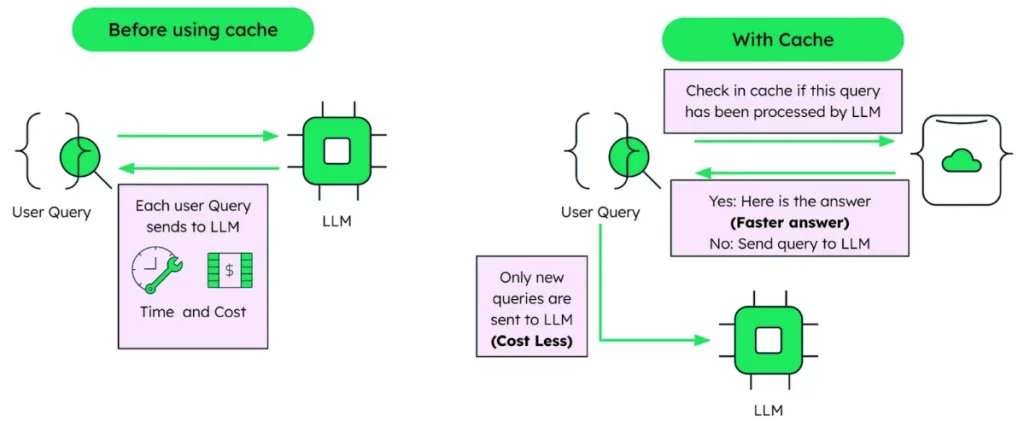
The cache usually sits between the orchestration layer and the model provider. Retrieval-heavy assistants, such as the ones our guide to Claude RAG describes, are natural candidates, because many users ask the same questions about the same documents.
How It Differs From Exact-Match and Prompt Caching
Traditional caching assumes identical input produces identical output. That works for database queries, but conversational traffic breaks it constantly: users rephrase, misspell, and reorder words without changing intent, so a cache keyed on the exact string rarely hits.
| Approach | What is matched | What is saved | Main risk |
|---|---|---|---|
| Exact-match cache | The identical request string | The whole model call | Very low hit rate on natural language |
| Provider prompt caching | A repeated prompt prefix inside one provider | Part of the input token cost and some latency | None for correctness, since the model still answers |
| Semantic caching | Requests close in meaning | The whole model call | Serving an answer to a question that only looks similar |
The difference in risk follows from the difference in what is reused. An exact-match cache can only be wrong if the stored answer was wrong, while semantic caching can also be wrong because two requests that look alike actually need different answers, which is why thresholds and entity checks exist.
Prompt caching and semantic caching are complementary. Anthropic’s prompt caching documentation describes how repeated prefixes, such as long system prompts or documents, are billed at a reduced rate on cache reads, but the model still generates every answer, while a semantic cache avoids generation altogether for repeat questions.
3 Benefits of Semantic Caching for LLM Applications: Spend, Latency and Consistency
Semantic caching delivers three benefits, and the first two are easy to measure.
- Lower model spend: Every cache hit removes a paid model call, so savings scale with the share of repeated intents.
- Lower latency: A cache hit skips generation, typically returning in tens of milliseconds compared with seconds for a fresh call.
- Consistent answers: Approved responses are served the same way every time, which helps where wording has been reviewed.

Savings arrive unevenly across a day and a product cycle. Launches, outages, and policy changes create bursts of nearly identical questions, which is exactly when semantic caching absorbs the most load and protects rate limits with the model provider.
Published research gives a sense of scale. The GPT Semantic Cache study (Regmi and Pun, 2024) stored query embeddings in Redis and reduced API calls by up to 68.8 percent, with cache hit rates between 61.6 and 68.8 percent across query categories and positive hit accuracy above 97 percent.
Those results come from repetitive, customer-service style traffic. Workloads with more unique or personalized requests will see lower hit rates, which is why a measurement plan on your own traffic matters more than any published figure.
Governance improves as a side effect. Because approved answers are served consistently, reviewers can check a fixed set of high-traffic responses instead of sampling an endless stream of freshly generated ones, which makes quality review of a busy assistant far more practical. It also gives compliance teams a concrete list of answers to approve, retire, or rewrite when a policy changes.
Model choice interacts with caching too. Teams comparing models on cost, as in our Claude vs Gemini analysis, should remember that a cheaper model is still called on every request, while a cache reduces the number of calls whichever model sits behind it.
4 Implementation Decisions, Starting With the Similarity Threshold
Semantic caching needs four design decisions, and the threshold is the most consequential.
Similarity is usually measured with cosine similarity between embeddings. The threshold sets how close a new request must be to a stored one, and the illustrative table shows how the same pairs behave at different settings.
| Request pair (illustrative) | Likely similarity | Correct outcome |
|---|---|---|
| “How do I reset my password?” and “I forgot my password, what now?” | High | Hit: same intent and same answer |
| “How do I reset my password?” and “How do I reset my PIN?” | High | Miss: different procedure, despite similar wording |
| “Branch hours on Saturday?” and “Is the branch open this weekend?” | Moderate to high | Hit only if hours do not vary by branch |
| “Card limit for gold card?” and “Card limit for platinum card?” | Very high | Miss: one word changes the answer |
The second and fourth rows show the main danger of semantic caching. Embeddings can rate requests that differ by one crucial word as nearly identical, so a loose threshold serves the wrong answer with full confidence, which is why thresholds should be tuned on real traffic rather than copied from a default.
Three further decisions complete the design:
- Scope of cacheable content: Personalized answers, account-specific data, and anything generated from a user’s own records are excluded.
- Entity checks: Requests that differ in product names, amounts, or dates are treated as misses even when similarity is high.
- Logging: Every hit records the matched entry, similarity score, and the age of the stored answer, which later drives invalidation and review.
Invalidation is where most rollouts fail. Each cached answer should record the source data it depends on, such as a price list, policy version, or product record, so that changing the source expires every dependent entry automatically, while time-based expiry acts only as a safety net.
4 Use Cases Where Caching on Meaning Works Best
Semantic caching pays off where many people ask a small set of questions with stable answers.
- Customer support and help desks: High repetition of intent despite varied phrasing makes support the usual starting point.
- Internal knowledge and HR assistants: Employees ask recurring questions about policy and benefits.
- Product documentation and developer support: Technical users phrase the same troubleshooting question many ways.
- E-commerce product questions: Sizing, shipping, and returns repeat across thousands of phrasings.

It works poorly where answers must be unique or personal, such as drafting a contract, summarizing a specific customer’s history, or answering about a live account balance. Those requests should bypass the cache entirely.
Regulated content needs extra care. Interest rates, fees, clinical guidance, and compliance wording should either stay out of the cache or come only from a human-approved answer set with short expiry tied to the source system.
5 Semantic Caching Tools and Techniques: Libraries, Platforms, Gateways
The semantic caching ecosystem includes open-source libraries, data platforms, and gateways. The table summarizes common options from public documentation read on October 2, 2026.
| Option | Type | What it provides |
|---|---|---|
| GPTCache (Zilliz) | Open-source library | Embedding, similarity evaluation, and storage adapters for LLM response caching |
| Redis with vector search | Data platform | Vector similarity search and semantic cache helpers in its client libraries |
| Amazon ElastiCache with vector search | Managed service | Vector search in a managed cache for semantic caching on AWS |
| LLM gateways such as LiteLLM | Gateway | Caching options alongside routing, budgets, and logging |
| Your existing vector database | Data platform | A separate collection for cached request embeddings and responses |
The technique matters more than the brand. A separate collection or index for the cache, an embedding model chosen for your language and domain, entity checks before serving, and dependency metadata for invalidation are what make any of these tools safe.
Caching also changes how vendor pricing plays out. A cache that removes a large share of calls changes monthly usage, which is worth modeling before committing to volume terms, as our guide to Claude enterprise pricing explains for enterprise agreements.
Measured Latency and Cost Reductions: How to Prove Them
We are not publishing client measurements here. Instead, the plan below shows how to measure semantic caching before and after, and how to calculate whether the cache pays for itself.
| Metric | Before caching | After caching |
|---|---|---|
| Cache hit rate | Not applicable | Share of requests served from the cache |
| Hit accuracy | Not applicable | Share of sampled hits a reviewer confirms as correct |
| p95 latency | Model response time | Blended time across hits and misses |
| Token cost per 1,000 requests | All requests call the model | Only misses call the model, plus embedding calls |
An illustrative breakeven shows the logic. At 100,000 requests a month costing about $9 per 1,000 on a mid-tier model, monthly model spend is about $900; a 40 percent hit rate saves about $360, while embeddings add only cents and a vector store might add, illustratively, $200, so net savings are modest. The same hit rate on a premium model costing about $18 per 1,000 saves about $720, which changes the case entirely.
Latency often justifies the cache before cost does. For customer-facing assistants, moving a large share of answers from seconds to tens of milliseconds improves the experience even where savings are small.
Partitioning is the part that makes semantic caching safe in an enterprise. The cache key should include the tenant, the permission scope of the requester, such as a role or group set, and the data classification of the answer, so an answer built from a restricted HR document is only ever served to people allowed to read that document.
Multi-tenant systems need hard boundaries. Entries are never shared across customers, sensitive tenants can run a dedicated cache on private infrastructure, and access to the cache store is logged like access to the underlying data.
Those controls matter most in regulated deployments, where the cache often runs in a private cloud next to the models and documents. Teams evaluating that setup can review how the Claude API for enterprise fits alongside a self-managed cache and retrieval layer.
Conclusion
Semantic caching removes repeat model calls by matching questions on meaning, which cuts latency sharply and can cut cost substantially on repetitive traffic. The results depend on thresholds tuned on real requests, invalidation tied to the data behind each answer, and partitions by permission and tenant so internal answers never reach the wrong person. This month, your team can log a week of requests from one assistant, estimate the share of repeated intents, and pilot a cache on a low-risk category with weekly hit reviews.
The next question is how caching, routing, and retrieval work together across your models and systems. Our platform integrations page shows how AI Hive connects them, including private deployment for regulated data.