

A lot of enterprises now run more than one large language model at once, yet very few teams have a clear framework for deciding which model belongs where. Choosing between Claude and Gemini often comes down to trial and error, and that trial and error gets expensive once your team is running thousands of API calls a day. This guide compares Claude vs Gemini across reasoning, coding, pricing, and governance, and it gives your team a repeatable framework for testing both models before you standardize on one.
Key Takeaways
|
Claude vs Gemini 2026: Overview & Key Differences
Anthropic and Google DeepMind built two systems around different priorities, and the table below shows where that split matters most for your enterprise. Anthropic’s current lineup centers on Claude Opus and Claude Sonnet, while Google DeepMind’s flagship line runs on Gemini 3.1 Pro, with Gemini 3.5 Flash now generally available as the faster, cost-efficient tier.
| Dimension | Claude | Gemini |
| Developer | Anthropic | Google DeepMind |
| Design priority | Sustained reasoning, writing quality, code correctness | Multimodal breadth, real-time search, Google ecosystem |
| Context window | 200K tokens standard (up to 1M on enterprise tiers) | 1M tokens standard on Pro; larger context planned for the next Pro release |
| Deployment model | API-first, platform-agnostic (also available via AWS Bedrock) | Native inside Google Workspace, Cloud, and Search |
| Best known for | Coding, long-form writing, document synthesis | Multimodal input, live web search, high-volume API pricing |
Anthropic builds Claude around what it calls Constitutional AI, an approach that pushes the model toward acknowledging uncertainty rather than guessing. Google, by contrast, built Gemini as a multimodal-first system connected to Search, Gmail, Docs, and Android from day one. Neither model, as a result, is a stripped-down version of the other; each one was built to solve a different class of problem. If your team is also weighing OpenAI’s models against Anthropic’s, our separate breakdown of how Claude compares to ChatGPT covers that comparison in detail.
Claude vs Gemini: A Detailed Comparison
This section breaks the comparison into the four factors your team is most likely to weigh during procurement: reasoning, coding, governance, and price. Each factor closes with a clear verdict so your team can map the right model to the right task.
1. Performance Comparison (Reasoning, Coding, Multimodal, Speed)
Reasoning
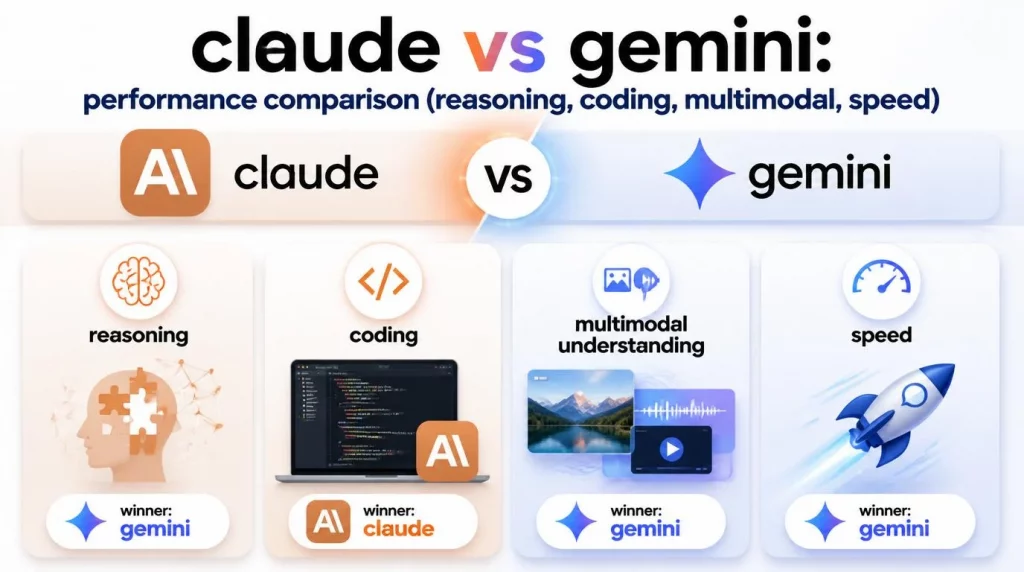
Gemini currently holds an edge in scientific and multi-step logic tasks. Gemini 3.1 Pro scores in the low-to-mid 90s on the GPQA Diamond benchmark, a PhD-level science reasoning test, while Claude’s Sonnet-tier models sit a few points behind on the same test. Claude, however, tends to flag its own uncertainty rather than present a guess with false confidence, which matters when your team is using the output to support a real business decision.
Verdict: Gemini is the better choice for raw scientific and multi-step logic tasks, because Google DeepMind tuned its architecture specifically for this class of reasoning problem.
Coding
Independent testing on the SWE-bench Verified leaderboard, the industry’s toughest real-world coding benchmark, consistently places Claude’s top-tier model at or near the front of the leaderboard. Claude also produces fewer “hacky” shortcut fixes, so your engineering team spends less time reworking the code after it ships. Gemini performs well on prototyping and boilerplate generation, but it occasionally introduces dependencies outside the existing stack when fixing a bug.
Verdict: Claude is the winner for production-grade coding tasks, because its output requires less manual rework across multi-file, multi-step engineering work.
Multimodal Understanding
Gemini was trained from the ground up to process text, images, audio, and video within a single prompt. Tasks such as reading a screenshot, parsing a chart, or summarizing a video call therefore feel native rather than added on afterward. Claude handles images and documents competently, but it remains text-first by design and does not yet process audio or video natively.
Verdict: Gemini is the clear winner for multimodal tasks, since native audio and video handling is a structural advantage Claude does not currently match.
Speed
Flash-class Gemini models are purpose-built for high-throughput, low-latency workloads. They can run several times faster than flagship-tier models from either lab, which matters once your enterprise moves from a handful of chat sessions to thousands of automated API calls per day.
Verdict: Gemini is the better choice for latency-sensitive, high-volume workloads, because its Flash tier trades a small amount of depth for a large gain in throughput.
2. Enterprise Features and Governance
Enterprises evaluating either model tend to care less about chat-window features and more about how the model behaves inside a governed environment. This section looks at how Claude and Gemini fit into an existing compliance stack.
- Claude is available through AWS Bedrock and AWS GovCloud, which makes it a common choice for healthcare, finance, and government workloads that already run on AWS infrastructure. Anthropic’s Constitutional AI framing also tends to produce more transparent refusals and uncertainty flags, a behavior auditors generally prefer over a confident-sounding wrong answer.
- Gemini, in contrast, integrates directly into Google Cloud’s security stack, including Vertex AI’s access controls. This makes it the natural choice if your organization already runs Workspace, BigQuery, or Google Cloud IAM. The tradeoff is that Gemini’s best enterprise features only activate fully once your team operates inside Google’s ecosystem, so a stack split across AWS, Azure, and on-premise systems turns that dependency into a real constraint.
Neither Claude nor Gemini ships with built-in governance for a multi-agent, multi-department deployment. Role-based access control, PII masking, and audit trails still need to be engineered on top of either model. This is precisely the gap our AI Agent Platform closes, since it lets your enterprise plug in Claude, Gemini, or both under one governance layer instead of building that layer from scratch. When we deployed a KYC onboarding agent for a regional banking group across six countries, the governance layer running underneath the model, not the model itself, cut average KYC processing time by 78 percent while keeping two markets fully data-resident on-premise.
3. Pricing, Features & Enterprise Suitability
At the individual subscription level, Claude Pro and Gemini’s paid tier are priced within a dollar of each other, so pricing rarely decides the outcome for a solo user. The gap widens considerably at the API layer, where usage patterns diverge sharply once your enterprise scales.
| Item | Claude | Gemini |
| Consumer subscription | ~$20/month (Pro tier) | ~$20/month (Advanced/AI Pro tier) |
| Flagship API input (per 1M tokens) | Highest among the two | Lower, roughly half of Claude’s flagship rate |
| Fast-tier API input (per 1M tokens) | Mid-range | Lowest of the two, built for high-volume calls |
| Top consumer tier | Roughly $100+/month | ~$250/month |
| Context window ceiling | 1M tokens (enterprise) | 1M tokens standard, larger context expected next |
If your workload is a small number of high-stakes tasks, such as contract review or financial analysis, Claude’s higher per-token cost is easy to justify because the output needs less rework. If your workload is high-volume and repetitive, Gemini’s Flash-tier pricing is difficult to beat on a cost-per-task basis. A manufacturing client running an IT helpdesk agent across three plants, for instance, reached 55 percent autonomous resolution of tier-1 tickets by routing routine requests to a fast, low-cost model and escalating only ambiguous cases to a stronger one.
Pros & Cons of Claude vs Gemini
The table below condenses the tradeoffs above into a quick reference your team can use during a procurement conversation.
Pros & Cons of Claude
✅Pros:
- Strong coding consistency: Claude maintains higher accuracy across complex, multi-file coding tasks, making it suitable for enterprise software engineering workflows.
- Long-form content quality: Claude preserves reasoning flow, tone, and structure more effectively in documents spanning thousands of words.
- Transparent reasoning behavior: Claude is more likely to acknowledge uncertainty and limitations instead of forcing an answer when confidence is low.
- AWS-friendly deployment: Claude integrates well into regulated AWS environments where governance and security requirements are strict.
❌Cons:
- Limited native web access: The standard chat experience does not provide the same level of built-in real-time web grounding available in some competing platforms.
- Higher flagship-model costs: Premium Claude models can become expensive for high-volume enterprise workloads.
- Smaller productivity ecosystem: Claude offers fewer native integrations across workplace productivity applications compared to Google’s ecosystem.
Pros & Cons of Gemini
✅Pros:
- Native multimodal capabilities: Gemini can process text, images, audio, and video within a single workflow without requiring separate tools.
- Real-time Google grounding: Deep integration with Google Search helps deliver fresher information for research and discovery tasks.
- Large context capacity: Gemini handles large volumes of documents and business data within a single session effectively.
- Cost-efficient Flash models: Gemini Flash provides one of the lowest per-token costs among major frontier AI models.
❌Cons:
- Long-form consistency challenges: Writing quality can become less consistent across very long reports and multi-section documents.
- Google ecosystem dependency: Many of Gemini’s strongest capabilities are unlocked only when organizations adopt broader Google services.
- Release schedule variability: Some flagship features have historically arrived later than initial public expectations.
When to Choose What: Best Use Cases for Each Model
Your team’s workflow, not a benchmark score, should ultimately decide which model to deploy where. The lists below map common enterprise tasks to the model built for them.
Choose Claude when:
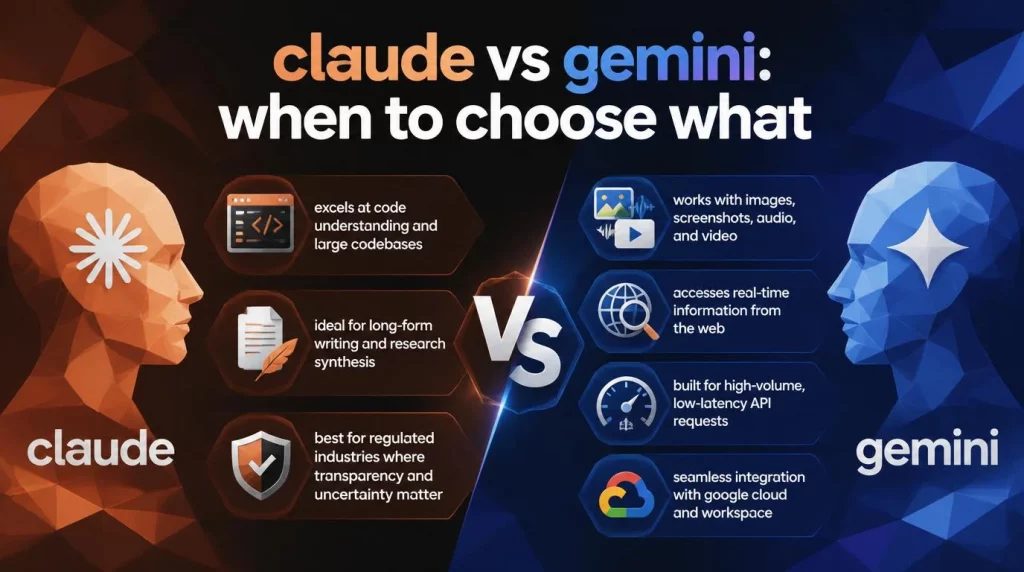
- Your team is debugging, refactoring, or reviewing production code across multiple files and needs the model to preserve project structure.
- Your enterprise is producing long-form content or research synthesis where tone needs to survive thousands of words.
- Your organization operates in a regulated industry, such as BFSI solutions, healthcare, or legal, where transparent uncertainty handling matters more than raw benchmark scores.
Choose Gemini when:
- Your task involves images, screenshots, audio, or video alongside text in the same prompt.
- Your enterprise needs current information pulled live from the web rather than relying on a training cutoff.
- Your team runs high-volume, latency-sensitive API calls, such as first-pass customer support triage.
- Your organization already standardizes on Google Cloud or Workspace, and tighter ecosystem integration outweighs flexibility.
Use both when: most mature enterprise teams do not commit to one model exclusively. A common pattern routes quality-critical tasks, such as code review or client-facing writing, to Claude, while high-volume tasks, such as ticket triage, go to Gemini’s Flash tier. A model-agnostic orchestration layer, rather than a single-vendor platform, is built to manage exactly this kind of split.
Score Both Models Yourself: A Same-Prompt Testing Framework
Most comparison articles describe capabilities in the abstract rather than showing your team how to test both models directly. Below is the framework our team uses when advising clients on model selection, along with the pattern we typically observe across five common task types.
We want to be transparent about what this table represents: the scores below are illustrative, based on publicly reported benchmark behavior and patterns developers have shared, not a single controlled internal study. Run this same framework against your own repository and documents before standardizing on one model.
| Task | What to test | Typical Claude pattern | Typical Gemini pattern | What to watch for |
| Debug a multi-file bug | Same repo, same bug report | Preserves existing code style and stack | Fix works, but can add a dependency outside the stack | Check whether the fix respects your architecture |
| Draft a long-form post | Same brief, same voice guide | Holds tone through a full draft | Tone can shift past 800-1,000 words | Read the last third, not just the opening |
| Summarize a long contract | Same PDF, same questions | Strong on nuanced clause interpretation | Strong on surfacing clauses quickly | Cross-check both against the source clause by clause |
| Analyze a dashboard image | Same image, same question | Competent but not built for this | Materially stronger, native multimodal | Weight this heavily if your workflow is visual-first |
| Same-day news summary | Same keyword, same window | Needs a browsing tool to stay current | Native search grounding, current by default | Confirm browsing is enabled before comparing |
Hidden Costs Nobody Talks About in Claude vs Gemini
Sticker price is rarely where enterprise teams get surprised. Three cost factors tend to show up only after deployment.
- Thinking-token billing: Claude’s extended reasoning mode bills “thinking tokens” at output rates, and complex tasks can consume 30-50% more tokens than a simple exchange would suggest. This matters even more on Anthropic’s newer Mythos-tier models, such as Claude Fable 5, which push extended reasoning further than the standard lineup.
- Context window overspend: A large context window does not mean your team should fill it on every call, since both models charge per token processed regardless of relevance.
- Retry cost: A cheaper model that needs a second pass to produce a usable answer is not actually cheaper once you factor in engineering time spent on rework.

Real-World Benchmarks & User Reviews: Failure Modes and Edge Cases
Benchmark scores describe controlled conditions, not production reality. Teams running both models side by side in production run into a consistent set of edge cases for each one.
- Claude’s common failure mode: without an external browsing tool enabled, Claude will not know about events past its training cutoff, and it will generally say so rather than guess. It can also be more conservative than teams expect, occasionally declining borderline requests a business user considers legitimate.
- Gemini’s common failure mode: longer creative or analytical documents can drift in tone partway through, and it is more prone to confident-sounding errors on tasks outside its core reasoning strengths.
- Shared limitation: neither model ships with built-in role-based access control, PII masking, or a full audit trail. Enterprises deploying either model at scale still need a governance layer on top, regardless of which model your team chooses.
What’s New in July 2026: Which Model Is Pulling Ahead
As of early July 2026, Gemini 3.5 Flash is Google’s latest generally available model (released May 2026). According to Google DeepMind, it delivers frontier-level performance on agentic and coding tasks while being significantly faster and more efficient than Gemini 3.1 Pro. Google’s next flagship, Gemini 3.5 Pro, is still in limited preview/enterprise testing and has slipped from the original June target — it is expected sometime in July but not yet widely available.
On the Anthropic side, the current production lineup includes Claude Opus 4.8 (flagship), Claude Sonnet 5 (released late June 2026 — the most agentic Sonnet yet), and Claude Haiku 4.5. Newer Mythos-tier models (e.g., Fable 5 / Mythos 5) are available in limited or preview capacity for advanced reasoning workloads.
Conclusion
Neither Claude nor Gemini is the universally better model in 2026. Claude leads on coding consistency, long-form writing, and regulated-industry deployment, while Gemini leads on multimodal input, real-time search, and cost-efficient high-volume API use.
The real decision your enterprise faces is not which single model to standardize on, but how to run both under one governance layer without locking into a single vendor’s roadmap. Our model-agnostic AI Agent Platform lets your team switch between Claude, Gemini, and other LLMs per agent, with built-in compliance and no vendor lock-in. Book a scoping call with our team to identify which model, or combination of models, fits your workflow.