
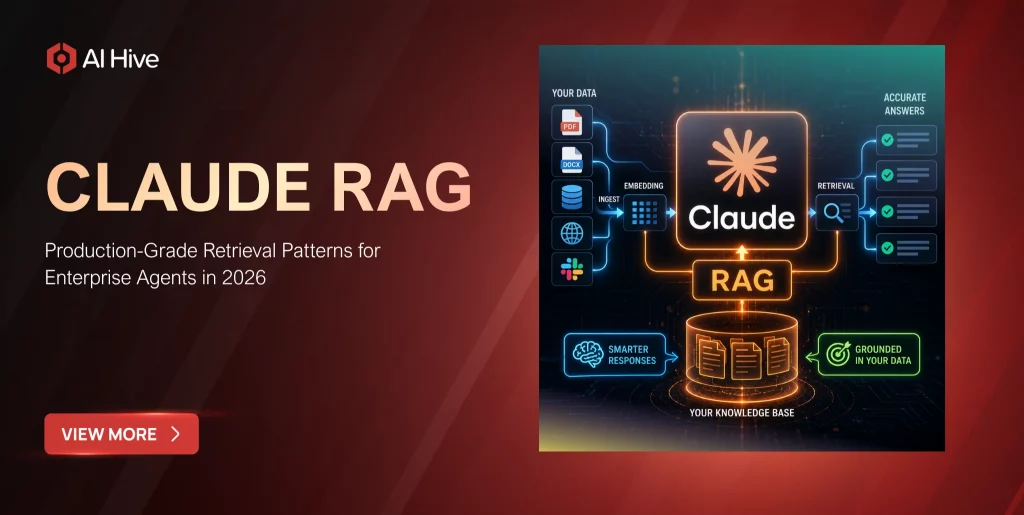

Your AI agent answered a customer question with outdated pricing from last quarter. The legal review bot cited a regulation that was amended six months ago. These failures share the same root cause: the model generated answers from its training data instead of retrieving current information from your enterprise systems. Claude RAG solves this problem by grounding Claude’s responses in your actual, up-to-date documents and databases. This article covers the retrieval architectures, chunking strategies, and production patterns that engineering teams need to build reliable Claude RAG systems in 2026.
What Is Claude RAG and How Does It Work?
Retrieval-augmented generation, or RAG, is an architecture pattern that combines document retrieval with language model generation. In a Claude RAG system, the workflow follows three stages: a user query triggers a search across your enterprise knowledge base, the most relevant documents are retrieved and injected into Claude’s context window, and Claude generates a response grounded in those retrieved documents rather than relying solely on its training data.
The fundamental value proposition is straightforward. Claude’s training data has a knowledge cutoff and does not include your proprietary information. RAG bridges both gaps by connecting Claude to your live data sources at inference time. Deloitte’s 2026 enterprise AI survey found that organizations implementing RAG reduced hallucination rates by 85% compared to vanilla LLM deployments, making it the single most impactful architectural decision for factual accuracy.
Why Enterprises Choose Claude for RAG Workloads
Several technical characteristics make Claude particularly well-suited for enterprise RAG architectures compared to competing models.
Extended Context Window for Retrieved Content
Claude Opus 4.8 and Sonnet 5 support a 1,000,000-token context window, which means RAG pipelines can retrieve and inject substantially more context per query than systems built on models with 128K or 200K limits. Where competing architectures must aggressively truncate retrieved passages, Claude can ingest 50 to 100 full document chunks while still leaving room for system prompts and output generation. This additional capacity reduces the risk of dropping critical information during retrieval.
Instruction Following in Dense Context
Enterprise RAG systems require the model to follow precise instructions about how to use retrieved documents. Claude needs to cite specific passages, acknowledge when retrieved content is insufficient, and avoid fabricating information that contradicts the provided sources. Anthropic’s Claude 4 family was explicitly designed for improved instruction adherence in agentic contexts, which directly benefits RAG use cases where the model must distinguish between what the documents say and what it might otherwise generate.
Prompt Caching for Cost-Efficient Retrieval
Claude’s prompt caching feature is particularly valuable for RAG systems where the system prompt and tool definitions remain constant across thousands of queries. Caching these repeated elements reduces input token costs by up to 90%, which significantly improves the unit economics of high-volume RAG deployments. An enterprise processing 50,000 queries per day with a 15K-token system prompt saves approximately $6,750 per month through caching alone.
Production-Grade Claude RAG Architecture
A production Claude RAG system consists of five layers, each with specific design decisions that affect accuracy, latency, and cost. The architecture that our team at AI Hive deploys for enterprise clients follows this proven structure.
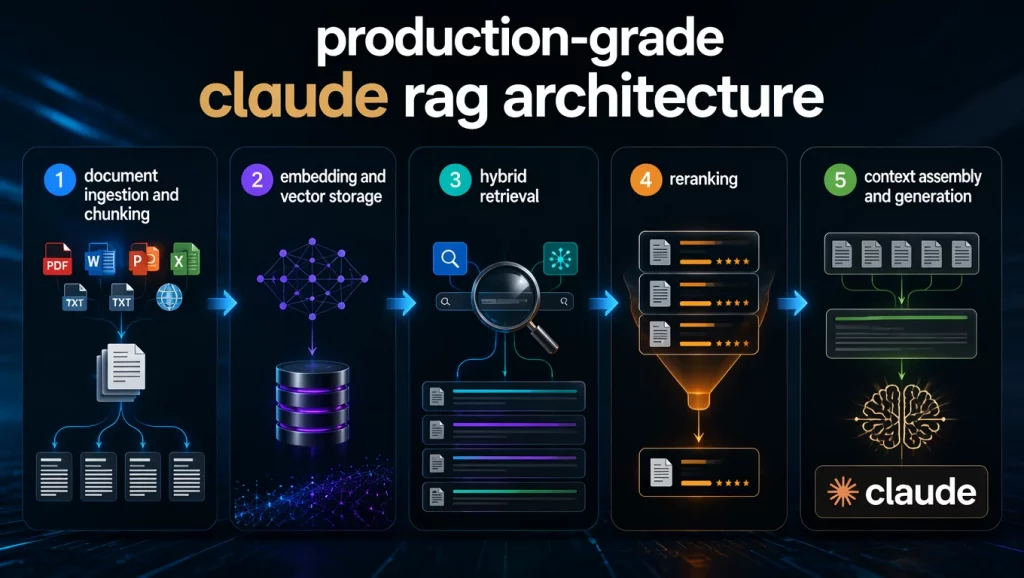
Layer 1: Document Ingestion and Chunking
Raw documents must be split into chunks before they can be embedded and stored in a vector database. The chunking strategy directly affects retrieval quality. Three approaches dominate enterprise deployments in 2026.
| Strategy | Chunk Size | Best For |
| Fixed-size with overlap | 512-1024 tokens, 20% overlap | General-purpose knowledge bases with uniform document structure |
| Semantic chunking | Variable, split at topic boundaries | Technical documentation, legal contracts, research papers |
| Hierarchical chunking | Parent (2048 tokens) + child (256 tokens) | Complex documents requiring both summary and detail retrieval |
The most common mistake in enterprise RAG deployments is using a one-size-fits-all chunking strategy. Financial reports with dense numerical tables require different treatment than narrative policy documents. Our experience across regulated industries shows that semantic chunking with metadata preservation produces 23% higher retrieval accuracy than fixed-size approaches for heterogeneous document collections.
Layer 2: Embedding and Vector Storage
Each chunk is converted to a vector embedding and stored in a vector database for similarity search. The embedding model choice affects both accuracy and cost. Production systems in 2026 typically use models like Cohere Embed v3, OpenAI text-embedding-3-large, or Voyage AI’s domain-specific embeddings. The vector database options range from managed services like Pinecone and Weaviate to self-hosted solutions like pgvector for organizations with strict data sovereignty requirements.
Layer 3: Hybrid Retrieval
Enterprise systems in 2026 almost always extend basic vector similarity search with additional retrieval techniques. The standard production pipeline combines semantic search via vector similarity for conceptual matching, keyword search via BM25 for exact term matching, and metadata filtering for access control and document type restrictions. IBM’s 2026 enterprise AI benchmark found that hybrid retrieval combining semantic and keyword search improved recall by 31% compared to semantic search alone, with minimal additional latency.
Layer 4: Reranking
After initial retrieval, a reranking model scores each chunk for relevance to the specific query. This step is critical because vector similarity often returns chunks that are topically related but do not directly answer the question. Reranking models like Cohere Rerank or cross-encoder models evaluate query-document pairs with significantly higher precision than the initial embedding-based retrieval. The latency cost is typically 50 to 100 milliseconds, which is negligible compared to the accuracy improvement.
Layer 5: Context Assembly and Generation
The final layer assembles the reranked chunks into Claude’s context window alongside system instructions and conversation history. Effective context assembly includes source attribution metadata with each chunk so Claude can cite specific documents, clear instructions for Claude to indicate when retrieved content is insufficient, and guardrails that prevent Claude from generating information not supported by the retrieved context. Organizations building enterprise AI agent platforms find that this structured approach to context assembly is what transforms a basic chatbot into a reliable knowledge worker.
Claude RAG vs. Full Context Window: A Decision Framework
One of the most common architectural questions in 2026 is whether to use RAG or simply load documents into Claude’s expanded context window. The answer depends on your specific constraints.
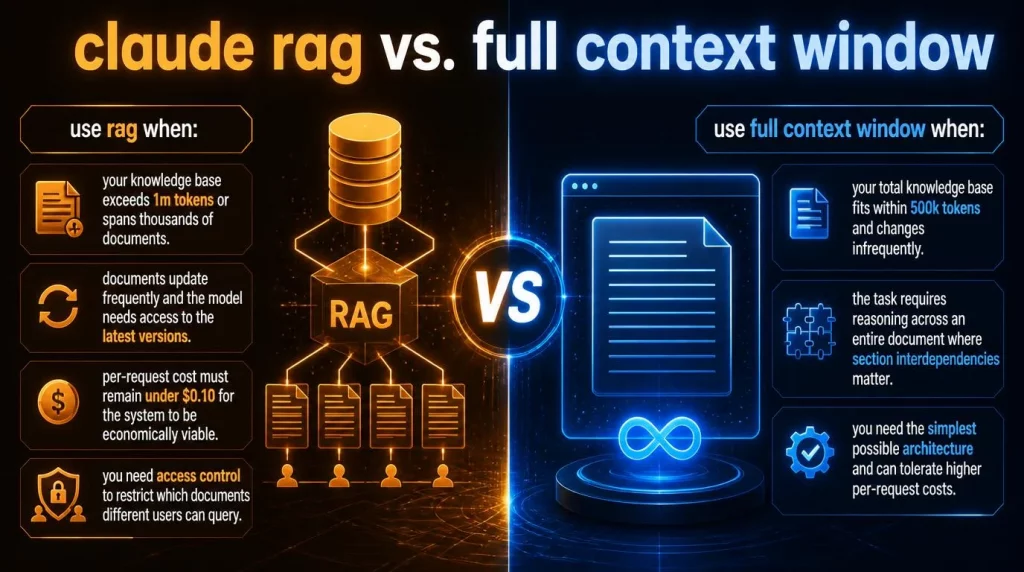
Use the full context window when:
- Your total knowledge base fits within 500K tokens and changes infrequently.
- The task requires reasoning across an entire document where section interdependencies matter.
- You need the simplest possible architecture and can tolerate higher per-request costs.
Use RAG when:
- Your knowledge base exceeds 1M tokens or spans thousands of documents.
- Documents update frequently and the model needs access to the latest versions.
- Per-request cost must remain under $0.10 for the system to be economically viable.
- You need access control to restrict which documents different users can query.
The 2026 consensus among enterprise architects, as documented in Gartner’s AI deployment framework, is that most production systems benefit from a hybrid approach. RAG handles retrieval across the broad knowledge base, and the retrieved content is loaded into Claude’s long context window for deep reasoning. This pattern delivers both breadth and depth without the cost penalty of full-corpus context loading.
3 Common Claude RAG Failure Modes and How to Fix Them
Production RAG systems fail in predictable ways. Recognizing these patterns early prevents costly debugging cycles.

1. Retrieval Miss
The correct document exists in the knowledge base but is not retrieved. This typically results from poor chunking that splits relevant information across chunks, embedding model mismatch where the query and document use different terminology, or missing metadata that would have filtered results effectively. The fix involves implementing hybrid retrieval, testing with real user queries rather than synthetic ones, and adding query rewriting to expand search coverage.
2. Context Poisoning
Irrelevant or contradictory documents are retrieved and injected into context, causing Claude to generate incorrect responses. Reranking significantly reduces this problem, but production systems should also implement relevance score thresholds that reject chunks below a minimum confidence level. Our team has found that setting the reranker threshold at 0.4 eliminates approximately 90% of poisoned context incidents without reducing recall.
3. Hallucination Despite Retrieved Context
Claude generates plausible-sounding information that is not supported by the retrieved documents. This happens most frequently when the retrieved context is insufficient to answer the query, but the system prompt does not explicitly instruct Claude to acknowledge the gap. The solution involves adding explicit instructions like ‘If the provided documents do not contain enough information to answer, state that clearly rather than generating an answer from your training data.’ Testing with adversarial queries that intentionally lack sufficient context validates this guardrail.
Advanced Patterns for Enterprise Claude RAG
Agentic RAG with Tool Use
The most sophisticated Claude RAG deployments in 2026 combine retrieval with Claude’s tool use capabilities. Rather than a simple retrieve-then-generate pipeline, an agentic RAG system allows Claude to decide which knowledge bases to query, formulate its own search queries based on the user’s intent, retrieve from multiple sources in parallel, and synthesize information across retrieved results before generating a final response. This agentic approach improves answer quality for complex, multi-faceted questions that require information from different document collections. Teams building these workflows can reference our guide to Claude API enterprise integration for the technical implementation details.
Multi-Index RAG for Regulated Industries
Healthcare, financial services, and legal organizations often maintain separate document indices with different access controls. A Claude RAG system for a bank might query a public knowledge base for general product information, a restricted index for internal policies, and a compliance-only index for regulatory documents. Each index has its own retrieval pipeline and access permissions, and Claude receives metadata indicating the classification level of each retrieved chunk.
Conclusion
Claude RAG has matured from an experimental pattern into the default architecture for enterprise AI systems that require factual accuracy and access to proprietary data. The combination of Claude’s expanded context window, strong instruction following, and prompt caching creates a foundation that supports production-grade retrieval workflows at scale. The teams that achieve the highest accuracy and lowest cost are those that invest in hybrid retrieval, proper chunking strategies, and rigorous reranking rather than simply connecting a vector database to an LLM and hoping for the best.
If your organization needs help designing a Claude RAG architecture that meets your compliance, accuracy, and cost requirements, contact AI Hive for a technical consultation with our AI engineering team.