

Your company already runs four AI agents, one each for support, search, sales research, and code review, and none of them share memory, permissions, or a log your auditors can read. Each new agent adds another silo, and McKinsey’s 2026 AI trust research found that only about 30 percent of organizations have mature governance for agentic AI. That is the coordination gap an agentic OS is meant to close. Teams that treat it as an architecture with six layers they can assemble today, rather than a product to wait for, make the next agent join a system instead of a pile.
Key Takeaways
|
What Does the Agentic OS Concept Mean?
It is the software layer that lets many agents share context, tools, and rules about who may act on what. It is not a single application, and it is not a chatbot with plugins.
A chatbot answers one conversation and forgets it when the session ends. An agentic OS persists context across sessions, coordinates several agents working toward the same goal, and keeps a record of what each agent did and why. Our comparison of AI agent vs chatbot covers that first distinction in detail.
The term borrows from operating system design on purpose, and it is more than a rebrand of workflow automation: a trigger-and-action tool runs a fixed script, while the coordination layer here has to manage agents that reason, branch, and remember. A traditional OS manages processes, memory, input and output, and permissions so that many applications can share one machine safely, and an agentic OS does the same job for agents.
| Traditional OS function | Agentic OS equivalent |
|---|---|
| Process scheduling | Deciding which agent or sub-agent runs next, and in what order |
| Memory management | Keeping working, episodic, and long-term context across sessions |
| Input and output | Routing tool calls, API requests, and data retrieval through one controlled interface |
| Permissions | Scoping what each agent may read, write, or execute, with approval for sensitive actions |
| Interrupt handling | Catching a failed or stalled step and rerouting or escalating it |
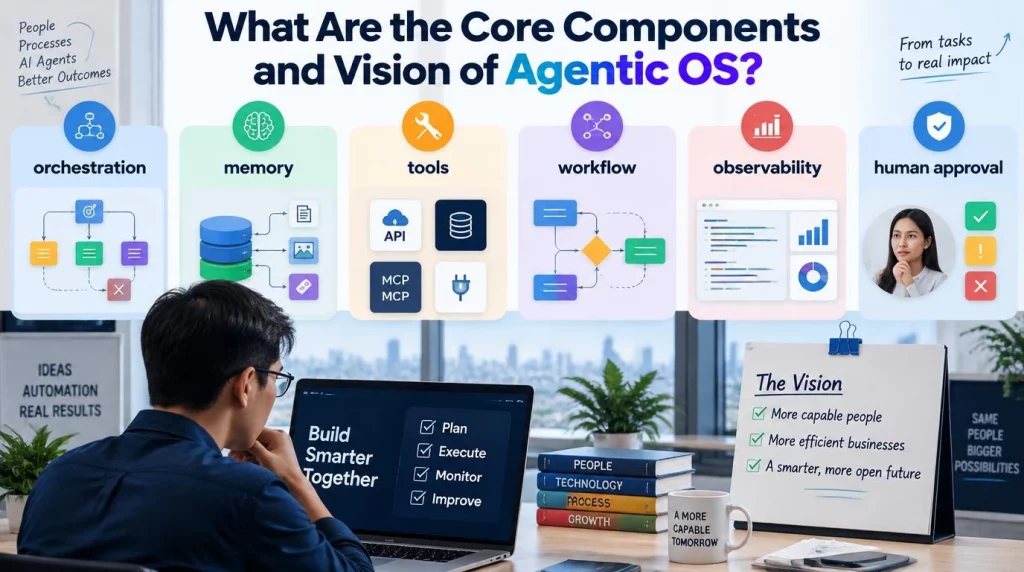
What Are the Core Components and Vision of Agentic OS?
The vision is simple: agents become managed workloads instead of isolated scripts. In practice, credible agentic OS designs converge on six layers, even when vendors name them differently.
The model sits inside this stack rather than above it. Generative models do the reasoning at each step, while the surrounding layers supply everything that turns reasoning into governed action, a split our comparison of agentic AI vs generative AI explains for budget planning.
- Orchestration: The kernel breaks a goal into steps, assigns them to agents, tracks completion, and decides what happens when a step fails.
- Memory: Working memory holds the current task, episodic memory stores past runs, and semantic memory holds durable business facts such as pricing or compliance rules.
- Tools: Agents act through APIs, databases, and, increasingly, the Model Context Protocol (MCP), which standardizes how an agent discovers and calls a tool.
- Workflow: Sequences and branches connect agent steps into a business process.
- Observability: Logs record every decision, tool call, and token, so engineers can debug and finance can see the real cost.
- Human approval: Gates, escalation paths, and overrides cover actions that should never run unsupervised, such as releasing funds.
Skipping a layer produces familiar failures. Agents without shared memory duplicate work, and agents without an approval layer take actions nobody signed off.
What Is the Current State of the Technology?
The agentic OS idea is real but early: parts of it ship today, and no single product covers all six layers for every enterprise. Four strands are worth tracking.
The desktop strand arrived in November 2025, when Windows announced native MCP support and an On-Device Registry for agent connectors in public preview, plus an isolated Agent Workspace in private preview. The announcement also drew a public backlash from users wary of more AI in the operating system, a reminder that adoption depends on trust as much as features.
The research strand took the metaphor literally. The AIOS paper by Kai Mei, Yongfeng Zhang and colleagues at Rutgers, first posted in March 2024 and published at COLM 2025, proposes a kernel with scheduling, context, memory, storage, and access control for LLM agents, and reports up to 2.1 times faster execution when serving agents built with different frameworks.
The open-source strand includes Agno’s AgentOS, a runtime that serves agents built with several frameworks and adds a control plane for monitoring; the runtime is free, and the hosted control plane starts at $150 a month on Agno’s pricing page. The fourth strand is coding agents, covered below, which already run a compact version of all six layers.
Leading Approaches and Players
Vendors describe their products so differently that a fair comparison needs a common frame. The table maps five approaches to the agentic OS layers that matter most, based on public documentation read on October 2, 2026.
| Category | Example | Strongest layers | Gaps to check | Best fit |
|---|---|---|---|---|
| Research kernel | AIOS (Rutgers, open source) | Scheduling, context and memory management | Enterprise governance, support | Teams studying agent scheduling and resource use |
| Operating system level | Windows MCP support, On-Device Registry, Agent Workspace | Tool access, isolation, agent identity | Preview status, cross-platform reach | Desktop agents in Microsoft-managed fleets |
| Self-hosted runtime | Agno AgentOS | Serving, request isolation, role-based access, tracing | You own hosting and governance design | Engineering teams that self-host |
| Coding agents | Claude Code, Cursor, OpenAI Codex CLI | Project memory files, sandboxed tools, approval prompts | Their scope covers only software work | Developer productivity |
| Enterprise agent platform | AI Hive and similar platforms | Orchestration, shared memory, approval workflows, audit logs | Fit with your existing systems | Regulated enterprises needing private or on-premise hosting |
Microsoft’s Ignite 2025 developer announcement shows how an operating system vendor reads the problem: every agent gets its own Agent ID, distinct from the user, so IT can audit each action, and an MCP proxy handles authentication, authorization, and auditing for tool calls. Those two ideas, separate agent identity and a gateway for tools, are worth copying in any design.
Coding agents make the agentic OS architecture tangible. Claude Code reads a project instructions file before each session as shared memory, delegates work to sub-agents, and asks permission before risky commands, while Codex CLI lets developers choose approval modes per session. Your developers already use a small version of the idea every day.
What Is the Potential Enterprise Impact off Agentic OS?
The impact is coordination at scale: one place to see, govern, and pay for every agent. That matters because agent counts are rising fast, and Gartner predicted in August 2025 that 40 percent of enterprise applications will feature task-specific agents by the end of 2026.
Without a shared layer, each new agent brings its own memory, credentials, and logs. Five agents become five security reviews, five cost lines, and five places where a customer’s history lives in a different form. Customer-facing agents feel this first, since an AI virtual agent that cannot see what a back-office agent did yesterday gives answers that contradict the rest of the company.
| Area | Without a shared layer | With an agentic OS |
|---|---|---|
| Governance | Each agent reviewed and logged separately | One permission model and one audit trail |
| Cost | Token spend scattered across teams | Budgets and limits per agent and per workflow |
| Customer experience | Agents give inconsistent answers | Agents read the same memory of the customer |
| Speed of new agents | Each one rebuilds plumbing | New agents reuse tools, memory, and policies |
The governance payoff of an agentic OS may matter most. Deloitte’s State of AI in the Enterprise 2026 found that only 21 percent of organizations have a mature governance model for agentic AI, and a shared layer is the most direct way to give every agent the same controls.
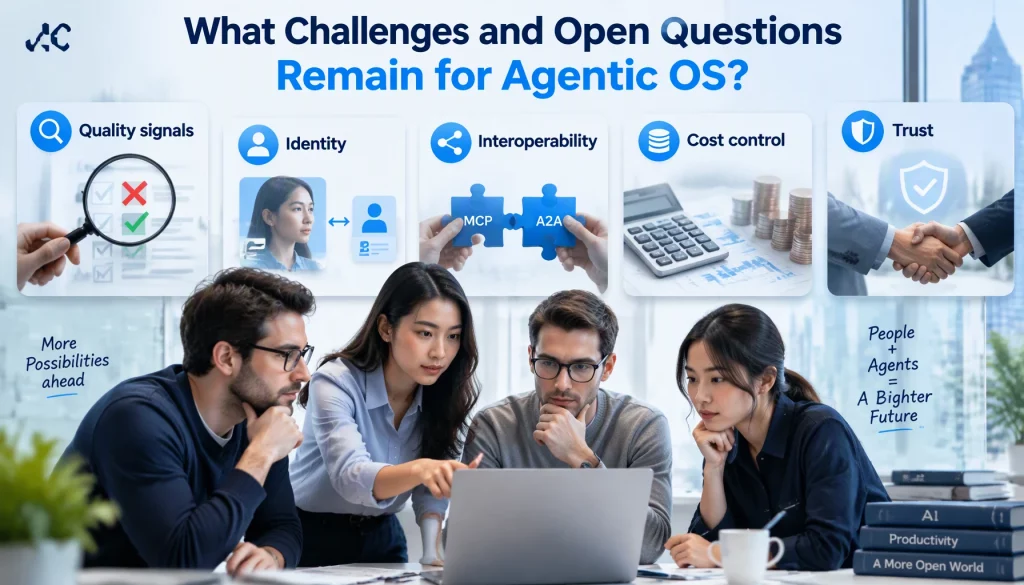
What Challenges and Open Questions Remain for Agentic OS?
The hardest problems for any agentic OS are not scheduling or storage; they are judging quality and assigning accountability. The “Kubernetes for agents” comparison shows why.
Kubernetes schedules containers, restarts the ones that crash, and scales resources, and its failures are well understood after a decade in production. An agent’s next step comes from a probabilistic reasoning process, so the orchestrator must evaluate whether a step was right, not just whether it ran. A crashed pod is obvious; a “successful” step that confidently produced the wrong answer is not, and no liveness probe catches it.
Several questions remain open across the industry:
- Quality signals: How should an orchestrator detect a confidently wrong step without a person reviewing every one?
- Identity: Should an agent act with its own identity, the user’s identity, or both, and how do audits read the result?
- Interoperability: Will MCP and agent-to-agent protocols become the common interface, or will each vendor keep its own?
- Cost control: Who owns the bill when one agent calls another inside an agentic OS, and where do the limits sit?
- Trust: How much autonomy will employees and customers accept, given the reaction to Windows’ agentic plans?
Common adoption mistakes follow from these gaps:
- Agents before coordination: Five agents without shared memory are five isolated pilots, and they duplicate work in ways that show up only on the bill.
- Memory as an afterthought: Teams that add persistent memory after launch often find their agents have been contradicting each other for weeks.
- Governance after an incident: Approval gates added after a mistake cost more in trust and rework than the same gates designed in.
- Watching steps instead of outcomes: Reviewing every intermediate step does not scale, while a view of goals and exceptions does.
- Neglecting the workflow layer: Orchestration gets the attention in vendor pitches, but most business value lives in how well the workflow sequences real tasks.
Realistic Timeline and What Enterprises Should Prepare For
No one has published a credible date for a complete enterprise agentic OS, so the timeline below is our view of how adoption is likely to unfold, not a forecast with a source. The safe move is to prepare foundations that any future platform will need.
| Horizon | What is likely | What your team should do |
|---|---|---|
| Now | Platforms and runtimes cover several layers; operating system support is in preview | Your team lists every agent with its data access, credentials, and owner |
| Next 12 months | Tool standards such as MCP spread, and agent identity becomes common in security tooling | Your team routes tool access through one gateway and gives each agent its own identity |
| One to three years | Shared memory and orchestration consolidate into fewer platforms | Your team picks a platform that keeps models and memory portable |
Your team can run any candidate agentic OS through a short checklist before committing budget:
- Auditability: The platform exports a complete log of every decision, detailed enough for an auditor months later.
- Cost caps: Hard limits apply per agent, per workflow, and per day, not only on the invoice.
- Model portability: The underlying model can change without rewriting orchestration.
- Approval granularity: Different action types can have different human-approval thresholds.
- Failure containment: A failed step stays contained instead of stalling the whole workflow.
- Data residency: Data stays where your regulator requires while agents reason over it.
A minimal version is a useful first step: one dashboard, one workflow of two or three steps, a simple memory store, and a manual approval gate for any external action.
A small, inexpensive model is usually enough to validate the design, and it can be upgraded later without rebuilding the system. Teams that try to stand up all six layers, five agents, and a polished interface in the first sprint are the ones most likely to stall, because the first thing that breaks is the part nobody tested alone. For a staged rollout plan around that core, our guide to agentic AI for enterprise covers how to choose the first processes and size the pilot.
Conclusion
An agentic OS is a coordination problem before it is a product purchase: six layers that let agents share memory, use tools safely, and answer to one set of rules. The technology is real but uneven, the Kubernetes comparison holds only until you need to judge quality, and the enterprises that prepare foundations now will adopt faster later. This quarter, your team should inventory every running agent with its owner, data access, and credentials, and route new tool access through one gateway.
Once that inventory exists, the next questions are which platform should host shared memory and how much autonomy each agent earns. If you want to see those six layers working on one governed platform, explore our enterprise AI agent platform and map your current agents onto it.