

Your Shopify store receives hundreds of customer inquiries every week, and many of them follow the same patterns: order status requests, return policy questions, and product availability checks. The real question is not whether you should automate these interactions, but which type of automation will deliver the best return on your investment. Two technologies dominate the conversation in 2026: AI Agent vs Chatbot (traditonal approach). While the terms are sometimes used interchangeably, the architectural differences between them determine whether your store simply answers questions or actively drives revenue.
Gartner projects that 40% of enterprise applications will integrate task-specific AI agents by the end of 2026, up from less than 5% in 2025. This rapid adoption signals a fundamental shift in how businesses approach customer interactions. For Shopify merchants, understanding this distinction is not an academic exercise – it directly impacts customer satisfaction scores, operational costs, and average order value.
What Is a Chatbot and How Does It Work on Shopify?
A chatbot is a conversational interface that responds to customer messages using predefined rules or pattern-matching algorithms. On Shopify, most chatbots operate as reactive systems: a customer types a question, the chatbot scans for keywords, and it returns a scripted response from its knowledge base. The interaction ends when the customer’s question has been addressed or when the chatbot escalates the conversation to a human agent.
Traditional Shopify chatbots excel at answering frequently asked questions such as “What is your return policy?” or “Do you ship internationally?” These systems draw from a static knowledge base that store owners configure manually. When a customer’s query matches a known pattern, the chatbot delivers a quick, consistent answer. This approach works well for stores with predictable, high-volume inquiries where the same ten or fifteen questions account for the majority of support tickets.
The limitation becomes apparent when customers ask questions that fall outside the chatbot’s predefined scripts. A customer asking “I ordered a size medium last month and it was too tight – should I go up to large for this new collection?” requires contextual understanding that most rule-based chatbots simply cannot provide. In these situations, the chatbot either returns a generic response or routes the customer to a human agent, adding friction to the experience.
What Is an AI Agent and Why Is It Different?
An AI agent is an autonomous system that plans and executes multi-step actions to achieve a goal, rather than simply responding to individual prompts. The distinction is architectural: chatbots are reactive and stateless, while AI agents maintain context, reason through problems, and take actions across multiple systems without requiring human intervention at each step.
Five dimensions separate AI agents from chatbots: understanding, action, memory, reasoning, and learning. A Shopify AI agent can understand a customer’s purchase history, take actions like processing a return or applying a discount, remember previous interactions across sessions, reason through complex scenarios like size recommendations based on past orders, and learn from successful resolutions to improve future performance.
Consider a practical example. When a customer messages “I want to return the shoes I bought last week and exchange them for the boots I saw on your Instagram,” an AI agent processes this as a multi-step workflow. The agent identifies the original order, verifies return eligibility against your store’s policy, initiates the return process, locates the product referenced from social media, checks inventory availability in the customer’s size, and creates the exchange order – all within a single conversation thread. A traditional chatbot would, at best, provide a link to your returns page.
For Shopify merchants evaluating their automation strategy, understanding how enterprise teams deploy AI agents at scale provides valuable perspective on where this technology is heading.
Feature-by-Feature Comparison: AI Agent vs Chatbot for Shopify
The following comparison breaks down the practical differences that matter most for Shopify store operations.
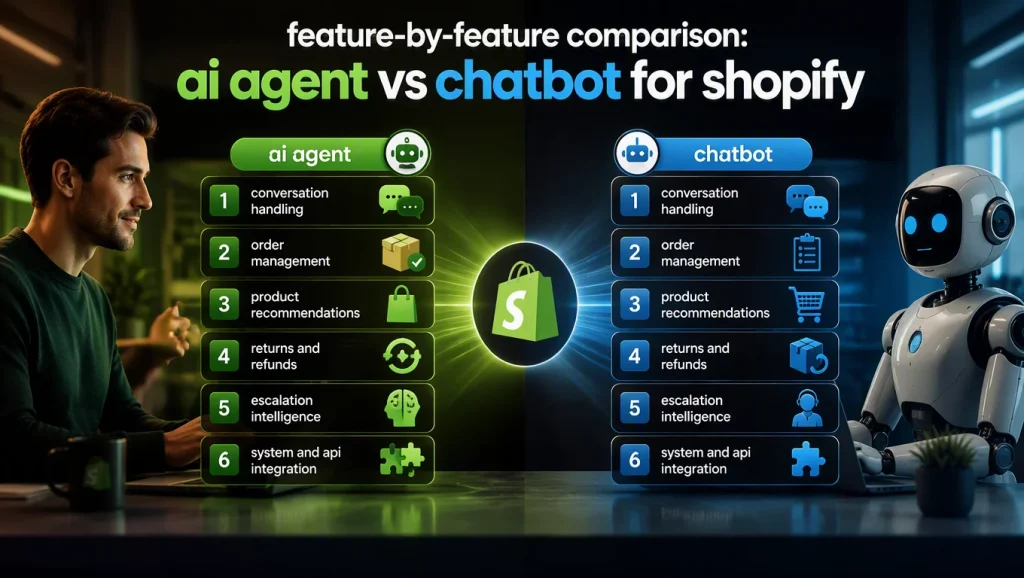
1. Conversation Handling
Chatbots handle one-turn interactions effectively. A customer asks a question, receives an answer, and the conversation concludes. AI agents handle multi-turn conversations where context builds across messages. The agent remembers that the customer mentioned a preference for eco-friendly products earlier in the conversation and factors that into subsequent recommendations.
2. Order Management
Chatbots can retrieve order status by querying Shopify’s API when a customer provides an order number. AI agents go further by proactively identifying potential issues – noticing that a shipment has been delayed and reaching out to the customer before they even ask, offering a discount on their next purchase as a goodwill gesture.
3. Product Recommendations
Chatbots display bestsellers or manually curated suggestion lists. AI agents analyze the customer’s browsing history, purchase patterns, and real-time cart contents to recommend products that align with demonstrated preferences. According to recent industry data, AI-driven personalized recommendations contribute to a 15-20% increase in conversion rates, and 49% of consumers have purchased products they did not initially intend to buy after receiving a personalized recommendation.
4. Returns and Refunds
Chatbots provide return policy information and links to return portals. AI agents verify eligibility, process the return, generate shipping labels, and initiate refunds – completing the entire workflow within the chat interface. Stores handling 750 WISMO tickets per month report spending roughly $3,000 using human agents versus approximately $300 using AI automation.
5. Escalation Intelligence
Chatbots escalate based on keyword triggers or when no matching response is found. AI agents escalate based on sentiment analysis and complexity assessment, providing the human agent with a complete context summary so the customer does not need to repeat information.
6. System and API Integration
Chatbots typically connect to Shopify through a single webhook or a narrow REST endpoint that retrieves basic order or product data on request. This shallow integration is enough for scripted responses, but it means the chatbot cannot act on what it retrieves. It can display an order status; it cannot cancel a fulfillment, adjust a discount, or push a change back into a connected system such as a CRM.
AI agents integrate at the API level across multiple systems at once. A Shopify AI agent typically connects to the Admin API for orders and inventory, a helpdesk platform such as Gorgias or Zendesk for ticket context, and an email or SMS platform for proactive outreach, coordinating actions across all three within a single customer interaction. This deeper integration is what lets an agent resolve the underlying task instead of just answering the question, whether that means issuing a refund, updating a shipping address, or triggering a win-back email after a cancelled order.
AI Agent vs Chatbot Cost Analysis: What Each Option Actually Costs Your Shopify Store
The cost structure differs significantly between the two approaches, and understanding the total cost of ownership prevents surprise expenses down the line.
- Chatbot costs typically range from $0-50 per month for basic Shopify apps with scripted responses, up to $150-300 per month for chatbots with basic AI capabilities. Setup requires 2-5 hours of knowledge base configuration, and ongoing maintenance involves updating scripts whenever policies change or new products launch.
- AI agent costs range from $200-800 per month for SaaS platforms, with usage-based pricing that adds $0.02-0.10 per resolved conversation on top of platform fees. Setup takes 1-2 weeks for proper integration with Shopify’s data ecosystem, but ongoing maintenance is lower because the agent learns and adapts.
The table below summarizes the practical difference in cost and implementation effort.
| Factor | Chatbot | AI Agent |
|---|---|---|
| Monthly platform cost | $0-300 | $200-800 |
| Per-conversation fee | None (flat scripted plan) | $0.02-0.10 per resolved conversation |
| Typical setup time | 2-5 hours | 1-2 weeks |
| Ongoing maintenance | Manual script updates | Lower; the agent adapts automatically |
| Reported first-year ROI | Not separately reported | 340% average, up to $3.50 per $1 invested |
The critical metric is cost per resolution. Businesses report an average 340% first-year ROI from AI chatbot implementations, with leading organizations achieving returns of $3.50 for every $1 invested in AI customer service. An AI agent costs 3 to 10 times more per resolved task than a chatbot in 2026, but the agent resolves categories of issues that chatbots cannot handle at all – meaning the alternative to the agent is a human agent, not a cheaper chatbot.
For merchants exploring how AI-powered chatbots specifically serve Shopify stores, the platform integration capabilities become an important factor in this cost equation.
When a Chatbot Is the Right Choice for Your Store
Chatbots remain the appropriate solution in specific scenarios. Your store has fewer than 500 customer conversations per month, and the majority of inquiries are simple FAQ-type questions. Your product catalog is small and stable, meaning recommendations do not require sophisticated personalization. Your team prefers direct control over every response the system provides, and your budget for customer service automation is under $100 per month.
Stores in early growth stages often benefit from starting with a chatbot to handle the 60-70% of inquiries that are truly repetitive, then upgrading to an AI agent as conversation volume and complexity increase. This staged approach minimizes upfront investment while still reducing the support burden on your team.
When an AI Agent Delivers Superior Results
An AI agent becomes the clear winner when your store processes more than 1,000 conversations per month and customers frequently ask questions that require context from order history, browsing behavior, or previous interactions. Stores with large catalogs (500+ SKUs) see the greatest benefit from agent-powered recommendations, and businesses where customer lifetime value exceeds $200 can justify the higher per-interaction cost because each well-handled conversation directly protects revenue.
E-commerce leads all sectors in AI customer service adoption, with 71% of online retailers now using some form of AI automation for support queries. McKinsey’s research found that a 10-point CSAT improvement correlates with a 4-8% increase in repeat purchase rate for ecommerce brands – a direct revenue impact that makes the AI agent investment defensible.
Our team at AI Hive has seen this play out directly. One online retailer we worked with processes more than 120,000 monthly orders through a 38-person support team that faced a recurring headcount surge every Q4. We deployed a tier-1 auto-resolution agent alongside a dedicated returns-processing agent and a cart-recovery agent. The tier-1 agent now resolves standard order-status, returns, and refund-status requests on its own, which took the seasonal pressure off the human team without adding headcount.
Gartner also estimates that agentic AI will autonomously resolve 80% of common customer service issues without human intervention by 2029, projecting a 30% reduction in operational costs. Merchants who adopt AI agents now position their stores to capture this efficiency curve early.
How to Evaluate AI Agent vs Chatbot Solutions for Your Shopify Store
Selecting the right automation technology requires evaluating your store against four criteria.
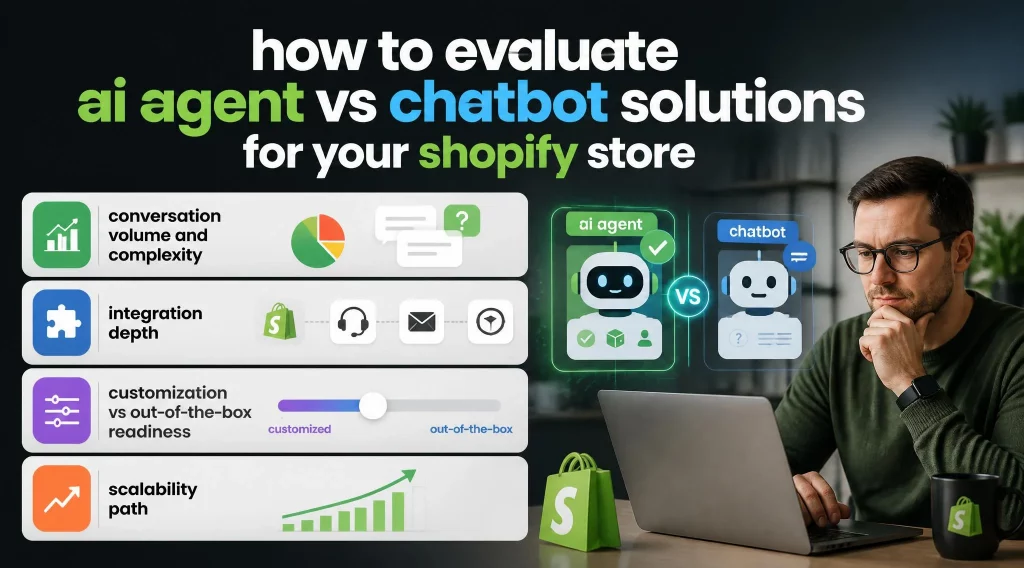
- Conversation volume and complexity. Track your support tickets for 30 days. Categorize each ticket as simple (answerable with a static response), moderate (requires order lookup or basic personalization), or complex (requires multi-step actions or judgment calls). If more than 30% of tickets fall into the moderate or complex categories, an AI agent will deliver measurably better outcomes.
- Integration depth. Verify that any solution you consider connects natively to Shopify’s API for order data, customer profiles, and inventory. Chatbots that rely on webhooks alone introduce latency and potential failure points. AI agents should integrate with your helpdesk (Gorgias, Zendesk), email marketing platform, and returns management system to deliver seamless cross-channel experiences.
- Customization versus out-of-the-box readiness. Some stores need an agent that follows strict brand voice guidelines and handles product-specific edge cases. Others need a solution that works immediately after installation. Your team’s technical capacity determines which end of this spectrum is realistic. If you decide an agent is the right fit, our guide to choosing an AI agent builder walks through the platform criteria that matter most for this decision.
- Scalability path. The solution you choose today should accommodate 3-5x growth in conversation volume without requiring a platform migration. Ask vendors specifically about pricing tiers at higher volumes and whether the system’s performance degrades as the knowledge base grows.
Conclusion
The choice between an AI Agent vs Chatbot for your Shopify store comes down to where your business sits on the complexity and scale spectrum. Chatbots remain effective for stores with straightforward, low-volume support needs, while AI agents deliver measurable ROI for merchants dealing with complex customer journeys, large catalogs, and high conversation volumes.
The technology landscape is shifting decisively toward agentic AI, and early adopters are already reporting significant improvements in customer satisfaction, operational efficiency, and revenue per interaction. Our team at AI Hive specializes in building enterprise-grade AI agents that integrate seamlessly with Shopify and other commerce platforms, ensuring your store captures the full value of intelligent automation. Reach out to AI Hive’s team to explore which approach aligns with your store’s growth trajectory.