
![Agentic AI for Enterprise: The Complete Deployment Guide [2026]](https://aihive.global/wp-content/uploads/2026/07/agentic-ai-for-enterprise-thumbnail-1024x538.webp)

A mid-sized bank we work with was burning 50 hours a week on manual AML screening, tying up five compliance officers to review documents that a trained agent could process in minutes. That kind of gap is exactly why 80% of enterprise AI projects still never reach production (Gartner, 2026), and it is not a technology problem, it is an execution problem.
This guide is written for CTOs, CIOs, and Operations Directors ready to move past pilots, and it covers what agentic AI for enterprise actually is, which use cases hit real ROI within 30 to 60 days, how to evaluate platforms without vendor lock-in, and the three-phase roadmap our team at AI Hive uses to ship a live agent in four weeks. This article does not cover AGI, edge computing infrastructure, or agent-to-agent communication protocols, since those belong to a different conversation.
Key Takeaways
|
What Is Agentic AI for Enterprise? (And Why Generative AI Alone Falls Short)
Most enterprise leaders have deployed some form of generative AI – a chatbot, a document summarizer, a drafting tool – and found that it answers well but cannot act. Agentic AI for enterprise solves the second half of that equation: it does not wait for a prompt at each step, but instead plans, calls tools, and executes toward a defined business goal on its own.
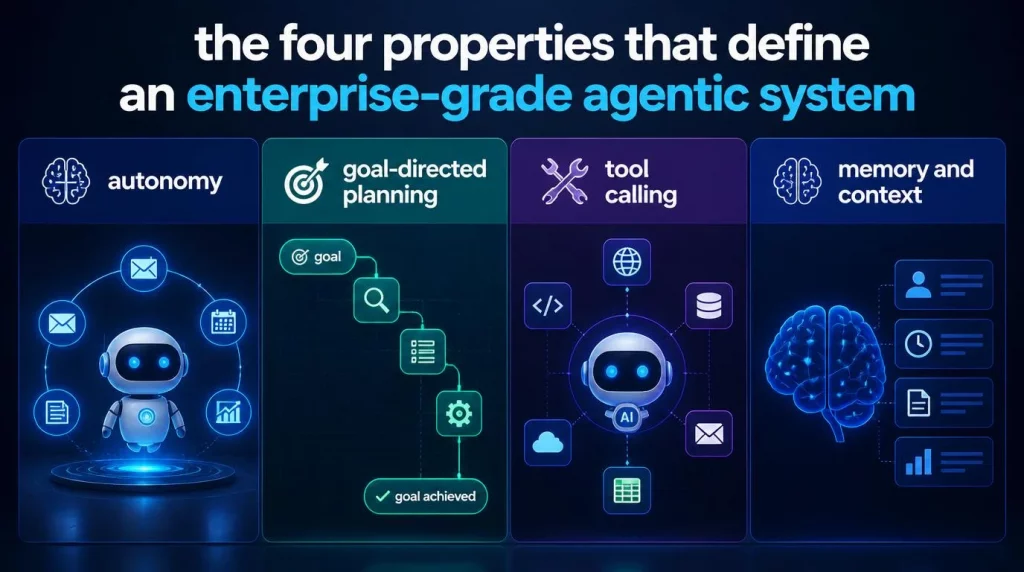
The Four Properties That Define an Enterprise-Grade Agentic System
Enterprise agentic AI is not a chatbot with extra steps. A system qualifies as genuinely agentic only when it exhibits all four of the following properties simultaneously. Our engineering team at AI Hive uses this framework to evaluate whether a proposed agent architecture will survive in production or collapse under real workload conditions.
|
Property |
What It Means in Practice |
Enterprise Requirement |
|
Autonomy |
Operates without human input at each decision step |
Must handle peak load across time zones without manual oversight |
|
Goal-directed planning |
Decomposes a high-level objective into sequential subtasks |
Requires a planning layer – ReAct, chain-of-thought – built into agent architecture |
|
Tool calling |
Invokes external systems: APIs, databases, CRM, ERP |
Needs 100+ native integrations or a purpose-built middleware layer |
|
Memory and context |
Retains short-term task state and long-term organizational knowledge |
Requires a RAG pipeline and vector search layer connected to live enterprise data sources |
Why Generative AI Alone Cannot Close the Enterprise Automation Gap
Generative AI delivered genuine value as a first step: it proved that language models could understand context, draft communications, and surface relevant information at speed. However, generative AI reaches a structural ceiling the moment a task requires action rather than output, and that ceiling is exactly where most enterprise automation projects stall.
Consider a KYC workflow at a regional bank. A generative model reads a submitted document and describes what it contains. Our agentic system at AI Hive, by contrast, reads the same document, cross-references the applicant against AML watchlists, checks eligibility criteria against current loan policy rules, and either approves the application or escalates it with a structured summary – in minutes, without human involvement at each step. The operational impact of that difference is not incremental.
Our BFSI deployments at AI Hive have reduced KYC processing time by 78%, based on six-month deployment data across two client organizations. That result requires the full agentic loop – not generative output capability.
|
Capability |
Traditional AI |
Generative AI |
Agentic AI |
|
Decision-making |
Pre-set rules only |
Produces outputs |
Autonomous, multi-step |
|
Tool use |
None |
Limited |
Native: API, CRM, ERP, DB |
|
Memory |
Static |
Session-only |
Short-term + long-term RAG |
|
Governance fit |
Low flexibility |
Requires human review |
Configurable HITL thresholds |
|
Enterprise deployment |
On-premise capable |
Primarily cloud |
Cloud + on-premise + hybrid |
Specifically, the governance column is the one most frequently underestimated during vendor selection. Agentic AI requires human-in-the-loop thresholds to be configured before go-live, not after the first error appears in production.
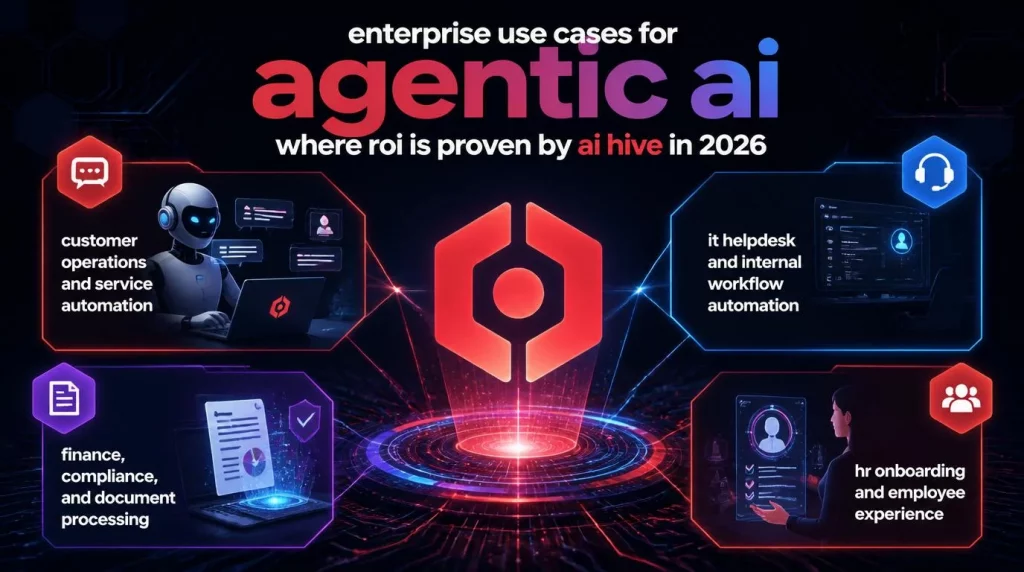
Enterprise Use Cases for Agentic AI – Where ROI Is Proven by AI HIVE in 2026
Agentic AI is not one solution applied uniformly across an organization. It is an operating layer that coordinates purpose-built autonomous agents assigned to specific, high-volume workflows – and the enterprises achieving the fastest returns in 2026 are concentrating their first deployments in four functional areas with a clear profile: high case volume, structured data, and deterministic rules.
Customer Operations and Service Automation
Customer service is the highest-volume entry point for enterprise agentic AI, and the reason is straightforward: tier-1 resolution accounts for 60 to 70% of inbound volume in most organizations, yet it consumes a disproportionate share of skilled agent capacity. The mismatch between task complexity and human resource allocation is exactly the problem agentic systems are built to resolve.
Our healthcare deployment at AI Hive reduced inbound call volume by 60% across a 120-clinic network, cutting average wait times from 18 minutes to under two minutes. Specifically, we found that configuring the confidence threshold at 0.82 – meaning the agent escalates any case where it is less than 82% confident in the resolution – reduced erroneous autonomous actions to zero across the first 90 days of production. The 40% of cases that still reached human agents were genuinely complex clinical escalations, which allowed clinical staff to operate at a level that matched their qualifications rather than handling appointment rescheduling.
Consequently, organizations that deploy agentic customer service should measure two metrics from day one: containment rate (percentage of cases resolved without human escalation) and escalation accuracy (percentage of escalated cases that genuinely required human judgment). Both metrics together tell a more honest story than containment rate alone.
IT Helpdesk and Internal Workflow Automation
IT helpdesk automation is consistently the second-highest ROI entry point, and the explanation is structural: in most organizations, password resets, VPN access, software provisioning, and new employee onboarding account for roughly 70% of tier-1 ticket volume. These tasks are high-frequency, low-complexity, and rule-bound – precisely the profile where agentic systems reach 95%+ resolution accuracy without needing frontier-tier LLM reasoning.
Our manufacturing deployment at AI Hive automated 55% of IT tickets across a 4,200-employee group operating in three countries. Our IT automation solutions handle tier-1 cases within minutes of submission. Before deployment, the 12-person IT team averaged a five-day resolution time; after deployment, they focus exclusively on infrastructure and architecture work.
Furthermore, we encountered one instructive failure during that engagement: the initial configuration attempted to handle software licensing approvals autonomously, but licensing policy varied by country entity and was not fully documented in the knowledge base. We resolved this by adding a structured escalation rule for multi-entity licensing requests. That failure taught us that any workflow with jurisdiction-dependent policy variations requires a separate escalation path before the agent goes live.
Finance, Compliance, and Document Processing
Regulated industries represent the highest-value agentic AI deployment opportunity because the cost of manual compliance work is structurally large and the task profile is ideal for automation: AML screening, invoice processing, contract review, and regulatory reporting all follow defined rules, produce structured outputs, and require complete audit trails. In addition, the data sovereignty requirement in regulated industries creates a competitive advantage for platforms that offer genuine on-premise deployment.
Our BFSI deployments use on-premise Kubernetes clusters to enforce zero data egress. This architecture directly addresses the data residency requirements that apply to financial institutions operating across multiple Southeast Asian jurisdictions, including Vietnam’s AI Law 134/2025/QH15 (effective March 1, 2026). Our on-premise deployment architecture is designed to meet this requirement from day one – a capability that cloud-only AI vendors cannot offer, which effectively removes them from consideration in regulated APAC markets.
HR Onboarding and Employee Experience
Employee-facing agentic AI delivers ROI through two distinct mechanisms that most HR leaders treat separately but that compound when deployed together. Faster onboarding reduces time-to-productivity for new hires, while always-available HR automation reduces the inbound query volume that consumes HR team capacity across the employee lifecycle.
An HR agentic system handles role-based access provisioning, policy questions, benefits enrollment guidance, and offboarding workflows autonomously, with human escalation triggered only on exceptions requiring judgment. According to a 2025 McKinsey study on enterprise AI adoption, organizations that automate HR tier-1 query handling report a 40 to 55% reduction in inbound HR volume within the first 90 days of deployment. Our HR deployments at AI Hive have produced results in that range consistently, though the specific percentage varies with how cleanly the organization’s HR policy documentation is structured at the time of knowledge base ingestion.
How to Evaluate Enterprise Agentic AI Platforms in 2026
The enterprise agentic AI market expanded significantly in April 2026, with Google, Oracle, Microsoft, and Salesforce each launching production-grade agentic platforms. That consolidation raises the quality floor across the category, but it also makes vendor selection more complex because marketing claims have converged while architectural differences remain significant. The right evaluation framework focuses on five criteria that directly determine whether a deployment reaches production or stalls.
Our team at AI Hive built the platform around one observation that shaped every architecture decision: the incumbents that dominate the enterprise AI agent conversation either sell an expensive platform and leave implementation entirely to the customer, or charge $350 per hour for the engineering work that makes the platform usable. Neither model delivers a four-week production timeline for a mid-market organization without an in-house AI engineering team.
The following five criteria are the ones our enterprise clients consistently identify as the deciding factors in vendor selection:
- Deployment flexibility (on-premise + cloud + hybrid): Regulated industries cannot use cloud-only platforms. Data sovereignty is a hard requirement in BFSI, healthcare, and government sectors, not a preference. Your first question to any vendor should be: “Can you deploy on our infrastructure with verified zero data egress?”
- Model agnosticism: Single-LLM lock-in inflates costs by 35 to 60% because different tasks have different model requirements. The platform should let you assign the optimal model to each agent independently.
- Built-in governance layer: RBAC, PII masking, confidence-threshold escalation, and audit trail generation must be native to the platform, not third-party add-ons.
- Time to first production agent: A 6 to 18 month deployment timeline eliminates ROI before it begins. Your vendor should be able to demonstrate a working agent in your environment within four weeks for standard use cases.
- Engineering support model: Most mid-market organizations do not have AI engineering teams large enough to operate an enterprise agent platform independently. The vendor’s answer to “What happens after we sign the contract?” reveals the actual delivery model.
|
Approach |
Timeline |
Cost |
Engineering |
Governance |
Best Fit |
|
Build in-house |
18-24 months |
$500K-$2M |
10+ AI engineers |
Custom build |
Fortune 500 with existing AI team |
|
Large incumbents (Kore.ai, IBM) |
6-18 months |
$300K+/year |
SI required |
Partial native |
Fortune 500, multi-year budget |
|
AI Hive |
4 weeks (first agent) |
$1.5K-$4K/mo |
Engineers for Hire included |
Full native |
Mid-market, regulated industries |
|
Lightweight tools |
Hours to days |
$50-$500/mo |
Self-serve |
Minimal |
Low-complexity, non-regulated |
Specifically, the governance column is where lightweight tools consistently fail enterprise requirements. Conversely, the engineering requirement column is where large incumbents create cost exposure that mid-market organizations cannot absorb.
Agentic AI Readiness – Is Your Enterprise Ready to Deploy?
Most enterprises overestimate their technical readiness and underestimate their governance readiness when evaluating agentic AI deployment. Our team at AI Hive runs a structured pre-deployment scoping exercise with every client, and the findings across 20+ enterprise engagements consistently show the same pattern: organizations that complete the following six checks before committing to a deployment timeline experience significantly fewer Phase 2 failures than those that skip straight to agent configuration.
Infrastructure Readiness:
- Data accessibility: Your primary data sources are accessible via API or structured query. Data locked in legacy systems requiring manual export creates a Phase 1 blocker that delays every subsequent step.
- Container support: Your environment supports containerized workloads via Kubernetes or an equivalent orchestration layer. This is a prerequisite for on-premise deployment and for governance controls requiring container-level isolation.
- Documented data source: At least one clean, well-documented data source exists and is ready to connect to your first agent without requiring a data remediation project first.
Governance Readiness:
- Data access policy: Your organization has defined which data the AI system can access, which it cannot, and who has authority to expand those permissions.
- Escalation path: The human escalation path for decisions the agent cannot resolve autonomously is documented and staffed – not assumed.
- Compliance review process: A review process exists for AI-generated outputs in regulated workflows, with sign-off ownership assigned before deployment begins.
Scoring: 5-6 checks = production-ready (proceed to Phase 1). 3-4 checks = pilot-ready (scope to low-risk workflow first). 0-2 checks = prioritize data and governance infrastructure before committing to any deployment timeline.
How to Implement Agentic AI at Enterprise Scale – A Three-Phase Roadmap
The most common implementation failure we see at AI Hive is organizations attempting to deploy a complex, multi-agent orchestration system before they have proven a single agent in production. The correct implementation sequence is sequential by design: each phase validates the conditions required for the next, and skipping phases creates compounding risk rather than accelerating timelines.
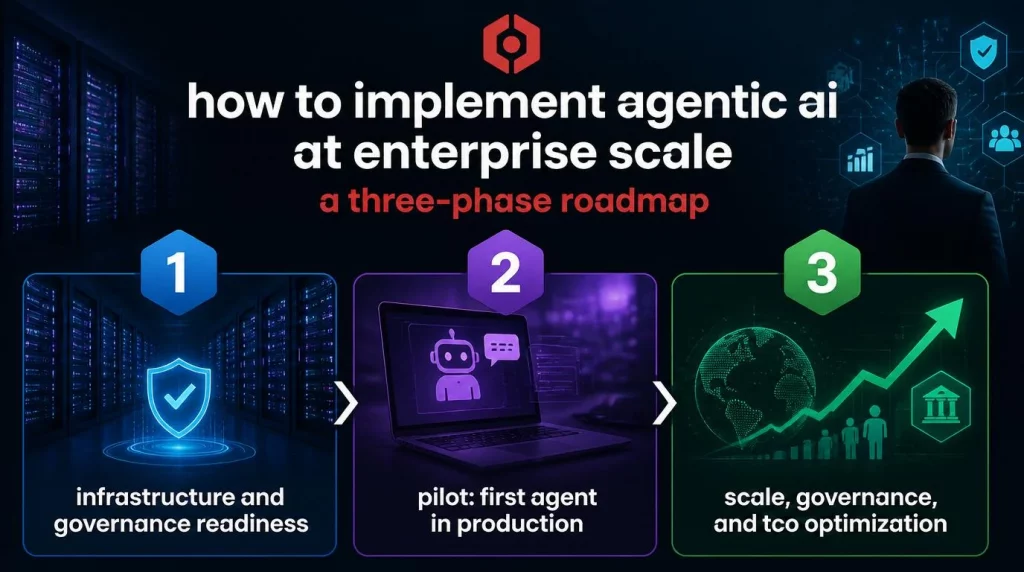
Phase 1 – Infrastructure and Governance Readiness (Weeks 1 to 2)
The first two weeks are not about building agents. They are about confirming that your environment can support an agentic system safely and that the governance controls are in place before any autonomous action begins. Our team at AI Hive opens every enterprise engagement with a two-day technical scoping exercise covering four specific outputs: a data source accessibility audit with API inventory, an RBAC policy definition for AI system permissions, a first use case selection based on volume and risk profile, and a deployment architecture decision – cloud SaaS, on-premise Kubernetes, or hybrid. The output is a written deployment blueprint that eliminates the most common causes of pilot failure before a single line of agent logic is written.
Phase 2 – Pilot: First Agent in Production (Weeks 3 to 4)
Phase 2 produces exactly one deliverable: a single live agent handling real cases in a production environment with a measurable outcome. The scope is deliberately narrow – one workflow, one data source, one performance metric – because breadth in Phase 2 is the second-most-common cause of pilot failure after data readiness issues. For most organizations, IT helpdesk tier-1 or customer service tier-1 is the correct first pilot. The AI Hive Marketplace provides 500+ pre-built agent templates for these use cases, which reduces the time from zero to a working prototype to under 30 minutes for standard configurations. By week four, your first agent should be handling live cases. If it is not, the architecture requires review before Phase 3 begins.
Phase 3 – Scale, Governance, and TCO Optimization (Months 2 to 3)
Phase 3 expands the deployment, formalizes governance controls, and begins the cost optimization work that turns a successful pilot into a sustained business asset. Scaling in this phase means adding agents for adjacent workflows rather than building complex orchestrations from scratch: the IT helpdesk agent expands to cover access provisioning, and the customer service agent expands from tier-1 containment to tier-2 case escalation with structured handoff.
Governance work includes implementing audit trail review cadences, tuning human-in-the-loop confidence thresholds based on first-production data, and assigning TCO per resolved case as the primary efficiency metric. Cost optimization is where the model-agnostic architecture of the AI Hive platform delivers its clearest return: by routing simpler classification tasks to smaller, cost-efficient models and reserving frontier-tier models for complex multi-step reasoning, our clients consistently reduce LLM operational costs by 35 to 60% compared to single-model deployments.
Risks, Guardrails, and Governance Frameworks for Agentic AI
Agentic AI introduces a category of operational risk that generative AI does not carry: autonomous action risk. When an agent produces an incorrect answer, a human reviews and corrects it. When an agent takes an incorrect action – miscategorizing a transaction, provisioning incorrect access, or initiating a refund it was not authorized to approve – the downstream consequence requires active operational remediation, not just a correction. This distinction changes the governance requirements fundamentally.
Our governance framework at AI Hive is built around five risk categories that every enterprise deployment should address before the first agent goes live:
- Autonomous decision errors: Agents take incorrect actions on real data when confidence thresholds are misconfigured or knowledge bases contain gaps. The mitigation is confidence-threshold checkpoints: any decision below the defined threshold automatically escalates to human review rather than executing.
- Data privacy exposure: Agents that access or surface PII they should not reach create GDPR, HIPAA, or local regulation violations at scale. PII masking must be implemented at the RAG retrieval layer, not as a post-processing filter, and RBAC must mirror the organization’s existing data governance policy exactly.
- Regulatory non-compliance: Agent outputs that do not meet GDPR, HIPAA, or Vietnam’s AI Law 134/2025/QH15 requirements create legal exposure. On-premise deployment for regulated data, a compliance filter on all agent outputs, and a complete audit trail are the three non-negotiable controls.
- Model hallucination at scale: An agent that acts on a hallucinated fact across thousands of cases creates compounding errors that are difficult to detect and expensive to reverse. Retrieval-augmented generation with verified, versioned knowledge sources – combined with output validation before action execution – is the correct architectural response.
- Governance drift: Agent performance degrades after model updates or knowledge base staleness, often without triggering obvious errors. Monthly performance benchmarking against defined baseline metrics, combined with an agent registry with version control, is the minimum viable monitoring posture.
In addition, enterprises operating in Southeast Asia face a specific compliance layer: Vietnam’s AI Law 134/2025/QH15 (effective March 1, 2026) classifies enterprise AI deployments by risk tier and mandates on-premise deployment controls for high-risk applications in healthcare, finance, and critical infrastructure. Our enterprise AI security and compliance architecture was designed to meet this requirement from day one – a capability that cloud-only vendors cannot offer and that creates a meaningful differentiation in the APAC market specifically.
Governance is not a layer you add after deployment. It is the architecture decision that determines whether your deployment is defensible under audit.
Conclusion
The bank we opened with, the one burning 50 hours a week on manual AML screening, now runs that entire workflow through an agentic system that clears the same volume in minutes, with a full audit trail and a clean human escalation path for the exceptions that genuinely need judgment. That is what agentic AI for enterprise looks like when the scope is right, governance is defined before go-live, and the team resists the urge to solve every AI problem in the first deployment.
We help enterprises across BFSI, healthcare, logistics, and manufacturing deploy their first production-ready agentic AI agent in four weeks – platform, governance framework, and engineering team included. If your organization is ready to move past the pilot stage, our team is available for a no-commitment technical scoping conversation. Explore the AI Hive Platform or contact our team to accelerate your deployment on a timeline that delivers ROI within 90 days.