


Your generative AI assistant writes a flawless refund email, then waits for someone to open the order system, check the policy, and press send. Multiply that handoff across thousands of tickets and the promised savings disappear, which is one reason Gartner expects over 40 percent of agentic AI projects to be canceled by the end of 2027 over rising costs, unclear value, or weak risk controls. The agentic AI vs generative AI decision is how you close that gap: generators draft, agents act, and the scoring framework below shows which one each use case deserves before you fund the next pilot.
Key Takeaways
|
What Are Generative AI and Agentic AI?
Generative AI and agentic AI share the same foundation models but differ in what the system is allowed to do with an answer. The agentic AI vs generative AI distinction is therefore about delegation, not about model quality.
Generative AI refers to models, most often large language models (LLMs), that produce new content from patterns learned in training. You send a prompt, the model returns a draft, and the work stops there. The model does not check its answer against a live database, run the next step of a process, or remember a previous session unless the surrounding application stores that context.
Agentic AI wraps those same models in a loop that adds planning, tool use, and memory across steps. An agent receives a goal instead of a single prompt, breaks it into subtasks, chooses a tool or system for each one, and checks the result before moving on. A loan-intake agent, for example, can collect documents, call a credit bureau API, flag mismatches for an underwriter, and update the origination system without a person moving each step along.
Agentic AI is not the same as full autonomy, which is a common misreading of the agentic AI vs generative AI split. Most enterprise agents run inside boundaries that people set, and an agent that acts without limits is a separate design choice with its own risks. Our guide to the autonomous AI agent covers where that line sits and the guardrails that keep it in place.
Agentic AI vs Generative AI: Side-by-Side Comparison
The top-ranking agentic AI vs generative AI comparisons list differences but rarely score them, so the table below rates each technology from 1 (low) to 5 (high) on the four criteria buyers ask about most. The scores are our editorial judgment for a typical enterprise deployment, and the notes say why.
| Criterion | Generative AI | Agentic AI | Why the scores differ |
|---|---|---|---|
| Autonomy | 1: it answers only when prompted | 4: it plans and acts inside set limits | The agent decides its own next step, while a generator waits for the next prompt |
| Task complexity handled | 2: single-step drafting and summarizing | 5: multi-step workflows across systems | Tool calls and memory let an agent carry a process from start to finish |
| Running cost per task | 2: one model call per request | 4: many calls per goal | Anthropic reported in June 2025 that agents use about 4 times more tokens than chat interactions |
| Ease of deployment | 4: a secure chat tool can go live quickly | 2: integrations, permissions, and testing come first | An agent needs access to real systems, and each connection adds review work |
| Type of risk | Informational: wrong or biased output | Operational: wrong actions in live systems | Risk is the widest agentic AI vs generative AI gap, because an agent can act on its own error before anyone reads it |
| Typical owner | Business teams and knowledge workers | Process owners with IT and risk teams | Agents touch systems of record, so ownership sits closer to operations |
Cost deserves more attention than it usually gets. The same Anthropic engineering post found that multi-agent systems use about 15 times more tokens than chats, which means an agent has to replace real work before its bill makes sense. A drafting task that a person finishes in two minutes rarely justifies that multiplier.
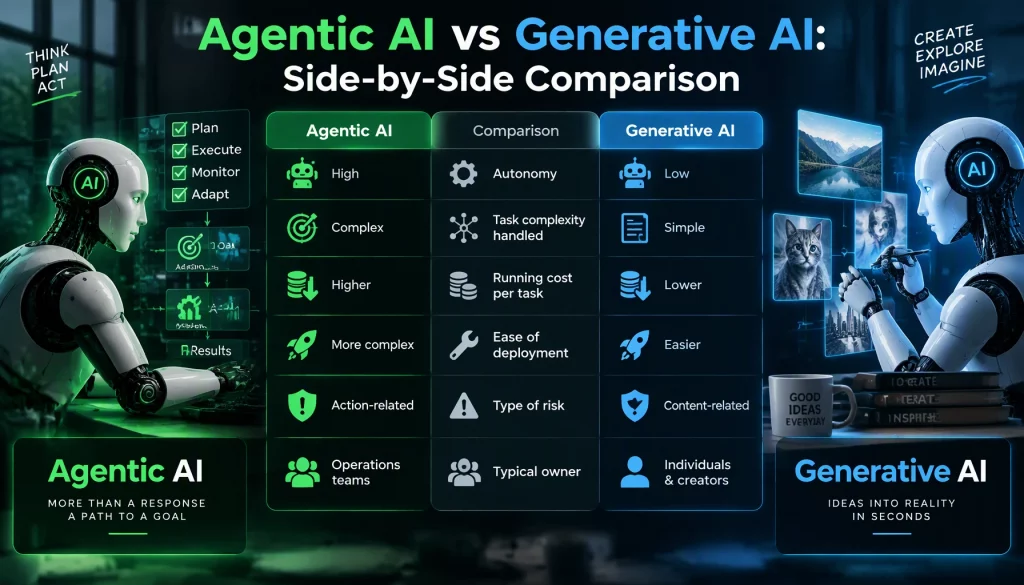
The table points to one conclusion. Generative AI is cheaper and faster to deploy, and agentic AI handles more of the work, so the right choice depends on how much of the process you need automated and how much risk you can govern.
How Do Autonomy, Memory, and Tool Use Differ?
Three capabilities separate an agent from a generator, and each one changes what your engineering team has to build. In the agentic AI vs generative AI debate, these three are the technical line, not the marketing one.
- Autonomy: A generator takes one prompt and returns one output, while an agent decides which step comes next and when the goal is complete.
- Memory: A generator treats each request alone unless the app adds context, while an agent keeps state across the whole workflow and adjusts its plan when conditions change.
- Tool use: A generator stays inside its own interface, while an agent calls APIs, queries databases, and writes to business systems to finish real transactions.
Vendors blur this line on purpose. Gartner described the practice as “agent washing” in June 2025, meaning the rebranding of assistants, RPA bots, and chatbots as agents without real agentic capabilities, and it estimated that only about 130 of the thousands of vendors claiming agentic AI were genuine. Our breakdown of how AI agents differ from chatbots lists the technical markers worth checking before you sign a contract that uses the word “agent” loosely.
A quick test settles the agentic AI vs generative AI claim in most demos. You should ask the vendor to give the system a goal with an unexpected obstacle, such as a missing field, and watch whether it plans around the gap or stops and waits for a new prompt.
When Should You Use Each?
Generative AI fits when a person makes the final decision, and agentic AI fits when a repeatable process can run with defined exceptions. Most real choices in the agentic AI vs generative AI decision fall into one of the rows below.
| Task | Best fit | Reason |
|---|---|---|
| Drafting marketing copy or proposals | Generative AI | A person reviews and approves every draft |
| Summarizing contracts or call notes | Generative AI | The output informs a human decision and triggers nothing by itself |
| Tier-1 support ticket triage and resolution | Agentic AI | The steps repeat, the data is known, and exceptions can route to a person |
| Invoice matching and accounts payable | Agentic AI | The agent reads, matches, and posts across systems with clear rules |
| Loan or claims intake | Hybrid | The agent gathers and checks data, and a qualified person makes the decision |
| Clinical or credit decisions | Hybrid with human sign-off | Regulated outcomes need an accountable person to approve |
Agents also overlap with older automation. Robotic process automation follows fixed scripts and breaks when a screen or data format changes, whereas an agent can reason about unstructured inputs. Our comparison of AI agent vs RPA explains where scripted automation still wins and where an agent earns its extra cost.
The rule of thumb is simple: the more a task depends on judgment across several systems, the more an agent pays off, and the more it depends on a person’s approval, the more a generator is enough.
How Do Agentic AI and Generative AI Work Together?
They work together as layers. In most production systems, the agent is the operating layer and the generative model is the reasoning layer inside it, so the agentic AI vs generative AI choice is often about which layer a task needs rather than which product to buy.
A support workflow shows the split. The agent receives a ticket, looks up the order, and checks the refund policy through tools. The generative model inside the agent reads the customer’s message, decides what the policy means for this case, and drafts the reply, and then the agent sends it and logs the action.
This layering has a practical consequence for budgets. Your generative AI licenses, prompt libraries, and evaluation sets carry straight into an agent program, while the new spending goes to integrations, orchestration, and governance. In our view, teams that plan the agent layer as an extension of their existing generative AI stack avoid paying twice for the same model access.
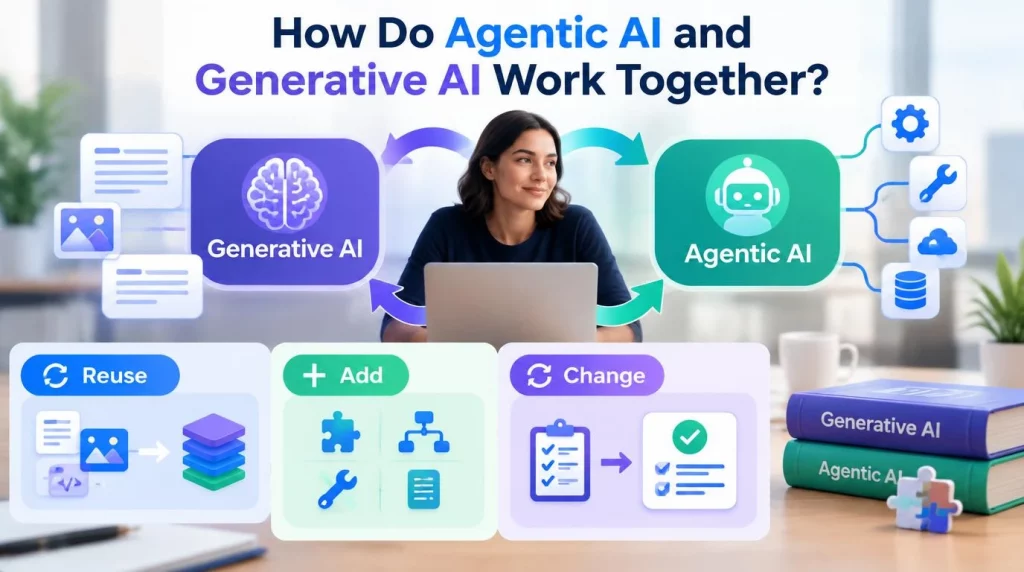
- Reuse: Prompts, retrieval indexes, and model contracts from generative pilots move into the agent layer.
- Add: Tool connectors, a workflow or orchestration engine, and action-level logging are new work.
- Change: Testing shifts from judging single outputs to judging whole task outcomes, including what the agent did.
What Governance Changes Do Agentic Systems Require?
Agentic systems need governance for actions, not only for outputs. A generative tool that drafts a wrong answer creates a review problem, while an agent that moves money or updates a record creates an accountability problem, and that shift is where the agentic AI vs generative AI gap matters most for regulated teams.
Most enterprises are not ready for that side of the agentic AI vs generative AI shift yet. Deloitte’s State of AI in the Enterprise 2026, based on a survey of 3,235 IT and business leaders in 24 countries, found that 74 percent expect their companies to use AI agents at least moderately by 2027, while only 21 percent say they have a mature governance model for agentic AI. Adoption is running ahead of control.
Three changes matter most, whatever your industry.
- Action-level audit trails: Every action an agent takes, not only every output it writes, needs a log detailed enough for a compliance officer to rebuild the decision later.
- Tiered autonomy by risk: Data retrieval can run without approval, while fund transfers or decisions near a diagnosis need a person to sign off before execution.
- Deployment control: Organizations under strict data residency rules often need an on-premise or hybrid deployment, so sensitive records stay on infrastructure they control.
Public frameworks now describe the same pattern. Singapore’s Infocomm Media Development Authority launched a Model AI Governance Framework for Agentic AI on January 22, 2026, and updated it in May 2026. The framework is voluntary and rests on four dimensions: bounding risks upfront, keeping humans meaningfully accountable, applying technical controls, and enabling end-user responsibility, while organizations stay legally accountable for what their agents do.
A Practical Decision Framework Used by Enterprise Teams
Your team should score the use case before it picks the technology. The framework below turns the agentic AI vs generative AI comparison into five questions, and a total of 10 or more points toward an agent.
| Question | 0 points | 1 point | 2 points |
|---|---|---|---|
| How many steps does the task have? | One step | Two or three steps | Four or more steps |
| How many systems does it touch? | None | One | Two or more |
| How often does it run? | Occasionally | Weekly | Daily or more |
| Can a wrong action be reversed? | No | With effort | Easily |
| Is there a clear success metric? | No | Partly | Yes, with a baseline |
Totals below 5 point to generative AI, totals from 5 to 9 point to a hybrid with human sign-off, and totals of 10 or more point to an agent. These thresholds are our rule of thumb, not an industry benchmark, and a low reversibility score should always pull the design toward human approval.
Different leaders should read the score differently, because the agentic AI vs generative AI trade-off looks different from each seat. The table below shows where each role usually starts.
| Your situation | Where to start | Why? |
|---|---|---|
| CIO with a generative AI rollout already live | One agent on a high-volume process that the generative pilot already touches | The prompts and data work are reused, so the first agent costs less |
| CTO or VP Engineering with a thin platform team | A hybrid design with human approval on every write | Approval gates reduce the testing and monitoring burden at the start |
| Risk leader in banking, insurance, or healthcare | Governance design before any pilot | Action logs and approval tiers are hard to add after an agent is live |
| Innovation lead at a mid-market company | A single agent with one metric, such as ticket resolution time | A narrow scope proves value before the budget round |
Once a use case scores high, a phased rollout keeps the risk small. The four phases below apply whether you are a mid-market team or a global enterprise.
- Prove value in one process: The first agent runs alongside the existing process on clean data, measured against a baseline, before anyone cuts over.
- Formalize governance before scaling: The team documents the audit trail, approval thresholds, and escalation path for that agent and reuses the document as a template.
- Expand through reuse: A proven agent pattern moves to a similar process in another department after the team reruns the agentic AI vs generative AI score for that process.
- Staff for oversight: Every live agent gets a named owner who watches its results and can switch it off.
For the rollout itself, our guide to agentic AI for enterprise covers how to pick the first processes and size the pilot. In our view, teams that settle the agentic AI vs generative AI question use by use, instead of once for the whole company, waste the fewest pilots.
Conclusion
The agentic AI vs generative AI choice comes down to delegation: generators draft and people decide, while agents act inside limits that people set. Agents handle more of the work but cost more to run and need action-level governance, and most successful programs combine both layers instead of picking one. This month, your team should score its top five AI requests with the framework above and move only the high scorers into an agent pilot.
Once a pilot works, the harder questions arrive: how you govern a growing number of agents, and how you price them when usage grows. If you want a platform built for that stage, explore our enterprise AI agent platform and map your first agent against your own systems.