

Robotic Process Automation promised to transform enterprise operations by scripting repetitive tasks-clicking buttons, copying data between systems, filling forms-at machine speed. For a while, it delivered on that promise. Then reality intervened. Deloitte’s 2026 Intelligent Automation Survey reports that 30-50% of RPA projects fail outright, and organizations that do achieve initial success spend 60-75% of their total RPA budget on maintenance rather than on building new automations. The bots break whenever a UI changes, an API updates, or an input deviates from the narrow path the script was designed to handle.
AI agents offer a fundamentally different approach. Rather than mimicking human clicks on a screen, AI agents reason about tasks, interpret unstructured data, handle exceptions autonomously, and adapt to changes in their operating environment without requiring script rewrites. The question for enterprise leaders in 2026 is not whether AI agents are better than RPA in the abstract-it is when to use each technology and how to combine them effectively.
AI Agent vs RPA: Quick Comparison
First of all, let’s break down the key differences between AI agent and RPA before diving deeper into the details of each approach:
| Comparison Criteria | AI Agent | RPA |
| Core Approach | Uses AI to interpret context, reason, and decide the next action | Follows predefined rules and fixed process steps |
| Best Data Type | Handles structured and unstructured data | Works best with structured, consistent data |
| Adaptability | Adjusts to changing inputs and unexpected situations | Requires reconfiguration when systems or workflows change |
| Decision-Making | Supports context-aware and goal-driven decisions | Executes deterministic, rule-based decisions |
| Workflow Complexity | Manages dynamic, multi-step workflows across tools | Automates repetitive, stable, and predictable processes |
| Human Involvement | Operates with human oversight for approvals and exceptions | Requires humans to manage process changes and rule exceptions |
| Integration Method | Connects through APIs, tools, databases, and agent frameworks | Often interacts with interfaces, forms, and legacy applications |
| Scalability | Scales across variable and knowledge-intensive tasks | Scales efficiently across high-volume repetitive tasks |
| Primary Risk | Incorrect reasoning, hallucinations, or uncontrolled actions | Workflow failure when interfaces or business rules change |
| Best For | Customer service, analysis, research, decision support, and complex automation | Data entry, invoice processing, system updates, and routine back-office tasks |
AI Agent vs RPA: Understanding the Architectural Difference
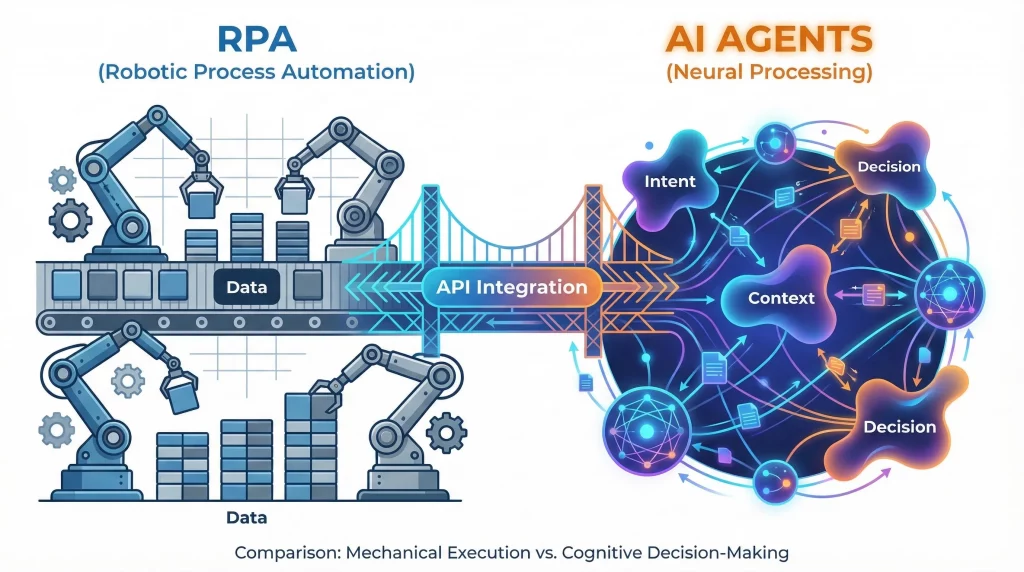
The difference between RPA and AI agents is not a matter of degree-it is a difference in kind. Understanding this architectural distinction is essential before evaluating which technology fits a specific use case.
How RPA Works
An RPA bot follows a deterministic script. A developer records or codes a sequence of UI interactions-click this button, read this field, paste this value into that cell-and the bot replays those interactions. The bot has no understanding of what it is doing or why. It recognizes screen elements by their position, HTML attributes, or image patterns, and it executes the same sequence every time, regardless of context.
This architecture works well for tasks that are genuinely repetitive, stable, and structured. Processing payroll entries where the same fields appear in the same locations in the same application every time is an ideal RPA use case. The task follows a predictable path, the inputs are structured, and the UI rarely changes.
How AI Agents Work
An AI agent combines a language model’s reasoning capability with tools that let it interact with systems. When an AI agent receives a task-“process this insurance claim”-it reads the claim document, understands its contents, identifies the relevant fields, checks them against policy rules, makes decisions about approval or escalation, and executes the appropriate actions across connected systems. If the claim document arrives in an unexpected format, the agent adapts. If a business rule has changed, the agent applies the updated rule without requiring a script rewrite.
The agent’s reasoning layer is what makes this possible. Rather than following a fixed script, the agent evaluates each situation, considers the available information, and selects the most appropriate course of action. This capability comes from the underlying language model’s ability to understand context, follow instructions, and generate structured outputs.
Where RPA Breaks Down in Enterprise Operations
The 30-50% failure rate for RPA projects is not random. The failures cluster around predictable patterns that expose the fundamental limitations of scripted automation.
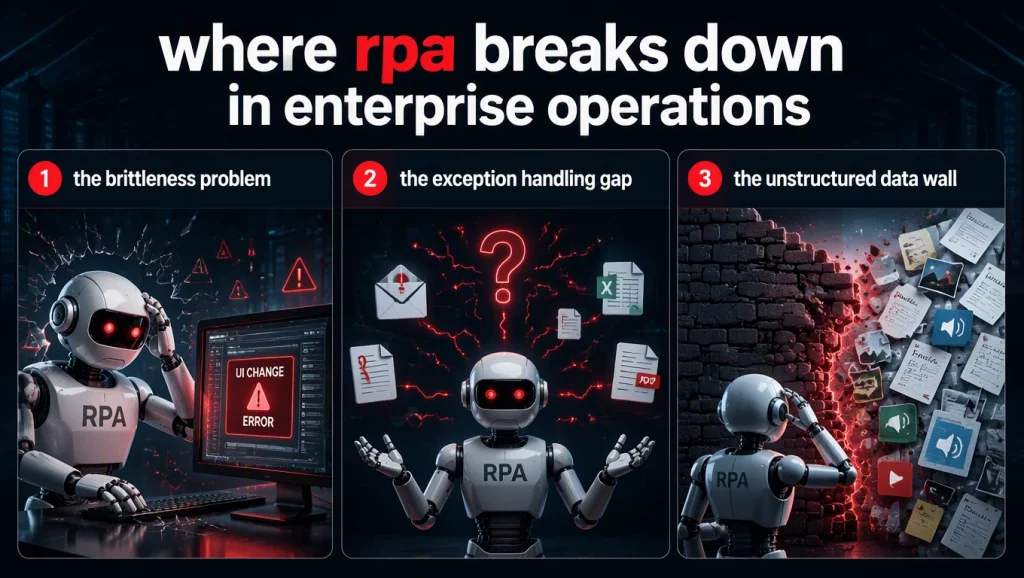
1. The Brittleness Problem
RPA bots rely on specific UI elements-a button at coordinates (340, 520), an input field with the CSS class invoice-amount, a dropdown menu with exactly seven options. When the target application updates its interface, those references break. A minor redesign that changes a button’s position, a platform update that modifies field identifiers, or a new compliance requirement that adds a checkbox to a form can halt an entire automation pipeline.
Enterprises running dozens of RPA bots spend significant engineering time monitoring for these breakages and updating scripts reactively. According to recent industry analysis, 45% of firms report weekly bot breakage requiring manual intervention. The maintenance burden grows linearly with the number of bots, creating a scaling problem that offsets the efficiency gains automation was supposed to deliver.
2. The Exception Handling Gap
In standard RPA, any deviation from the predefined path-what developers call an “exception”-requires human intervention. A customer submits a form with a typo in their account number. An invoice arrives in a slightly different format. A required field contains unexpected data. Each of these situations triggers an exception that the RPA bot cannot resolve because it lacks the reasoning capability to interpret what went wrong and determine the correct response.
AI agents handle these situations natively. When an agent encounters an unexpected input, it analyzes the context, considers what the input was likely intended to be, and either resolves the issue autonomously or escalates it with a specific explanation of the ambiguity-giving the human reviewer enough context to make a quick decision rather than restarting the entire process.
3. The Unstructured Data Wall
RPA operates on structured data-fields, forms, tables with consistent formats. The moment a workflow involves unstructured data-emails, PDFs, images, free-text descriptions, handwritten notes-RPA requires external tools for data extraction before it can proceed. This adds complexity, introduces failure points, and limits the scope of processes that RPA can automate end-to-end.
AI agents process unstructured data as a core capability. A language model can read an email, understand its intent, extract relevant information, and take action-all within a single reasoning step. This capability is why enterprise AI agent solutions are increasingly replacing RPA in document-heavy workflows across financial services, healthcare, and legal operations.
Cost and ROI Comparison
The financial case for AI agents over pure RPA has become clearer as both technologies have matured and organizations have accumulated deployment data.
Implementation Costs
Traditional RPA implementations cost approximately $228,000 in year one, including licensing, development, infrastructure, and initial maintenance. AI automation platforms average $77,000 for comparable scope-a 66% reduction, according to 2026 enterprise automation benchmarks. The cost difference stems primarily from reduced development time (visual workflow builders versus script coding) and lower maintenance requirements (adaptive agents versus brittle bots).
Three-Year Total Cost of Ownership
The maintenance disparity widens the cost gap over time. RPA maintenance costs consume 60-75% of the total automation budget, meaning an organization that spent $228,000 implementing RPA in year one may spend $135,000-$170,000 annually maintaining those bots. AI agent platforms require maintenance investment as well, but adaptive reasoning reduces the frequency of breakage-driven maintenance by an estimated 40-60%.
Over a three-year TCO horizon, agentic AI delivers 2-3x more net value than RPA in complex, judgment-intensive enterprise workflows. For high-volume, structured tasks that rarely change, the cost advantage is smaller-which is precisely why hybrid approaches outperform pure plays on either technology.
ROI Timelines
RPA delivers measurable ROI for simple, stable tasks within 3-6 months. AI agent deployments targeting complex workflows typically reach ROI within 90 days when implemented on mature platforms, because the agents automate higher-value work that generates greater savings per automated task. AI Hive clients consistently report positive AI agent ROI within the first quarter of deployment, though the specific timeline depends on workflow complexity and integration scope.
The Hybrid Strategy: When to Use Each Technology
The enterprise automation leaders in 2026 are not choosing between RPA and AI agents. They are deploying both technologies strategically, using each where it delivers the greatest value.
1. Use RPA When
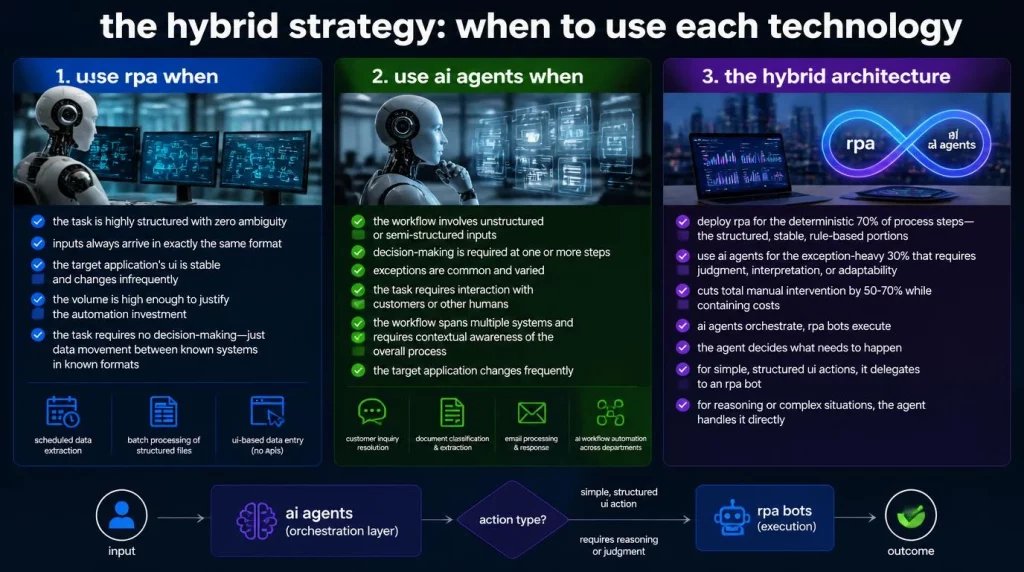
The task is highly structured with zero ambiguity. Inputs always arrive in exactly the same format. The target application’s UI is stable and changes infrequently. The volume is high enough to justify the automation investment. The task requires no decision-making-just data movement between known systems in known formats.
Examples include scheduled data extraction from legacy systems with stable interfaces, batch processing of structured files in known formats, and UI-based data entry into applications that lack APIs.
2. Use AI Agents When
The workflow involves unstructured or semi-structured inputs. Decision-making is required at one or more steps. Exceptions are common and varied. The task requires interaction with customers or other humans. The workflow spans multiple systems and requires contextual awareness of the overall process. The target application changes frequently.
Examples include customer inquiry resolution, document classification and extraction, AI workflow automation across multiple departments, email processing and response, and any process where the next step depends on interpreting the current situation.
3. The Hybrid Architecture
The Fortune 500 migration pattern emerging in 2026 deploys RPA for the deterministic 70% of process steps-the structured, stable, rule-based portions-and AI agents for the exception-heavy 30% that requires judgment, interpretation, or adaptability. This hybrid approach cuts total manual intervention by 50-70% while containing costs because RPA handles the high-volume simple work at lower per-execution cost.
The integration architecture typically positions AI agents as the orchestration layer and RPA bots as execution tools. The agent decides what needs to happen, and when the action is a simple, structured UI interaction, it delegates to an RPA bot. When the action requires reasoning, the agent handles it directly. This layered approach leverages the strengths of both technologies while mitigating their individual weaknesses.
Migration Strategy: Moving from Pure RPA to Hybrid
Organizations with existing RPA investments do not need to rip and replace. A phased migration preserves the value of existing bot investments while systematically introducing AI agent capabilities where they deliver the greatest marginal improvement.
- Phase 1: Identify high-exception workflows. Analyze your RPA portfolio to find bots with the highest exception rates-these are the workflows where RPA is performing worst and AI agents will deliver the most improvement. Workflows where more than 15% of executions require human intervention are strong candidates.
- Phase 2: Add an AI reasoning layer. Rather than replacing the RPA bot entirely, add an AI agent as a pre-processing layer that handles exception detection and resolution before passing standardized inputs to the existing bot. This approach preserves your RPA investment while dramatically reducing the human intervention rate.
- Phase 3: Consolidate and simplify. As AI agent capabilities mature within your organization, evaluate which RPA bots can be fully replaced by agent workflows. Bots that require frequent maintenance, handle low volumes, or automate tasks that have grown in complexity since the bot was originally built are the best candidates for full replacement.
- Phase 4: Scale intelligent automation. With a proven hybrid architecture and organizational experience managing AI agents, expand automation to workflows that were previously considered too complex or variable for any automation technology. These represent the highest-ROI opportunities because they currently require significant manual labor.
Conclusion
The RPA versus AI agent debate resolves into a practical question: which technology handles which portion of your automation portfolio most effectively? Pure RPA deployments will continue to lose ground as enterprise workflows grow more complex, data sources become more varied, and the pace of application change accelerates. Pure AI agent deployments, while increasingly capable, miss the cost efficiency of RPA for simple structured tasks.
The winning strategy in 2026 is hybrid-and the organizations building that hybrid architecture today will hold a structural advantage over competitors still running fragile bot farms. If your enterprise is evaluating the transition from pure RPA to intelligent automation, approach AI Hive’s engineering team for a migration assessment tailored to your current automation landscape.