


Most RAG chatbot pilots pass the demo and fail the security review. The bot answers fluently from a folder of PDFs, then production brings policies that change weekly, tables the parser mangled, questions with three parts, and an employee who sees a salary band from a document they were never allowed to open. Each failure erodes trust faster than accuracy gains can rebuild it, and a project without document-level permissions rarely gets approved at all. A production design fixes this with a measured retrieval pipeline, permissions inherited from the source systems, and acceptance metrics agreed before go-live.
Key Takeaways
|
What Is a RAG Chatbot and How Retrieval Grounds Its Answers
A RAG chatbot is a conversational system that retrieves relevant passages from an external knowledge source when a question arrives, then gives those passages to a large language model as the basis for its answer. It is not a model fine-tuned on your documents, and it is not a search box with a chat window on top: it looks up current facts on every query and can cite where each answer came from.
The technique comes from Retrieval-Augmented Generation, introduced by Lewis and colleagues at Facebook AI Research in a 2020 NeurIPS paper that paired a neural retriever with a text generator. The idea stuck because it separates how the model writes from which facts it is allowed to use.
That separation is what makes the system auditable. When an answer is wrong, a team can see whether the retriever returned the wrong passage or the model misread the right one, which is impossible when knowledge lives inside model weights.
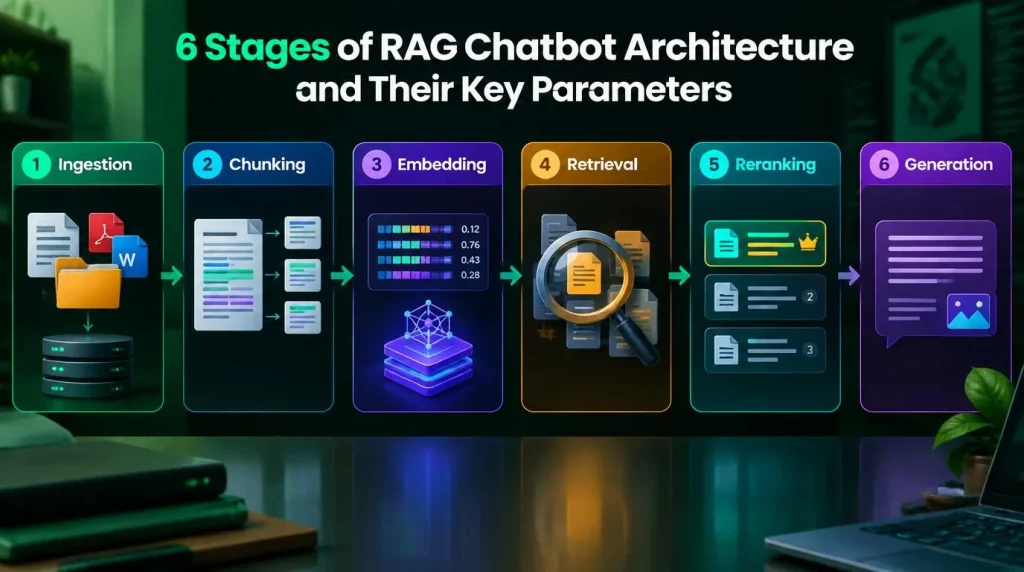
6 Stages of RAG Chatbot Architecture and Their Key Parameters
A production RAG chatbot is a pipeline of six stages, and each one can lose accuracy before the model ever sees the question. The table shows what each stage does and which parameter matters most.
| Stage | What it does | Parameter with the biggest effect |
|---|---|---|
| Ingestion | Parses PDFs, Word files, wikis, and tickets into clean text with metadata | Parser quality on tables, headers, and scanned pages |
| Chunking | Splits text into passages small enough to retrieve precisely | Boundaries that follow sections and clauses, not fixed lengths |
| Embedding | Converts each chunk into a vector that captures its meaning | An embedding model tested on your own documents and questions |
| Retrieval | Finds candidate chunks for the question | Hybrid search that combines vectors with keyword matching |
| Reranking | Re-scores candidates for true relevance | The reranker model and the number of chunks passed on |
| Generation | Writes the answer from the retrieved chunks with citations | Instructions to answer only from sources and to refuse when they fall short |
Chunking is the most underrated of these. A contract clause split across two chunks makes the retriever return half an answer, while chunks that are too large carry noise that pulls the model off course. Section-aware splitting, with a short header saying where the chunk came from, usually beats fixed-length splits.
Hybrid retrieval matters for a RAG chatbot over enterprise content because vectors match meaning but miss exact strings. Product codes, clause numbers, and error IDs are found far more reliably by keyword search, so combining the two closes a gap that pure vector search leaves open.
The vector store and the model also need to fit your hosting rules, not only your accuracy targets. Our walkthrough of Claude RAG shows how one model family handles long retrieved context and citations inside this pipeline.
3 Benefits of a RAG Chatbot Over Plain LLM Chatbots
A plain LLM chatbot answers from what the model memorized during training, while a RAG chatbot answers from documents you control. Three benefits follow from that difference.
- Current answers: A policy updated this morning is available to the chatbot as soon as it is re-indexed, with no retraining.
- Citations: Each answer can point to the passage it used, so users and auditors can check it.
- Control: Removing a document from the index removes it from every future answer, which matters for withdrawn policies and deletion requests.
| Dimension | Retrieval-based chatbot | Fine-tuned model |
|---|---|---|
| Knowledge freshness | Current after re-indexing, with no retraining | Needs a new training run to learn new facts |
| Source transparency | Cites the exact passage used | Cannot point to a source |
| Upfront work | Building and tuning the retrieval pipeline | Labeled training data and compute for each run |
| Best fit | Policies, catalogs, contracts, and regulations that change often | Stable tone, format, or task behavior |
| Factual errors | Lower when retrieval is good, since answers stay tied to sources | Higher for factual recall, since facts come from memorized patterns |
Many teams combine both, fine-tuning lightly for tone or format and relying on retrieval for facts. When a chatbot starts taking actions, such as opening a ticket after answering, it becomes an agent, and retrieval turns into one tool among several in a broader AI agent architecture.
6 RAG Chatbot Implementation Steps: From Document Inventory to Pilot
The path from a RAG chatbot demo to production follows a consistent sequence. The order matters, because skipping the early steps is what makes the later ones fail.
- Document inventory and classification: Every source, from contracts to ticket histories, gets an owner, an update frequency, and a sensitivity level, since that classification decides who may see answers drawn from it.
- Permission mapping: Access rights are read from the source systems, such as SharePoint, Confluence, or a document management system, and stored with each chunk.
- Parsing and chunking tests: At least two chunking strategies are tested on a sample of real documents, including the ones with tables and scans.
- Embedding and retrieval benchmark: Two or three embedding models and a hybrid setup are compared on real user questions, measuring retrieval hit rate directly.
- Test set and thresholds: A set of real questions with known answers and sources is built, and pass thresholds are agreed with the business owner before launch.
- Narrow pilot: One document set and one user group go live first, with weekly metric reviews before scope widens.
Each of these steps is engineering work with its own tests and monitoring, not configuration, and teams that treat it as ordinary AI agent development tend to reach production with fewer surprises.
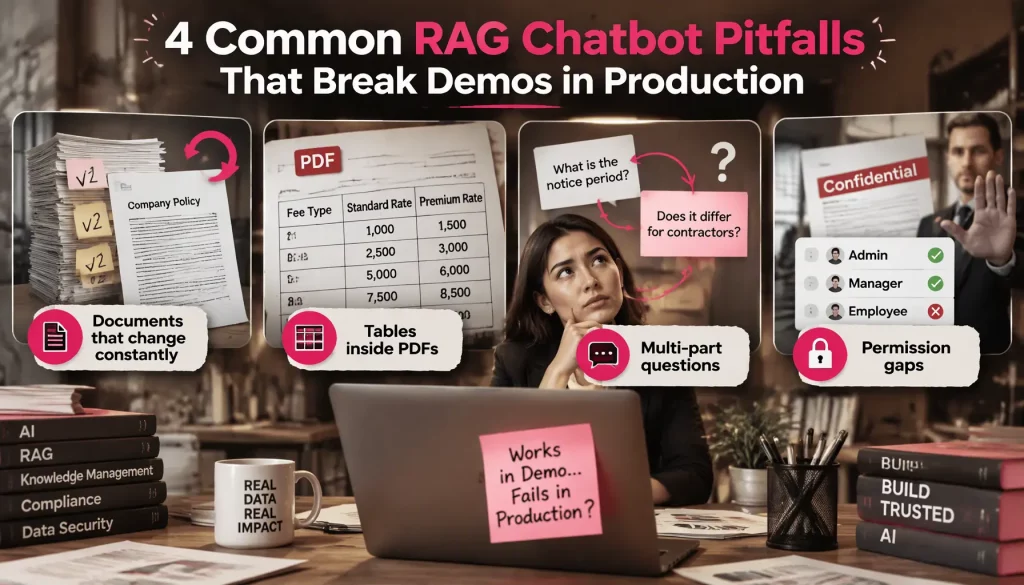
4 Common RAG Chatbot Pitfalls That Break Demos in Production
Most RAG chatbot demos break on the same four things when they meet production documents.
- Documents that change constantly: If re-indexing runs nightly or by hand, the chatbot cites last week’s policy, and in regulated work that is a compliance issue, not a quality issue.
- Tables inside PDFs: Generic parsers flatten tables into lines of numbers, so a fee schedule or rate table loses the link between rows and columns.
- Multi-part questions: A question such as “what is the notice period, and does it differ for contractors?” needs two retrievals, and a single search often returns only one half.
- Permission gaps: A retrieval layer that ignores document permissions can quote a confidential file to the wrong employee, which ends most projects in security review.
A fifth failure is subtler: a question with no answer in the documents. Without an explicit instruction to refuse, the model fills the gap with a plausible guess, which looks exactly like a correct answer to the user.
Each pitfall has a known fix. Event-driven re-indexing, triggered when a source document changes, keeps answers current, and that trigger is a natural job for AI workflow automation. Table-aware parsers that keep tables as structured text, query decomposition for multi-part questions, and permission filters applied inside the search query handle the rest.
4 RAG Chatbot Evaluation Metrics to Pass Before Launch
A RAG chatbot is ready for production when it passes agreed metrics on real questions, not when the demo looks good. Four metrics cover the essentials, and each one needs a threshold agreed before launch.
| Metric | What it measures | How to measure it |
|---|---|---|
| Retrieval hit rate | Whether the right passage appears in the retrieved set | Share of test questions whose known source is in the top results |
| Faithfulness | Whether every claim in the answer is supported by the retrieved passages | Claim-by-claim check by a reviewer or an evaluator model |
| Answer relevance | Whether the answer addresses the question asked | Reviewer or evaluator model scoring on the test set |
| Correct refusal rate | Whether the bot declines when the documents do not contain the answer | Share of unanswerable test questions the bot refuses |
The RAGAS framework (Es and colleagues, 2023) popularized automated versions of faithfulness, answer relevance, and context quality, using a language model as the judge. Automated scores are useful for tracking changes, but a human-reviewed sample should anchor them, because an evaluator model shares the blind spots of the model it grades.
The test set for a RAG chatbot should come from real questions. Search logs, helpdesk tickets, and interviews with the people who answer these questions today can yield 100 to 200 questions with known answers and sources, plus a set of questions the documents cannot answer, which is the only way to measure refusals.
Acceptance thresholds are a business decision. As our planning guidance, a retrieval hit rate above 90 percent and faithfulness close to 100 percent on high-stakes topics are reasonable launch targets, with higher bars where answers drive financial or clinical decisions.
4 Controls for Document-Level Permissions and Private RAG Deployment
Permissions are where most RAG chatbot projects stall, because the demo indexed a shared folder and production must respect who can see what. The fix is to inherit permissions from the source systems rather than recreate them.
- Permission sync: Each chunk carries the access control list of its source document, synced from SharePoint, Confluence, Google Drive, or the document management system, and refreshed when rights change.
- Filtering at retrieval: The user’s identity and groups filter the search itself, so unauthorized chunks never reach the model; filtering after generation is too late.
- Answer-level citation: Each answer lists its sources, so a user who opens the original passes the source system’s own access check again.
- Audit logging: Every question, retrieved chunk, and answer is logged with user identity and time, which supports compliance review and incident response.
Hosting completes the picture. Running embedding, vector search, and generation on private infrastructure keeps sensitive documents inside your boundary, which matters under GDPR, HIPAA, and Vietnam’s personal data protection law. AI Hive supports on-premise, private cloud, and SaaS deployment, so the same retrieval and permission design can run where your data rules require.
A production handover should include the metric results from the previous section, signed off by the business owner, alongside the permission tests. Acceptance criteria agreed before the build are what turn a promising pilot into a system a security team approves.
RAG Chatbot Accuracy Improvements Documented in Public Tests
We have no internal benchmark to publish, so this section uses public tests that measured RAG chatbot accuracy changes under controlled conditions. They show where improvement effort pays off.
Anthropic’s Contextual Retrieval study, published in September 2024, is the clearest example. Adding a short, model-written context to each chunk before embedding cut the top-20 retrieval failure rate from 5.7 to 3.7 percent, contextual keyword search brought it to 2.9 percent, and reranking brought it to 1.9 percent.
| Change | Top-20 retrieval failure rate | Reduction from baseline |
|---|---|---|
| Baseline with standard embeddings | 5.7 percent | None |
| Contextual embeddings | 3.7 percent | 35 percent |
| Plus contextual BM25 keyword search | 2.9 percent | 49 percent |
| Plus reranking | 1.9 percent | 67 percent |
The same study put the one-time cost of generating chunk contexts at about $1.02 per million document tokens with prompt caching, and it found that passing the top 20 chunks to the model worked better than the top 5 or 10. Both findings are specific to its datasets, so treat them as a hypothesis for your own test set rather than a guarantee.
Position matters as well. Liu and colleagues showed in Lost in the Middle (2024) that models use information at the start and end of a long context better than information in the middle, which argues for reranking so the strongest passages come first.
The pattern across these results is consistent: the largest gains come from retrieval, not from a bigger generator. Teams that measure retrieval first usually find their cheapest improvement there.
Conclusion
A RAG chatbot succeeds or fails on its retrieval layer, its permissions, and the metrics it must pass, far more than on the language model behind it. Section-aware chunking, hybrid search with reranking, permissions inherited from source systems, and a test set built from real questions are what move a demo into production. This month, your team can collect 100 real questions with known answers, measure retrieval hit rate and faithfulness on the current prototype, and fix retrieval before touching the model.
The next question is how retrieval, permissions, and agent workflows run together on infrastructure you control. Our platform features page shows how AI Hive connects them for enterprise deployments.