

Your RPA bots break every time a supplier changes an invoice layout, a portal moves a button, or a customer sends a scanned PDF instead of a clean file, and every break lands in a manual exception queue. The automation team ends up maintaining scripts instead of automating new work, while the exceptions, often the most expensive part of the process, still sit with people. Agentic process automation targets exactly that remainder: agents that read messy inputs, reason through exceptions, and escalate with context, layered on top of the bots you already run. The path that pays off keeps deterministic steps in RPA, gives judgment to agents, and proves the economics on one process before scaling.
Key Takeaways
|
What Agentic Process Automation Is?
Agentic process automation is the use of AI agents that perceive context, reason about a goal, and take multi-step action across enterprise systems to run a business process end to end. It is not a chatbot added to an RPA bot: a chatbot answers within one conversation, while an agent pursues a goal across tools and data sources and changes its plan when the first approach fails.
The term comes from research. Ye and colleagues introduced it in the 2023 paper ProAgent: From Robotic Process Automation to Agentic Process Automation, which described language-model agents that build workflows from human requirements and make dynamic decisions inside them. Automation vendors have since adopted the label for their own agent products.

The defining trait is autonomous decision-making inside guardrails you set. A loan-processing agent does not only extract fields from a PDF; it classifies the document, checks it against policy, flags the field that fails a threshold, and routes only that case to an underwriter with a written explanation.
4 Criteria That Separate Agentic Process Automation from RPA
Three generations of automation now coexist, and agentic process automation is easiest to understand against the other two. The table compares them on the four criteria that matter most to operations leaders.
| Criterion | Rule-based RPA | Intelligent automation (RPA plus OCR and ML) | Agentic process automation |
|---|---|---|---|
| Exception handling | Stops or fails and sends the case to a person | Handles known document variations, fails on new situations | Reasons through new exceptions and resolves or escalates them with context |
| Adaptation to interface change | Breaks when a screen, selector, or format changes | Partly adapts on documents, still breaks on screens | Adapts because it interprets intent rather than fixed coordinates |
| Maintenance cost | Rises as edge cases accumulate | Moderate, with model retraining for new document types | Concentrated in guardrail design and evaluation, with less script upkeep |
| Explainability of decisions | Fully deterministic and easy to audit | Model scores with limited reasoning | Needs explicit decision logs, since reasoning varies from run to run |
The table hides one important trade-off. Průcha and colleagues compared an Anthropic computer use agent with UiPath RPA on data entry, monitoring, and document extraction in 2025, and found RPA faster and more reliable, while the agent cut development time and coped better with changing interfaces.
That result supports a hybrid, not a winner. Bots keep the stable, high-volume steps, and agents take the variable ones, a split our comparison of AI agent vs RPA explores step by step.
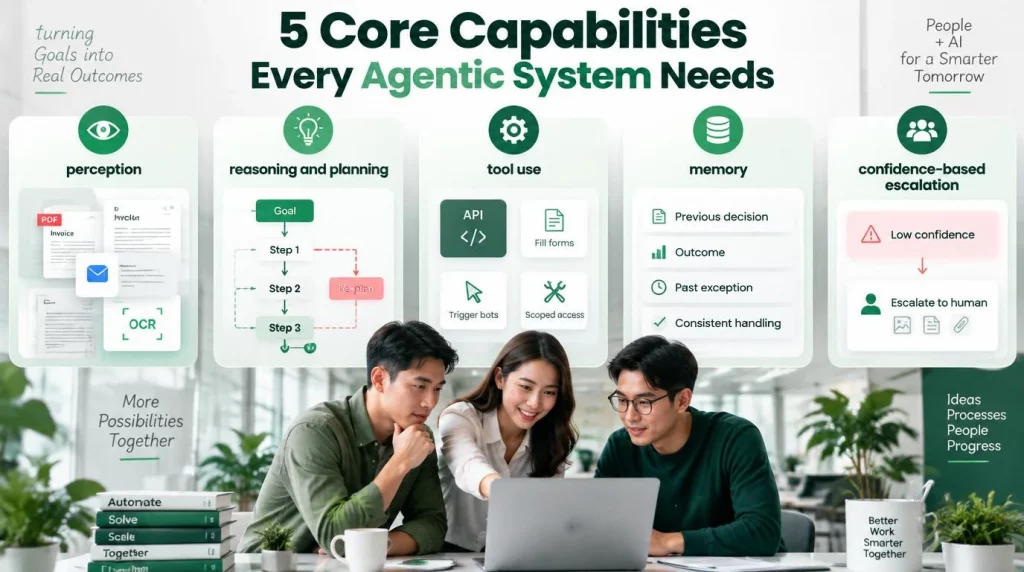
5 Core Capabilities Every Agentic System Needs
An agentic process automation system needs five capabilities working together, and a pilot that skips one usually stalls before production.
- Perception: The agent reads structured fields, scanned documents, emails, and API responses, using OCR and a language model to extract meaning from unstructured inputs.
- Reasoning and planning: It breaks a goal into steps, checks each step against business rules, and re-plans when a step fails.
- Tool use: It calls APIs, fills forms, or triggers bots with permissions scoped to exactly what the task needs.
- Memory: It records past decisions and outcomes, so the same exception is handled consistently next time.
- Confidence-based escalation: It recognizes its own uncertainty and routes low-confidence cases to a person with the evidence attached.
Escalation is the capability most demos leave out and most production systems depend on. An agent that knows when it does not know is worth more than one with slightly higher raw accuracy, because its errors arrive at a reviewer instead of in a ledger.
These capabilities map onto the standard layers of an AI agent architecture, with perception, reasoning, action, and memory kept separate so each can be tested and governed on its own.
5 High-Value Use Cases for Document-Heavy Processes
The best agentic process automation candidates are document-heavy, exception-prone processes where people currently clear a queue of cases that bots could not finish.
- Vendor invoice reconciliation: Agents match invoices to purchase orders and receipts, explain mismatches, and propose corrections.
- Insurance claims triage: Agents classify claims, check coverage, and send complex cases to an adjuster with a summary.
- KYC and sanctions screening: Agents reconcile customer data across systems and document every match and dismissal.
- Prior authorization in healthcare: Agents read referrals, verify eligibility, and prepare the request for staff review.
- Customer onboarding: Agents collect missing documents, chase gaps by email, and complete records across systems.
Invoice reconciliation shows how agentic process automation works in practice. A bot can post invoices that match purchase orders exactly, but quantity differences, price changes, split deliveries, and unknown suppliers fall out as exceptions. An agent can read the invoice and the correspondence, check tolerance rules, and either resolve the case or send it to a clerk with the likely cause stated.
| Metric | Before agents (illustrative) | After agents (illustrative) |
|---|---|---|
| Invoices per month | 20,000 | 20,000 |
| Share falling out as exceptions | 15 percent, or 3,000 cases | 15 percent, or 3,000 cases |
| Exceptions resolved without a person | None | 60 percent, or 1,800 cases |
| Staff time at 12 minutes per manual case | 600 hours | 240 hours |
The figures are assumptions for planning, not measurements, and your own baseline should replace them before any business case. Finance teams evaluating this use case can compare it with the wider scenarios in our guide to the AI agent for finance.
Regulated industries gain the most from the escalation design. In banking, insurance, and healthcare, the cost of manual review grows with headcount, while an agent that resolves routine exceptions and documents its reasoning lets scarce reviewers focus on the cases where judgment and accountability matter.
5 Steps to Upgrade Your Existing Automation with Agents
Agentic process automation works best as an upgrade of the automation you already run. The table shows which steps of a typical invoice flow stay with bots and which move to an agent.
| Step | Owner after the upgrade | Reason |
|---|---|---|
| Invoice download from portals and inboxes | RPA bot | Stable, repetitive, and fast |
| Field extraction from standard layouts | RPA with OCR | Known formats with high accuracy |
| Three-way matching of invoice, purchase order, and receipt | RPA rules | Deterministic when all three agree |
| Investigation of mismatches and unknown layouts | Agent | Requires reading context and judgment |
| Approval of corrections above tolerance | Person | Financial authority stays with staff |
| ERP posting and evidence archiving | RPA bot or API | Deterministic and auditable |
The sequence matters as much as the split. Teams that succeed usually follow five steps:
- Baseline first: The current exception rate, minutes per case, and backlog are measured before any agent is built.
- Exception catalog: Every way the process breaks today is listed, and the list becomes the agent’s test suite.
- Guardrails agreed: Risk and operations teams decide what the agent may do alone, what needs sign-off, and what it must never do.
- Bounded pilot: One process runs with full logging, measured against the manual baseline rather than a vendor benchmark.
- Shared orchestration: Bots, agents, and people are coordinated through one workflow layer rather than separate tools.
That orchestration layer is the core of AI workflow automation, where triggers, handoffs, and approvals between bots, agents, and staff are defined and monitored in one place.
Benefits and Challenges: Where the Breakeven Falls
The business case for agentic process automation rests on exception volume, and a simple model shows where the breakeven falls.
| Input or result | Illustrative value |
|---|---|
| Staff hours saved per month | 360 hours, from the reconciliation example |
| Loaded cost per staff hour | $35 |
| Monthly labor saving | $12,600 |
| Agent run cost at $0.10 per invoice | $2,000 per month |
| Platform, monitoring, and support | $4,000 per month |
| Net monthly benefit | $6,600 |
| One-time build and integration | $60,000 |
| Breakeven | About 9 months |
The benefits go beyond labor. Agentic process automation shortens cycle times because exceptions no longer wait in a queue overnight, it produces a written reason for every resolved case, and it frees experienced staff for the disputes and supplier conversations that need them. Those gains are harder to price, so most business cases count only the hours and treat the rest as upside.
Every input in the model is an assumption to replace with your own numbers. The structure is what matters: cases per month, the share of exceptions an agent resolves, minutes saved per case, and run cost per case decide the payback, and low-volume processes rarely clear the fixed costs.
The challenges are real. Gartner predicted in June 2025 that over 40 percent of agentic AI projects will be canceled by the end of 2027 because of escalating costs, unclear business value, or inadequate risk controls, and it estimated that only about 130 of the thousands of vendors claiming agentic capability offer real agents.
Governance is the other gate. Deloitte’s 2026 State of AI in the Enterprise report found that only about one in five companies has a mature model for governing autonomous agents. Three controls should exist before an agent touches a regulated process: a decision log that reconstructs why the agent acted, escalation thresholds set by the business, and a kill switch a risk officer can use without engineering help.
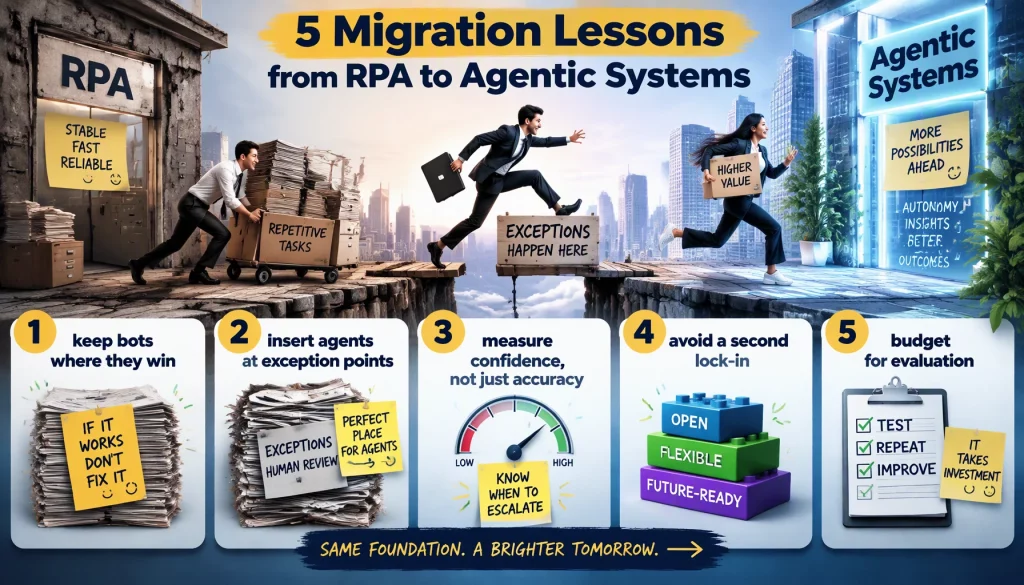
5 Migration Lessons from RPA to Agentic Systems
Public research and a decade of RPA programs point to a consistent set of lessons for teams moving toward agentic process automation.
- Keep bots where they win: The 2025 comparison by Průcha and colleagues showed RPA ahead on speed and reliability for stable tasks, so replacing working bots adds cost without benefit.
- Insert agents at exception points: The highest return sits where bots already hand cases to people, because that queue is measurable and its cost is known.
- Measure confidence, not just accuracy: An agent that routes uncertain cases is safer than one that guesses well on average, and the escalation threshold needs tuning on real cases.
- Avoid a second lock-in: An orchestration layer independent of any single RPA or model vendor keeps future choices open, which matters because RPA vendors increasingly bundle their own agents.
- Budget for evaluation: Agents need test suites and re-testing after model updates, a cost RPA programs never carried.
The automation center of excellence changes too. Bot developers who maintained selectors and scripts move toward writing test cases, tuning escalation thresholds, and reviewing agent logs, and that shift needs training and new performance measures rather than a rename of the team.
The lock-in point deserves emphasis. Incumbent RPA vendors write most content on this topic and rarely discuss switching costs, so a vendor-neutral team should price what it would take to move agents, prompts, and logs to another platform before signing.
Conclusion
Agentic process automation earns its place in the exception queues that rule-based RPA leaves behind, not by replacing bots that already work. The four-criteria comparison, an upgrade path that keeps deterministic steps in RPA, and a payback model built on exception volume turn the decision from a technology debate into a business case. This quarter, your team can pick one process with a measurable exception queue, record the baseline, and pilot an agent on those cases alone.
The next question is how bots, agents, and people run under one orchestration and governance layer as more processes move over. Our platform features page shows how AI Hive brings those pieces together, as SaaS or on-premise.