


Your team switched on an AI agent to cut manual work, and three weeks later a queue of pending approvals moves slower than the process it replaced. That is the usual way human in the loop AI fails: every action waits for a person, reviewers start approving without reading, and the one decision an auditor later asks about has no record of who approved it or why. Gartner expects over 40 percent of agentic AI projects to be canceled by 2027, and oversight placed by instinct is one of the quicker routes there. Approval gates placed by risk, sized to reviewer capacity, and logged for inspection keep both the speed and the accountability.
Key Takeaways
|
What Human in the Loop AI Means for Agents
Human in the loop AI is the practice of inserting a person into an otherwise automated workflow at specific points, so that a human decides, confirms, edits, or rejects what an AI agent proposes. It matters most for agents, because a system that only answers questions has nothing to approve; once an agent can issue a refund or update a record, the location of the checkpoint becomes a design decision.
Three human in the loop AI control modes cover almost every checkpoint, and each fits a different level of risk.
| Mode | What the person does | Risk level it fits | Example |
|---|---|---|---|
| Human decides | The agent prepares the case and recommends, and a person makes the decision | High: legal, financial, or safety consequences | A credit decision on a loan application |
| Human approves | The agent proposes a specific action, and a person approves or rejects it before execution | Medium: costly but reversible | A vendor payment above a set limit |
| Human samples | The agent acts, and a person reviews a sample afterwards and can reverse errors | Low: cheap to undo, high volume | Tagging support tickets |
A fourth arrangement, often called human on the loop, has a person monitoring the agent with the power to stop it but no duty to approve individual actions. It suits mature, low-risk flows and is not a substitute for approval where an action cannot be undone.
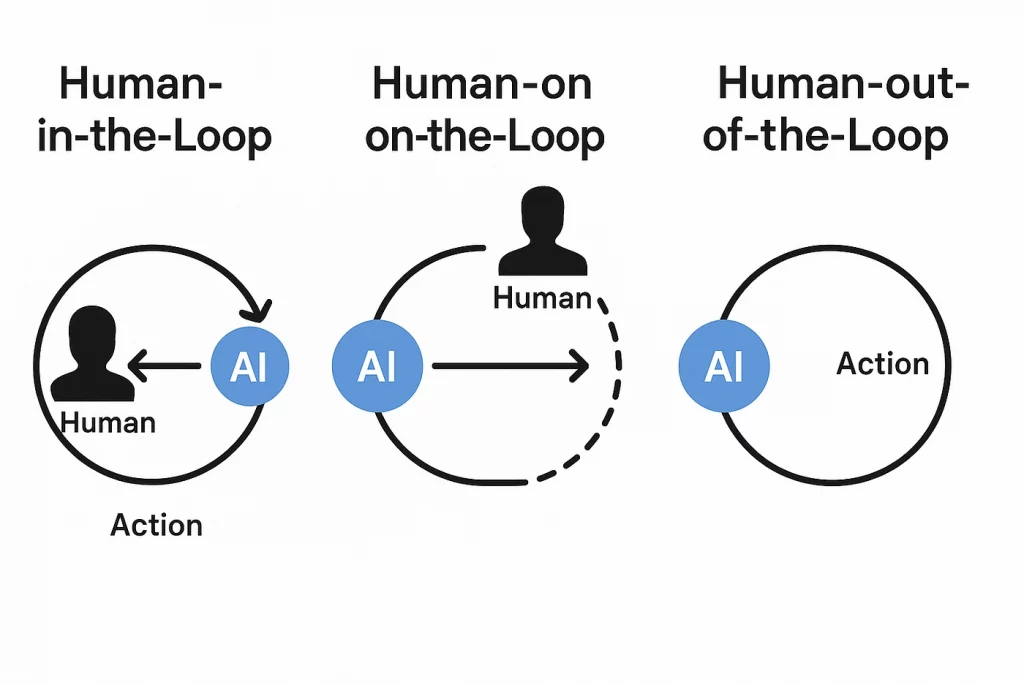
Most production workflows mix all three modes in one pipeline. The deterministic steps, such as routing a case to the right reviewer and writing the decision back to the system of record, usually run as AI workflow automation, while the agent handles the judgment in between.
4 Legal and Audit Triggers That Require Human in the Loop AI
Human in the loop AI is required in two situations: when a law says a person must be able to oversee or contest a decision, and when an error would cost more than the delay of a review. The legal triggers are now explicit in several jurisdictions.
- EU AI Act, Article 14: High-risk AI systems must be designed so that people can oversee them effectively, understand their limits, stay aware of automation bias, override or reverse an output, and stop the system.
- GDPR, Article 22: People in the EU have the right not to be subject to a decision based solely on automated processing that has legal or similarly significant effects, and the permitted exceptions still require safeguards such as human intervention.
- Vietnam’s AI Law 134/2025/QH15: In force since March 1, 2026, the law requires human supervision and conformity assessment for high-risk AI systems, along with disclosure when people interact with AI.
- SOC 2 audits: Auditors test whether changes and approvals are authorized, logged, and reviewable, which makes an agent’s human in the loop AI approval trail part of the control evidence.
The business trigger is just as real. Gartner predicted in June 2025 that over 40 percent of agentic AI projects will be canceled by the end of 2027, citing escalating costs, unclear business value, and inadequate risk controls. Deloitte’s 2026 State of AI in the Enterprise report found that only about one in five companies has a mature model for governing autonomous agents.
Those two findings point in the same direction. Agents are being deployed faster than the controls around them, and the checkpoints that do exist are often placed by instinct rather than by risk.
5 Common Human in the Loop AI Patterns: Where to Place the Reviewer
Five human in the loop AI patterns cover most agent pipelines. They differ in when the person acts and how much of the volume they touch.
- Pre-action approval: The agent proposes and waits, and a person approves before anything executes. This pattern fits irreversible or regulated actions, where a wrong action costs more than the wait.
- Post-action review with rollback: The agent executes, and a person reviews within a set window with the power to reverse. It fits actions that are costly but genuinely reversible.
- Sampled review: A person reviews a share of completed actions, and the sampling rate rises automatically when errors rise. It fits high-volume, low-impact work where full review is uneconomic.
- Confidence-based escalation: The agent acts alone when its confidence clears a threshold and routes the case to a person when it does not, so the human workload falls as accuracy improves.
- Dual control: Two people must approve the same action, the four-eyes principle long used in banking. The EU AI Act applies the same idea to remote biometric identification, where a match must be verified by at least two people before anyone acts on it.
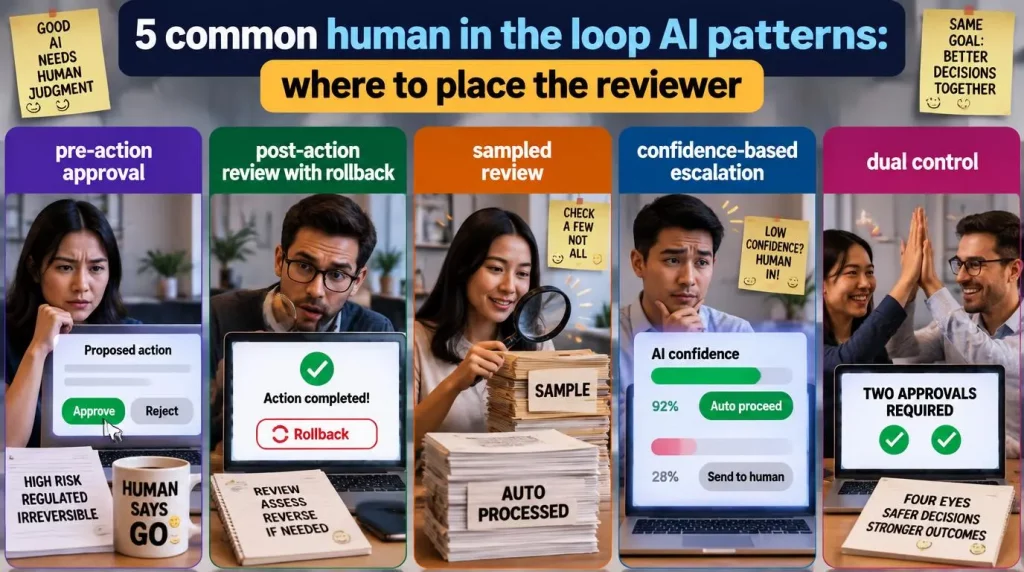
The pattern should be configurable per action, not per agent. The AI agent framework you build on needs to pause a run, persist its state while a person decides, and resume or cancel cleanly, because the right pattern for an action changes as evidence about the agent accumulates.
Human in the Loop AI Design Best Practices: Classify Every Action
Good human in the loop AI design starts with the action, not the agent. An agent that drafts emails and the same agent issuing refunds need different gates, so every distinct action gets its own classification.
Three variables decide where a gate belongs: the value at stake, how hard the action is to reverse, and the model’s confidence. The table turns them into a starting rule set, which your risk team should calibrate to its own limits.
| Value at stake | Reversibility | Model confidence | Starting mode |
|---|---|---|---|
| Low | Easy to reverse | High | Human samples after execution |
| Low | Easy to reverse | Low | Confidence-based escalation to a person |
| Medium | Reversible at a cost | High | Human approves, single reviewer |
| Medium | Reversible at a cost | Low | Human approves, with the agent’s reasoning shown |
| High | Hard or impossible to reverse | Any | Human decides, with dual control above delegated authority limits |
Confidence should never lower the mode for an irreversible, high-value action. A model that is confidently wrong on a large wire transfer is exactly the case the gate exists for.
The reviewer’s screen decides the quality of every human in the loop AI review. A person should see the proposed action, the data the agent used, its reasoning, relevant history about the case, and the alternative the agent rejected. Pulling that history in reliably depends on how the agent stores and retrieves context, which is a core concern of AI agent development from the first sprint.
The audit log is what turns a click into evidence. Each approval record should hold the fields below, in a store your compliance team can query without engineering help.
| Field | Why it matters |
|---|---|
| Reviewer identity and role | Shows the decision was made by someone with the authority to make it |
| Time of proposal and time of decision | Proves the review happened before execution and measures the delay |
| Data shown to the reviewer | Lets an inspector see what the person knew at the time |
| Agent proposal, reasoning, and confidence | Separates the agent’s suggestion from the human decision |
| Decision and stated rationale | Supports disputes, fair-lending reviews, and clinical audits |
| Policy and model versions | Shows which rules and which model were in force |
3 Metrics for Balancing Autonomy vs Control in Reviewer Throughput
Every gate in a human in the loop AI program has a throughput cost, and reviewer time is the scarcest resource in it. Treating that time as a budget is what keeps oversight from collapsing into a queue.
A simple calculation shows the scale. If a reviewer spends three minutes per case, one person clears about 20 cases an hour; 8,000 gated cases a month then need about 400 reviewer hours, or roughly two and a half full-time people at 160 hours each. The numbers are illustrative, but this arithmetic belongs in every business case.
Three metrics show whether a human in the loop AI gate is working:
- Cases per reviewer hour: A falling number signals cases that are too complex or reviewer screens that lack context.
- Average review time: A time that drops sharply while volume rises can signal rubber-stamping rather than efficiency.
- Override rate: The share of agent proposals that reviewers change or reject shows whether the gate is catching anything at all.
Rubber-stamping is a documented risk, not a hunch. Research on automation bias, reviewed by Parasuraman and Manzey in Human Factors (2010), shows that people over-trust automated recommendations, and Article 14 of the EU AI Act names automation bias explicitly as something overseers must be able to guard against.
Any loosening of control should follow evidence. As planning guidance, an action can move to a lighter mode when its override rate stays below an agreed level, for example 1 to 2 percent, across at least two review cycles with a meaningful sample, and it moves back up as soon as the rate rises. The thresholds belong to your risk owners, and every change of mode should itself be approved and logged.
6 Tools That Support Human in the Loop AI: Approval Gates to Inboxes
Support for human in the loop AI ranges from a single pause function to full approval inboxes. The table lists common options by the mechanism they provide, based on public documentation read on October 2, 2026.
| Tool | Human review mechanism | Best fit |
|---|---|---|
| LangGraph | Interrupts that pause a graph, persist state, and resume after human input | Custom agents built in Python or JavaScript |
| AWS Step Functions | Callback tasks that wait for an external approval token | Approval steps inside AWS workflows |
| Amazon Augmented AI (A2I) | Human review workflows for model predictions, with conditions that trigger review | Document and image processing with low-confidence review |
| Microsoft Power Automate | Approval actions routed to Teams, Outlook, or a web portal | Microsoft 365 organizations |
| Camunda | User tasks in BPMN process models with forms and assignment rules | Enterprises with an existing process engine |
| UiPath Action Center | Human tasks that pause automations for validation or approval | RPA-centered operations teams |
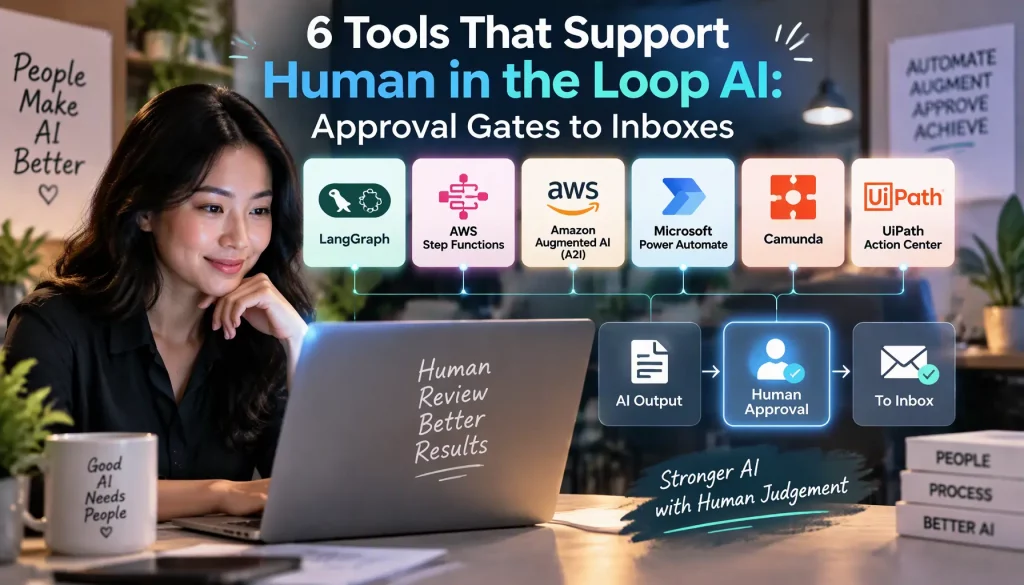
Whatever the tool, three capabilities matter more than the interface: durable pause and resume without losing state, per-action configuration of the gate pattern, and an exportable approval log. Teams that design flows visually in an AI agent workflow builder can place these gates on the same canvas as the agent steps, which speeds up review by risk and compliance teams.
4 Escalation Thresholds Anchored in Regulation
Regulated firms rarely need to invent escalation thresholds. The most defensible human in the loop AI thresholds reuse limits that already exist in law and in the firm’s own delegated authority matrix.
- Regulatory reporting limits: In the United States, cash transactions of more than $10,000 trigger a Currency Transaction Report under the Bank Secrecy Act, so an agent handling cash operations should route anything near that line to a person.
- Delegated authority limits: Banks already cap how much each officer can approve, and an agent should inherit the same limits, escalating anything above the lowest human limit.
- Two-person rules: Where policy or regulation already requires dual control, such as large payments or the EU AI Act’s two-person verification of biometric matches, the agent workflow keeps it.
- Adverse decisions on people: Declining credit, insurance, or treatment has significant effects under GDPR Article 22 and similar rules, so the decision stays with a person who can explain it.
Applied to loan origination, a human in the loop AI threshold ladder might look like this. The structure is illustrative, and the limits should come from your own credit policy.
| Step in a loan application | Agent role | Human role | Escalation trigger |
|---|---|---|---|
| Document collection and checks | Extracts and verifies documents | Samples completed files | Missing or inconsistent documents |
| Scoring and policy checks | Scores the application against policy | Reviews exceptions | Any policy exception or low confidence |
| Approval within the lowest officer limit | Recommends approval or decline | Approves or rejects | Every application |
| Approval above officer limits | Prepares the credit memo | Credit committee decides with dual sign-off | Amount above the delegated limit |
| Decline | Drafts the reasons for the adverse decision | Confirms and signs the decision | Every decline |
The pattern holds beyond lending. The agent does the preparation at full speed, people keep the decisions that already had an owner, and the audit log shows both, which answers an inspector’s question about who approved a decision without giving up the throughput the business case promised.
Conclusion
Human in the loop AI works when gates follow consequence rather than discomfort. Three control modes, a placement rule built on value, reversibility, and confidence, reviewer capacity treated as a budget, and an audit log that records who decided what on which data give you both speed and accountability. This month, your team can list every action its agents take, assign each one a mode, and measure override rates for four weeks before changing anything.
The next question is how those gates scale across dozens of agents without every team building its own approval tooling. To see how per-action gating, audit logs, and on-premise deployment work together, explore the AI Hive platform features.