


Insurance carriers have spent two decades investing in digital tools, yet expense ratios have barely moved. According to Swiss Re Institute’s sigma research, the global industry generated approximately $8.3 trillion in gross written premiums in 2025, while profits grew more slowly than premiums over the same period.
That mismatch reflects a structural gap that manual workflows and rule-based automation cannot close. An AI agent for insurance offers a fundamentally different path: autonomous execution across claims processing, underwriting, and fraud detection, at a scale and consistency that no human workforce can replicate.
This guide explains where AI agents deliver the highest measurable ROI for carriers, what the enterprise architecture requires, and how your organization can move from pilot to production in 2026.
Key Takeaways
|
Why Insurance Carriers Cannot Afford to Wait on AI Agents
The cost structure of insurance has remained stubbornly resistant to improvement. According to McKinsey’s July 2026 research on AI in insurance, expense ratios in property and casualty (P&C) have hovered between 27 and 32% since 2005, despite successive waves of automation investment. The combined ratio, which adds the loss ratio to the expense ratio, tells the same story: carriers have not found a way to bend the cost curve using traditional automation alone. Distribution costs alone consume 10 to 25 cents of every premium dollar in P&C lines, and up to 80 cents of the first-year premium in life insurance.
Technology improved labor productivity by 14% in P&C and 24% in life over two decades, yet average industry costs still increased because those gains were offset by rising IT complexity and compliance overhead. The competitive stakes are now acute. McKinsey’s research found that AI leaders in insurance have generated six times greater total shareholder returns than laggards. That gap did not emerge from having access to better AI models. It emerged, instead, from the willingness to move from pilots to production.
Most carriers have proof-of-concept experience; very few have deployed AI agents that execute real workflows autonomously. Three realities are accelerating urgency. First, insurance fraud costs the US industry an estimated $308 billion annually, according to Coalition Against Insurance Fraud’s cost research. Rule-based detection systems are losing ground as fraud networks grow more sophisticated.
Second, nearly half of North American customers now use AI tools when purchasing or managing personal insurance (McKinsey, 2026), raising response speed expectations across every touchpoint. Third, the global cyber insurance protection gap has reached an estimated $900 billion in uninsured exposure, a figure that AI-enabled underwriting can help carriers safely close. Carriers that deploy production-grade AI agents for insurance today, rather than staying in InsurTech pilot mode, are building the cost structures and risk selection capabilities that will define competitive position for the rest of the decade.
This pattern holds true across other regulated, high-volume industries as they weigh the same build-versus-buy decision for enterprise AI agents.
How AI Agents Transform Claims Processing
Claims processing is the highest-volume, most document-intensive workflow in insurance operations. A mid-sized commercial auto carrier processing 40,000 claims per month faces a simple arithmetic problem: hiring enough adjusters to handle intake, documentation review, coverage verification, reserve setting, and communication drafts is prohibitively expensive, and the quality of decisions varies by individual.
An AI agent for insurance claims solves the arithmetic without sacrificing accuracy.
First Notice of Loss Automation
When a policyholder reports a claim through a mobile app, web portal, or voice channel, the FNOL agent captures structured data in real time, validates coverage against the policy record, checks for open prior claims, and initiates the assignment workflow. In practice, FNOL processing time drops from an industry average of 24 to 72 hours to under 30 minutes for standard claims.
The agent does not wait for a human to log in and read an email. It executes immediately, sets the initial reserve, and sends the policyholder a confirmation with next steps. All of this happens before a human adjuster has even seen the file.
Document Extraction and Intelligent Settlement
Beyond intake, AI agents read unstructured documents, including medical records, police reports, repair estimates, and court filings, and extract structured data that populates the claims management system without manual keying.
Natural language processing classifies document type, extracts key facts such as treatment codes, diagnosis, vehicle damage classification, and liability assessment, maps them to standard ACORD claim data fields, and surfaces inconsistencies between documents automatically.
For settlement, the agent compares the claim profile against historical settlement data for comparable claims, recommends a settlement range, and drafts the communication for adjuster review. Adjusters approve and release rather than write from scratch.
Consider a windshield replacement claim submitted through a mobile app on a Saturday morning. The FNOL agent validates coverage and opens the file within seconds.
By Monday, the document extraction agent had already read the repair shop estimate, matched the vehicle identification number against the policy record, flagged that the shop’s quote sits 18% above the regional benchmark for the same repair, and routed the file to an adjuster with a recommended settlement range attached.
The adjuster’s job shifts from data entry to judgment, and the file closes in under 48 hours instead of the one to two weeks a manual queue would typically require.
McKinsey estimates that AI deployed at scale in insurance operations can deliver 20 to 40% reductions in customer onboarding costs and 10 to 20% improvements in insurance agent productivity.
Figures like these compound quickly across a large claims organization, and they help explain why claims leakage, the gap between what a claim should cost and what it actually costs to settle, keeps shrinking wherever carriers put AI agents into production rather than into a pilot sandbox.
The same discipline, measuring AI agents by process cost and cycle time reduction rather than by pilot novelty, is playing out through AI agents for finance function cost control across banking, insurance, and other regulated financial services.
AI Agents for Underwriting Automation
Underwriting is where risk selection happens, and where AI agents create the sharpest competitive differentiation for carriers willing to move beyond manual processes. Traditional underwriting introduces inconsistency by design: judgment varies by individual underwriter, data enrichment is manual and incomplete, and turnaround times frustrate distribution partners waiting on a quote.
An AI agent for underwriting applies consistent logic, enriches every application automatically, and returns a pre-scored recommendation in seconds rather than days. Standard risks move through straight-through processing (STP) without ever reaching a human queue, which matters just as much to the distribution partners selling the policy as it does to the carrier writing it.
The same urgency around fast, consistent customer response is why we built AI agents built for enterprise sales teams, so that distribution and underwriting can move at the same speed instead of underwriting becoming the bottleneck in the sales cycle.
Risk Scoring and Multi-Source Data Enrichment
When an application arrives, the underwriting agent does not simply read what the applicant submitted. It enriches the file automatically, pulling property inspection records, vehicle telematics history, weather catastrophe exposure for the address, workers’ compensation claims history, credit signals where regulations permit, and prior policy data from industry databases.
It scores the enriched profile against the carrier’s appetite model and returns a recommendation within seconds. High-confidence standard risks move to bind automatically. Complex or borderline risks go to a human underwriter with a pre-populated file. That single step alone saves 60 to 80% of the manual data-gathering time underwriters would otherwise spend before they can even begin evaluating the risk.
Model-Agnostic Architecture for Regulated Carriers
One of the most overlooked risks in insurance AI programs is model dependency. Carriers that embed a single proprietary LLM into their underwriting workflow face a serious problem if that model provider changes pricing, withdraws the model version, or introduces bias that regulators cannot verify through an explainability audit.
Our team at AI Hive builds underwriting agents on a model-agnostic orchestration layer that allows carriers to switch between Claude, GPT-4o, Llama-based models, or proprietary fine-tuned models without rebuilding the agent logic or retraining the workflow. For regulated carriers that must demonstrate explainability and maintain audit trails, this architecture is not optional.
It is a prerequisite for regulatory approval and ongoing compliance.
AI Agent for Insurance Fraud Detection
Insurance fraud is not a static problem. It evolves continuously as fraud networks learn which patterns trigger detection. Rule-based systems are effective against known fraud signatures but are inherently reactive. An AI agent for insurance fraud detection learns from emerging patterns, builds entity graphs across claims data, and detects anomalies that no rule writer anticipated.
Network-Based Fraud Pattern Recognition
Sophisticated fraud rings operate across multiple carriers, multiple policies, and multiple claimants simultaneously. An individual claim may appear clean when reviewed in isolation; the fraud only becomes visible when you map the relationships between claimants, service providers, legal representatives, and vehicle identification numbers across thousands of claims.
AI agents build entity graphs continuously, connecting data points across claims history, to identify coordinated fraud networks at the organizational level rather than the individual claim level. Where a rule-based system flags one suspicious claim, the AI fraud agent surfaces the entire network in a single investigation queue, reducing the cost per fraud case resolved by a significant margin.
This entity-graph approach mirrors AI agents for banking fraud detection and anti-money-laundering investigations, where the same graph-based logic connects accounts, beneficiaries, and transaction patterns that a rules engine alone cannot see.
Real-Time Pre-Payment Fraud Prevention
For health insurance and workers’ compensation, the highest-value fraud detection position is pre-payment prevention rather than post-payment recovery. AI agents monitor billing code submissions and provider behavior in real time, comparing current submission patterns against the provider’s historical baseline and industry norms.
When a provider suddenly submits claims at three times their normal volume, bills procedure codes that do not match diagnosis history, or submits duplicate claims with slight date variations, the AI agent flags the anomaly before payment releases.
According to the Association of Certified Fraud Examiners, organizations using AI-assisted fraud detection reduce fraud losses by an average of 42% compared to those relying on manual review workflows.
Furthermore, AI agents cross-reference claims data against external fraud intelligence databases in real time, matching against known fraud networks, suspended providers, and flagged vehicle identification numbers across industry-wide data pools.
Compliance, Governance, and Data Sovereignty for Insurance AI
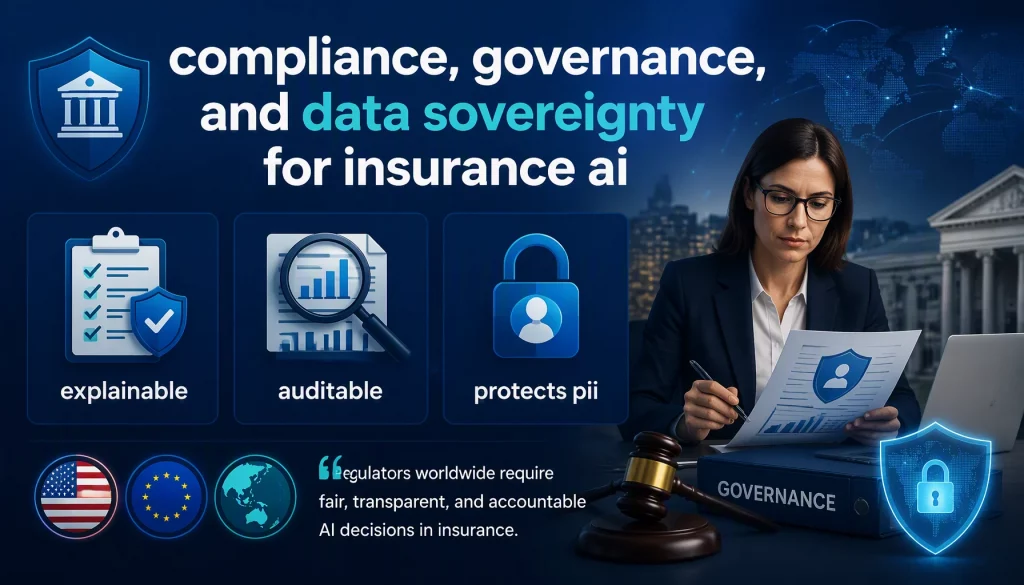
Insurance is one of the most heavily regulated industries globally, and AI deployment must meet a higher standard than other sectors. Every decision made by an AI agent in claims, underwriting, or fraud must be explainable, auditable, and protective of personally identifiable information (PII).
Regulators in the United States, guided in large part by the NAIC’s AI regulatory guidance for insurers, along with counterparts in the European Union and Asia Pacific, increasingly require carriers to demonstrate that automated decisions do not introduce prohibited bias and that policyholders can receive a meaningful explanation for adverse actions.
AI Hive’s enterprise platform addresses these requirements at the architecture level. Every agent action is logged with a complete decision trace: what data was accessed, which model produced the output, what confidence threshold triggered the decision, and what escalation criteria moved the case to a human.
For carriers that cannot allow claims data to leave their own infrastructure, our platform supports on-premise and private cloud deployment with no vendor lock-in on the underlying models. Our platform is SOC 2 Type II certified and designed to support GDPR and HIPAA compliance frameworks.
This governance architecture is what separates a production-grade AI agent for insurance from a pilot chatbot. Pilots demonstrate capability; production deployments require auditability, security, and the organizational confidence that comes from a documented compliance posture.
How AI Hive Deploys AI Agents for Insurance Carriers
AI Hive is an enterprise AI agent platform purpose-built for the gap between proof of concept and production. Our insurance clients typically struggle not with finding an AI use case; they have usually identified dozens already. Their real challenge is deploying agents that integrate cleanly with legacy core systems, maintain compliance, and scale beyond the initial pilot.
You can see the full range of that work on the AI agent platform for banking and insurance, where the same orchestration layer we describe in this guide also serves adjacent regulated financial services use cases.
Our approach combines three elements that most carriers cannot assemble independently.
- Agent Marketplace with over 500 pre-built templates: Purpose-specific templates for FNOL processing, underwriting enrichment, fraud triage, and claims communication drafting reduce time-to-deploy from months to weeks for standard use cases.
- Modular Implementation for full data sovereignty: You can deploy on your own infrastructure, whether on-premise, private cloud, or hybrid, and keep full control over claims and policy data throughout the process.
- AI Engineers for Hire for legacy integration: Dedicated engineering teams handle custom integrations with legacy policy administration systems, claims management platforms, or proprietary fraud databases when your internal team lacks the bandwidth or the specialized AI skill set.
We partner with your team to move from a defined use case to a running production agent in 30 to 90 days, depending on integration complexity. Our platform documentation provides a full overview of the deployment architecture.
Conclusion
The insurance industry’s cost ratios have not improved meaningfully in two decades despite repeated waves of digital investment. AI agents represent a structural break from that pattern: not a tool that merely assists humans with existing workflows, but an autonomous execution layer that handles the volume of routine decisions at a quality and consistency that manual processes cannot match.
From claims processing automation to underwriting enrichment to real-time fraud prevention, the use cases for an AI agent for insurance are production-ready in 2026. Carriers that build production-grade AI agent deployments this year will exit the decade with cost structures, fraud ratios, and customer response times that create durable competitive distance from peers that continue piloting.
If your team is ready to move from pilot to production, schedule a technical consultation with AI Hive’s insurance specialists. Reach out to our team today to discuss your specific use cases and deployment requirements.