
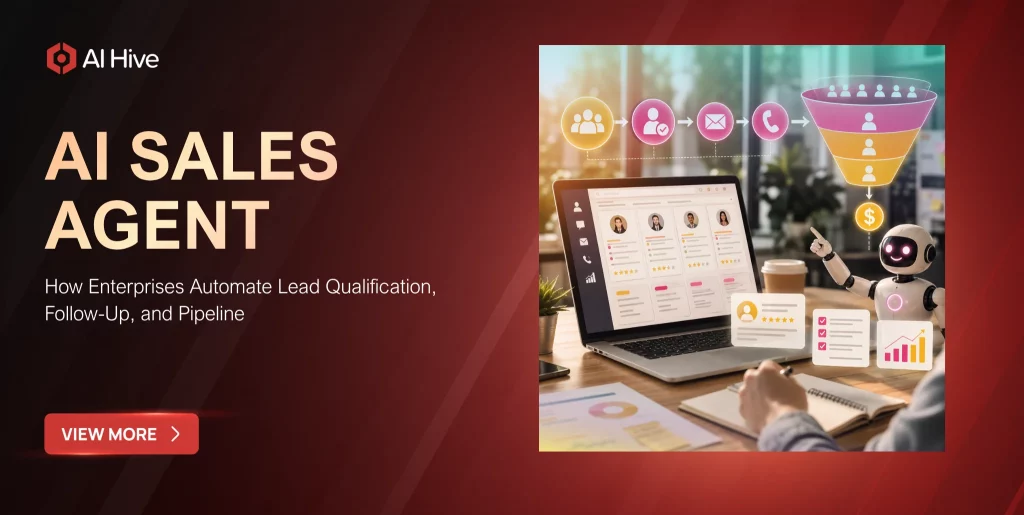

Revenue teams lose an estimated 30% of qualified opportunities not because their leads are bad, but because follow-up arrives too late. When a prospect submits an inquiry at 2 a.m. and receives no response until the next business day, a competitor running an AI sales agent has often already booked the discovery call. AI sales agents mark a fundamental shift in how enterprises build pipeline. Instead of supplementing human sellers, they operate as a high-velocity front line that runs continuously, qualifies instantly, and hands off to a person only when human judgment is genuinely required.
This guide explains how AI sales agents work in production environments, which capabilities matter most at the enterprise level, and how your organization can deploy one without falling into the traps that sideline well-intentioned pilots.
Key Takeaways
|
What Is an AI Sales Agent?
An AI sales agent is an autonomous software system that performs outbound prospecting, inbound qualification, follow-up sequencing, and meeting scheduling without requiring a human to trigger each individual action. It is not a basic chatbot that answers frequently asked questions, and it is not a marketing automation tool that fires pre-written email blasts on a fixed schedule. An AI sales agent reasons about intent, retrieves data from your CRM, evaluates lead quality against predefined criteria, and determines the next best action in real time.
The distinction matters at the enterprise level. A chatbot is reactive: it waits for a question and returns a scripted answer. An AI sales agent is proactive. It monitors intent signals, initiates outreach, adapts messaging based on interaction history, and escalates to a human account executive only when the opportunity meets a defined qualification threshold.
Core Capabilities of a Production-Grade AI Sales Agent
A production-grade AI sales agent in 2026 typically handles six categories of work, spanning the full motion from first touch to a booked meeting. Enterprises usually run these capabilities inside a broader AI agent platform that also orchestrates support, HR, and IT agents, so sales does not sit on a separate, disconnected tool.
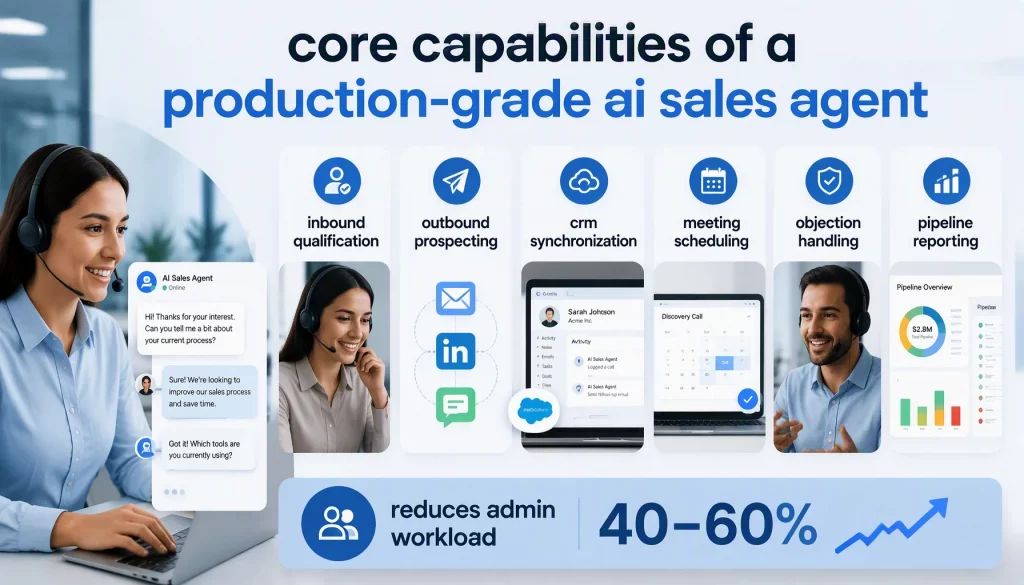
- Inbound qualification: The agent engages every inbound lead within seconds, asks progressive qualification questions, and scores the conversation against your ideal customer profile (ICP).
- Outbound prospecting: Using enriched contact data, the agent sends personalized sequences across email, LinkedIn, and SMS, adapting cadence and messaging based on response signals.
- CRM synchronization: The agent logs every interaction automatically, which reduces administrative overhead for human sellers by 40 to 60%.
- Meeting scheduling: The agent books discovery calls directly into an account executive’s calendar without human coordination.
- Objection handling: The agent draws on a curated knowledge base to respond to common objections with contextually appropriate replies.
- Pipeline reporting: The agent surfaces real-time pipeline health data, flagging at-risk deals and highlighting accounts that have not been engaged within a defined window.
The Enterprise Case for AI Sales Agents in 2026
Boardrooms no longer ask whether AI belongs in the sales stack. They ask how fast a deployment pays for itself, and the analyst data now backs a direct answer.
Gartner projects that 40% of enterprise applications will embed task-specific AI agents by 2026, up from less than 5% in 2025, and sales is one of the functions absorbing that shift fastest, according to a 2025 Gartner press release. Separately, McKinsey’s 2025 research on agentic AI in B2B growth functions found that companies applying agentic AI to prospecting and relationship management saw 3 to 15% higher revenue per relationship manager and 20 to 40% lower cost-to-serve, while freeing up roughly 10% of seller time for revenue-generating work rather than admin tasks.
Beyond the analyst data, many enterprises deploying an AI sales agent in production report a consistent pattern across lead qualification, initial outreach, and discovery scheduling. The findings below are the ones that consistently drive boardroom approval, though we recommend validating them against your own pipeline data before you present a business case internally.
- Lead-to-sale conversion: Teams often see conversion rates climb once AI-powered scoring keeps sales resources focused on high-intent prospects rather than spreading effort evenly across the funnel.
- Pipeline velocity: Velocity improves measurably because the agent removes the human latency that normally sits between lead creation and first contact.
- Response time: First-contact time drops to under 90 seconds in many deployments, compared with the multi-hour delay typical of a manual follow-up queue.
- Close rate: Close rates improve, not because AI closes deals, but because human sellers spend less time on unqualified leads and more time on accounts that have already been warmed and educated.
4 AI Sales Agent Use Cases Across Enterprise Functions
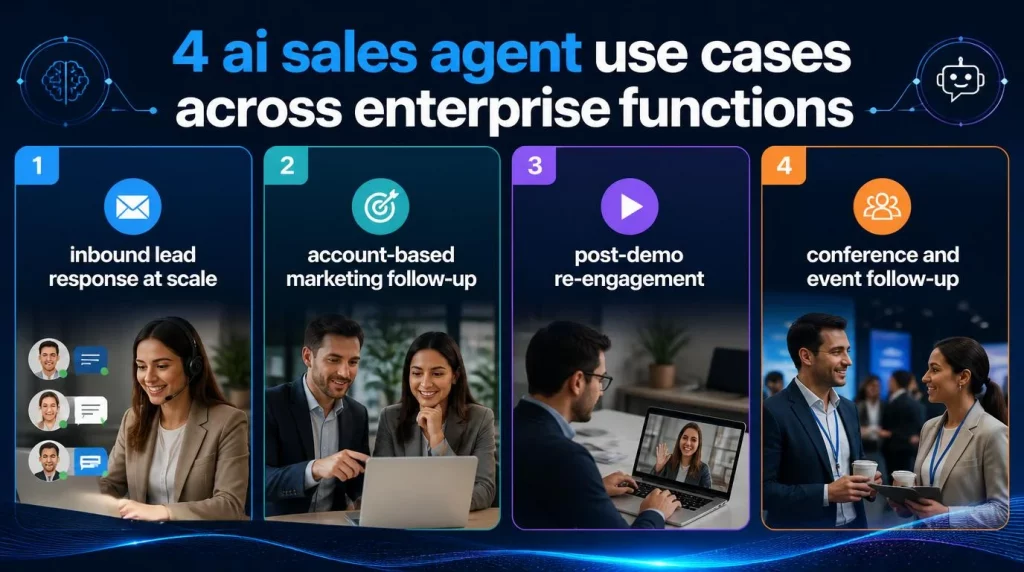
The capabilities above translate into four use cases that show up again and again once an enterprise moves an AI sales agent past the pilot stage. Each one solves a different bottleneck in the pipeline, and most enterprises run more than one at the same time.
1. Inbound Lead Response at Scale
Large enterprises often face a paradox. They invest heavily in demand generation but lack the human bandwidth to respond to every inbound inquiry at speed. An AI sales agent solves this by acting as an always-on first responder. When a prospect fills out a contact form, registers for a webinar, or downloads a whitepaper, the agent reaches out immediately, qualifies the intent, and either books a meeting or routes the lead to the appropriate human seller with a full conversation summary attached.
2. Account-Based Marketing Follow-Up
AI sales agents are particularly effective in account-based marketing (ABM) programs, where the target account list is finite but follow-up sequences must be personalized at scale. The agent tracks engagement signals, including email opens, page visits, and content downloads, and triggers context-aware outreach that references specific interactions. Consequently, the prospect receives communication that feels informed and human rather than generic and automated.
3. Post-Demo Re-Engagement
One of the most underutilized capabilities of AI sales agents is the re-engagement of stalled opportunities. After a product demonstration, many deals go quiet because neither side follows up with urgency. An AI agent monitors the deal stage, identifies stall signals in the CRM, and sends a timely, relevant follow-up that reopens the conversation, often at a fraction of the cost of an outbound call from a human SDR.
4. Conference and Event Follow-Up
Enterprise sales teams collect hundreds of business cards and badge scans at industry events. AI sales agents can process that contact list within hours of the event ending, send personalized follow-up messages referencing the event context, and prioritize responses by engagement score. That ensures every lead receives timely outreach before the memory of the face-to-face conversation fades.
Build vs. Buy: What Enterprises Actually Choose
Every enterprise evaluating an AI sales agent eventually reaches the same fork: build a custom system, buy a legacy platform, or adopt a modular solution built for the job. The right answer depends less on budget than on how fast your revenue team needs to move.
The build-versus-buy debate for AI sales agents follows a familiar pattern in enterprise technology. Building a custom solution from scratch offers maximum control but carries substantial risk. Enterprise software cost estimates commonly put the all-in price of a custom AI sales agent at $500,000 to $2 million, with deployment timelines of six to eighteen months. For most organizations, that timeline is commercially unacceptable against a board that expects pipeline results this quarter, not next year.
We designed AI Hive specifically for enterprises that cannot afford the cost and timeline of a custom build, or the rigidity and vendor lock-in of legacy platforms. Our Agent Marketplace includes more than 500 pre-built templates for sales automation workflows, and our AI Engineers for Hire service means your team does not need specialized AI expertise to go from concept to production deployment in days rather than months.
Table: Build vs. Buy Cost and Time Comparison for AI Sales Agents
| Approach | Initial Cost | Time to Value | Vendor Lock-In | Compliance |
| Build in-house | $500K-$2M | 6-18 months | None | Full control |
| Legacy platform (Kore.ai, IBM Watson) | $300K+/year | 6-12 months | High | Moderate |
| Lightweight SaaS tools | $10K-$50K/year | 2-4 weeks | High (single LLM) | Limited |
| AI Hive Modular Platform | Mid-market pricing | Days to weeks | None (multi-model) | Full (GDPR, SOC 2) |
The comparison makes one pattern clear: cost and lock-in rise together in the legacy and custom-build columns, while a modular platform is the only path that keeps both low at once.
Key Technical Requirements for Enterprise AI Sales Agents
A polished demo tells you nothing about whether an AI sales agent will survive contact with your existing tech stack. Three requirements separate a production-grade deployment from a proof-of-concept that never ships.
CRM and Data Integration
An AI sales agent that cannot read and write to your CRM is a toy, not a tool. Salesforce, HubSpot, Microsoft Dynamics, and SAP must integrate without requiring custom development work. In addition, the agent needs enrichment data from sources such as LinkedIn Sales Navigator, ZoomInfo, or Clearbit to personalize outreach accurately. AI Hive’s modular integration layer supports all major CRM platforms out of the box, with REST and webhook connectors for custom data sources.
Multi-Model Flexibility and Vendor Independence
Vendor lock-in to a single large language model is a significant operational risk. If your AI sales agent is hardwired to a single model provider, a pricing change, model deprecation, or policy shift can disrupt your entire pipeline operation overnight. AI Hive’s architecture is model-agnostic, so you route different tasks to different models based on cost, latency, and capability requirements. For a comprehensive overview of deployment patterns and real-world implementations, visit our enterprise AI agent use cases guide.
Compliance and Data Privacy
Enterprise sales agents handle personally identifiable information at scale. Your solution must enforce GDPR Article 6 lawful basis for processing, CAN-SPAM compliance for outbound email, and data residency requirements for international deployments. Our enterprise AI agent platform supports deployment within your own infrastructure, ensuring your customer data never leaves your perimeter.
3 Common Deployment Mistakes and How to Avoid Them
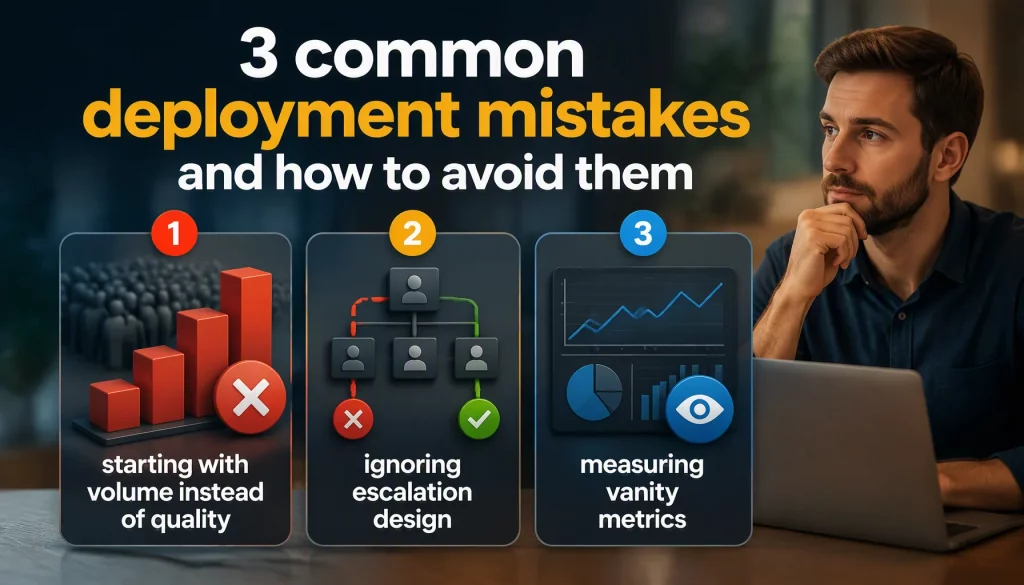
Most failed AI sales agent rollouts do not fail because the model is weak. They fail because of three avoidable decisions made in the first two weeks of setup, before the agent ever talks to a real prospect.
1. Starting with Volume Instead of Quality
The most common mistake is configuring an AI sales agent to maximize outreach volume before tuning qualification criteria. When the agent contacts every lead in the database without a meaningful filter, human sellers receive a flood of low-quality handoffs and lose confidence in the system within weeks. We recommend starting with a tightly defined ideal customer profile and expanding the target criteria only after the agent has demonstrated consistent qualification accuracy over at least four weeks of production data. It is a slower start on purpose.
2. Ignoring Escalation Design
An AI sales agent that cannot escalate gracefully is more damaging than no agent at all. If a prospect becomes frustrated with automated responses and cannot reach a human, the relationship is damaged before it begins. Every production deployment should include a clear escalation trigger: a specific phrase, sentiment signal, or intent pattern that immediately routes the conversation to a human seller with full context and a qualification score summary. Skip this step and the first angry prospect becomes a support ticket instead of a pipeline win.
3. Measuring Vanity Metrics
Open rates and message volume are easy to measure but tell you nothing about pipeline impact. The metrics that matter are qualified meeting conversion rate, pipeline contribution by AI-sourced leads, time from lead creation to first meeting booked, and human seller hours recovered per week. Establish these baselines before deployment and measure against them monthly to maintain accountability and continuous improvement. A dashboard full of open rates will not survive a board meeting.
Conclusion
An AI sales agent is no longer a future investment. It is a present-day competitive requirement for enterprises that need to close pipeline gaps, accelerate follow-up, and scale outbound prospecting without proportionally scaling headcount. The question for your enterprise is not whether to deploy one, but how to do it in a way that integrates securely with your existing systems, respects your compliance obligations, and delivers measurable results within a reasonable window of going live.
Our team at AI Hive has guided enterprises across financial services, healthcare, and retail through this journey, from architecture design through compliance review to full production deployment. If your organization is ready to move from experiment to production, we invite you to schedule a consultation with the AI Hive team and discover what a purpose-built AI sales agent can deliver for your pipeline.