
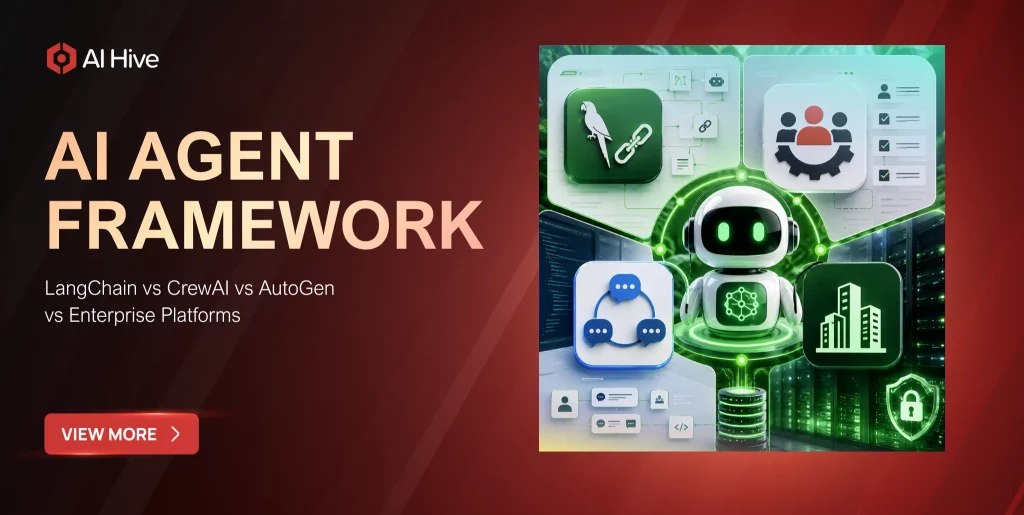

An AI agent framework is the software toolkit your engineering team uses to build, orchestrate, and deploy autonomous AI agents. It is not a finished enterprise platform: a framework governs how agents reason and act, but on its own it does not manage security, compliance, or production-grade observability.
By mid-2026, 68% of enterprise development teams have moved beyond simple AI coding assistants to full agentic AI systems, according to industry survey data. Yet fewer than 10% have successfully scaled those systems to deliver measurable business value, and the most common reason is a framework mismatch: teams select a framework based on GitHub star counts or tutorial popularity, then discover months later that it cannot meet their production requirements for scalability, compliance, or integration with enterprise systems.
We at AI Hive have evaluated every major framework in this category and deployed agent systems across BFSI, healthcare, retail, and logistics environments. This comparison gives you the unvarnished picture of what each framework does well, where each one breaks down, and what questions you must answer before making a selection.
Key Takeaways
|
What Is an AI Agent Framework?
An AI agent framework is a software development toolkit that provides the scaffolding for building, testing, and deploying AI agents – systems that can autonomously perceive inputs, reason about goals, select tools, and execute multi-step tasks. An AI agent framework is not an enterprise platform: it handles the agent-logic layer, not the governance, audit, and compliance layer your production deployment also needs.
The framework abstracts the low-level mechanics of LLM API calls, tool orchestration, memory management, and agent-to-agent communication. This is what turns a single LLM call into genuine AI workflow automation – letting developers focus on agent behavior and business logic rather than reinventing plumbing.
The choice of framework has significant downstream consequences: which LLM providers you can use, how easily you add new agent capabilities, how you handle memory and state across long-running tasks, and – critically – what observability and governance features are available out of the box.
Why the framework decision matters at enterprise scale:
- Architectural commitment: the framework shapes your security posture and long-term scalability, not just developer productivity.
- Compliance readiness: frameworks with weak audit trails push governance work onto your own engineering team.
- Vendor exposure: some frameworks tie you tightly to one model provider or cloud ecosystem.
Why Framework Choice Carries More Weight in 2026 Than Ever Before
Framework choice matters more in 2026 because production AI agent systems now routinely involve multi-agent workflows, real-time integration with core business systems, and binding regulatory requirements. In 2024 and early 2025, most enterprise deployments were single-agent prototypes where framework limitations rarely surfaced; that grace period is over.
The EU AI Act’s enforcement deadline of August 2026 is the most consequential regulatory shift, and it is one reason enterprise AI agent governance can no longer be an afterthought bolted onto an existing framework.
McKinsey’s 2026 State of AI data shows that organizations achieving a median 3.7x return on GenAI investment share a common characteristic: they deploy with a defined scope and a measurable baseline, which requires a framework that surfaces the data to establish those baselines. Frameworks with limited observability or inflexible orchestration become bottlenecks in exactly the enterprise contexts where AI investment is largest.
The Major AI Agent Frameworks: Capabilities and Limitations
Five frameworks account for most production AI agent deployments in 2026: LangChain/LangGraph, CrewAI, Microsoft AutoGen (AG2), the OpenAI Agents SDK, and Google’s Agent Development Kit (ADK). Each optimizes for a different combination of flexibility, ecosystem, and enterprise readiness, detailed below and summarized in the comparison table that follows.
1. LangChain and LangGraph
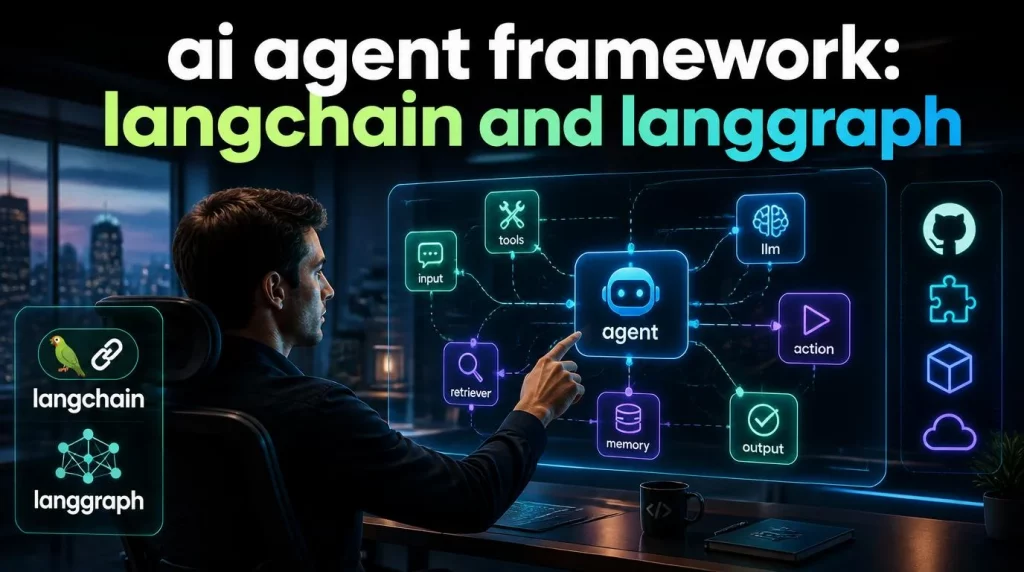
LangChain is the most widely adopted open-source AI agent framework, with over 110,000 GitHub stars and the largest ecosystem of third-party integrations. Its graph-based extension, LangGraph, models agent workflows as directed graphs – nodes represent functions or agents, edges represent transitions – giving fine-grained control over agent state, branching logic, and long-running processes.
Strengths:
- Broadest integration coverage: connects to hundreds of data sources, APIs, and tools.
- LangGraph gives explicit, inspectable control over agent state and branching logic.
- Best fit when your team has strong Python engineering capability.
Watch for:
- Production-grade observability, access controls, and multi-tenant isolation require significant custom engineering that open-source tutorials do not cover.
- A rapid release cadence means breaking changes are common without a dedicated maintenance team.
2. CrewAI
CrewAI introduced the role-based multi-agent paradigm: developers define agents by professional role (researcher, writer, analyst, reviewer) and assign tasks based on role expertise. With 30,000+ GitHub stars, CrewAI has found a strong audience for business-automation use cases where a collaborative-team mental model maps naturally onto the agent design.
Strengths:
- Intuitive API significantly reduces the time to a working multi-agent prototype.
- Role-based design fits business-process automation cleanly.
Watch for:
- The role abstraction becomes a constraint when you need granular control over inter-agent communication, custom memory backends, or complex conditional routing.
- Enterprise teams often report working around the framework’s abstractions for compliance gates, custom audit logging, or legacy-system integration.
3. Microsoft AutoGen (AG2)
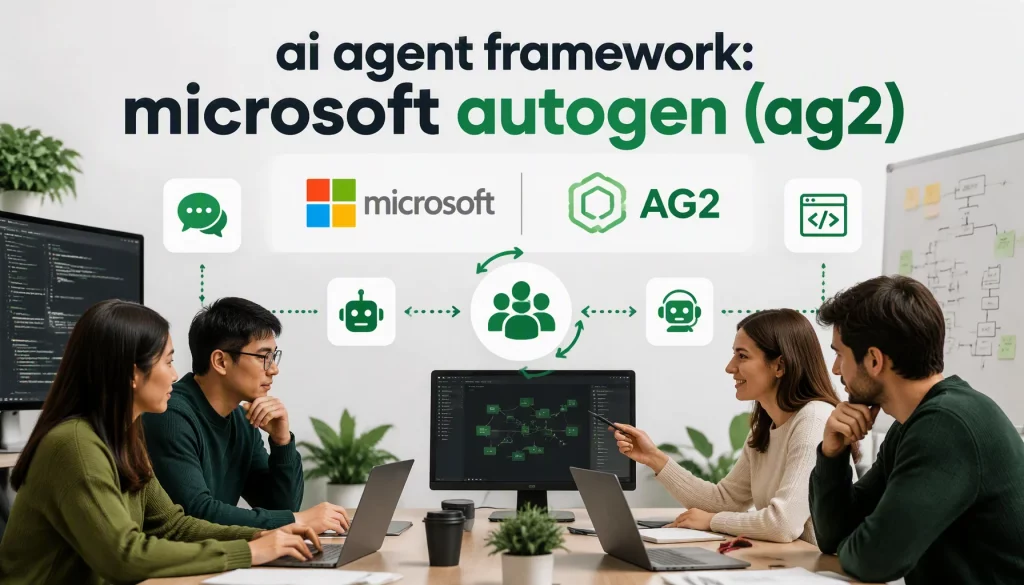
Microsoft’s AutoGen – now converged with Semantic Kernel into the AG2 framework – is optimized for conversational multi-agent systems where agents engage in structured dialogue to solve problems collaboratively. It is the framework of choice for research agents, code review workflows, and debate-style reasoning tasks.
Strengths:
- Deep integration with Azure Active Directory, Azure OpenAI, and Microsoft Fabric.
- Strong fit for organizations already standardized on the Microsoft Azure ecosystem.
Watch for:
- The conversational architecture introduces latency overhead in high-throughput production scenarios as agent-to-agent turns compound.
- Outside the Azure ecosystem, out-of-the-box integration coverage is thinner than LangChain’s.
4. OpenAI Agents SDK
The OpenAI Agents SDK provides the simplest path to a working agent for developers already using OpenAI’s API. Its handoff mechanism for transferring control between agents is elegant, and its built-in tracing tools give developers reasonable visibility into agent execution.
Strengths:
- Lowest time-to-working-prototype of any framework in this comparison.
- Best fit for startups and small teams building exclusively on OpenAI models.
Watch for:
- Vendor lock-in is the most significant limitation for enterprise buyers: the framework is tightly coupled to OpenAI’s API, making it difficult to incorporate non-OpenAI models.
- Enterprises anticipating a need to switch or diversify model providers should treat this as a real architectural risk, particularly under data-residency requirements in regulated industries.
5. Google Agent Development Kit (ADK)
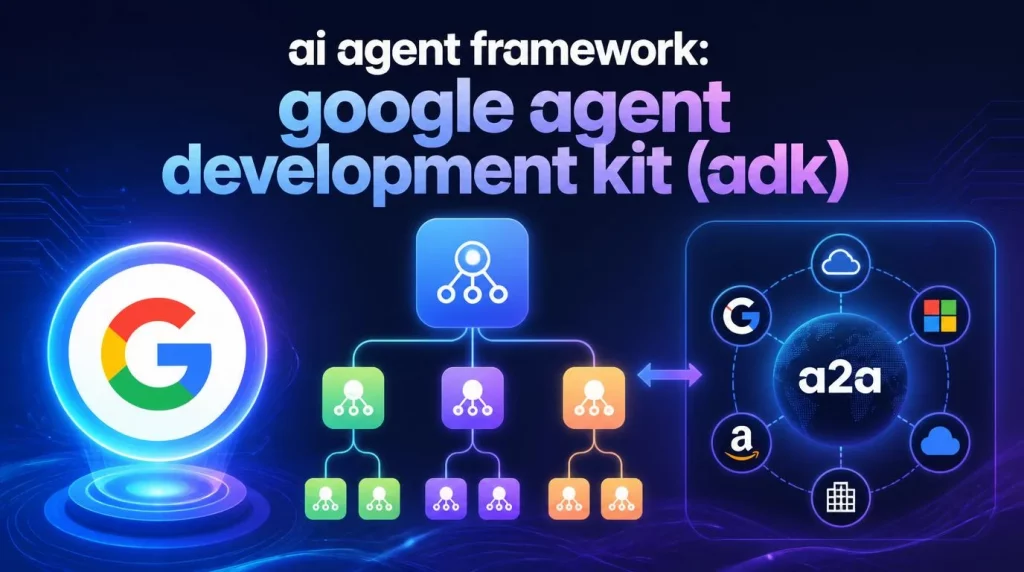
Google’s ADK, released in 2025 and matured significantly by mid-2026, introduces hierarchical agent trees with native support for the Agent-to-Agent (A2A) protocol – a proposed standard for interoperability between agent systems from different vendors.
Strengths:
- Tight integration with Google Cloud services and Vertex AI.
- A2A protocol support positions ADK well for multi-vendor agent environments where interoperability will increasingly matter.
Watch for:
- Best suited to organizations already invested in the Google Cloud ecosystem; the benefit is smaller outside it.
Framework Comparison at a Glance
No single framework wins in every dimension. The table below summarizes where each one is strongest so you can shortlist candidates before a deeper evaluation.
| Framework | Best For | Multi-Agent | Vendor Independence | Enterprise Readiness |
| LangChain / LangGraph | Broad integrations, custom workflows | Strong (LangGraph) | High | Medium (requires custom work) |
| CrewAI | Role-based team automation | Native | Medium | Medium |
| Microsoft AutoGen (AG2) | Conversational, research agents | Native | Low (Azure-focused) | High (Azure shops) |
| OpenAI Agents SDK | Quick prototypes, OpenAI-only | Via handoffs | Low | Low-Medium |
| Google ADK | Google Cloud, A2A interoperability | Via A2A protocol | Medium | Medium-High |
The Hidden Gap: Open-Source Frameworks vs Enterprise Platforms
Every framework in the table above is a development toolkit – it helps your engineers build agents. None of them is an enterprise platform, and that distinction is where most agentic AI budgets quietly overrun.
Building with an open-source framework means your team is also responsible for building, maintaining, and securing the surrounding infrastructure: the vector database, the model gateway, the audit logging system, the human-in-the-loop workflow, the deployment pipeline, the monitoring dashboards, and the access control layer. Gartner estimates that organizations building entirely in-house spend between $500,000 and $2 million on initial infrastructure before their first agent reaches production.
💡 From the field: A regional insurance carrier we worked with had already spent four months building a claims-processing agent on LangGraph alone before an internal audit flagged that no version of the system produced a reviewable decision trail. We layered AI Hive’s audit plane and access controls on top of their existing LangGraph agent logic in three weeks, without asking them to rebuild it. The lesson we keep relearning: your framework choice does not have to be an all-or-nothing platform decision, but the governance layer cannot be an afterthought.
An enterprise AI agent platform – such as AI Hive – provides that surrounding infrastructure pre-built, pre-integrated, and pre-validated against compliance frameworks including SOC 2, GDPR, and HIPAA. Your team can use the framework of its choice at the agent-logic layer while relying on the platform for everything above and below it: model governance, PII handling, audit trails, and deployment management.
What AI Hive Adds to Any Framework Stack
We built AI Hive to be framework-agnostic at the agent-logic layer. Whether your engineering team prefers LangGraph, CrewAI, or a proprietary agent design, AI Hive wraps it with the enterprise infrastructure layer that open-source frameworks leave for your team to build:
- A vendor-neutral model gateway that supports Anthropic Claude, OpenAI GPT series, Google Gemini, Mistral, and open-source models – without requiring changes to your agent logic when you switch providers.
- A compliant data layer that enforces PII detection, masking, and access controls before any data reaches an LLM endpoint – critical for GDPR and HIPAA compliance.
- A production-grade audit plane that captures the full reasoning chain of every agent execution in a tamper-evident log format acceptable for regulatory review.
- An Agent Marketplace with 500+ industry-specific agent templates that your team can deploy and customize rather than building from scratch.
- AI Engineers for Hire who accelerate your framework implementation when your internal team needs specialist support.
Together, these components function as a full AI agent orchestration platform that sits above your chosen framework – coordinating models, data, and compliance controls so your engineers can stay focused on agent logic rather than infrastructure.
How to Choose the Right AI Agent Framework for Your Enterprise
Choose your AI agent framework against the constraints that will determine success or failure in your specific environment, not by popularity. The following five criteria are drawn from our experience across enterprise deployments in regulated and non-regulated industries.
- Data residency and compliance: If your data cannot leave your infrastructure, eliminate any framework tightly coupled to a single cloud provider’s inference API. Prioritize architectures that support private model deployment.
- Multi-agent complexity: If your use case requires more than two or three agents collaborating, invest in a framework with native multi-agent orchestration rather than trying to bolt coordination logic onto a single-agent framework.
- Engineering team capability: LangChain offers the most power with the highest learning curve. CrewAI offers faster onboarding with less flexibility. Honest assessment of your team’s experience should guide the selection.
- Time to production: If your organization measures success in weeks rather than months, a managed enterprise platform that handles infrastructure reduces risk significantly compared with assembling an open-source stack.
- Vendor lock-in tolerance: Assess your organization’s risk appetite for being dependent on a single framework vendor. Open standards adoption (A2A protocol, OpenAPI tool schemas) is increasingly available in newer frameworks.
Conclusion
The AI agent framework landscape in 2026 offers more capable options than ever before, but also more complexity. LangGraph, CrewAI, AutoGen, OpenAI Agents SDK, and Google ADK each solve specific architectural problems well, while leaving other challenges for your team to address.
The enterprises achieving the highest ROI from agentic AI are not the ones that picked the most popular framework. They are the ones that matched their framework selection to their actual production constraints and complemented it with the enterprise platform infrastructure that open-source frameworks cannot provide on their own – a lesson every one of our deployment engagements has confirmed.
We have guided enterprises across every major industry through this decision and through the subsequent build-deploy-operate cycle. If your team is evaluating framework options or struggling to move an existing prototype into production, we invite you to explore what AI Hive can do for your organization.
Connect with our AI engineering team to discuss your framework requirements and production timeline – reach out to AI Hive here.