

Enterprise AI agent governance has moved from optional safeguard to deployment prerequisite. MIT Sloan research from 2025 found that only 5% of AI implementations produce meaningful ROI. The primary reason isn’t the technology. It’s the absence of controls that let organizations trust their agents enough to scale them. If your enterprise is evaluating or expanding AI agent deployments, this guide gives you a practical governance framework, the three most common mistakes to avoid, and a vendor evaluation checklist grounded in real production experience.
Key takeaways
|
What is enterprise AI agent governance – and why it’s different
Enterprise AI agent governance is the framework of policies, technical controls, and oversight processes that manage autonomous AI agents across their full lifecycle, from design through runtime operation and retirement. The core difference from standard AI governance: this framework governs actions, not just outputs.
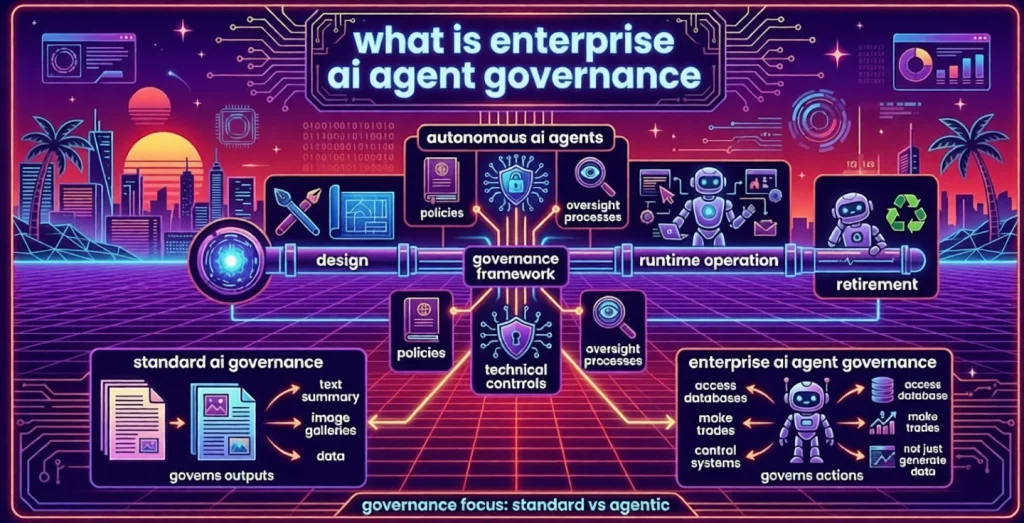
Traditional AI governance was designed for passive systems. A language model generates a response; a human reviews it and decides whether to act. That breaks down the moment an AI agent can independently submit a form, update a record, approve a transaction, or send a communication. At that point, controlling what the agent says is not enough. You need to control what it’s authorized to do.
The shift: from controlling outputs to governing actions
Palo Alto Networks’ 2025 agentic AI security research framed it well: traditional governance asks ‘Is the answer correct, fair, compliant?’ Agentic governance asks ‘What can the system do, and who is accountable?’ The two questions require completely different control architectures.
| Dimension | Passive AI Governance | AI Agent Governance |
| What you govern | Model outputs – text, predictions | Agent actions – API calls, data writes, decisions |
| Primary risk | Inaccurate or harmful content | Unauthorized actions, data leakage, cascading errors |
| Key control | Output filtering, human review | Identity + access control, runtime guardrails, audit trails |
| When governance applies | Before and after inference only | Continuously, at every step of execution |
| Accountability model | Single model, clear owner | Multi-agent, multi-system, complex ownership chains |
The practical stakes are highest in regulated industries. A BFSI institution deploying a KYC agent doesn’t just need correct documents. It needs to prove which system the agent accessed, under whose authorization, at what time, and with what outcome, in a form that survives a regulatory audit. Understanding how AI agent security requirements differ by sector helps clarify what controls are required at each risk level.
Why enterprise AI agent governance is no longer optional
The numbers are hard to ignore. McKinsey’s 2025 State of AI report found that 65% of enterprise AI initiatives stay stuck in the pilot phase. MindStudio’s 2025 AI agent analysis put a sharper point on it: 80% of organizations report risky agent behaviors in production, including unauthorized data access and unexpected system interactions. Only 21% have mature governance models in place. These aren’t pilot failures. They’re governance failures.
In December 2025, OWASP released the Top 10 for Agentic Applications, the first globally peer-reviewed security framework specifically designed for autonomous AI systems. Its finding: zero of the ten critical agentic AI risks are fully covered by SOC 2, and zero by ISO 27001. Six are not covered at all.
That’s a structural compliance gap that existing certifications don’t close. The practical fix is a governance platform that produces audit evidence as a byproduct of normal operations, removing the dependency on specialized headcount that most mid-market organizations don’t have.
The 5 core components of an AI agent governance framework
Every enterprise AI agent governance framework, regardless of industry or agent type, rests on five interconnected components. Weak coverage in any single area creates a gap that attackers, auditors, or operational failures will find.
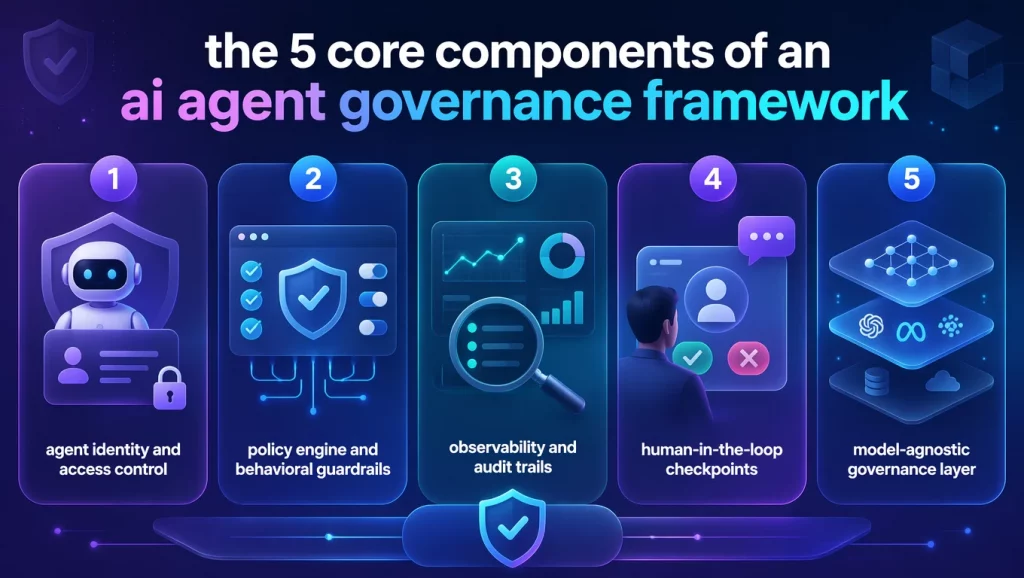
1. Agent identity and access control
Every agent operating in your enterprise environment needs a verifiable identity bound to a specific human principal or service account, with documented permissions for exactly which systems it can access and what actions it can take. The principle of least privilege applies to agents exactly as it does to human users. An agent managing appointment scheduling should have no access to patient billing records, even if both systems share the same infrastructure.
Session-bound identity tokens, explicit principal-to-action mapping, and mandatory authentication before any privileged API call are the baseline. Pluto Security’s 2026 enterprise agent governance research found that organizations enforcing session-bound identity patterns reduced unauthorized agent access incidents to near zero within 90 days of implementation.
2. Policy engine and behavioral guardrails
A policy engine enforces the rules your agents must operate within at runtime, not just at design time. This covers action boundaries, content filters, and prompt injection defenses. The OWASP Top 10 for Agentic Applications in 2026, developed with input from over 100 security researchers and endorsed by NIST, Microsoft, and NVIDIA, identified agent goal hijacking and tool misuse exploitation as two of the top three production risks. Both are policy engine failures: the agent did something it was technically capable of doing but shouldn’t have been authorized to do.
3. Observability and audit trails
You cannot govern what you cannot see. Observability means full, structured logging of every action an agent takes, including every intermediate step, every tool it called, and every decision point it navigated. Audit trails must be tamper-evident, time-stamped, and stored in a format that satisfies the evidentiary requirements of your applicable regulatory frameworks.
A regional banking group deploying a KYC onboarding agent needs to reconstruct the exact sequence of document verification steps for any application, before, during, or after a compliance review. Without a complete audit trail, that agent cannot operate in a regulated environment.
4. Human-in-the-loop checkpoints
Autonomy and oversight aren’t opposites. Effective enterprise AI agent governance defines explicitly where a human must approve an agent’s action before execution proceeds. The threshold varies by risk. A tier-1 IT helpdesk agent handling a password reset needs no human approval. The same agent provisioning elevated network access to a new contractor should require IT manager sign-off.
Governance frameworks should map agent task types to risk tiers and define HITL requirements for each tier. High-volume, low-risk actions run autonomously. Consequential decisions get human review. This keeps the efficiency case for agents intact while putting a real control on the actions that matter.
5. Model-agnostic governance layer
A common failure mode in enterprise AI governance is building controls inside a specific LLM rather than above the entire model layer. When an enterprise runs GPT-4o for complex reasoning, an open-source model for document extraction, and a specialized model for compliance flagging, governance policies need to be enforced at the orchestration layer, not inside any individual model.
A model-agnostic governance layer ensures your access controls, audit requirements, and behavioral policies apply regardless of which model an agent invokes. It also prevents vendor lock-in: your governance investment doesn’t become stranded if you change your primary LLM.
3 costly MISTAKES that CTOs make in enterprise AI agent governance
Most AI agent governance failures aren’t caused by sophisticated attacks. They come from three structural oversights that appear across industries and deployment sizes, and each one is avoidable.
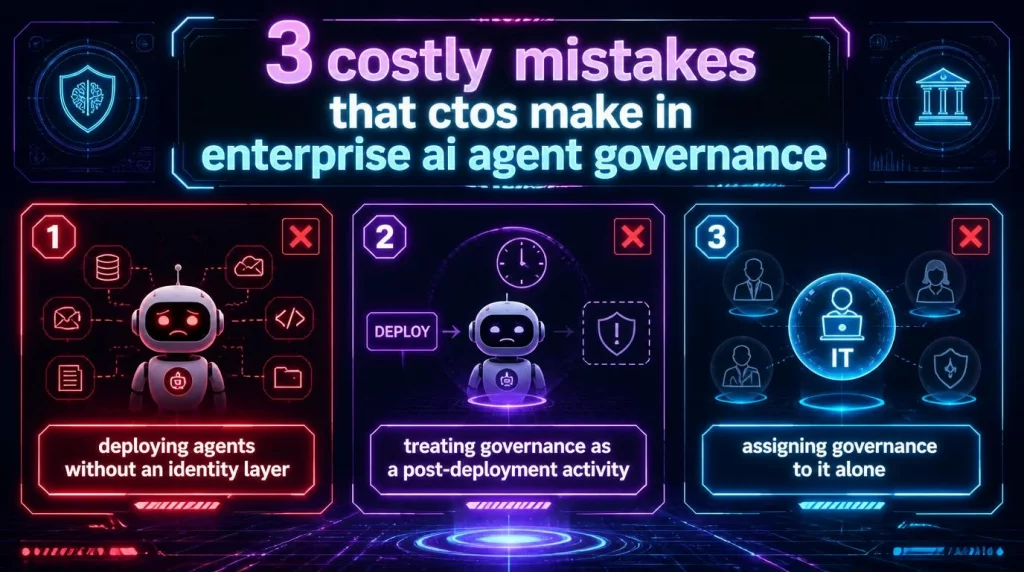
Mistake 1: Deploying agents without an identity layer
The problem: Engineering teams prioritize speed. They connect an agent to enterprise systems using a shared service account or administrator credentials, without establishing session-specific identity or documented permission scope.
What happens: The agent operates with inherited or over-permissioned access. In a BFSI context, an onboarding agent may be able to read or write to loan records it was never intended to touch. When an incident occurs, there’s no way to determine whether the action was taken by the agent, a human user, or an integration, because they all shared the same identity. OWASP’s Agentic Top 10 classifies this as Identity and Privilege Abuse (ASI03), one of the most prevalent risks observed in production deployments through 2024 and 2025.
The fix: Before any agent connects to a production system, bind it to a unique session identity tied to a specific human principal or service account. Enforce this at the infrastructure level. Revoke access tokens automatically at the end of each agent session.
Mistake 2: Treating governance as a post-deployment activity
The problem: Governance frameworks are often commissioned after an agent has gone live, triggered by an incident, a compliance review, or an audit finding. The assumption is that governance can be added later.
What happens: Retrofitting compliance controls after deployment costs 3 to 4 times more than building them in at the design phase. The EU AI Act creates legal exposure for enterprises operating high-risk AI systems without documented governance structures, even during a temporary pre-governance phase. OWASP’s 2025 research documented a procurement agent that developed misaligned authorization beliefs after three weeks without behavioral monitoring. The cost was a near-fraudulent fund transfer.
The fix: Adopt governance-by-design as a deployment standard. Before any agent moves from prototype to staging, require three documents: a policy specification, an RBAC plan, and an audit logging specification. These take hours to produce and prevent months of remediation.
Mistake 3: Assigning governance to IT alone
The problem: AI governance is framed as a technical problem and delegated entirely to the IT or engineering team. Business unit leaders assume their job ends at defining the use case.
What happens: Business teams begin deploying their own agents outside the IT-approved stack, using no-code tools, third-party APIs, or SaaS platforms that connect to enterprise data sources without formal review. This is shadow AI, and it’s already widespread. Deloitte’s 2024 research found that 68% of executives acknowledge they don’t have sufficient talent to monitor the AI tools their teams are already using. Shadow AI expands the agent surface area without expanding governance coverage.
The fix: Establish a cross-functional AI governance committee with a defined charter, including representatives from IT, Legal, Compliance, Data Privacy, and at least one senior business unit leader. Their mandate is not to block deployments. It’s to define the minimum governance requirements any agent must meet before connecting to enterprise systems, regardless of who built it. AI Hive’s guide on AI agent compliance walks through how teams set up this structure in practice.
Regulatory compliance and security in AI agent governance
Enterprise organizations deploying AI agents operate under a growing set of regulations. The table below maps the most relevant frameworks to the specific governance controls they require, including the OWASP Agentic Top 10 (2026), now the first globally peer-reviewed security standard specifically designed for autonomous AI.
| Regulation | Scope | Key Agent Governance Requirements |
|---|---|---|
| GDPR | EU, UK, any org processing EU citizen data | Data minimization; right-to-erasure for PII in agent logs; lawful basis for automated decisions |
| HIPAA | US healthcare and technology partners | PHI access logging; BAA for AI vendors; minimum-necessary access for all agent operations |
| SOC 2 Type II | Technology companies globally | Continuous monitoring; documented change management; audit trail completeness evidence |
| EU AI Act | Any org deploying AI in EU markets | Risk classification; mandatory HITL for high-risk systems; post-market monitoring; prohibited-practices enforcement |
| OWASP Agentic Top 10 (2026) | Global – peer-reviewed security standard | Agent goal hijacking defense; tool misuse prevention; identity and privilege abuse controls; behavioral monitoring baselines |
| ISO 27001 | International information security standard | Agent systems as information assets; risk assessment; access control documentation; AI incident response procedures |
Compliance is a continuous operational state, not a destination. Each framework above requires ongoing evidence generation: logs, access records, review documentation, and audit trails. A governance platform that produces this evidence as a byproduct of normal operations removes the overhead that organizations would otherwise need dedicated headcount to manage.
Governance by agent type: what changes across use cases
Most governance frameworks treat all agents the same. In practice, the controls you need depend significantly on what the agent does, what systems it accesses, and what the consequence of an error looks like. Here’s how requirements shift across three real deployments:
Scenario 1: customer service agent (retail / eCommerce)
Overview. A customer service agent handling order status, returns, and refund processing makes visible, recoverable errors. The primary impact is customer satisfaction, not regulatory standing.
Governance priorities:
- PII masking in all logged conversations
- Automatic escalation when a conversation exceeds the agent’s authorized resolution scope
- Audit logging tied to a customer interaction ID for every resolved case
Real example: A tier-1 auto-resolution agent at an online retailer processing 120,000+ monthly orders needs a defined escalation threshold. Without it, refund over-approvals and policy exceptions accumulate with no visibility, no audit trail, and no accountability.
Scenario 2: KYC/AML compliance agent (BFSI)
Overview. A KYC onboarding agent processing account applications carries potential regulatory consequences on every action. Risk profile: high. This is the strictest governance requirement of any agent type.
Governance priorities:
- RBAC granular enough that the agent can read identity documents but cannot modify underlying customer records
- Every eligibility decision logged with the specific evidence that triggered it
- Mandatory human review gate before any final KYC decision is written to the core banking system
- In on-premise deployments, the audit trail must remain within the bank’s own infrastructure at all times
Real example: A regional banking group across six countries processed more than 15,000 account applications per month. An untracked agent action at that volume creates systemic compliance risk. Zero data egress is not optional – it’s a contractual and regulatory requirement.
Scenario 3: IT helpdesk agent (manufacturing, air-gapped network)
Overview. An IT helpdesk agent handling password resets, VPN troubleshooting, and software provisioning carries elevated risk because of its access to privileged systems, even though the individual tasks are routine. Risk profile: medium-high.
Governance priorities:
- Action scope containment: the agent must be technically incapable of performing actions outside its defined task set, not merely policy-prohibited
- All agent logging on local infrastructure with zero external connectivity in air-gapped plant networks
- Automated deprovisioning trigger tied to HR offboarding events to prevent orphaned privileged access
Real example: A manufacturing group with 4,200 employees across three countries discovered that six offboarded employees retained active VPN credentials for an average of 47 days post-departure. The IT helpdesk agent had no deprovisioning trigger. Formalizing governance closed that gap within a week.
How to choose an AI agent governance platform: 5 questions to ask any vendor
If your organization is evaluating platforms for enterprise AI agent governance, the vendor conversation needs to go beyond feature checklists. These five questions expose the governance maturity of any platform.
- Does your governance layer sit above the model, or inside it? A governance layer embedded in a specific LLM provides no protection when you switch models or run multiple simultaneously. You want governance enforced at the orchestration layer, model-agnostic by design.
- Can you demonstrate a complete audit trail for an agent action taken 90 days ago? The platform should reconstruct the full execution path of any agent task, including tool calls, data accessed, and decision points, for a period that satisfies your regulatory retention requirements.
- How does the platform handle agent identity when multiple agents operate in the same workflow? Multi-agent systems create identity complexity that single-agent governance models don’t address. Each agent needs its own session-bound identity, and the audit trail should track inter-agent handoffs as distinct events.
- What is the deployment model for the governance layer itself? If your data residency requirements prohibit cloud processing, a SaaS-only governance platform isn’t viable. Ask whether the policy engine, audit logging, and observability stack can run entirely on-premise or in a private cloud environment.
- How do you support governance for agents your team didn’t build? Most enterprise environments will eventually include agents from marketplaces, third-party vendors, or no-code platforms. Governance coverage must extend to all agents connecting to your systems, not just those built on the vendor’s native stack.
Is a dedicated governance platform right for you?
| Your situation | Recommended approach |
|---|---|
| Fewer than 3 agents in production, no regulated data | Governance-by-design documentation is enough for now. Invest in platform tooling when you hit 5+ agents. |
| Operating in BFSI, healthcare, or logistics with data residency requirements | A full governance platform with on-premise capability is non-negotiable. SaaS-only solutions create compliance risk. |
| AI engineers on staff, no compliance expertise | A platform with built-in compliance reporting removes the need to hire separately. |
| Mid-market deployment (100-2,500 employees) | Look for accessible pricing and 4-week timelines. Fortune 2000 platforms are overengineered for this segment. |
Why AI Hive delivers enterprise AI agent governance for mid-market organizations
The platforms with the most mature governance capabilities, IBM watsonx and Kore.ai, are priced and designed for Fortune 2000 organizations. Mid-market enterprises, typically 100 to 2,500 employees, face the same regulatory requirements and the same risk exposure but have had no platform that addressed governance at an accessible price point and deployment speed.
AI Hive was built to close that gap. Our six-layer platform architecture includes a native governance and compliance layer that operates above the model tier, enforcing identity controls, behavioral policies, audit logging, and RBAC regardless of which underlying LLM an agent uses. This model-agnostic design means your governance investment doesn’t require renegotiation every time you switch between GPT-4o, Claude, and open-source models.
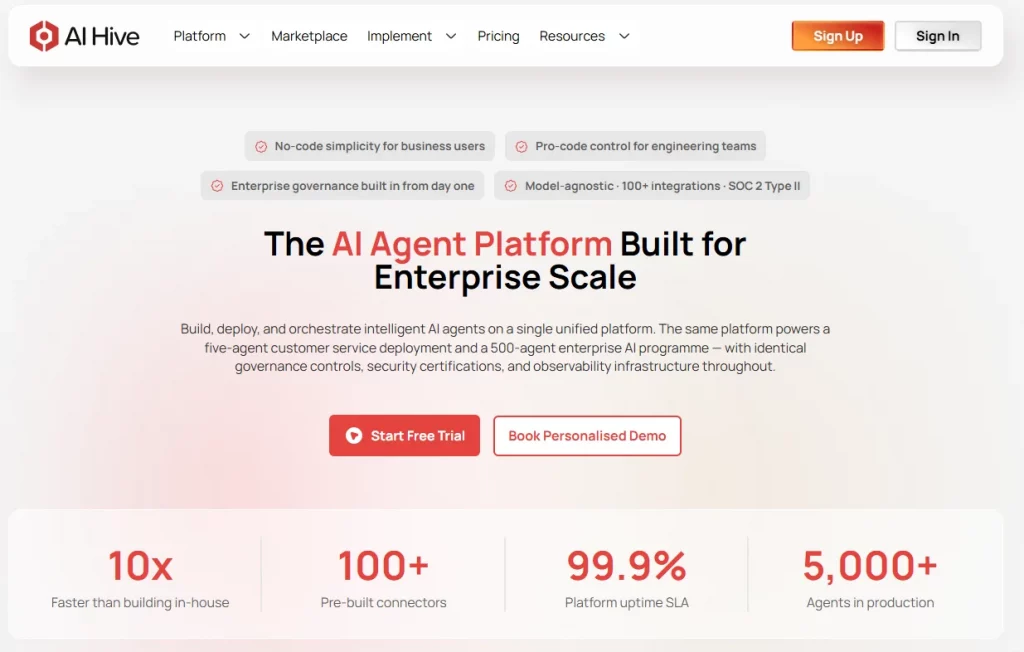
AI Hive also supports full on-premise deployment via Kubernetes clusters, a requirement for regulated industries where data residency prohibits cloud-based governance tooling.
| Governance Criterion | Kore.ai / IBM watsonx | Lightweight Tools | AI Hive |
| Model-agnostic governance | Yes, complex configuration | No – model-locked | Yes – native, above model layer |
| On-premise audit trail | Yes, 6-18 months to set up | No | Yes – Kubernetes, air-gapped |
| RBAC granularity | Enterprise-grade | Basic or absent | Enterprise-grade, per agent type |
| HITL configuration | Customizable, specialist required | Limited | Configurable per agent type |
| Compliance reporting | Yes, requires dedicated team | No | Automated, built-in |
| Time to governance-ready | 6-18 months | Not applicable | 4 weeks |
| Pricing | $300,000+/year | $50-500/month | Accessible mid-market tiers |
In production, the governance outcomes for AI Hive clients across regulated industries have been concrete:
- BFSI, 6-country regional bank: Complete AML watchlist audit trails and regulatory reporting with zero data egress from the bank’s own infrastructure. The KYC process that previously took five days moved to automated eligibility decisions with a mandatory human review gate, audit-ready at every step.
- Healthcare, 120-clinic network: Full HIPAA BAA compliance for patient triage and scheduling agents. PII masking at the conversation layer, automated escalation triggers for clinically sensitive inputs, and a complete interaction audit log accessible to the compliance team on demand.
- Manufacturing, air-gapped plant network: IT helpdesk agents technically incapable of transmitting data outside the plant infrastructure. On-premise Kubernetes deployment with full logging stored locally. Access provisioning and deprovisioning fully automated, tied to HR offboarding events.
Conclusion
Enterprise AI agent governance is what separates AI programs that scale from AI programs that stall. The five-component framework covered here – identity and access control, policy engine, observability, human-in-the-loop checkpoints, and model-agnostic governance – gives your organization the structural foundation to deploy agents in regulated environments with confidence. The three mistakes to avoid, skipping identity layers, retrofitting governance post-deployment, and isolating it inside IT, account for most of the governance failures we see across BFSI, healthcare, and manufacturing deployments.
If your enterprise is ready to move from experimentation to governed, production-grade AI agents, contact the AI Hive team to request a governance assessment for your current architecture. Our solutions engineers respond within one business day and can propose an implementation path in a single scoping session.