
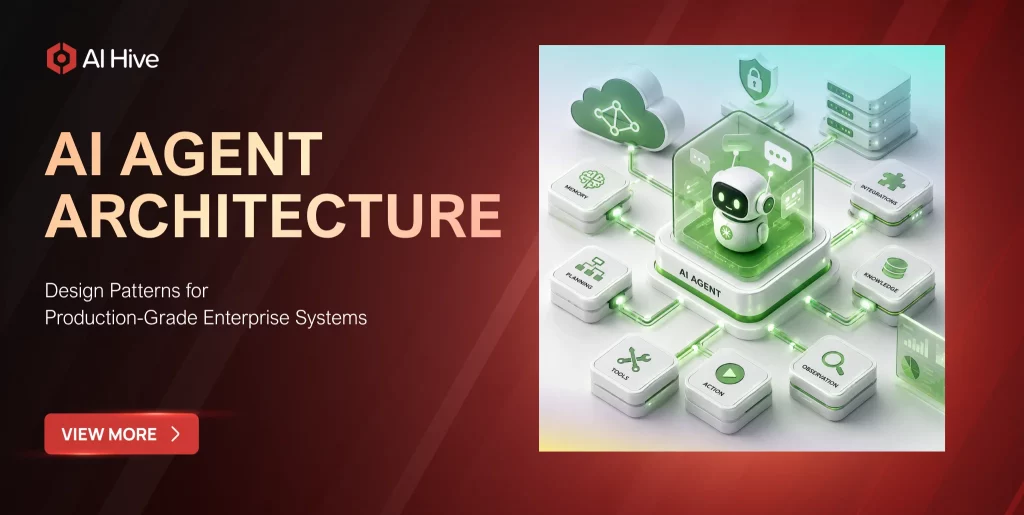

According to Gartner’s 2026 Hype Cycle for Agentic AI, 40% of agentic AI projects will be canceled by the end of 2027 – not because the technology failed, but because the underlying architecture was never designed to survive contact with enterprise reality. The gap between a compelling proof-of-concept and a system that handles millions of transactions, respects data sovereignty requirements, and satisfies your compliance team is almost entirely an architecture problem. We at AI Hive have guided dozens of enterprises through this transition, and the pattern is consistent: teams that invest in robust AI agent architecture reach production in weeks; teams that skip it spend months firefighting.
AI agent architecture is NOT AI model architecture. AI model architecture refers to the internal structure of the language model itself – transformer layers, attention heads, and parameter configuration. AI agent architecture refers to the system design that surrounds and utilizes that model: how it receives inputs, retrieves context, selects tools, executes actions, coordinates with other agents, and logs its behavior for audit. Enterprises rarely need to design model architecture; they always need to design agent architecture.
This guide covers the seven core component layers, five proven design patterns, the three enterprise-critical considerations your engineering team must address, a framework comparison for 2026, and the architectural mistakes that consistently kill enterprise AI initiatives before they reach production.
What Is AI Agent Architecture and Why Does It Determine Production Success?
AI agent architecture refers to the structural design of an autonomous AI system – the way its perception, reasoning, memory, action, and oversight components are organized and connected. Unlike a simple chatbot that responds to a single prompt, an AI agent perceives its environment, formulates multi-step plans, invokes external tools or APIs, and iterates on its own output until a task is complete. The architecture defines how all these capabilities are wired together, how data flows between components, and where human oversight is enforced.
For enterprise deployments, architecture is not an implementation detail – it is a strategic decision. The architecture you choose determines whether your agents can integrate with existing ERP and CRM systems, whether sensitive customer data stays within your private cloud, and whether your AI operations team can debug a failure without calling the vendor. In 2026, with McKinsey estimating that deployed AI agents generate a median 3.7x return on investment for organizations with a defined scope and measurable baseline, getting the architecture right has never been more consequential.
What Are the Seven Core Components Every Production AI Agent Needs?
Production-grade AI agents share a common set of building blocks regardless of the framework or LLM underneath. Understanding each component helps your engineering and product teams evaluate vendors, design integration points, and anticipate failure modes before they occur in the field.
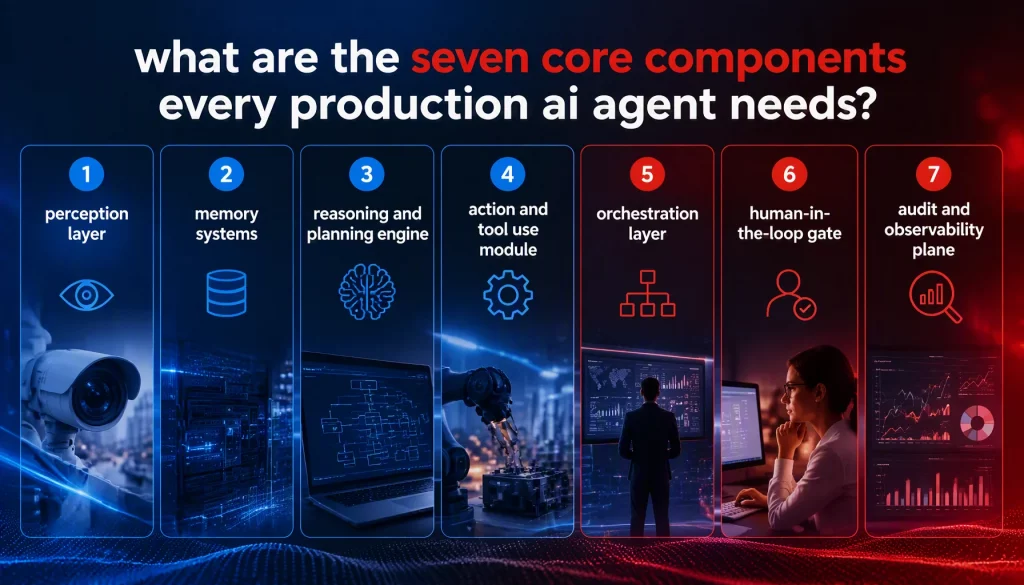
1. Perception Layer
The perception layer ingests inputs from the agent’s environment – user messages, API responses, database query results, file contents, and event streams. In enterprise settings, this layer must handle structured data (JSON, XML, SQL result sets), unstructured text (emails, contracts, support tickets), and multimodal inputs such as images and voice. The perception layer is also the first line of defense against prompt injection attacks, which OWASP ranked as the top vulnerability in its 2025 LLM Top 10 list.
2. Memory Systems
Effective agents require at least three types of memory: short-term working memory that holds the current conversation context; long-term semantic memory backed by a vector database for retrieving relevant documents; and episodic memory that records past task outcomes so the agent can learn from prior interactions. Enterprise deployments typically add a fourth layer – procedural memory – which stores the agent’s approved workflows and policy constraints so that compliance rules are applied consistently across every execution.
3. Reasoning and Planning Engine
This component is where the large language model operates. In production systems, the reasoning engine does not simply pass every user input directly to the model. Instead, it applies a planning strategy – such as the ReAct pattern or Plan-and-Execute approach – to decompose complex goals into sub-tasks, select the appropriate tools for each sub-task, and evaluate intermediate outputs before proceeding. Enterprises increasingly route simpler sub-tasks to smaller, cheaper models while reserving frontier models for complex reasoning, a practice that can reduce LLM API costs by 40 to 60 percent.
4. Action and Tool Use Module
An agent’s value is proportional to the range of actions it can execute: reading from and writing to databases, calling internal APIs, sending emails, creating tickets, executing code, or triggering robotic process automation scripts. The action module must enforce strict permission scoping – the principle of least privilege – so that an agent provisioned to read customer records cannot inadvertently write to them. In regulated industries, every action must be logged with a complete audit trail for regulatory review.
5. Orchestration Layer
The orchestration layer coordinates the sequencing of tasks, manages dependencies between sub-agents, and handles retries and fallback logic when a step fails. In multi-agent systems, the orchestrator distributes work to specialized worker agents – a claims-analysis agent, a fraud-detection agent, a customer-communication agent – and aggregates their outputs into a coherent result. This layer is what separates a single-purpose bot from a genuine enterprise AI platform.
Enterprises seeking to understand how the orchestration layer connects to broader business processes will find our guide on AI workflow automation for enterprise operations a natural complement to this architectural overview.
6. Human-in-the-Loop Gate
The EU AI Act and most enterprise risk frameworks require human oversight checkpoints for high-stakes decisions. The human-in-the-loop gate pauses agent execution at configurable decision thresholds – for example, when a loan application score falls in an ambiguous range, or when an agent proposes to delete more than a defined volume of records – and routes the decision to a human reviewer before continuing. Well-designed gates balance oversight with throughput by using risk scoring to determine which decisions require human review and which can proceed autonomously.
7. Audit and Observability Plane
Enterprise AI agents must produce a complete, tamper-evident record of every decision, tool call, and output. The audit plane captures structured logs of agent reasoning chains, input-output pairs, and tool invocations in a format that satisfies both internal compliance teams and external regulators. Observability tooling on top of these logs enables your operations team to track latency, accuracy drift, and anomalous behavior patterns in real time.
Which AI Agent Architecture Patterns Are Proven for Enterprise in 2026?
Architecture patterns are reusable solutions to common design problems. In 2026, five patterns have emerged as the most reliable for enterprise AI agent deployments. Each addresses a distinct set of use-case requirements, and many production systems combine two or more patterns within the same agent.
| Pattern | Best For | Key Mechanism | Latency | Cost | Compliance Fit |
| ReAct | Dynamic tool selection tasks (CX, inquiry resolution) | Thought → Action → Observation loop | Medium | Medium | High – interpretable reasoning chain |
| Plan-and-Execute | Complex multi-step workflows (financial reports) | Frontier model plans; smaller models execute | Low (parallel execution) | Low (model tiering) | Medium |
| Reflection | High-stakes content (legal, medical, financial) | Self-critique loop before final output | High | High | Very High – built-in quality gate |
| Orchestrator-Worker | Enterprise platforms with specialized domains | Central orchestrator + specialist worker agents | Medium | Medium | High – domain isolation |
| Supervisor Routing | High-volume multi-domain environments | Classifier routes to specialist agents | Low | Low | High – clear escalation paths |
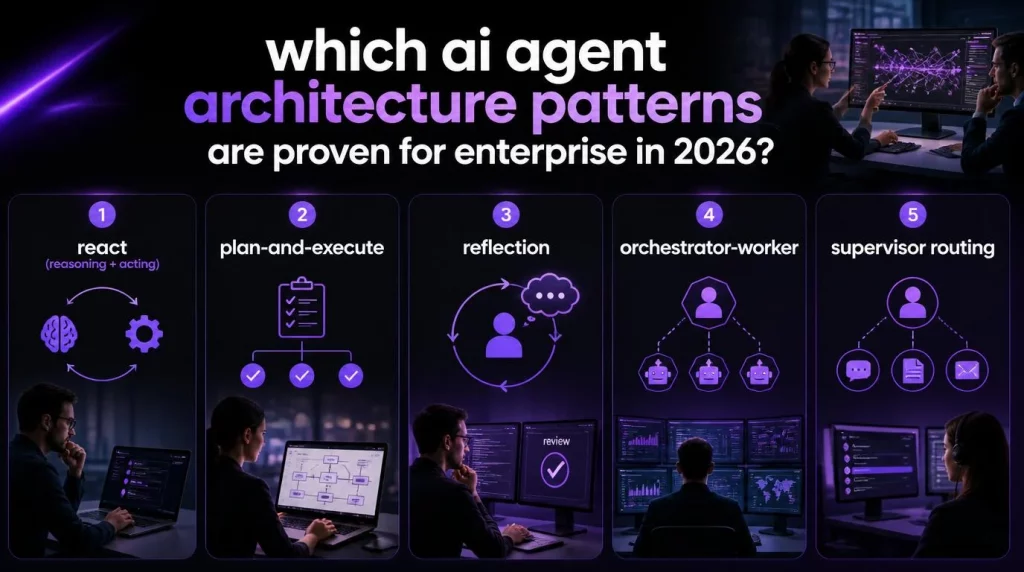
Pattern 1: ReAct (Reasoning + Acting)
The ReAct pattern interleaves the agent’s reasoning process with its tool-use actions, creating a Thought-Action-Observation loop. The agent explicitly narrates its reasoning before each action, making the process interpretable and debuggable. This pattern is well-suited for tasks that require dynamic tool selection – such as customer inquiry resolution, where the agent may need to check an order database, query a shipping API, and compose a personalized response in a single execution chain. ReAct’s transparency makes it particularly valuable in compliance-sensitive environments where auditors need to understand why the agent made a specific decision.
Pattern 2: Plan-and-Execute
The Plan-and-Execute pattern separates high-level strategic planning from tactical step-by-step execution. A frontier model generates the plan; smaller, faster, lower-cost models execute the individual steps. This division of labor reduces both latency and cost for complex multi-step workflows such as financial report generation. Enterprises that adopt this pattern typically report 40 to 60 percent reductions in per-task LLM costs.
Pattern 3: Reflection
The Reflection pattern forces an agent to evaluate and critique its own output before presenting results to the user or downstream system. After completing an initial response, the agent passes its output to a reviewer sub-agent – which may be the same model with a critic persona, or a separate specialized model – and iterates until quality thresholds are met. This pattern is especially effective for high-stakes content such as legal contract drafts, medical coding outputs, or financial disclosures, where a first-attempt error can have significant downstream consequences.
Pattern 4: Orchestrator-Worker
In the Orchestrator-Worker pattern, a central orchestrator agent decomposes a complex task and delegates sub-tasks to a pool of specialized worker agents. Each worker agent is optimized for a narrow function – document extraction, entity recognition, regulatory cross-referencing – and returns its output to the orchestrator for synthesis. This pattern scales horizontally, enabling enterprises to add new worker agents for new capabilities without restructuring the entire system. Fifty-seven percent of organizations with multi-agent systems in production use some variant of this pattern, according to 2026 industry survey data.
Pattern 5: Supervisor Routing
The Supervisor Routing pattern uses a lightweight classifier to analyze incoming requests and route them to the most appropriate specialized agent. Rather than sending every query through the same generalist agent, the supervisor directs billing inquiries to a finance agent, technical support requests to an engineering agent, and escalation-risk cases to a human handoff queue. This pattern significantly reduces average response latency and improves domain-specific accuracy, because each specialist agent is fine-tuned or retrieval-augmented with domain-specific knowledge.
Which AI Agent Framework Should Your Enterprise Use: LangChain, AutoGen, or CrewAI?
Selecting the right framework is the first architectural decision your engineering team must make. The three dominant open-source frameworks in 2026 – LangChain, AutoGen, and CrewAI – take fundamentally different approaches to agent orchestration, and your choice affects everything from development speed to production scalability.
| Framework | Architecture Philosophy | Best Pattern Fit | Learning Curve | Enterprise Readiness | Ideal For |
| LangChain / LangGraph | Graph-based workflow; explicit state management with LangGraph | ReAct, Plan-and-Execute, Orchestrator-Worker | Medium-High | High – mature ecosystem, 90k+ GitHub stars | Teams wanting full control over agent state and workflow graphs; complex multi-step pipelines |
| AutoGen (Microsoft) | Conversational multi-agent; agents communicate via natural language messages | Reflection, Orchestrator-Worker, Supervisor Routing | Medium | High – backed by Microsoft Research; strong enterprise support | Multi-agent conversations where agents critique and refine each other’s outputs |
| CrewAI | Role-based team abstraction; agents assigned explicit roles, goals, and backstories | Orchestrator-Worker, Supervisor Routing | Low | Medium – growing fast, simpler API than LangChain | Teams new to multi-agent; rapid prototyping; task delegation between specialized roles |
| AI Hive Platform | Managed multi-framework orchestration; no-code Agent Studio + custom code path | All five patterns supported | Very Low (no-code) to Medium (custom) | Very High – SOC 2, GDPR, on-premise, model gateway, audit plane included | Enterprises that need production-grade governance, compliance, and on-premise deployment without building infrastructure from scratch |
LangChain / LangGraph Code Sample: ReAct Agent
The following example demonstrates a minimal ReAct agent using LangGraph that queries an order database and carrier API – a pattern applicable to enterprise customer service automation:
| from langgraph.graph import StateGraph, END
from langchain_core.messages import HumanMessage from langchain_openai import ChatOpenAI # Define agent state def build_react_agent(tools): model = ChatOpenAI(model=”gpt-4o”).bind_tools(tools) graph = StateGraph(dict) graph.add_node(“agent”, lambda s: {“messages”: [model.invoke(s[“messages”])]}) graph.add_node(“tools”, tool_node) # executes tool calls graph.set_entry_point(“agent”) graph.add_conditional_edges(“agent”, should_continue) graph.add_edge(“tools”, “agent”) return graph.compile() |
This graph structure enforces the Thought-Action-Observation loop explicitly: the agent node reasons and selects a tool, the tools node executes it, and control returns to the agent node with the observation. The audit plane records every transition for compliance purposes.
AutoGen Code Sample: Reflection Pattern
AutoGen’s conversational model makes the Reflection pattern particularly natural to implement – a writer agent produces a draft, a critic agent evaluates it, and iteration continues until quality criteria are met:
| import autogen
writer = autogen.AssistantAgent(name=”writer”, system_message=”You draft high-quality financial disclosures.”, llm_config={“model”: “gpt-4o”}) critic = autogen.AssistantAgent(name=”critic”, system_message=”You review disclosures for accuracy, compliance, and clarity. Return APPROVED or list specific issues to fix.”, llm_config={“model”: “gpt-4o”}) groupchat = autogen.GroupChat(agents=[writer, critic], max_round=6) manager = autogen.GroupChatManager(groupchat=groupchat) writer.initiate_chat(manager, message=”Draft Q3 earnings disclosure for…”) |
In production, the critic’s system message encodes your compliance team’s review criteria. The max_round limit prevents infinite loops, and the full conversation is logged for the audit trail.
What Enterprise Architecture Considerations Must You Address Beyond the Framework?
Open-source AI agent frameworks provide powerful building blocks, but they address only a fraction of the concerns an enterprise architecture team must manage. The following three considerations distinguish a robust enterprise deployment from a well-functioning research prototype.
Data Sovereignty and On-Premise Deployment
Organizations in regulated sectors – banking, healthcare, defense, and government – frequently cannot route sensitive data through third-party cloud inference endpoints. Your AI agent architecture must support private deployment modes in which the language model, the vector database, and the orchestration layer all run within your own infrastructure perimeter. Architectures built on a model gateway abstraction layer, which decouples agent logic from the specific LLM provider, retain the flexibility to switch between cloud and on-premise inference without redesigning the entire system.
Vendor Lock-In and the Model Gateway
Designing your agent logic with hard dependencies on a single LLM provider’s API is an architectural liability. Model providers deprecate models, change pricing, and introduce breaking API changes regularly. A model gateway – a unified abstraction layer that maps your agent’s LLM calls to interchangeable model endpoints – insulates your production system from provider-level disruptions. In practice, this means your agent can migrate from one provider to another without modifying the agent’s core logic. AI Hive’s model gateway supports Anthropic Claude, OpenAI, Google Gemini, Mistral, and locally hosted open-source models without any code changes to your agent logic.
Security Architecture and Zero-Trust Principles
AI agents operate with credentials and permissions that make them high-value targets for adversarial manipulation. A zero-trust security architecture treats every agent action as potentially untrusted: all tool calls are authenticated, all data access is scoped to the minimum required permission, and all agent-to-agent communications are encrypted and logged. The 2026 AI agent threat landscape includes prompt injection via malicious documents, data exfiltration through compromised tool calls, and model manipulation via fine-tuning attacks – all of which require architectural countermeasures that cannot be retrofitted after deployment.
When Should You Choose Single-Agent vs. Multi-Agent Architecture?
The choice between single-agent and multi-agent architecture is one of the most consequential decisions in your AI deployment. Each approach has distinct cost, complexity, and capability tradeoffs – and choosing the wrong one for your use case creates technical debt that is expensive to unwind.
| Dimension | Single-Agent Architecture | Multi-Agent Architecture |
| Complexity | Lower – one reasoning loop, one tool set | Higher – orchestration, inter-agent communication, state synchronization |
| Cost | Lower – single model per request | Higher – multiple model calls per task, but reducible with model tiering |
| Scalability | Limited – bottleneck at single agent capacity | High – horizontal scaling by adding worker agents |
| Domain accuracy | Good for narrow, well-defined tasks | Superior for multi-domain tasks requiring specialist knowledge |
| Debuggability | High – single reasoning chain to trace | Medium – must trace across agent handoffs |
| Compliance fit | Easier to audit – one decision path | Requires orchestration-level audit logging to maintain full trail |
| Recommended for | Single use-case deployments: one chatbot, one document classifier | Enterprise platforms spanning multiple functions or business units |
How Does AI Hive Deliver Production-Ready AI Agent Architecture?
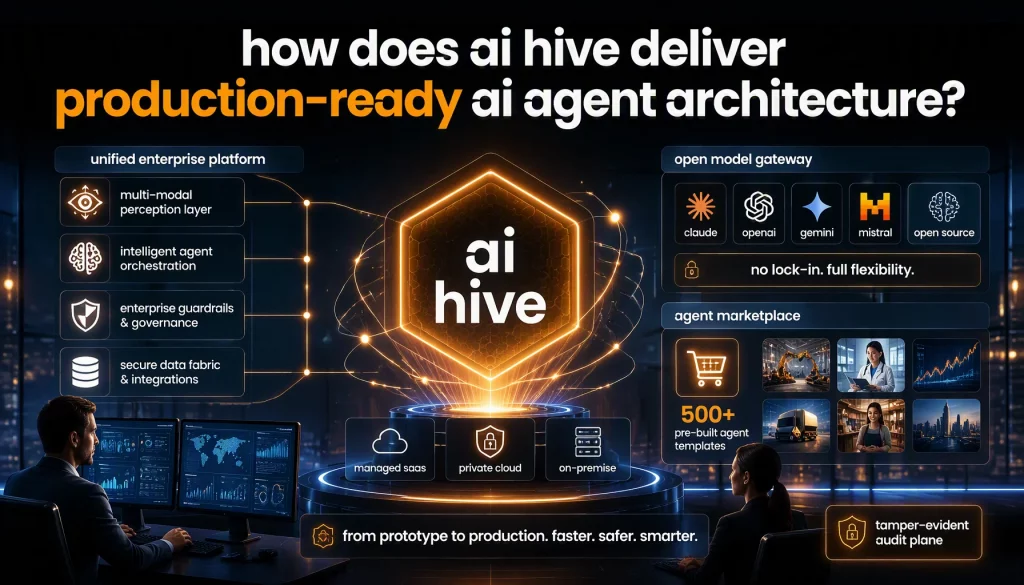
We designed AI Hive specifically to address the architectural gaps that cause enterprise AI projects to stall between prototype and production. Our platform implements all seven core components described above – from a multi-modal perception layer to a tamper-evident audit plane – within a unified framework that your team can deploy on our managed SaaS environment or within your own private cloud or on-premise infrastructure.
Our model gateway supports any major LLM provider – Anthropic Claude, OpenAI, Google Gemini, Mistral, and locally hosted open-source models – without any code changes to your agent logic. This means your enterprise is never locked into a single provider’s pricing model or capability roadmap. Furthermore, our Agent Marketplace provides over 500 pre-built agent templates – organized by industry and use case – that your team can deploy, customize, and extend without building foundational architecture from scratch.
Teams that prefer a visual approach to agent design can explore our no-code AI agent workflow builder, which maps to the orchestration and action layers described in this guide.
For organizations that lack in-house AI engineering talent, our AI Engineers for Hire service pairs your team with specialists who design, build, and validate production agent architectures aligned to your specific compliance, security, and integration requirements. We have consistently reduced time-to-production from the industry average of six to eighteen months to under ninety days.
You can explore how enterprise organizations are applying these architecture patterns in practice on our enterprise AI agent deployment guide, which includes case studies across BFSI, healthcare, manufacturing, and logistics.
What Are the Most Common AI Agent Architecture Mistakes That Kill Enterprise Projects?
Our team has audited dozens of stalled enterprise AI initiatives. The same architectural missteps appear repeatedly across industries and technology stacks – and all of them are preventable with upfront architectural discipline.
- Monolithic agent design: Building a single general-purpose agent instead of a modular system creates a system that becomes impossible to test, debug, or update without regression risk as complexity grows. Decompose into specialized agents from the start.
- Skipping the memory layer: Assuming the LLM’s context window is sufficient for all tasks. In production, agents need persistent semantic memory to maintain coherent behavior across long-running tasks and returning users. A 128k context window is not a memory strategy.
- No human-in-the-loop gates: Deploying fully autonomous agents for high-stakes decisions before establishing risk thresholds and escalation paths. The cost of a single autonomous error in a regulated process can outweigh months of efficiency gains. Gate design must happen before go-live.
- Hardcoded tool permissions: Granting agents broad system access during development and never scoping down to least-privilege before production. This is the most common vector for security incidents in agentic AI systems. Apply the principle of least privilege to every tool call.
- Missing observability: Launching without structured logging of agent reasoning chains. Without an audit trail, debugging production failures becomes guesswork and regulatory audits become nightmares. Build the audit plane before writing the first agent.
Conclusion
AI agent architecture is the foundation upon which every enterprise AI initiative either succeeds or fails. The organizations reaching production in 2026 are not necessarily those with the largest AI budgets or the most advanced models – they are the ones that invested in principled architectural decisions before writing a single line of agent code. From perception layers that defend against prompt injection, to orchestration patterns that coordinate specialized agents at scale, to audit planes that satisfy regulators, each architectural element plays a non-negotiable role in a production-grade system.
We built AI Hive to give your enterprise the architectural foundation it needs without requiring you to build it from scratch. Whether you need a fully managed SaaS deployment, an on-premise implementation that keeps your data within your own infrastructure, or a team of AI engineers to design and build your agent architecture alongside your team – we are ready to support your journey from prototype to production in ninety days or less.
Ready to build your enterprise AI agent architecture on a foundation designed for production? Schedule a consultation with our AI Hive team today and let us show you how to reach production in ninety days or less.