

Static product recommendation widgets on your Shopify store operate on limited signals – purchase history, browsing category, and basic collaborative filtering. These widgets surface suggestions on product and cart pages, but they cannot ask a clarifying question, understand a customer’s specific need, or adapt their recommendations mid-conversation. A Shopify chatbot for product recommendations changes this dynamic fundamentally: the chatbot engages customers in a guided discovery conversation, gathers real-time intent signals that no passive widget can capture, and translates those signals into personalized suggestions that drive measurably higher average order values.
What a Shopify product recommendation chatbot is NOT: It is not a simple pop-up that displays bestsellers based on page views. A genuine recommendation chatbot uses natural language understanding to interpret customer intent, filters against your live catalog including stock levels and variants, applies your business rules (margins, promotions, new arrivals), and learns from each accepted or rejected recommendation to improve future suggestions.
Product recommendations contribute 10–25% of total ecommerce revenue and increase AOV by 15–30% when properly implemented, according to 2026 ecommerce personalization benchmarks. Furthermore, 49% of consumers report purchasing products they did not initially intend to buy after receiving a personalized recommendation. The question for Shopify merchants is no longer whether personalization works – it is how to deliver it in a way that feels genuinely helpful rather than algorithmic.
Why Do Conversational Recommendations Outperform Static Widgets?
Conversational recommendations outperform static widgets because they capture real-time intent – what the customer actually needs right now – rather than inferring preferences from historical behavioral data alone. A static widget treats every customer browsing running shoes identically; a chatbot asks whether they are shopping for themselves or buying a gift, and delivers an entirely different recommendation set based on the answer. This single distinction accounts for most of the measurable AOV difference between the two approaches.
Traditional product recommendation engines operate on what a customer has done – their browsing history, past purchases, and items in their current cart. These behavioral signals are valuable but incomplete. A customer browsing running shoes may be shopping for themselves, buying a gift, replacing worn-out shoes, or exploring a new hobby. Each scenario requires a different recommendation strategy, and a static widget treats them all identically.
A chatbot-driven recommendation system adds a layer that static engines cannot provide: real-time conversational context. When a customer interacts with the chatbot, it can ask questions that reveal intent, preference, and constraints: “Are you shopping for yourself or looking for a gift?” “What activities will you be using these for?” “Do you have a budget range in mind?” Each answer narrows the recommendation set and increases the probability that the suggested products match what the customer actually needs.
This conversational approach mirrors the experience of shopping with a knowledgeable sales associate in a physical store. The associate does not simply point to the bestseller shelf – they ask questions, listen to answers, and guide the customer toward products that fit their specific situation. The chatbot replicates this guided selling experience at scale, available 24/7 across every customer interaction.
Merchants who understand the broader AI agent capabilities available for Shopify stores can leverage recommendation chatbots as one component of a comprehensive automation strategy that spans pre-purchase discovery, post-purchase support, and retention.
How Does a Shopify Product Recommendation Chatbot Work?
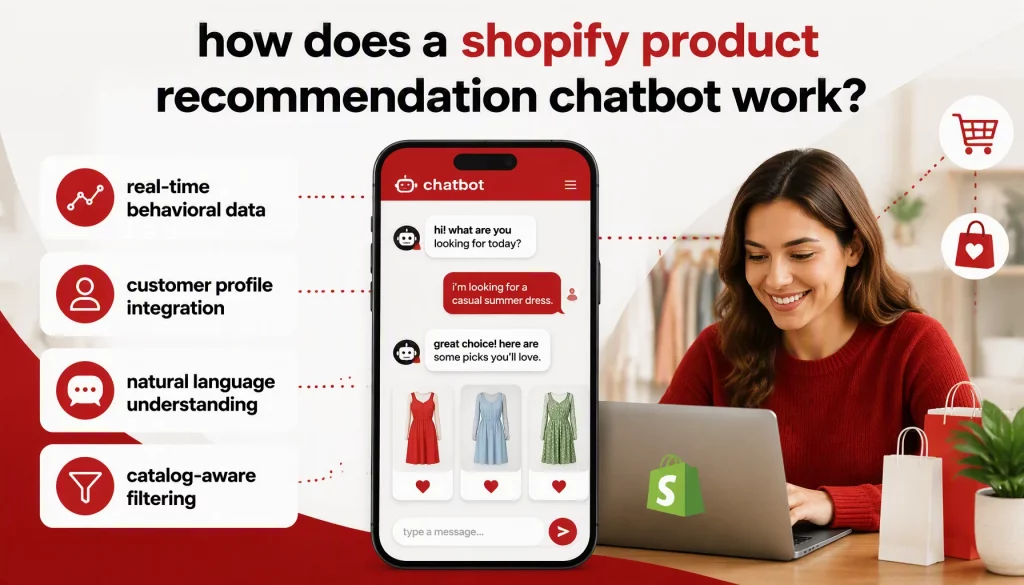
A Shopify product recommendation chatbot works by layering four data sources – real-time session behavior, customer profile history, natural language intent signals, and live catalog inventory – to generate recommendations that are simultaneously personalized, contextually relevant, and commercially viable. Each layer adds specificity that the previous layer alone cannot provide.
Real-Time Behavioral Data
The chatbot tracks the customer’s current session behavior: which product pages they visited, how long they spent on each page, which products they added to and removed from their cart, and what search queries they entered. This real-time behavioral data provides immediate context about the customer’s current shopping intent, distinct from their historical purchase patterns.
Customer Profile Integration
For returning customers, the chatbot accesses their Shopify customer profile, including past order history, total spend, preferred product categories, and average order value. This historical data informs recommendations by identifying patterns: a customer who consistently purchases premium products receives recommendations at a corresponding price point, while a customer who typically buys during sales may respond better to value-oriented suggestions.
Natural Language Understanding
The chatbot processes the customer’s natural language input to extract intent signals. When a customer says “I need something for my mom’s birthday, she is into yoga and likes earth tones,” the chatbot identifies the gift-giving context, the recipient’s interests, the activity category, and the color preference – generating a highly targeted recommendation set that a static widget could never produce from behavioral data alone.
Catalog-Aware Filtering
The recommendation engine filters against your live Shopify inventory, ensuring that every suggested product is currently in stock in the relevant sizes and variants. Recommending an out-of-stock product wastes the customer’s time and damages trust. The chatbot also respects business rules you configure: promoting new arrivals, prioritizing high-margin products, or featuring items from a current promotional campaign – so commercial priorities and customer relevance are optimized simultaneously.
Which Strategies Drive 25% Higher AOV Through Chatbot Recommendations?
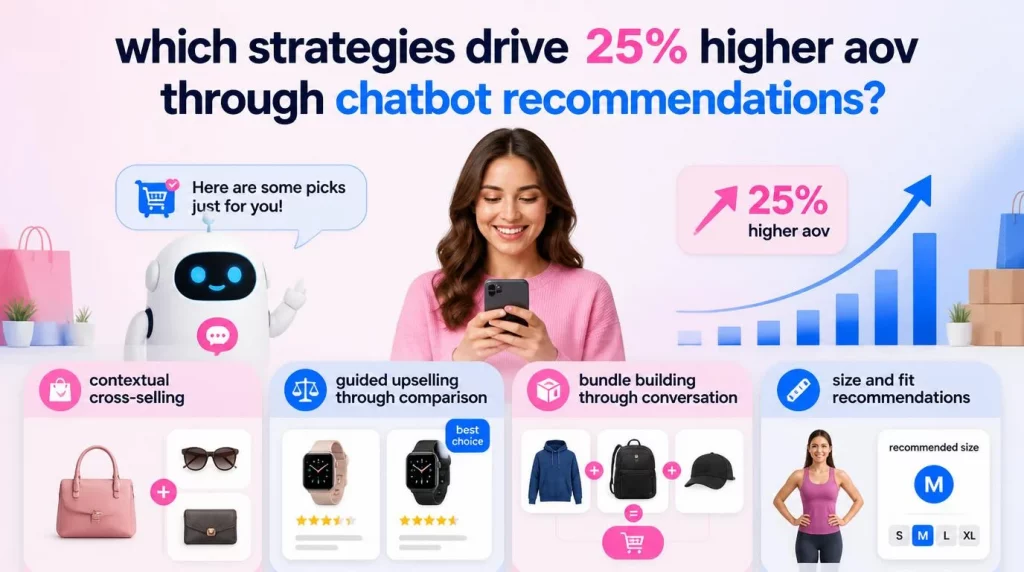
The AOV impact of chatbot-driven recommendations comes from four specific strategies that leverage the conversational format’s unique advantages. Each strategy operates differently and addresses a distinct stage of the purchase decision process.
Contextual Cross-Selling
When a customer adds a product to their cart, the chatbot identifies complementary items based on the specific product selected – not just the product category. A customer who adds a leather jacket receives suggestions for the matching belt and care kit from the same collection, not generic “you might also like” suggestions. This specificity increases the perceived relevance of the cross-sell. Merchants typically see AOV lifts of 8–15% from cart-based recommendations when the suggestion logic accounts for both the cart contents and the customer’s demonstrated preferences from the conversation.
Guided Upselling Through Comparison
Rather than simply showing a higher-priced alternative, the chatbot explains the value difference: “The Classic Watch is a great choice at $149. If you are looking for sapphire crystal and water resistance to 100 meters, the Professional model at $249 includes both – would you like me to compare them side by side?” This consultative upselling approach presents the higher-priced option as a better solution rather than simply a more expensive one, which reduces price resistance and increases the likelihood of upgrading.
Bundle Building Through Conversation
The chatbot can build custom bundles based on the customer’s expressed needs. A customer shopping for a home office setup might receive a curated bundle – desk lamp, monitor stand, and wireless keyboard – based on their stated workspace requirements and aesthetic preferences. The chatbot presents the bundle as a complete solution with a combined price, encouraging a larger single transaction rather than multiple separate purchases made across different sessions.
Size and Fit Recommendations
For apparel and footwear stores, sizing uncertainty is a major barrier to purchase and a leading cause of returns. The chatbot addresses this by asking fit-related questions: “How did your last pair of our shoes fit?” “Do you prefer a relaxed or slim fit?” Based on the customer’s answers and historical size data from previous orders, the chatbot recommends the right size with confidence, reducing purchase hesitation and the 15–30% return rate that plagues apparel ecommerce. AI-driven personalized recommendations contribute to a 15–20% increase in conversion rates across these four strategies – and the compounding effect of higher conversion rate multiplied by higher average order value makes chatbot recommendations one of the highest-ROI investments a Shopify merchant can make.
Which Are the Best Shopify Chatbot for Product Recommendations in 2026?
The Shopify app ecosystem offers several distinct approaches to conversational product recommendations. The comparison below covers the top platforms evaluated on recommendation sophistication, catalog integration depth, conversation design flexibility, and pricing – to help you match the right tool to your store’s size and requirements.
| Platform | Best For | Recommendation Engine | Price Range | Key Strength | Limitation |
| Rep AI | Mid-to-large stores (500+ orders/month) | Behavioral AI + conversational NLU | $299–$599/month | Real-time behavioral signals + proactive engagement | Higher price point; ROI needs volume |
| Octane AI | DTC brands focused on quizzes + SMS | Quiz-based recommendation flows | $50–$200/month | Product quiz builder, Klaviyo + SMS integration | Less dynamic; relies on pre-built quiz flows |
| Tidio | Small to mid-size stores | Rule-based + basic ML | Free–$59/month | Affordable entry point, live chat hybrid | Limited catalog depth, less personalization |
| ChatBot.com | Stores needing visual flow builder | Rule-based conversational flows | $52–$142/month | Drag-and-drop flow builder, multi-channel | Requires manual catalog mapping |
| Gobot | Guided selling focus | Quiz + conversational recommendations | $99–$299/month | Strong guided selling flows for complex products | Smaller ecosystem, fewer integrations |
Merchants evaluating budget before committing to a paid platform will find our review of free chatbot options for Shopify a useful starting point before scaling to ML-driven tools.
How to Choose the Right App Based on Your Store Size
| Store Size | Monthly Orders | Recommended App | Rationale |
| Small store | Under 200 orders/month | Tidio (free plan) | Low cost, basic personalization, easy setup. Upgrade when volume justifies ML-driven approach. |
| Growing DTC brand | 200–500 orders/month | Octane AI or Gobot | Quiz-based recommendations drive strong AOV lift; Klaviyo integration supports retention. |
| Established mid-market | 500–2,000 orders/month | Rep AI | Behavioral AI delivers measurable AOV improvement at this volume; ROI typically covers platform cost within 60 days. |
| Enterprise / high SKU count | 2,000+ orders/month | Custom build via AI Hive | At scale, a custom AI recommendation agent integrated directly with your catalog, pricing engine, and CRM delivers superior personalization and avoids platform vendor lock-in. |
When Does It Make Sense to Build a Custom Recommendation Chatbot Instead of Using an App?
Understanding the difference between an AI agent and a traditional chatbot is essential before deciding whether a custom build is justified for your store’s scale. A custom recommendation chatbot becomes the right choice when your store’s requirements outgrow what off-the-shelf apps can deliver – specifically, when you need deep catalog integration beyond standard product fields, multi-LLM orchestration for cost optimization, or compliance-grade data handling for markets with strict privacy requirements.
Three signals indicate you have outgrown app-based solutions: your recommendation logic requires data from systems outside Shopify (ERP, loyalty platform, custom pricing engine); your SKU count exceeds 10,000 products where pre-built quiz flows become unmanageable; or your per-transaction LLM cost on a managed platform has become a material line item.
Building a Recommendation Chatbot Using the ChatGPT API
Merchants with development resources can build a lightweight recommendation chatbot using OpenAI’s ChatGPT API connected to their Shopify product catalog. The core architecture involves three components: a catalog sync that exports your Shopify products (title, description, price, inventory, tags) to a vector database such as Pinecone or Weaviate; a conversation layer that uses GPT-4o to interpret customer intent from natural language input; and a retrieval layer that queries the vector database with the interpreted intent to surface the most relevant products.
The primary advantage of this approach is cost control: you pay only for actual API usage rather than a monthly platform fee, and you can route simpler recommendation queries to a smaller, cheaper model (GPT-4o-mini) while reserving GPT-4o for complex multi-turn conversations. Organizations that implement multi-model routing in this way typically reduce per-session LLM costs by 35–60% compared to single-model approaches.
The primary disadvantage is implementation time and ongoing maintenance. Building a production-grade recommendation chatbot with proper catalog sync, session memory, escalation logic, and analytics typically requires 4–8 weeks of engineering effort. For merchants who lack in-house AI engineering resources, our AI Engineers for Hire service provides a dedicated team that designs, builds, and maintains custom recommendation agents integrated with your specific Shopify architecture.
How Do You Set Up a Shopify Chatbot for Product Recommendations That Actually Converts?
Deploying a product recommendation chatbot requires thoughtful conversation design, not just app installation. The implementation steps below maximize the revenue impact of your chatbot from day one.
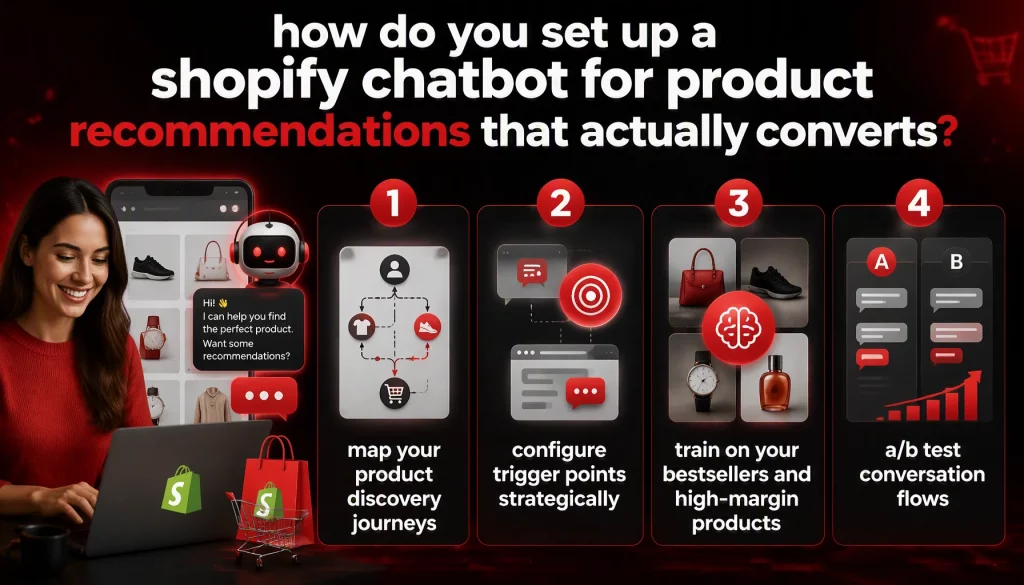
Step 1: Map your product discovery journeys
Before configuring the chatbot, document the questions a great human sales associate would ask for each major product category. For a skincare store, the discovery journey might include skin type, primary concerns, current routine, and budget. For an electronics store, the journey covers use case, technical requirements, compatibility needs, and price range. These discovery journeys become the conversation flows your chatbot follows.
Step 2: Configure trigger points strategically
The chatbot should not interrupt every visitor with a recommendation prompt. Configure triggers based on behavioral signals that indicate a customer is in discovery mode: browsing multiple products in the same category, spending more than 60 seconds on a product page without adding to cart, returning to a previously viewed product, or searching for terms that indicate comparison shopping.
For a detailed technical walkthrough of Shopify chatbot integration best practices – including API authentication, webhook setup, and catalog sync – our integration guide covers each step.
Step 3: Train on your bestsellers and high-margin products
Ensure the chatbot’s recommendation logic accounts for your business priorities, not just the customer’s stated preferences. Configure the system to prioritize products with healthy margins, strong reviews, and low return rates. The chatbot should present these products when they match the customer’s criteria – not force unsuitable products simply because they are profitable.
Step 4: A/B test conversation flows
Run controlled experiments comparing different conversation approaches: short flows (2–3 questions) versus detailed flows (5–6 questions), recommendation formats (single product versus curated set of three), and follow-up strategies (immediate cart addition prompt versus “take your time” approach). Let conversion and AOV data determine which approach works best for your specific audience.
How Do You Measure Whether Your Product Recommendation Chatbot Is Delivering ROI?
Track these five metrics to quantify your recommendation chatbot’s impact and identify where to optimize its performance.
| Metric | What It Measures | Healthy Benchmark | Action If Below Benchmark |
| Revenue attributed to chatbot | Total revenue from orders where customer added a chatbot-recommended product | Platform cost recovered within 60 days | Review recommendation logic and trigger points |
| AOV lift | AOV of chatbot-assisted sessions vs. unassisted sessions | 10–25% increase | Improve cross-sell specificity and upsell framing |
| Recommendation acceptance rate | % of recommendations added to cart | 15–30% | Below 10%: recommendations not relevant. Above 40%: only recommending bestsellers. |
| Cart abandonment rate | Abandonment rate for chatbot-engaged vs. non-engaged sessions | Chatbot sessions abandon less | Review purchase hesitation points in conversation flows |
| Return rate by source | Return rate for chatbot-recommended vs. self-selected products | Equal or lower | Refine size/fit and specification questions in discovery flows |
Conclusion
A Shopify chatbot for product recommendations transforms passive browsing into guided discovery, leveraging conversational AI to understand each customer’s specific needs and match them with products that drive both satisfaction and measurable revenue growth. Merchants who implement conversational recommendations see AOV increases of 15–25%, conversion rate improvements of 15–20%, and lower return rates – because customers receive recommendations that match their actual requirements rather than generic bestseller lists.
We build AI recommendation agents at AI Hive that integrate directly with your Shopify catalog, learn from every customer interaction, and optimize for your specific business metrics – not generic conversion targets. Whether you need an off-the-shelf integration configured for your store or a fully custom recommendation engine built on your proprietary data, our team designs solutions that scale with your ecommerce operation.
Approach the AI Hive team to explore how conversational product recommendations can accelerate your store’s revenue growth.