

Finding the right AI engineers for hire has quietly become one of the biggest execution risks in enterprise AI programs, since even fully funded projects stall when talent decisions are made too fast or without a clear engagement model. In addition, the 2026 market has become significantly more expensive, with base salaries reaching $185,000, contract rates hitting $160 per hour, and full-year costs routinely exceeding $300,000 once integration and management overhead are included. Consequently, choosing where and how to source AI engineers for hire has a bigger impact on delivery outcomes than most leadership teams anticipate.. Accordingly, this guide compares the top platforms, explains the real cost structure, and helps you match engagement models to project types before you begin outreach.
Key takeaways
|
Why hiring AI engineers in 2026 is structurally broken
The AI engineering talent shortage is not a temporary hiring freeze. It’s a structural gap created by an entirely new discipline that barely existed three years ago – and it’s not closing quickly.
Three data points frame the problem:
- Bain’s 2025 AI at Work report found that over 40% of CTOs name “evaluating real-world AI engineering skill” as their primary hiring obstacle – not budget, not tools, but identifying who can actually deliver.
- Gartner research shows 70% of AI projects fail to reach production, with the root causes traced to team skill mismatches and unclear role definitions, not the technology itself.
- McKinsey’s 2025 AI talent research found that organizations with structured AI-role taxonomies ship AI features 25 to 35% faster than peers relying on ad hoc hiring.
The engineers who are genuinely good at this work – who have built RAG systems that held up under enterprise data volumes, managed LLM inference costs at scale, and navigated compliance requirements in regulated industries – are few, well-compensated, and rarely job hunting. That combination is what makes AI engineering structurally different from general software hiring.
Three specific roles are driving the most demand, each requiring a meaningfully different skill set:
- LLM and AI Agent Engineers build autonomous agents and orchestrate large language models through multi-step reasoning pipelines. They are responsible for what happens when an agent fails mid-task, not just when it succeeds.
- RAG and Knowledge Engineers connect enterprise data sources – CRM, ERP, internal documents – to LLMs through retrieval-augmented generation pipelines and vector databases. Their core job is ensuring the model answers from your data, not from hallucination.
- MLOps Engineers keep AI systems running reliably in production. They manage model monitoring, cost-per-inference optimization, version control for model releases, and the performance drift that kills AI deployments slowly over months.
If your project involves any of these three areas, you need someone with verifiable production experience. A candidate who “worked with GPT” on a side project is not the same person.
What AI skills actually matter before you post a job?
Many companies open a hiring platform before they’ve defined what they actually need. The title “AI engineer” now covers everything from someone who prompts Claude in a Jupyter notebook to someone who fine-tunes a 7-billion-parameter model on proprietary datasets and deploys it on-premise behind a compliance layer. Those two profiles don’t cost the same, and they won’t solve the same problem.
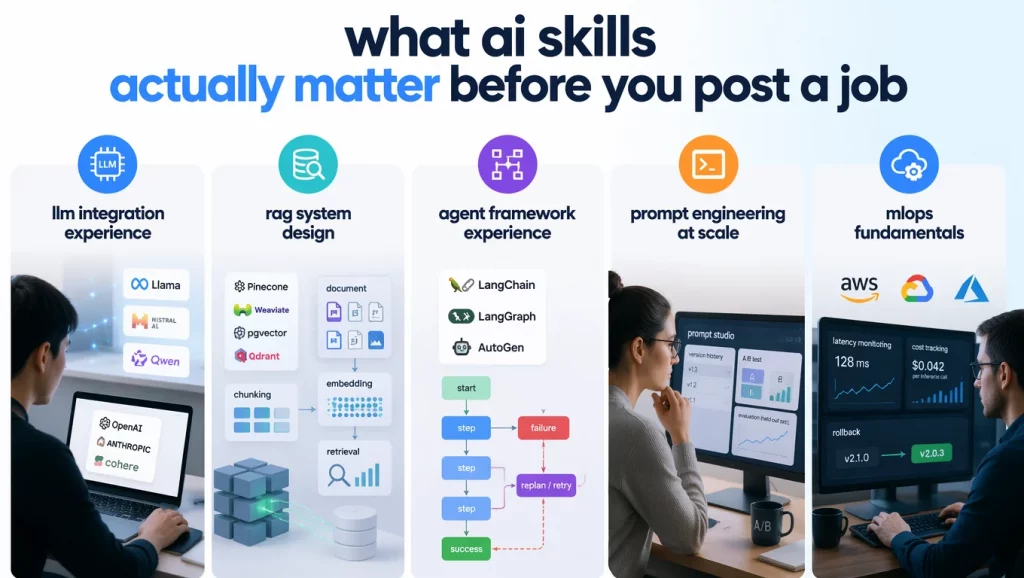
The skills that separate production-ready AI engineers from the broader talent pool cluster around five areas. Understanding these before you post any job description saves weeks of filtering and significantly reduces mis-hire risk.
- LLM integration experience: Direct working knowledge of at least one major API (OpenAI, Anthropic, or Cohere) and at least one open-weight model family (Llama, Mistral, or Qwen), plus the ability to evaluate model behavior under production conditions, not just on published benchmarks.
- RAG system design: Solid understanding of vector databases like Pinecone, Weaviate, pgvector, and Qdrant, with the ability to discuss chunking strategies for mixed-format documents and retrieval quality degradation under real-world query distributions.
- Agent framework experience: LangChain, LangGraph, and AutoGen are the most common. More important than the framework is whether the candidate has handled multi-step task failure modes in a live system, not just happy-path demos.
- Prompt engineering at scale: Versioning prompts, A/B testing output quality against a held-out evaluation set, and detecting the prompt drift that emerges when models update or domain data shifts.
- MLOps fundamentals: Model deployment on AWS, GCP, or Azure; latency monitoring; cost tracking per inference call; and rollback procedures when a new model version regresses on production metrics.
Beyond core skills, the right emphasis shifts significantly by project type:
| Project type | Skills to prioritize |
|---|---|
| Enterprise chatbot or virtual assistant | LLM fine-tuning, RAG, dialogue management, safety guardrails |
| Document automation (KYC, contracts, compliance) | OCR integration, structured data extraction, LLM parsing pipelines |
| AI agent or autonomous workflow | Agent orchestration, tool calling, error recovery design |
| Predictive analytics or risk modeling | ML modeling with XGBoost or PyTorch, feature engineering, model explainability |
| On-premise or regulated deployment | Data residency architecture, PII handling, audit trail generation |
Knowing which category your project sits in before you post a job description not only saves weeks of filtering – it also determines which hiring platform and engagement model carry the least risk.
Top 5 platforms to hire AI engineers in 2026
Choosing the right platform for AI engineers for hire is not about brand recognition. Instead, these five platforms are evaluated on criteria that matter for production AI work: vetting rigor, AI-tool fluency assessment, time to first candidate, and realistic cost range.. Each platform fits a different scenario.
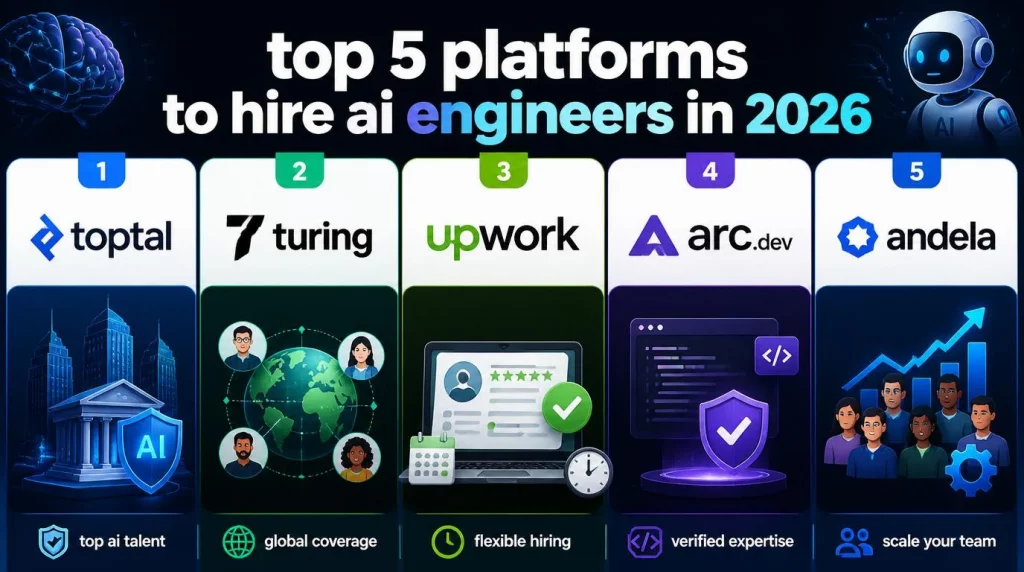
| Platform | Acceptance rate | Time to candidate | Hourly rate | Best for |
| Toptal | Under 3% | 2-5 days | $120-$250/hr | Senior AI architects, high-stakes enterprise |
| Turing | Around 1% | 10-14 days | $40-$120/hr | Cost-efficient global talent, MLOps, dedicated teams |
| Upwork | Open market | 1-3 days | $50-$200/hr | Short-term, scoped tasks, POC builds |
| Arc.dev | Curated | 3 days (72-hr shortlist) | $80-$180/hr | Production AI with open-source credentials |
| Andela | Structured | 10-18 days | $40-$100/hr | Rapid team scaling, MLOps, data pipeline work |
1. Toptal – best for high-stakes enterprise AI projects
Toptal accepts fewer than 3% of applicants and explicitly evaluates candidates on LLM productionization, RAG system design, and OpenAI or Anthropic SDK integration. Their two-week trial engagement model provides meaningful risk reduction for high-investment projects.
Key services:
- Pre-vetted senior AI architects for complex system design and technical strategy
- LLM integration, fine-tuning, and model evaluation specialists
- Full-time, part-time, and project-based engagements with a 40-hour commitment floor
What works well:
- Over 90% of recent Toptal AI engagements involve production LLM work, not academic ML research
- Two-week trial period before full commitment reduces hiring risk on expensive projects
- Candidates are evaluated on real integration tasks, not abstract algorithmic problems
What to watch:
- Premium pricing ($120 to $250/hr) puts Toptal out of reach for early-stage or POC budgets
- 40-hour minimum makes it unsuitable for short discovery phases
- Matching process can run 2-5 days before a shortlist appears
Best fit:
- Established enterprises running high-stakes AI projects – production agent deployments, compliance automation at scale, large-scale RAG systems – where the cost of a bad hire exceeds the platform premium
2. Turing – best for cost-efficient AI teams with global coverage
Turing operates a curated global network of more than 25,000 AI engineers across 140 countries, with approximately 1% acceptance. Their AI-powered matching system explicitly tracks LangChain proficiency, vector database experience, and MLOps tooling – not just years of Python listed on a resume.
Key services:
- Dedicated AI engineers embedded in your delivery cycle on a 160-hour/month minimum
- MLOps and model deployment specialists across North America, Latin America, and Eastern Europe
- AI-powered talent matching with documented specialization tracking
What works well:
- Documented case: a North American fintech cut senior ML time-to-hire from 8 weeks to 10 days and shipped a new credit-risk model in under three months
- Cost differential vs. US-based platforms is real at $40 to $120/hr
- Strong vetting for MLOps and LLM integration roles
What to watch:
- 160-hour/month minimum for dedicated placements offers no downward flexibility – variable demand means paying for idle capacity
- Quality varies across AI specializations; thinner for domain-specific work in regulated industries
- Requires structured async workflows for teams with strict time-zone overlap requirements
Best fit:
- Engineering leaders who need to scale an AI team cost-effectively, have global timezone flexibility, and are building for MLOps, LLM integration, or data pipeline use cases
3. Upwork – best for short-term, well-scoped AI tasks
Upwork is an open marketplace with over 200,000 AI and ML professionals listed. Job posts mentioning LLM, RAG, or MLOps grew 85% year-over-year through 2025 to 2026. Without the Expert-Vetted or Talent Scout filter, companies search an enormous pool of self-certified “AI engineers,” many of whom rebranded in the past 18 months without shipping anything real.
Key services:
- Fractional AI work, prototyping, and MVP builds on hourly or milestone contracts
- Short-term LLM integration and prompt engineering contracts with no minimum commitment
- Expert-Vetted sourcing filter for significantly higher candidate quality
What works well:
- Fastest path to a qualified candidate for 3-4 week POCs with clearly defined output
- AI/ML projects using Expert-Vetted filter fill 40% faster at meaningfully higher quality
- No minimum commitment – ideal for scoped, time-bounded tasks
What to watch:
- Platform sliding fees of 5 to 20% add to the effective hourly rate
- Accountability structure is platform-first, not delivery-cycle-first – creates real risk for long-duration projects
- Not a primary channel for senior, full-time AI engineering hires
Best fit:
- Well-scoped, short-term tasks where you can evaluate a candidate through a paid test project first; not appropriate for six-month enterprise deployments in regulated industries
4. Arc.dev – best for production AI with verifiable open-source credentials
Arc.dev curates engineers with verified open-source contributions to PyTorch, Hugging Face, and popular LLM tooling repositories. Their three-stage assessment emphasizes real-world AI system deployment, and clients see an average 50% reduction in time-to-shortlist because candidates arrive pre-tagged with scores across AI frameworks and cloud platforms.
Key services:
- Production AI engineers with public GitHub track records that are independently verifiable
- MLOps and LLM framework specialists with documented deployment histories
- 72-hour candidate shortlist with AI specialization matching
What works well:
- Open-source contribution history is one of the harder-to-fake signals in AI hiring – merged PRs in widely-used LLM libraries demonstrate real capability publicly
- 50% reduction in time-to-shortlist vs. unfiltered marketplaces
- Strong for teams whose stack overlaps with PyTorch and Hugging Face ecosystems
What to watch:
- 11% platform service fee adds directly to effective engagement cost
- Smaller pool than Upwork or Turing – less suitable for urgent, high-volume hiring
- Thinner coverage for proprietary enterprise AI integrations (SAP-native AI, Salesforce Einstein)
Best fit:
- Teams building AI-native products who want verifiable, public-facing evidence of engineering quality before the interview begins
5. Andela – best for scaling an AI team fast and repeatably
Andela’s Talent Decision Engine pre-vets engineers on data pipeline work, model deployment, and MLOps tooling. Companies using Andela cut time-to-hire by 60% – from 45-plus days to under 18 – while reporting a 96% successful engagement rate at the three-month mark. Most platforms publish acceptance rates; Andela publishes what happens after the engineer starts working.
Key services:
- Rapid AI team scaling for mid-size enterprises with structured engagement management
- MLOps, data engineering, and AI infrastructure specialists
- Repeatable hiring process designed to reduce internal recruiting overhead across multiple hires
What works well:
- 96% three-month success rate – the metric that matters most for sustained delivery, not just initial placement
- Structured process compounds in value for organizations scaling more than once
- 60% reduction in time-to-hire vs. unstructured in-house search
What to watch:
- Less focused on cutting-edge LLM and agent engineering than Toptal or Arc.dev
- Better calibrated for MLOps and data infrastructure than frontier AI capabilities
- Pricing less transparent upfront than other platforms on this list
Best fit:
- Mid-size organizations scaling an AI team for the first time who need a reliable, repeatable process rather than a bespoke executive search
The real cost to hire AI engineers in 2026 (what the job ad never shows)
Most cost guides give you a table of hourly rates and stop there. A 2026 analysis by divogue.net found that the true year-one cost of a US AI engineer runs 1.5 to 2x the base salary – closer to $300,000 than the $185,000 on the offer letter – once you account for everything the rate card omits.
The table below captures what most hiring proposals ignore:
| Hidden cost category | What it actually includes | Realistic financial impact |
| Recruiting fee | 20-25% of first-year base salary; AI-specific searches run 21-23% due to thinner candidate pools | $37,000 to $55,000 on a $185K hire |
| Platform service fee | Upwork 5-20%; Arc.dev 11%; Hired 11%; not charged by Toptal or Turing | Adds 11-20% to effective hourly rate |
| Onboarding ramp | 8 to 12 weeks before a new AI hire ships real work; needs your eval set, prompt library, data lineage, and incident postmortems | 2-3 months of lower-than-expected output |
| LLM API and GPU compute | OpenAI/Anthropic API usage, vector database hosting, GPU compute for fine-tuning; scales with productivity | $200 to $5,000-plus per month |
| Iteration overhead | AI projects require model evaluation, prompt iteration, and output quality testing that standard dev estimates don’t capture | 20-35% higher time estimates than equivalent software projects |
| Failed-hire replacement | McKinsey research: failed senior technical hires cost 1.5 to 3x annual salary in recruiting, lost productivity, and replacement search | $300,000 to $600,000 for a $200K AI role |
| Vacancy tax | Average US AI engineer search runs 90 to 120 days in 2026; work not being built during that window is a real cost | Project delays, competitor advantage, compounding opportunity cost |
The practical implication: for a three-month AI project at $100/hr on Upwork, the true cost including platform fees, onboarding, API spend, and iteration overhead typically runs 1.4 to 1.6 times the initial estimate. Every AI hiring proposal submitted to finance should reflect that buffer before approval.
Southeast Asian AI engineers with comparable production experience typically cost 40 to 60% less than US rates (Second Talent, 2026), with all-in monthly costs running $3,000 to $6,000 for senior engineers in Vietnam and the Philippines. Hidden costs exist in this model too – timezone coordination, async communication, domain context transfer – but the loaded year-one total remains substantially lower than a US direct hire.
Matching the right hiring model to your scenario
The most expensive AI hiring mistake isn’t overpaying for a platform. It’s applying the wrong hiring model to the wrong project type. Use this decision matrix before opening any platform:
| Scenario | Duration | Internal AI maturity | Recommended model |
| Proof of concept | 4-8 weeks | Low | Upwork Expert-Vetted, hourly, paid test project first |
| MVP build | 2-4 months | Low to medium | Arc.dev or Turing, fixed-scope contract |
| Production system | 4-12 months | Medium | Toptal or Turing, dedicated engagement with clear milestones |
| Scale existing AI team | Ongoing | High | Andela or direct hire via Hired |
| Enterprise AI transformation | 12 months-plus | Mixed | Managed AI engineering team with delivery accountability |
| Regulated industry (BFSI, healthcare) | Any duration | Any level | Vendor with on-premise capability, compliance architecture, and embedded engineers |
Individual engineers hired through marketplaces provide technical capacity. They don’t provide a delivery framework, architecture governance, compliance infrastructure, or accountability after go-live. For projects requiring data sovereignty, on-premise deployment, or legacy system integration, a managed team of AI engineers for hire typically outperforms a marketplace hire on total project cost and risk. AI Hive’s model is built for exactly this gap. Our senior engineers work embedded inside your delivery cycle, with explicit accountability for production outcomes rather than individual task completion. For enterprises building agentic AI workflows or enterprise AI agent systems at scale, we bring compliance architecture and data residency controls alongside the engineering capability.
How to evaluate AI engineers under real conditions
Platform vetting removes the weakest candidates from the pool. Your internal technical screen is what separates engineers who can demo a system from engineers who can own one in production. The five-step framework below catches what resume reviews and standard coding interviews consistently miss.
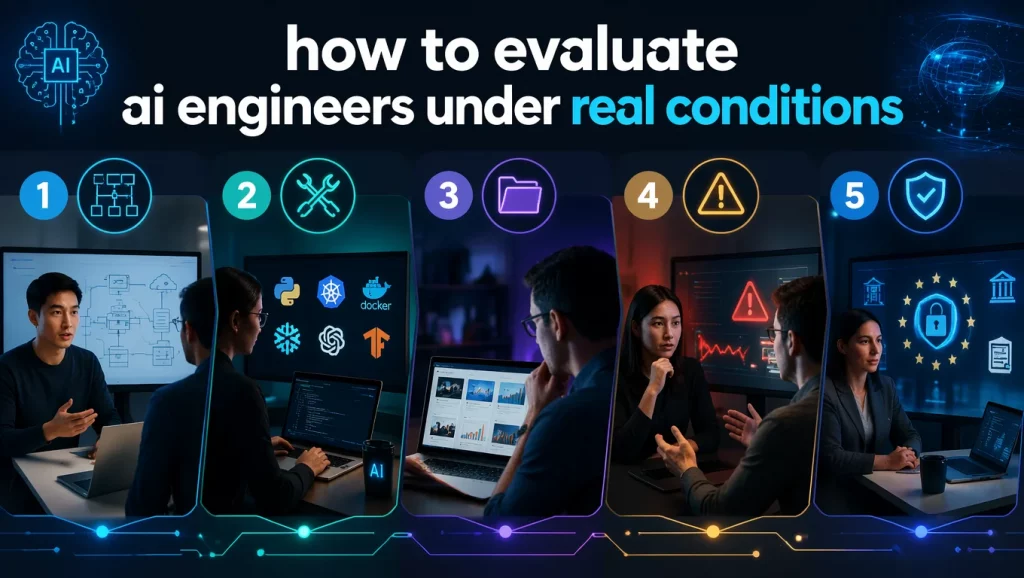
Step 1: Live system design interview (45 minutes)
Give the candidate a real scenario from your industry – not a toy example or whiteboard abstraction. For a financial services company: “Design a RAG system for our compliance team to search 50,000 internal regulatory filings. Walk me through your architecture, chunking strategy for mixed-format PDFs, embedding model selection, and how you’d handle queries spanning filings from different jurisdictions.” Evaluate the clarity and specificity of their reasoning, not just their vocabulary.
Step 2: Tool fluency assessment (30 minutes)
Provide access to a simple codebase with one integration task: wire an LLM to retrieve data from a mock database and return structured output. Ask candidates to narrate their process using their preferred AI development tools. The specific thing you’re evaluating: do they use Claude, GitHub Copilot, or Cursor as a genuine productivity multiplier, or do the tools sit open and idle while they write boilerplate line by line?
Step 3: Portfolio review with production evidence
Request two deliverables: a GitHub repository with recent commits to a real AI project, and a five-minute walkthrough of a production system they personally shipped. Candidates who can only show demos, Jupyter notebooks, or proof-of-concept prototypes should not advance. Production AI work leaves a clear paper trail – deployment logs, monitoring dashboards, API usage tracking, and incident postmortems.
Step 4: Failure mode discussion
Ask directly: “Tell me about an AI system you built that failed in production. What broke, how did you diagnose it, and what did you change?” Engineers who have shipped production AI have specific stories with specific failure modes. Candidates who haven’t will answer in the abstract. The granularity of the failure narrative tells you more than any technical question.
Step 5: Domain and compliance fit check
For any project in a regulated industry, verify the candidate understands the compliance layer: data residency requirements, PII handling procedures, audit trail generation standards, and model explainability requirements for regulatory reporting. This dimension is almost never covered in standard technical screens, yet it’s the one most likely to become a project-blocker six months into the engagement.
Real case studies: AI engineering deployments in Vietnam and APAC
Access to global talent is one thing. Delivering inside a specific regulatory, linguistic, and institutional context is another. For enterprises in Vietnam and Southeast Asia, regulatory complexity, data localization requirements, and domain-specific language add dimensions that a generalist freelance engineer won’t account for. These are not edge cases – they’re the norm in any serious enterprise AI agent development engagement across APAC.
1. Techcombank: rebuilding credit risk scoring with AI
Challenge: Manual KYC and credit underwriting processes averaging 5 business days per application, with a compliance backlog growing every quarter. Engineers needed to understand both the ML architecture and Vietnam’s State Bank reporting standards.
What was deployed: AI and predictive analytics models for credit risk scoring, with Vietnamese-language document processing and compliance reporting built into the pipeline. Engineers required specific intersecting skills: production ML experience, Vietnamese financial regulation familiarity, and integration capability with domestic core banking infrastructure.
Outcomes: Significantly faster application processing compared to manual underwriting baselines, with improved accuracy in risk classification. The compliance layer met State Bank of Vietnam reporting requirements from day one.
Key lesson: AI credit scoring in Vietnam is not a generic software problem. Finding engineers who understand both the technical architecture and the compliance layer through a global marketplace takes considerably longer than working with a team that already operates in-market.
2. BIDV and Vietcombank: institutional-scale AI integration in core banking
Challenge: High-volume manual processes across core banking operations – process automation, fraud detection pattern recognition, and customer service workflow automation – each requiring multi-year engineering engagements, not freelance sprints.
What was deployed: AI systems integrated into legacy core banking infrastructure, covering fraud detection, automated process flows, and customer service routing. Integration with regulatory reporting pipelines required sustained teams with institutional knowledge of each bank’s specific data architecture and compliance obligations.
Outcomes: Both banks reduced operational overhead in high-volume compliance workflows. The multi-year nature of both engagements reflected the integration complexity: connecting AI to legacy core banking systems with active regulatory reporting requirements cannot be scoped as a short-term freelance project.
Key lesson: Short-term marketplace hires work for isolated, well-defined tasks. Production-grade AI in complex, regulated environments requires sustained engineering teams with domain depth, ongoing accountability, and the capacity to navigate compliance requirements that evolve over time.
For enterprises operating in similar contexts, AI Hive’s engineers bring direct experience in APAC enterprise deployments. Our BFSI AI solutions and on-premise deployment model are designed for environments where marketplace hires hit their limits.
Step-by-step: how to hire AI engineers from brief to first commit
AI engineering hiring follows a different rhythm than standard software development hiring. This four-week process minimizes time-to-productivity and surfaces mis-hires before they cost six months of runway.
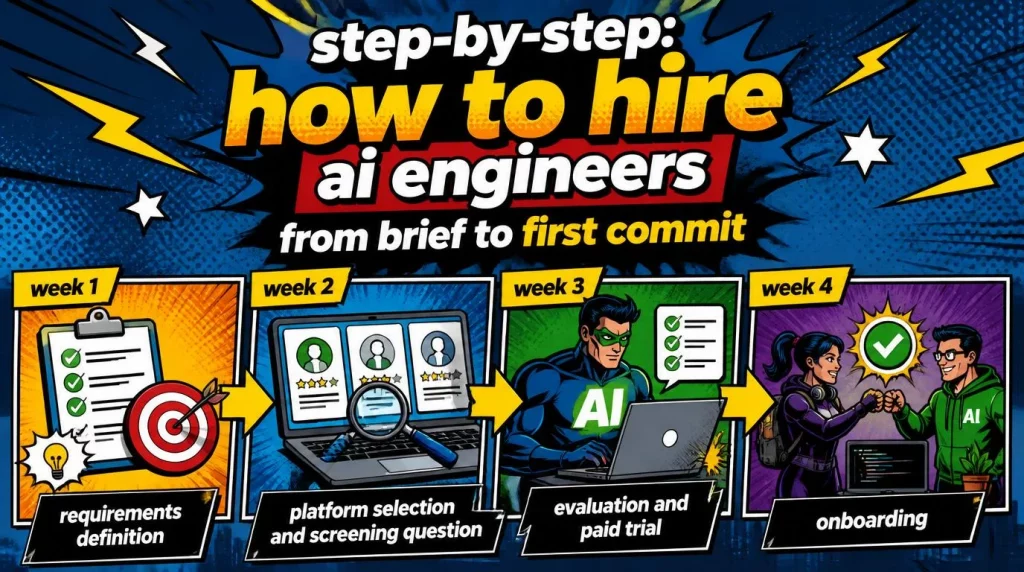
Week 1: Requirements definition
Write a role brief that specifies the technical problem you need solved – not a job description listing technologies. “We need to build a RAG system to automate document review for our compliance team – 50,000 documents, primarily contracts and regulatory filings in Vietnamese and English, with auditable output at every step” is more actionable than “Senior AI Engineer, 5-plus years experience, LLM required.” Define success metrics before outreach begins: time-to-first-answer, accuracy benchmark, latency target, cost-per-query ceiling. Define data constraints separately: what the engineer can access, how it’s structured, and what cannot leave the building.
Week 2: Platform selection and screening question
Choose one primary platform using the scenario matrix above. Post with a specific AI task as a screening question, not a generic request to describe AI experience. An effective screening question: “Describe how you would design a chunking strategy for a RAG system processing mixed-format documents – PDFs, HTML, and scanned images. What are the key tradeoffs between fixed-size and semantic chunking for a compliance document corpus?” Candidates who answer concretely advance. Candidates who answer in marketing language do not.
Week 3: Evaluation and paid trial
Run the five-step framework from the evaluation section above. For any engagement expected to run longer than three months, add a paid one-week trial on a bounded, scoped task before full commitment. Pay particular attention to how the candidate handles ambiguity, communicates blockers, and whether they ask the right clarifying questions before building.
Week 4: Onboarding
Allocate five full business days for environment setup, codebase orientation, and context transfer. Define one specific, measurable 30-day milestone. Set up monitoring infrastructure from day one – API costs, latency tracking, output quality metrics – so you have data to manage the engagement against and catch model drift before it escalates into a production incident.
Common mistakes when hiring AI engineers (and the fix for each)
Even well-resourced teams make the same five mistakes when evaluating AI engineers for hire for the first time, especially when scaling into production AI projects that go beyond isolated pilot builds.
- Mistake 1: screening for credentials instead of production evidence. A PhD in machine learning does not predict performance on a production LLM integration project with legacy data access, API rate limits, compliance guardrails, and cost constraints. Screen for production evidence first: “show me a system you shipped and kept running.”
- Mistake 2: using the wrong platform for the engagement type. Upwork is excellent for a three-week prompt engineering contract. It is structurally wrong for a six-month production AI deployment at a regulated financial institution. Use the scenario matrix above before opening any platform.
- Mistake 3: underestimating onboarding as a material cost. Plan for two to three weeks of lower productivity during context transfer. This is the standard ramp-up cost for any complex AI project and belongs in both the timeline and the budget from day one.
- Mistake 4: discovering the compliance layer six months too late. Confirm in the first interview that candidates understand data residency requirements, PII masking procedures, audit trail generation, and model explainability standards. These stop projects from shipping when they surface late.
- Mistake 5: running LeetCode interviews for AI engineering roles. Algorithmic interviews measure skills largely orthogonal to what production AI work requires. Use the five-step framework above instead.
Conclusion
Ultimately, sourcing the right AI engineers for hire in 2026 depends on three decisions made before you engage any platform, since defining the technical problem, aligning the engagement model with your project type, and budgeting the true delivery cost matter more than the platform brand itself.. Consequently, Toptal and Arc.dev remain strong for vetted production work, Turing and Andela excel at global scaling, and Upwork works best for short, well-scoped tasks, though none provide the accountability required for complex enterprise programs.
For enterprises that need embedded AI engineers who own outcomes rather than isolated tasks, AI Hive delivers Engineers for Hire that integrate directly into your delivery cycle, compliance environment, and production infrastructure. Therefore, if your organization requires senior AI engineers capable of shipping production systems within your governance model, our team can help you scope the right engagement in a single session. Simply contact our support team and we can get in touch with you asap for fastest collaboration.