


As enterprises move from AI pilots to live production systems, many are turning to enterprise AI agent development services rather than building a team from scratch. Outsourcing this work lets you tap into specialized expertise without the 12 to 18 month hiring cycle that an in-house AI team typically requires. This article covers what to expect from these services in 2026: the three engagement models providers actually offer, realistic timelines by project complexity, a full cost breakdown that includes the operating expenses vendors often leave out of the first conversation, and a practical brief template you can use to scope your own project.
Key Takeaways
- Cost range: Enterprise AI agent development typically runs $25,000 to $400,000+ depending on agent complexity, not the flat $50,000-to-low-six-figures range often quoted upfront.
- Operating cost is the hidden line item: Monthly operating costs (LLM tokens, hosting, monitoring) commonly run $65 to over $20,000 per month depending on usage scale, and this is the figure most vendor proposals understate.
- Timeline depends on complexity: A single-task agent can ship in 4 to 8 weeks, while a multi-agent enterprise system with deep ERP or CRM integration can take 6 to 12 months.
- Production is the real bottleneck: According to IDC research conducted with Lenovo, 88% of enterprise AI proof-of-concepts never reach production, and integration depth, not the LLM itself, is usually the reason.
- Engagement model matters as much as vendor choice: Fixed-scope, dedicated pod, and managed service each carry a different cost structure and risk profile.
- Two questions prevent most disputes: Who owns the IP, and who is responsible for token costs that exceed the original estimate.
When You Should Outsource Enterprise AI Agent Development Services?
Outsourcing enterprise AI agent development makes sense in a specific set of situations, not as a default choice. If your organization lacks in-house AI engineering talent, or if your timeline doesn’t allow for a multi-month hiring cycle, a specialized partner can close that gap directly. According to a 2024 Deloitte report, organizations that engage external AI services can reduce development time by up to 30% compared to building the same capability internally.
This advantage matters more in 2026 than it did even a year ago. Research from IDC, conducted in partnership with Lenovo, found that 88% of enterprise AI proofs-of-concept never reach production, with the gap traced primarily to weak data readiness, unclear project ownership, and underestimated integration work rather than model quality. AI agent development services that have already solved these integration problems across multiple enterprise clients carry that experience into your project from day one, which is the real value of outsourcing beyond simply adding headcount.
If your enterprise AI agent platform needs to connect to systems with strict data residency requirements, this consideration becomes even more important. A development partner that already supports on-premise deployment can shorten the path to a compliant production system considerably.
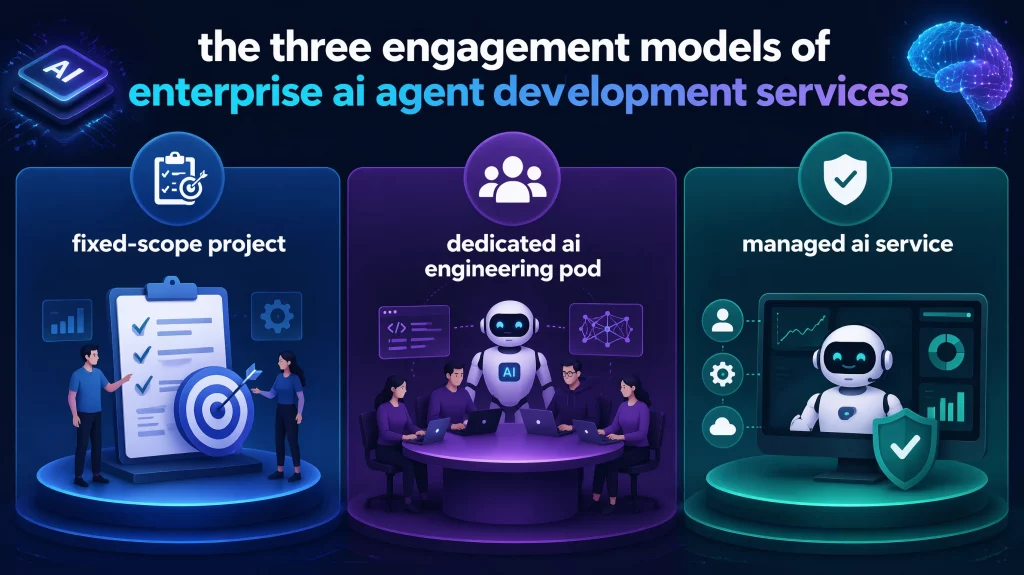
The Three Engagement Models of Enterprise AI Agent Development Services
Enterprise AI agent development services generally offer three distinct engagement models, and choosing the wrong one for your situation is a common source of budget overruns later.
| Engagement model | Best for | Typical structure | Risk if you choose wrong |
| Fixed-scope project | A single, well-defined agent with clear deliverables and a known timeline | Set price, set scope, set delivery date | Expensive change orders if requirements shift mid-project |
| Dedicated AI engineering pod | Enterprises building multiple agents over 6+ months, needing continuity | A team works exclusively on your roadmap, often embedded in your sprints | Higher monthly retainer cost if your use-case pipeline isn’t large enough to keep the pod busy |
| Managed AI service | Enterprises that want agents built, monitored, and maintained without growing internal AI headcount | Ongoing subscription covering build, monitoring, and updates | Less direct control over architecture decisions |
A fixed-scope engagement suits a company validating its first AI agent before committing further. A dedicated pod suits a company with an AI roadmap, not just one project. A managed service suits a company that wants the agent treated as infrastructure it doesn’t have to staff for. Most enterprises that work with enterprise AI Agents start with a fixed-scope pilot and convert to a dedicated pod once the first agent proves its value in production.
A Realistic Timeline: From Kickoff to Production
A single fixed timeline doesn’t reflect how enterprise AI agent development actually unfolds, because timeline depends heavily on what kind of agent you’re building.
|
Agent complexity
|
Typical timeline |
What’s included
|
| Single-task agent (FAQ bot, simple classifier) | 4–8 weeks |
Discovery, prompt design, one system integration, basic testing
|
| Contextual agent (RAG-based, multi-turn) | 8–16 weeks |
Knowledge base setup, 1–2 system integrations, iterative refinement
|
| Autonomous agent (multi-step reasoning, tool use) | 16–28 weeks |
Decision logic, multiple integrations, extensive testing and evaluation
|
| Multi-agent enterprise system | 6–12 months |
Agent orchestration, deep ERP/CRM integration, governance and audit trails
|
For a mid-complexity contextual agent, a structured 12-week path commonly looks like this:
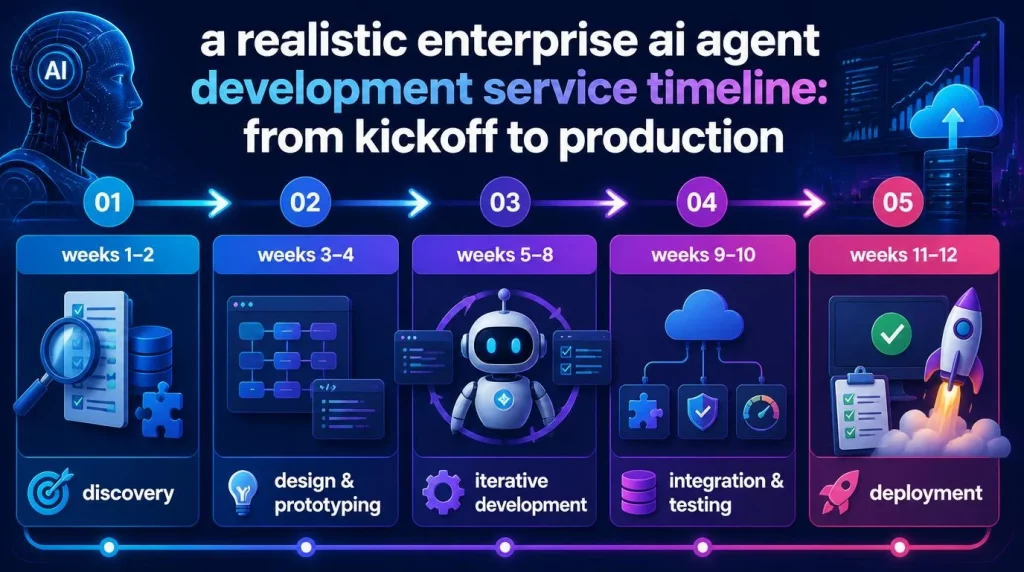
- Weeks 1–2: Discovery, where the development partner defines scope, maps integration points, and audits data quality.
- Weeks 3–4: Design and prototyping, including the first working version of the agent’s core logic.
- Weeks 5–8: Iterative development, where the agent is refined against real test cases and edge conditions.
- Weeks 9–10: Integration with existing systems and performance testing under realistic load.
- Weeks 11–12: Final adjustments, user acceptance testing, and production deployment.
Maintaining this structure matters because skipping the data audit in weeks 1–2 is one of the most common reasons enterprise AI agents stall after launch instead of before it.
Cost Breakdown: Build Cost vs. the Operating Cost Nobody Mentions Upfront
Most vendor conversations focus entirely on build cost, which is only half the budget picture. The build phase typically breaks down as follows:
| Build phase | Typical cost range |
What drives the cost up
|
| Discovery | $10,000–$50,000 |
Depth of data audit, number of stakeholders, compliance requirements
|
| Build | $25,000–$400,000+ |
Agent complexity, number of integrations, level of autonomy required
|
| Integration | $20,000–$100,000 |
Quality of internal API documentation; poorly documented systems can double this cost
|
| Initial support (first 1–3 months) | $5,000–$20,000/month |
Service level agreement scope, monitoring depth
|
What this table leaves out, and what most proposals leave out too, is what happens after the agent goes live. Once an agent is in production, ongoing LLM token costs, hosting, and monitoring become a recurring monthly expense that scales with usage, not a one-time line item. A production agent handling a modest volume of conversations can run $850 to $3,100 a month in operating costs; at enterprise scale, that figure can climb past $20,000 a month once reasoning tokens, tool calls, and state management stack up. Annual maintenance, covering prompt updates, model upgrades, and integration upkeep, typically adds another 15% to 25% of the original build cost every year.
Asking a prospective partner to model your expected monthly operating cost at your actual target usage volume, not at pilot-stage volume, is one of the most useful questions you can put in front of them before signing anything.
How to Brief a Development Partner
A strong brief is the single biggest factor in getting an accurate proposal instead of a guess. At minimum, your brief should define:
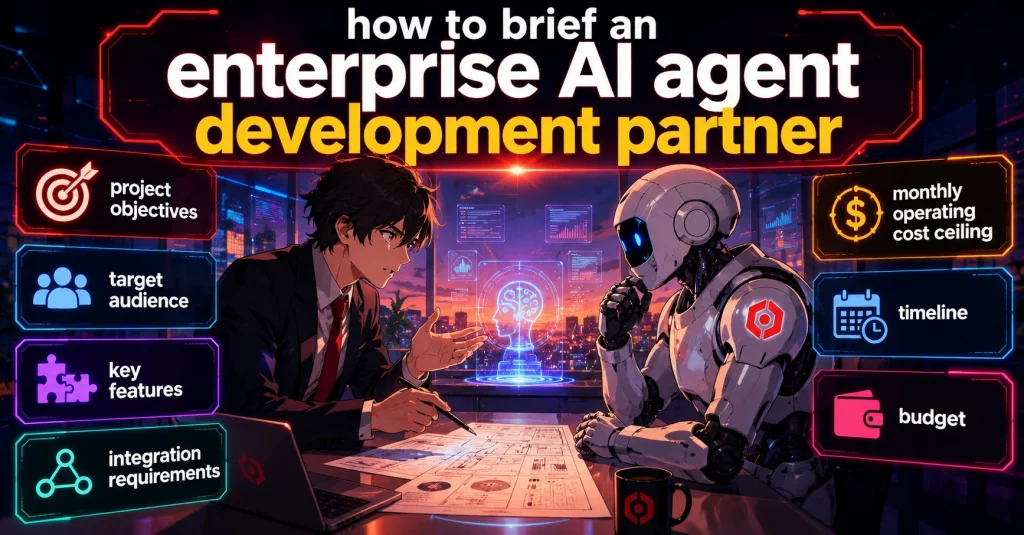
- Project objectives: What specific business outcome should this agent move, not just what task it performs.
- Target audience: Who interacts with the agent, and what their technical comfort level looks like.
- Key features: Which functionalities are essential on day one versus which can wait for a phase two.
- Integration requirements: Exactly which systems the agent must connect to, and how well those systems are documented internally.
- Monthly operating cost ceiling: The maximum ongoing spend you’re willing to accept, which forces vendors to model real OpEx instead of quoting build cost alone.
- Timeline: Your desired delivery schedule, tied to a specific business event if one exists.
- Budget: Your financial constraints, stated as a range rather than a single number.
Red Flags in AI Agent Development Vendor Proposals
Watch for these warning signs when comparing proposals from potential development partners:
- Vague deliverables. If a proposal can’t tell you exactly what gets handed over at the end, including code ownership and prompt files, expect scope disputes later.
- A single fixed quote with no operating cost model. A vendor unwilling or unable to estimate your monthly token and infrastructure spend at production scale hasn’t actually scoped your project.
- Unrealistic timelines. A 4-week promise for a multi-agent system with five system integrations is a sign the vendor hasn’t accounted for integration complexity, which routinely takes longer than the LLM work itself.
- No production case studies in your industry. A portfolio of demos and proofs-of-concept doesn’t tell you whether the vendor’s agents survive contact with real production data.
- Ambiguous intellectual property terms. Ask directly who owns the custom code, prompts, and any fine-tuned model weights. Some vendors retain rights that effectively license your own system back to you.
- No defined support plan beyond launch. Ask what month 3 through month 6 looks like, and what it costs, before you sign anything.
If your enterprise operates in a regulated sector or under Vietnam’s new AI Law (134/2025/QH15), confirm during vendor evaluation whether the partner can support on-premise deployment, since several of these red flags become higher-stakes once data residency requirements are involved.
In Summary
Enterprise AI agent development services in 2026 offer a faster, lower-risk path to production than building an in-house team from scratch, provided you go in with a realistic view of both build cost and the operating cost that follows it. Evaluating engagement models, timelines, and vendor proposals against the benchmarks above puts you in a stronger position to budget accurately and avoid the most common reasons these projects stall after go-live. For more insights or assistance, talk to our AI engineers today.