


The Claude Sonnet vs Opus decision has quietly become one of the highest-impact model choices enterprise teams make in 2026. However, most comparisons focus on benchmark scores rather than where each tier actually earns its price in production, which is where budget leaks and rework costs really appear. This article breaks down real cost-per-task, reasoning depth, and workload fit using Anthropic’s official benchmarks and independent evaluations. Consequently, your team can confidently route Sonnet and Opus to the specific workloads where each one delivers the strongest ROI instead of committing to a single tier by default.
Key Takeaways
|
Claude Sonnet vs Opus 2026: Overview
Anthropic’s current lineup runs from Haiku at the low-cost end, through Sonnet as the mid-tier workhorse, up to Opus as the flagship, with the newer Mythos-class models sitting above Opus for a small set of trusted partners. Anthropic shipped Claude Opus 4.8 on May 28, 2026 as its strongest Opus to date. Claude Sonnet 5 followed one month later, on June 30, 2026, and the company built it specifically to close the gap to Opus 4.8 rather than give Sonnet 4.6 a minor bump. For a closer look at what changed under the hood, our deep dive on Claude Sonnet 5 covers the tokenizer update and effort-level controls in more detail.
| Model | Release date | Input / output price (per million tokens) | Position in lineup |
| Claude Opus 4.8 | May 28, 2026 | $5 / $25 | Flagship |
| Claude Sonnet 5 | June 30, 2026 | $3 / $15 standard ($2 / $10 intro through Aug 31, 2026) | Mid-tier, agentic workhorse |
Both models share a 1-million-token context window and support up to 128,000 output tokens, so context length won’t decide this comparison for you. The real split shows up in raw capability and in how each model handles long, multi-step agentic work, which is what the rest of this article gets into.
Claude Sonnet vs Opus: Pros and Cons
Skip the benchmark tables for a second. Neither model is a strict upgrade over the other. Each one wins on a different axis, and that’s the whole point of having both.
| Claude Sonnet 5 | Claude Opus 4.8 | |
| Pros | Costs 40 to 60 percent less per token, wins Terminal-Bench 2.1 and knowledge work, and runs a strong self-checking loop that writes tests before code | Leads deep, multi-file coding, holds up better on tool-free reasoning, plans more coherently over long horizons, and drifts less on ambiguous instructions |
| Cons | Its new tokenizer burns 20 to 42 percent more tokens for the same input, which narrows the effective price gap, and it can lose its cost advantage entirely at the highest effort setting | Costs 1.7 to 2.5 times more per token than Sonnet 5, responds more slowly, and is overkill for high-volume, well-defined tasks |
Sonnet 5 is the safer default for routine, high-volume work. Opus 4.8 earns its keep whenever a wrong answer is expensive to catch and fix later.
Claude Sonnet vs Opus: Performance benchmarks
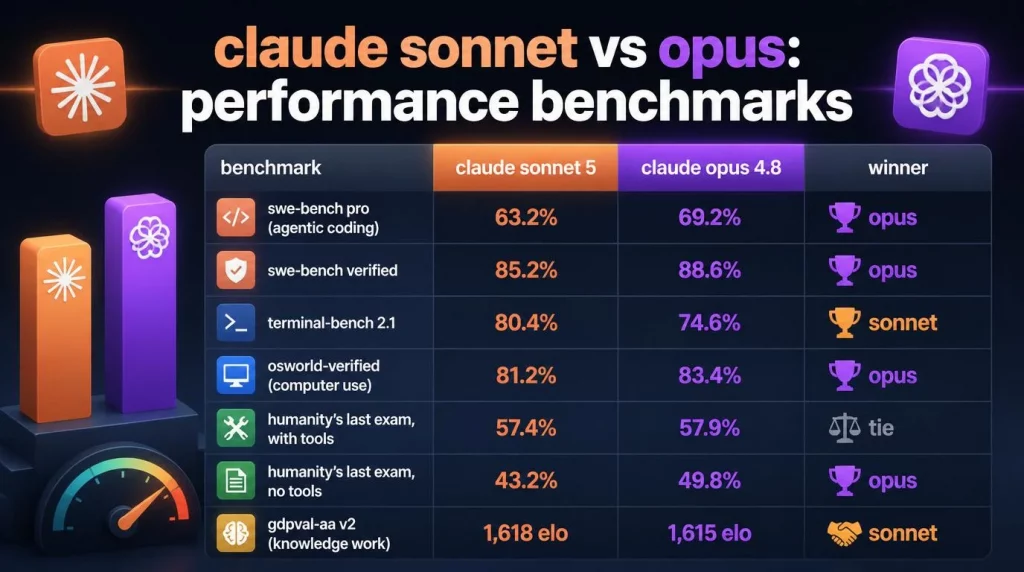
Anthropic’s official Sonnet 5 announcement published a direct comparison in the Claude Sonnet 5 System Card on June 30, 2026, and it’s the clearest picture available of where each model actually stands.
| Benchmark | Claude Sonnet 5 | Claude Opus 4.8 | Gap |
| SWE-bench Pro (agentic coding) | 63.2% | 69.2% | Opus by 6.0 points |
| SWE-bench Verified | 85.2% | 88.6% | Opus by 3.4 points |
| Terminal-Bench 2.1 | 80.4% | 74.6% | Sonnet by 5.8 points |
| OSWorld-Verified (computer use) | 81.2% | 83.4% | Opus by 2.2 points |
| Humanity’s Last Exam, with tools | 57.4% | 57.9% | Statistical tie |
| Humanity’s Last Exam, no tools | 43.2% | 49.8% | Opus by 6.6 points |
| GDPval-AA v2 (knowledge work) | 1,618 Elo | 1,615 Elo | Sonnet, though close enough to call it a tie |
Where Sonnet 5 actually wins
Terminal-Bench 2.1 is the clearest upset on this list. Sonnet 5 scores 80.4 percent against Opus 4.8’s 74.6 percent, which even beats what Opus 4.7 posted at its own launch. On GDPval-AA v2, a benchmark built around real business knowledge work, Sonnet 5 edges past Opus 4.8 too. That’s the first time a Sonnet-tier model has out-scored its Opus counterpart on any benchmark Anthropic has published.
Where Opus 4.8 still leads
The remaining gaps sit exactly where you’d expect a flagship model to hold ground: deep, multi-file coding on actively maintained repositories (SWE-bench Pro), computer-use tasks that need sustained multi-step planning (OSWorld), and tool-free reasoning under real ambiguity (HLE no-tools). Third-party testing from SoftwareSeni also found Opus 4.8 tracing cross-file dependencies more reliably across codebases past the 100,000-token mark, landing in the 80 to 90 percent band on ProgramBench against Sonnet 5’s 76 to 86 percent. If you’re weighing Claude against a non-Anthropic alternative for the same coding workloads, our Claude vs Gemini comparison runs the same benchmarks side by side with Google’s model.
Claude Sonnet vs Opus: Pricing and value comparison
The sticker price favors Sonnet 5 by a wide margin: 40 percent cheaper at standard rates, and 60 percent cheaper during the introductory window that runs through August 31, 2026. But the per-token rate is not the number that actually shows up on your invoice.
| Metric | Claude Sonnet 5 | Claude Opus 4.8 |
| Standard price per million tokens | $3 input / $15 output | $5 input / $25 output |
| Introductory price (through Aug 31, 2026) | $2 input / $10 output | N/A |
| Relative per-token cost | 40 to 60 percent cheaper | Baseline |
| Tokenizer overhead vs prior generation | 1.0 to 1.35 times more tokens for identical text | Unchanged |
Independent analysis from Artificial Analysis, cited by SoftwareSeni, found that Sonnet 5 actually cost more per completed task than Opus 4.8 in one measured workload: $2.29 against $1.99, despite the lower per-token rate. The reason comes down to the new tokenizer, which produces roughly 20 to 42 percent more tokens for the same input, and at higher effort settings Sonnet 5 can burn through up to six times more agentic turns than it does at its lowest setting. So budget by completed task, not by the rate card. A task that needs Sonnet 5 running at its highest effort just to match Opus-level quality has probably stopped being the cheaper option.
Claude Sonnet vs Opus: Best use cases
Match the model to the shape of the task, not to a blanket company policy.
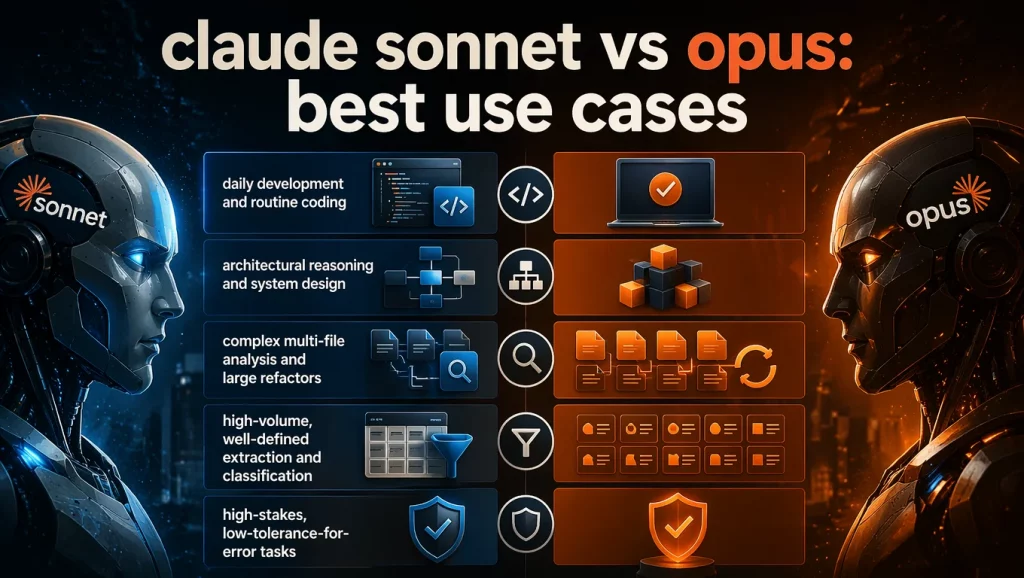
- Daily development and routine coding: Sonnet 5 handles function writing, bug fixes, code review, and boilerplate at close to Opus quality for a fraction of the cost.
- Architectural reasoning and system design: Opus 4.8’s stronger tool-free reasoning and lower drift on ambiguous instructions make it the safer pick for decisions that are hard to reverse.
- Complex multi-file analysis and large refactors: Opus 4.8’s six-point lead on SWE-bench Pro reflects a real advantage tracing dependencies across messy, actively maintained repositories.
- High-volume, well-defined extraction and classification: Sonnet 5’s speed and lower baseline cost make it the practical default for document processing at scale.
- High-stakes, low-tolerance-for-error tasks: legal document analysis, financial data extraction, and medical coding all carry a real cost when the model gets it wrong, and that’s where Opus 4.8’s reliability at the edges pays for itself. Teams building these workflows from a template rather than from scratch can pull a pre-built starting point from AI Hive’s AI Agent Marketplace.
Which model should you choose? A Decision framework
Route by task shape, not by job title.
| Your situation | Recommended model | Why |
| High-volume, structured tasks (extraction, summarization, routine PRs) | Sonnet 5 | Task structure makes up for most of the capability gap |
| Ambiguous instructions, complex tool chains, backtracking required | Opus 4.8 | Lower drift, better at inferring intent |
| Latency-sensitive, user-facing interactions | Sonnet 5 | Faster responses, lower cost per interaction |
| Planning or task decomposition inside a multi-step agent | Opus 4.8 | Sets a coherent strategy the rest of the pipeline can follow |
| Execution steps after the plan is set | Sonnet 5 | Handles tool calls and formatting at lower cost |
| Security-sensitive or cyber-adjacent work | Opus 4.8 | Sonnet 5 ships with deliberately conservative cyber guardrails |
Several teams have landed on the same pattern: Opus 4.8 handles planning and error recovery, Sonnet 5 handles execution and formatting, and Haiku 4.5 takes the high-volume, low-complexity routing decisions underneath both. Wiring this up usually comes down to how the models are called in production, and our guide to enterprise Claude API integration walks through the authentication and routing setup most teams need.
When Is Opus 4.8 Actually Worth It Over Sonnet 5?
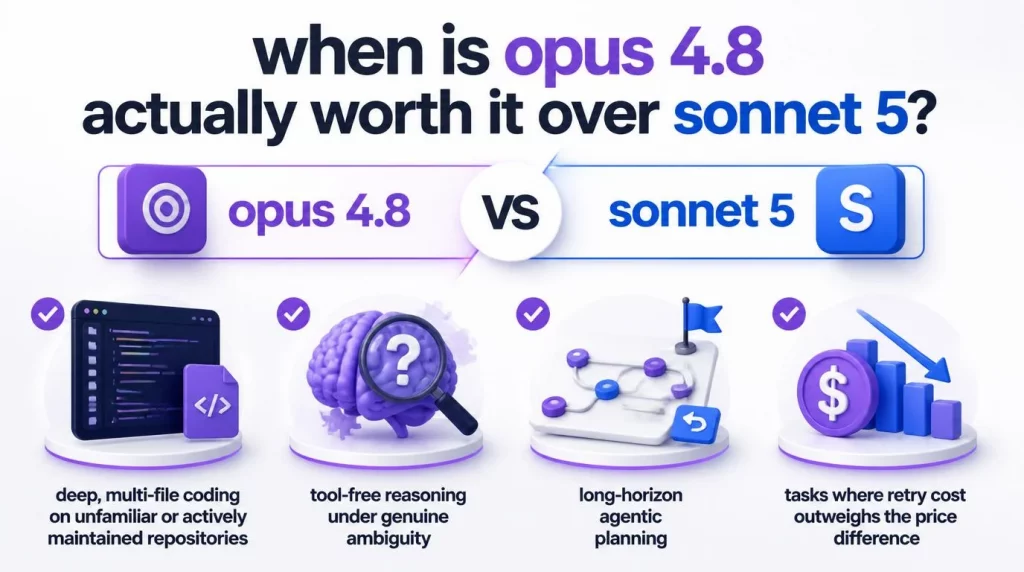
Most comparison articles skip this question, or answer it with something vague like “Opus is more powerful.” That’s not useful if you’re the one signing off on the API budget. Based on Anthropic’s own benchmark gaps and independent production testing, Opus 4.8 earns its premium in four specific situations.
- Deep, multi-file coding on unfamiliar or actively maintained repositories: The SWE-bench Pro gap, 69.2 percent against 63.2 percent, is the widest coding-specific gap in the whole comparison, and it tracks directly with longer, messier engineering work where dependency tracing actually matters.
- Tool-free reasoning under genuine ambiguity: On Humanity’s Last Exam without tools, Opus 4.8 leads by 6.6 points, the largest gap in the entire benchmark table. When a prompt is underspecified and there’s no tool call to fall back on, Opus infers intent more reliably.
- Long-horizon agentic planning: MindStudio’s production testing found Opus keeps a coherent strategy across dozens of steps where Sonnet 5 can drift, especially on ambiguous instructions and situations that require backtracking.
- Tasks where retry cost outweighs the price difference: SoftwareSeni’s read of the Artificial Analysis data shows that once you count actual task completion instead of raw token rate, Opus 4.8 can come out cheaper on complex jobs, mostly because it needs fewer retries to get there.
Sonnet 5 still fits 80 to 90 percent of day-to-day workloads, especially routine coding and office-task automation where budget is the priority. The four conditions above are where that default should flip.
Claude Sonnet vs Opus: Real-world user reviews and experiences
Anthropic’s launch partners reported concrete workflow outcomes rather than general praise. One partner described Sonnet 5 investigating a bug, writing a reproducing test, implementing the fix, and confirming the bug came back without the change, all in a single pass. CodeRabbit’s independent review found that Sonnet 5 tends to write tests before building the feature, then runs everything before calling the task done, which closes a gap that used to let earlier models ship code that looked fine and broke a week later. That kind of self-checking loop shows up consistently in independent coverage of the Sonnet 5 launch, not just in Anthropic’s own materials.
The limits show up in specific places rather than vague complaints. A widely discussed r/ClaudeAI thread found that at high and extra-high effort settings, Sonnet 5 loses its cost advantage on certain agentic search benchmarks, which had users asking why they’d pay high-effort Sonnet pricing when Opus 4.8 costs about the same for the same demanding work. Code Culture’s roundup of that thread concluded Sonnet 5 fits best at low or medium effort, especially in bulk agent workflows, and is less convincing as a full high-effort Opus replacement. That distinction, effort level and task type rather than one blanket “which model is smarter” verdict, is what separates a useful comparison from a marketing headline.
Developer Review: Sonnet or Opus for AI Agent Development?
Developers who compare the two rarely settle on one model for an entire agent stack, and that instinct holds up. The pattern that keeps surfacing across independent reviews is routing by step: Opus 4.8 for planning and judgment calls, Sonnet 5 for execution and formatting. AI Hive’s model-agnostic AI agent platform is built around exactly this kind of setup.
Because it supports 11-plus LLMs, including Claude, GPT, Gemini, and Llama, your enterprise can assign Sonnet 5 to one agent and Opus 4.8 to another, then swap either one without rebuilding the workflow around it. For teams that don’t have the in-house time to test and tune this routing themselves, AI Hive’s engineers for hire can set up the tiered model architecture directly inside your existing delivery cycle, the same approach that has cut LLM costs by 35 to 60 percent for our clients.
Conclusion
Ultimately, the Claude Sonnet vs Opus decision is not a permanent choice, since Sonnet 5 handles the majority of daily coding, extraction, and customer-facing work efficiently, while Opus 4.8 justifies its premium on deep multi-file engineering, ambiguous reasoning, and any task where a retry costs more than the price gap. Consequently, the teams extracting the most value from Claude route both models within a single agent architecture rather than forcing every workflow through one tier.
At AI Hive, we help enterprises deploy model-agnostic architectures that dynamically route tasks across Claude Sonnet, Opus, and other frontier models based on complexity and cost. Therefore, if your organization wants a Claude Sonnet vs Opus setup that scales without re-engineering, let our team help you design that architecture in weeks rather than months.