

Picture the day your agency signs a white label AI chatbot contract and the first invoice, the branding, and the legal terms turn out to look nothing like the pricing page. Agencies and SaaS teams license a chatbot instead of building one because it is the fastest way into AI, and it is also the route with the most fine print. In 2026 that fine print includes add-ons that decide your margin and EU transparency rules that took effect on August 2, 2026. This guide compares five platforms on published prices, shows where the hidden costs sit, and gives you a checklist for choosing a provider before your name goes on their product.
Key Takeaways
|
What Is a White Label AI Chatbot?
A white label AI chatbot is a conversational AI product that one company builds and maintains and another company rebrands under its own name, logo, and domain to sell to its own clients. The vendor runs the model, the infrastructure, and most of the engineering, while your agency owns the branding, the client relationship, and the margin.
It is not the same as an open-source framework that you host and brand yourself, and it is not a custom build from an AI engineering firm. White labeling sits in the middle: you get a working product on day one, and you inherit the vendor’s roadmap, uptime, and pricing changes. That trade-off matters more than any feature list, because a feature list never says who is accountable when the bot fails in production.
Two buyer types dominate. Agencies use a white label AI chatbot to extend an existing retainer, and SaaS companies embed one to add an AI tier without a multi-quarter build. Both also inherit a duty that feature lists hide.
The European Commission’s Article 50 FAQ, updated on July 24, 2026, describes providers as those who develop AI systems, or have them developed, and put them into service under their own name or trademark. That description fits white labeling closely. Whether it makes you the provider in a given deal is a legal question, and you should settle it in the contract before launch.
Which Features Do Buyers Expect From a White Label AI Chatbot?
Buyers who have resold a white label AI chatbot before ask about the same seven things, and most of them concern running many client accounts, not the model itself. The table turns each feature into a test you can run during a vendor demo.
| Feature | Why it matters | How to test it in a demo |
|---|---|---|
| Multi-tenant workspaces | Each client needs an isolated account with its own knowledge base, branding, and users | The vendor adds a new client account live, without a support ticket |
| Branding depth | Clients should never see the vendor’s name in the white label AI chatbot they pay for | You open the login page, the emails, and the invoices and look for the vendor’s name |
| Per-client knowledge base | Answers must come from each client’s own documents | You upload a sample file and ask three questions only that file can answer |
| Model and configuration choice | Clients with stricter data rules may need different settings | You ask whether the model changes per client and who pays for the change |
| Reporting and billing | You need usage reports in your brand and a way to invoice clients | You export a sample report and a sample invoice |
| Channels | Clients ask for web, WhatsApp, and voice | You get the channel list and the billing rule for each channel |
| Support and SLA | You carry the client’s frustration when the bot goes down | You get uptime, response, and resolution terms in writing |
Multi-tenancy deserves the most scrutiny. Without it, every new client becomes a small project: your team requests an instance, waits for provisioning, and configures settings that should have been templated. That friction compounds with each client, and it shows whether a vendor built its white label AI chatbot platform for resellers or added reseller features to a single-tenant product later.
Running many client bots also means ongoing monitoring, version changes, and eventually retirement. Our guide to AI agent lifecycle management covers those phases for enterprise teams, and the same discipline applies to a portfolio of client bots.
Support terms for a white label AI chatbot need the same rigor, and you should confirm four points in writing rather than on a sales call. First, whether onboarding includes a named contact. Second, whether the SLA sets uptime, response, and resolution terms separately. Third, whether an outage escalates to a real engineer outside business hours. Fourth, whether a partner success manager appears once your revenue crosses a threshold.
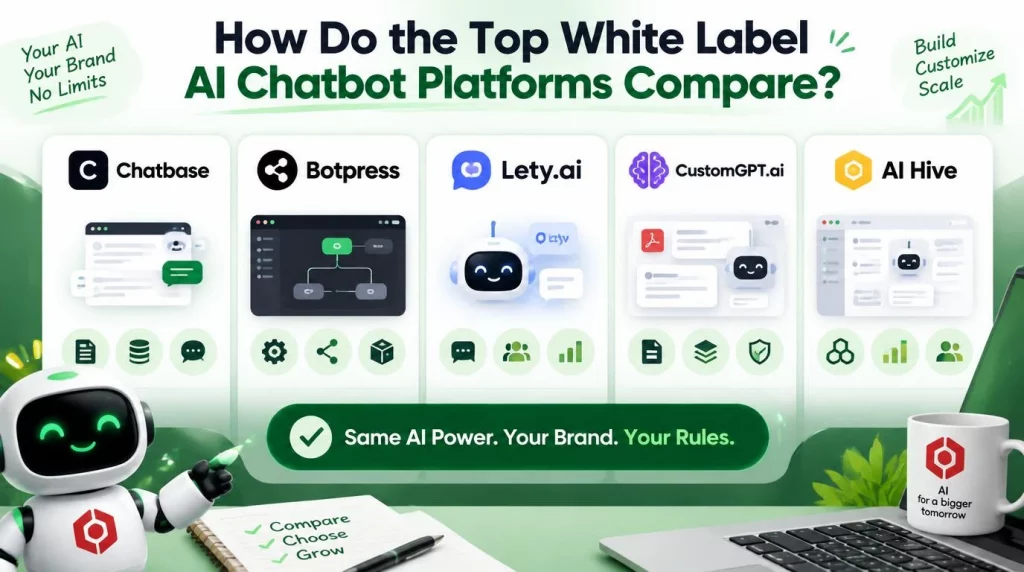
How Do the Top White Label AI Chatbot Platforms Compare?
Published prices tell only part of the story, but they are the only part you can compare on the same day. The table reflects each vendor’s own pages as read on September 24, 2026, and prices change often, so confirm them before you quote a client.
Chatbase, Botpress, Lety.ai, and CustomGPT.ai appear here without links because they compete with the white label AI chatbot program we run ourselves, which sits in the last row.
| Platform | What the pages publish about price | Branding and client management | Where the cost hides |
|---|---|---|---|
| Chatbase | Hobby at $40, Standard at $150, and Pro at $500 per month, with Enterprise on request | The pricing page lists a “Remove Powered By Chatbase” add-on and does not mention white label, custom domain, or reseller plans | Branding removal adds $99 per month to a white label AI chatbot setup, and message credits (700, 4,000, and 15,000 on Hobby, Standard, and Pro) can be topped up at $40 per 1,000 |
| Botpress | Plus at $150 and Team at $750 per month billed annually, with Enterprise on request | Plus includes a white label webchat and a custom-domain help center, and Team adds unlimited seats, routing, and role-based access | Each conversation includes $0.10 of AI usage, and further AI spend is bought in $10 grants sold at cost |
| Lety.ai | Plan prices are not shown on its white label page | Standard supports up to 10 client subaccounts, Unlimited supports unlimited ones, and the vendor name is hidden by default | A flat platform fee applies, and usage such as LLM tokens and WhatsApp sessions passes through at vendor cost |
| CustomGPT.ai | White label pricing is not published, and its pages tell buyers to confirm terms with the partner team | Its white label pages say the Premium and Enterprise plans can remove the “Powered by CustomGPT” branding | You cannot model the margin of a white label AI chatbot until you hold a written quote |
| AI Hive | The white label page lists an 80 percent revenue share for partners, and says partners pay AI Hive’s wholesale cost and set their own client prices | Domain, logo, colours, email templates, documentation, error pages, and invoice headers are white labeled, with Stripe-based billing | The vendor’s name still appears in the legal terms, as the page states |
No two vendors price the same thing. One sells branding removal as an add-on, one gates it by plan, one charges a flat fee with usage passed through, and one does not publish a price. For a white label AI chatbot, the sticker price is therefore the wrong number to compare, and the total cost at your expected volume is the right one.
White Label AI Chatbot Pricing and Licensing Models: What You Actually Pay
Every white label AI chatbot vendor publishes a clean pricing page, and almost none of them shows what a real client deployment costs once branding, overages, and support are added. Three licensing structures dominate, and they differ mainly in who carries the usage risk.
A wholesale model charges your agency a per-seat or per-bot rate on each white label AI chatbot you resell, and you mark that rate up freely, which gives you pricing control but means you front the cost before the client pays. A revenue-share model takes a percentage of what you bill, which lowers upfront risk but caps your margin as you scale. A flat subscription with a markup allowance sits between the two, with a fixed platform fee and usage capped by contract.
| Model | Who carries the usage risk | Question to ask before you sign |
|---|---|---|
| Wholesale per seat or per bot | Your agency, until you rebill the client | How are overages charged, per conversation or per seat? |
| Revenue share | Vendor and agency share the risk | How does the contract define revenue, and do client discounts count? |
| Flat subscription with markup | Your agency, up to a contractual cap | Which add-ons sit outside the flat fee? |
The number that decides profitability is the gap between what you charge and what the vendor charges once usage and add-ons are counted. Margin per client equals your client price minus that client’s usage cost and its share of the platform fee. As an illustration with made-up numbers, a $250 monthly platform bill and $30 of usage per client leave $1,600 a month across five clients billed at $400 each.
You should ask every shortlisted vendor for a written cost breakdown at 10, 50, and 200 monthly conversations per client. A white label AI chatbot that looks cheapest at 10 conversations can look very different at 200, and most published tables stop at the entry tier.
How Deep Can Customization and Branding Go?
Rebranding a white label AI chatbot ranges from a swapped logo to a vendor that is invisible to the client, and the gap between the two shows up in places a demo skips. The checks below separate the two.
- Knowledge base ingestion: You need a simple way to upload each client’s documents, and deeper CRM or help desk integrations may call for outside AI engineers for hire when no-code tools stop short.
- Domain and subdomain control: Your agency points the widget and any client dashboard to its own domain, so the browser bar never exposes the vendor’s platform.
- Login screens, emails, and invoices: The pages a client sees every month should carry your brand, not only the parts a prospect notices during a demo.
- Documentation and error pages: API references and error messages sit outside the main product screens, so a vendor’s name can survive there unless you check.
- White-labeled reporting: Usage dashboards that clients read should show your agency’s name, not a vendor logo.
Even a fully white labeled product can name the vendor in legal documents. AI Hive’s own white label page says the vendor’s name appears only in the GDPR terms, and you should ask every provider which documents, such as the data processing agreement and the sub-processor list, carry its name.
Cloud or On-Premise: When Does Data Control Become Non-Negotiable?
Most white label AI chatbot platforms run in the vendor’s cloud, which suits a marketing agency selling FAQ bots to small e-commerce clients. That model stops working when your agency lands a client in banking, healthcare, insurance, or government, where data residency and audit requirements are contractual.
In those cases you need a vendor that supports private-cloud or on-premise AI deployment, where the client’s conversations and connected knowledge base stay on infrastructure the client controls. This requirement usually surfaces late, once the client’s procurement or compliance team joins the sales cycle, so confirm deployment flexibility before you build a proposal around it.
Timing and price also change. AI Hive’s implementation page lists two to four weeks as typical for a white label deployment and four to eight weeks for on-premise or air-gapped setups, and you should expect on-premise to need a separate quote. Building that cost into your quote from the start protects your margin better than discovering it after you have promised a flat monthly fee.
How Do You Choose a White Label AI Chatbot Provider?
By this point the pattern is clear: vendors that look identical on a comparison page differ enormously on pricing at scale, support depth, and deployment options. The checklist below turns those differences into questions for your next vendor call.
| Evaluation area | Question to ask the vendor |
|---|---|
| Pricing transparency | What does this cost at 10, 50, and 200 monthly conversations per client? |
| Multi-tenancy | Can I provision a new client instance myself, in minutes, without a vendor ticket? |
| Branding depth | Does the vendor’s name appear in the white label AI chatbot or in its legal documents? |
| Support structure | Is there a named onboarding contact and an SLA with separate uptime and response terms? |
| Deployment options | Do you support private-cloud or on-premise deployment for regulated clients? |
| Contract flexibility | Who owns the conversation history and knowledge base if I cancel, and in what format can I export them? |
Your client mix should weight these rows differently, so the table below shows where to put the weight for common situations.
| Your situation | Weight this most | Why |
|---|---|---|
| A few small local clients | Pricing transparency and setup speed | Low volumes make add-ons and overages the main risk |
| A growing agency with ten or more clients | Multi-tenancy and reporting | Manual setup breaks first as the client count rises |
| Regulated clients in finance, health, or the public sector | Deployment options and legal terms | Data residency and disclosure duties are contractual |
| A SaaS company embedding a white label AI chatbot in its product | API access and billing | Your customers see your brand and pay through your billing |
In our view, your agency should run a 30-day pilot with one real client before it accepts annual billing, because a plan billed annually locks in a price that you tested for only a month. For agencies planning a broader AI practice than a single white label AI chatbot relationship, a partner that offers AI implementation services alongside white label options gives you a path to custom builds once a client outgrows any off-the-shelf platform.
Hidden Costs and Real Deployment Lessons
Hidden costs in a white label AI chatbot deal rarely come from bad faith. They come from pricing pages that describe the product and contracts that describe the business. We have no anonymized client case to publish here, so the lessons below come from vendor pages and public records.
| Hidden cost | Where it shows up | What to ask |
|---|---|---|
| Branding removal as an add-on | Chatbase lists it at $99 per month on top of the plan | Is branding removal included in the white label AI chatbot plan, and at which tier? |
| Branding gated by plan | Botpress starts its white label webchat at Plus, $150 per month billed annually | What does the plan below it lack, and how long is the billing commitment? |
| Credits and usage top-ups | Chatbase sells extra credits at $40 per 1,000, and Botpress buys extra AI spend at cost | What happens at the credit limit, and who sets the top-up price? |
| Unpublished pricing | CustomGPT.ai and the Enterprise tiers of Chatbase and Botpress give no public figure | Can I have the total in writing before I quote a client? |
| Exit terms | The contract, not the pricing page | Who owns conversation history and knowledge base content, and can I export it? |
The arithmetic is unforgiving. Branding removal turns Chatbase’s $40 Hobby plan into $139 a month, which is more than three times the sticker price, and the two vendors are not directly comparable products.
The legal lessons come in two parts, and the first is older than most platforms. In February 2024, a British Columbia tribunal held Air Canada liable for wrong information that its website chatbot gave a customer about bereavement fares, as the American Bar Association’s summary of Moffatt v. Air Canada explains. The company that deploys the bot answers for what it says, so a white label AI chatbot puts your agency, and possibly your client, in that position.
The second lesson is newer. Article 50 of the AI Act applies from August 2, 2026. Providers of interactive AI systems must ensure that people are told they are talking to an AI system unless that is obvious, and the Commission’s FAQ states that fines can reach 15 million euros or 3 percent of worldwide turnover. Your contract should require the vendor to ship the disclosure by default and to state in writing who acts as provider for your deal.
How AI Hive’s White Label Program Works
We run a white label program ourselves. It ships a branded AI agent platform, which covers the same ground as a white label AI chatbot and goes further into agents, so we hold it to the same checklist we give you. The details below come from our public white label page and implementation page.
- Commercial terms: The page lists an 80 percent revenue share for partners, says partners pay AI Hive’s wholesale cost and set their own client prices, and describes 3x to 5x margins as typical.
- Partner tiers: Starter covers one to five clients up to $50,000 in annual recurring revenue, Growth covers five to 25 clients up to $500,000, and Scale covers 25 or more clients above that.
- Branding and billing: The domain, logo, colours, email templates, documentation, API reference, error pages, and invoice headers are white labeled, with Stripe billing, usage-based billing, and a real-time MRR dashboard.
- Timeline: The page describes a branded platform in two to four weeks, and the implementation page lists four to eight weeks for on-premise.
One detail deserves a plain mention: the vendor name still appears in the GDPR terms. If you compare us with the vendors above, your team should apply the same checklist to us.
Conclusion
Choosing a white label AI chatbot comes down to three things: the total cost at your expected volume, the depth of the branding and multi-tenant controls, and the support and legal terms that hold up when a bot fails in front of a client. This week, your team should ask each shortlisted vendor for a written cost at 10, 50, and 200 conversations per client, and for the provider role under Article 50.
The next questions arrive after the first client goes live: how you monitor a growing portfolio of bots, and when a client outgrows an off-the-shelf platform and needs a custom build. If you want a second opinion before you sign a reseller agreement, talk to our team at AI Hive and we will review the terms with you.