
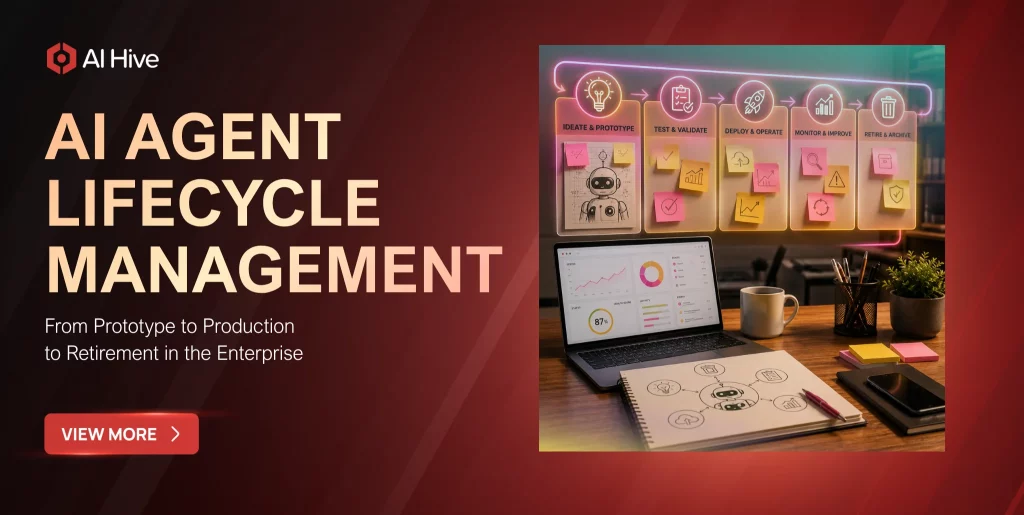

Most enterprise AI initiatives begin with promise and end in limbo. According to McKinsey’s 2024 State of AI report, fewer than 20% of enterprise AI projects ever reach full production deployment. The reasons are consistent across industries: teams build proof-of-concept agents that no one knows how to govern, scale, or eventually decommission. Without a disciplined approach to AI agent lifecycle management, each new deployment becomes a liability rather than an asset.
AI Hive was built to solve exactly this problem. Our enterprise agent platform provides the governance frameworks, deployment tooling, and operational infrastructure that transform experimental agents into production-grade systems, in days rather than quarters. This post outlines what AI agent lifecycle management actually involves, where most organizations stumble, and how a structured approach changes the economics of enterprise AI.
Key Takeaways
|
What Is AI Agent Lifecycle Management?
AI agent lifecycle management is the set of processes, tools, and governance policies that guide an AI agent from initial concept through active deployment to eventual retirement. It encompasses every decision point in that arc: how an agent is designed, trained, tested, released, monitored, updated, and ultimately decommissioned.
The discipline borrows from software development lifecycle principles but adds layers specific to AI systems. Unlike conventional software, AI agents exhibit emergent behavior, consume external data at inference time, and can degrade in performance as the world changes around them. These characteristics make lifecycle management essential, not just useful, for any enterprise operating agents in regulated or customer-facing environments.
Lifecycle management also extends beyond technical concerns. It includes stakeholder alignment, compliance documentation, model versioning, and the organizational workflows that ensure human oversight at each stage. For enterprises exploring the full scope of enterprise AI agent deployment, lifecycle governance is the structural foundation that makes production-grade performance sustainable.
Why Enterprises Fail Without Structured Lifecycle Governance
The gap between AI experimentation and production is wider than most teams expect, and the failure modes cluster around three recognizable patterns.
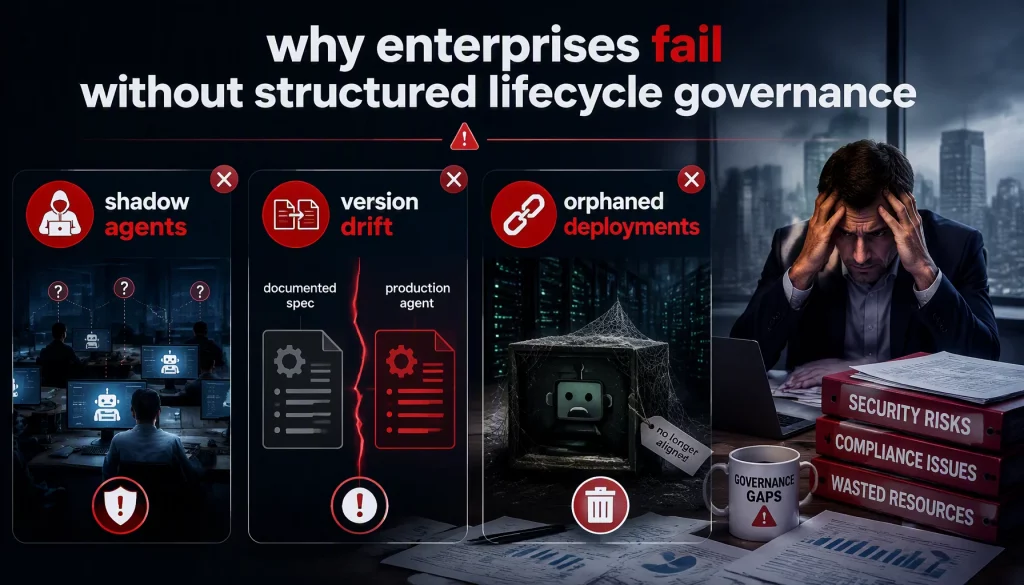
- Shadow agents: AI agents built by individual teams without central visibility, which creates security and compliance blind spots that multiply as the organization scales. Gartner has flagged this pattern as a defining governance risk of the current agent buildout.
- Version drift: Production agents that diverge from documented specifications because updates are applied ad hoc rather than through a governed release process.
- Orphaned deployments: Agents that remain in production long after the use case they were built for has changed, consuming compute resources and occasionally producing outputs no longer aligned with business objectives.
Organizations that invest in lifecycle governance early tend to recover their AI investment substantially faster than those that impose governance retroactively, once remediation, re-architecture, and compliance rework have already piled up. The discipline of lifecycle management isn’t overhead. It’s the mechanism through which AI investments compound instead of decaying.
The 5 Phases of AI Agent Lifecycle Management
A well-designed lifecycle framework organizes agent development and operation into five distinct phases. Each phase has defined entry and exit criteria, responsible parties, and artifact requirements.
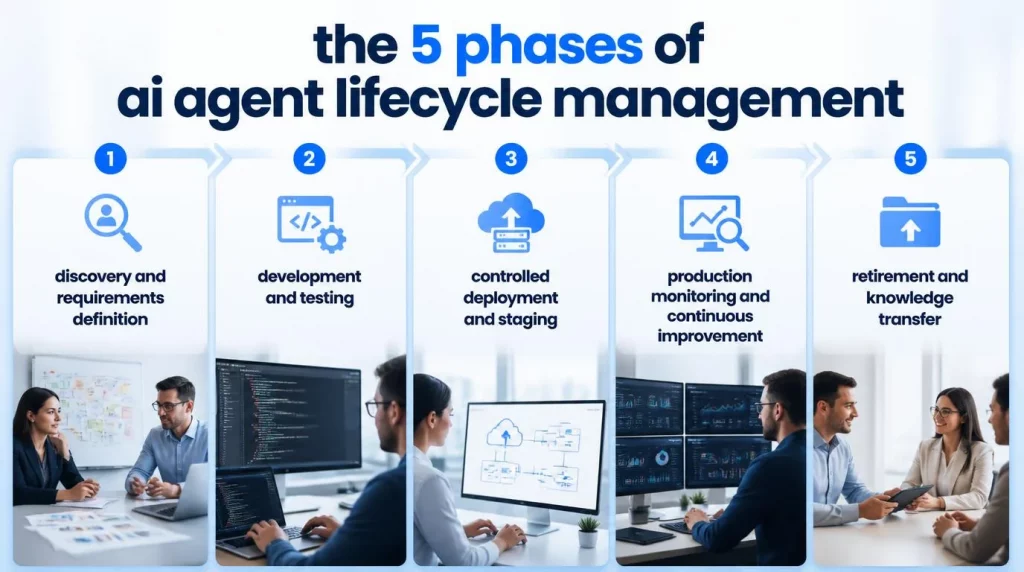
Phase 1: Discovery and Requirements Definition
The discovery phase establishes why the agent should exist and what success looks like before any code gets written. Your enterprise needs clear answers to four questions: What decision or task will the agent own? What data sources will it access? What accuracy and latency thresholds are acceptable? Who is accountable for the agent’s outputs?
We recommend producing a formal Agent Charter at this stage, a one-page document that captures business objective, data dependencies, compliance requirements, and the human escalation path for edge cases. This charter becomes the governing reference throughout the remaining phases. Enterprises that skip this step consistently report scope creep and misaligned stakeholder expectations once the agent reaches production.
Phase 2: Development and Testing
Development covers model selection, prompt engineering or fine-tuning, tool integration, and the construction of evaluation harnesses. At AI Hive, we deploy agents against a structured testing matrix that includes functional accuracy, adversarial robustness, latency under load, and compliance with data handling requirements.
For a full walkthrough of how to score and compare candidates at this stage, our guide to AI agent evaluation covers the benchmarks and scoring methods in depth.
A critical part of this phase is establishing a baseline performance profile. Your enterprise cannot manage what it cannot measure, and the metrics recorded during testing form the benchmark against which production behavior gets compared throughout the agent’s operational life.
Phase 3: Controlled Deployment and Staging
Production deployment should follow a graduated release model: internal testing, then a limited user group, then general availability. This approach limits blast radius if unexpected behaviors emerge and generates real-world performance data before full rollout.
At this phase, your enterprise should also activate the observability stack: logging, tracing, and alerting configurations that will govern Phase 4.
For more on architecture patterns that support controlled release and production readiness, our AI agent architecture guide covers the technical underpinnings in detail, and our AI agent observability guide walks through exactly what that instrumentation needs to capture.
Phase 4: Production Monitoring and Continuous Improvement
Once an agent is live, your team must monitor both its technical health, latency, error rate, uptime, and its business outcomes, resolution rate, user satisfaction, cost per transaction. Continuous improvement in this phase follows a defined feedback loop: collect production signals, identify drift or degradation, implement targeted updates, validate in staging, then redeploy. This loop should run on a defined cadence, typically monthly for stable agents and weekly for agents in high-velocity environments.
Our dedicated guide to AI agent monitoring breaks down which signals actually predict degradation early enough to act on.
Phase 5: Retirement and Knowledge Transfer
Agent retirement is the lifecycle stage most organizations neglect. When a use case changes, a better model becomes available, or a business unit pivots, the outgoing agent should be formally decommissioned: data connections revoked, API keys rotated, logs archived per policy, and institutional knowledge transferred to successor systems or documentation.
Failure to retire agents properly creates technical debt, compliance exposure, and confusion about which version of an agent is authoritative. A quarterly agent audit that reviews every production agent against its original Agent Charter is the simplest preventive measure available.
Build vs. Buy: Lifecycle Tooling for Enterprise Teams
Your enterprise can assemble lifecycle management tooling from open-source components, MLflow for experiment tracking, Kubernetes for orchestration, Prometheus for monitoring, or adopt an integrated platform. The build path offers flexibility but requires significant engineering investment, and most teams underestimate the effort involved by a wide margin.
| Capability | Build In-House | AI Hive Platform |
| Model versioning | Custom MLflow setup | Built-in version control |
| Compliance documentation | Manual | Automated audit trails |
| Multi-agent orchestration | Custom code | Visual orchestration layer |
| Time to first deployment | 3 to 6 months | Days |
| Annual operational cost | $500K to $2M | Fraction via SaaS |
For enterprises in regulated industries, banking, insurance, healthcare, the compliance automation that integrated platforms provide is often the deciding factor. Manual documentation of data lineage and model provenance is both expensive and error-prone at enterprise scale.
How AI Hive Supports Every Stage of the Agent Lifecycle
AI Hive is designed to eliminate the friction points at each lifecycle phase. Our platform offers visual agent-building tools for the discovery and development phases, a native staging and canary deployment system for controlled rollouts, and a real-time observability dashboard for production monitoring.
What differentiates our approach is the combination of platform self-service and human expertise. Through our AI Engineers for Hire service, enterprises that lack in-house AI engineering talent can embed AHT Tech specialists at any lifecycle phase, from defining the Agent Charter to managing production handoff. This hybrid model means your enterprise is never blocked by a skills gap when an agent needs to move forward.
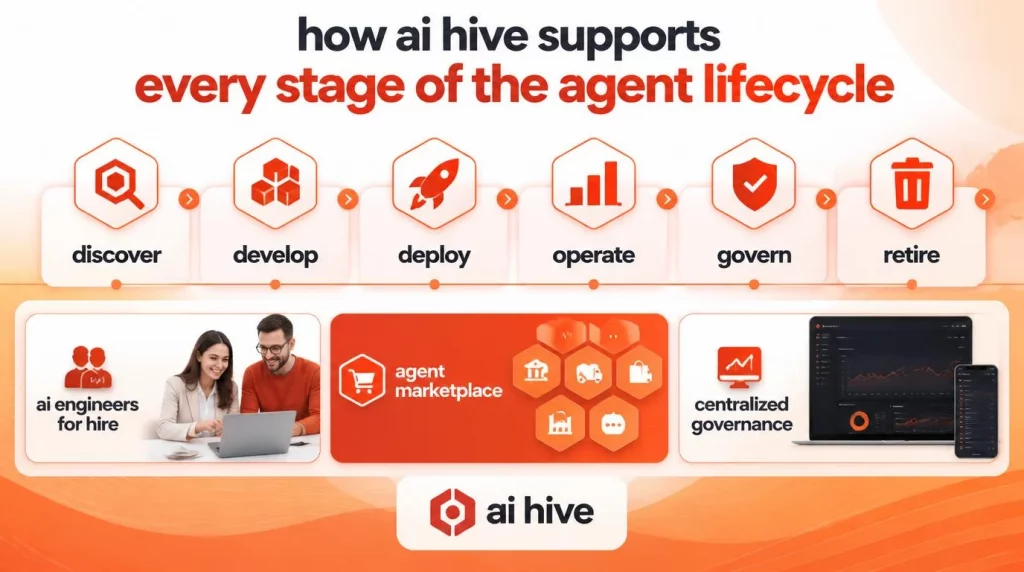
AI Hive’s Agent Marketplace also provides 500+ pre-built agent templates across industries, so enterprises in banking, healthcare, and logistics can begin Phase 2 with a validated foundation rather than a blank canvas. You can explore the full spectrum of enterprise AI agent use cases our marketplace supports to identify the highest-impact starting point for your program.
For enterprises managing agents through the full lifecycle, our AI agent platform provides the centralized governance layer that keeps every deployed agent visible, measurable, and compliant, from first deployment through final retirement.
Conclusion
AI agent lifecycle management is not an operational nicety. It is the structural foundation that determines whether your enterprise’s AI investments generate lasting value or accumulate as technical debt. Organizations that govern the full arc from prototype to retirement reduce deployment costs, accelerate time-to-value, and maintain the compliance posture that regulated industries require.
We built AI Hive specifically to support this journey. Whether your enterprise is designing its first agent or managing a portfolio of fifty, our platform and engineering team provide the tooling and expertise to advance every phase of the lifecycle with confidence. Schedule a lifecycle assessment with the AI Hive team to map your current agent portfolio against a mature governance framework and identify the fastest path from prototype to sustainable production.