
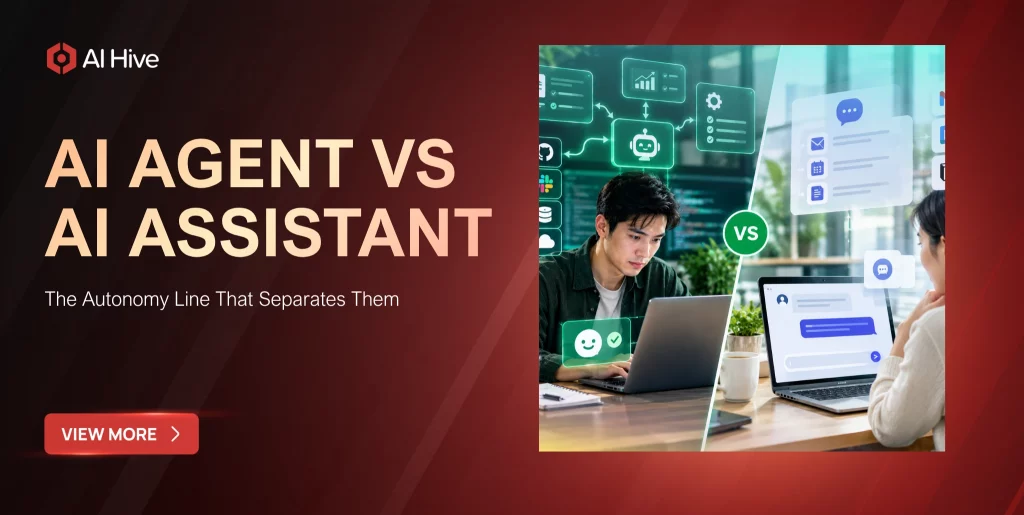

Your team bought software sold as an “AI agent”, and three weeks in it still waits for a prompt before every step. That gap is the whole AI agent vs AI assistant question, and it is expensive to get wrong: Gartner warned in June 2025 that many vendors rebrand chatbots and assistants as agents without real autonomy, a practice it calls agent washing. Buyers who confuse the two either pay for autonomy they cannot govern or buy a helper that never finishes the job. Three measurable tests, run in any vendor demo, tell you which one you are looking at before you sign.
Key Takeaways
|
What Is the Core Difference Between an AI Agent and an AI Assistant?
The core difference is who drives the task. An assistant waits for you and acts once per request, while an agent receives a goal and decides the next steps on its own, within limits you set.
IBM’s explainer on AI agents vs. AI assistants puts it plainly: assistants are reactive and perform tasks at your request, while agents are proactive, plan their own workflow, and can keep working after an initial prompt. IBM lists Siri, Alexa, Microsoft Copilot and ChatGPT as familiar assistants, and code generation, IT automation, and customer service systems as typical agent territory.
The AI agent vs AI assistant line is not about the model underneath. The same large language model can power both, and what changes is the orchestration around it: planning logic, tool access, memory across steps, and error handling. An assistant with those pieces added starts to behave like an agent.
- An assistant shortens a step: It drafts, summarizes, or suggests, and a person decides what happens next.
- An agent removes the sequence: It chains retrieval, reasoning, action, and checking, and a person reviews the outcome or the exceptions.
AI Agent vs AI Assistant: Comparison Table
Most comparisons stop at “reactive versus proactive,” which sounds tidy but is hard to test in a demo. The table scores the AI agent vs AI assistant difference on criteria your team can check during a proof of concept.
| Criterion | AI assistant | AI agent |
|---|---|---|
| Human intervention mid-task | High: a person triggers or confirms every step | Low: a person sets the goal and reviews outcomes or exceptions |
| Steps per task | Usually one request and one response | Several chained steps: retrieve, reason, act, verify |
| Error recovery | Stops and returns control when something fails | Retries, re-plans, or escalates without abandoning the task |
| Memory | Usually per session | Often persists across the whole task |
| Tools and systems | One tool or data source per request | Several tools, APIs, and internal systems in one run |
| Typical output | A draft, an answer, or a suggestion | A finished action, such as a closed ticket or an updated record |
The error-recovery row is where vendor claims usually fall apart. You should ask what happens when step three of five fails; if the honest answer is “it stops and asks you,” you are looking at an assistant with agent branding.
The model-versus-system distinction runs deeper than this table. Our comparison of agentic AI vs generative AI explains why the same generative model can sit inside both an assistant and an agent, and how that changes cost and risk.
4 Typical Use Cases for AI Agent vs AI Assistant
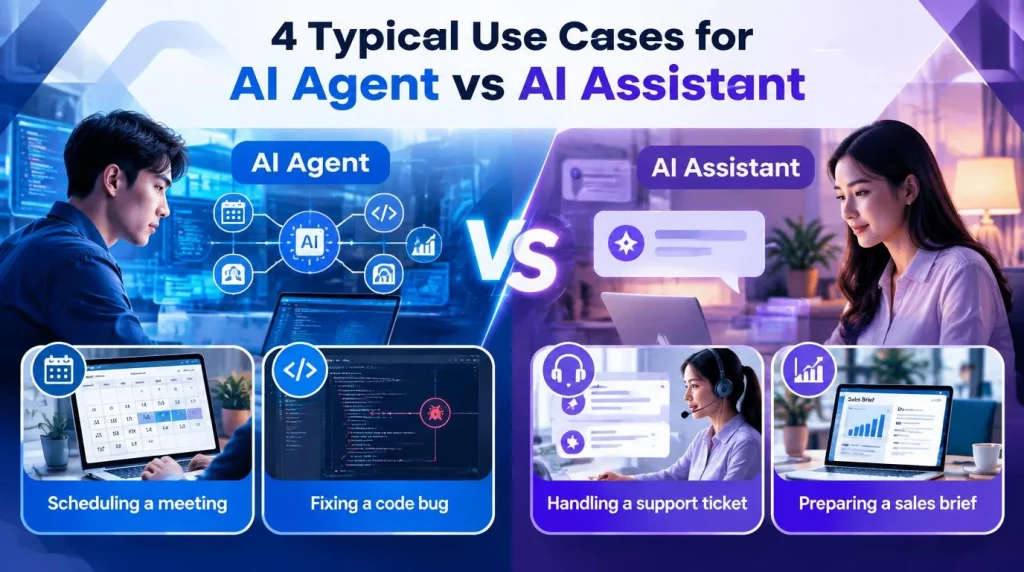
Use cases follow the same split: assistants speed up a person’s work, while agents take over a defined sequence. Running the same task through both models makes the AI agent vs AI assistant gap concrete.
| Task | What an AI assistant does | What an AI agent does |
|---|---|---|
| Scheduling a meeting | Suggests three open slots and waits for you to send the invite | Checks five calendars, resolves time zones, sends the invite, and rebooks if someone declines |
| Fixing a code bug | Explains the stack trace and proposes a fix in the editor | Writes the fix, runs the tests, patches its own failure, and opens a pull request for review |
| Handling a support ticket | Drafts a reply for a person to edit and send | Checks the order and policy, issues a refund within a limit, updates the CRM, and closes the ticket |
| Preparing a sales brief | Summarizes notes you paste in | Pulls account history, recent emails, and open deals, then drafts the brief in your CRM |
In each row the assistant shortens one step, and the agent removes the need to manage the sequence. Agents also overlap with robotic process automation, which replays fixed scripts and breaks when a screen changes. Our breakdown of AI agent vs RPA shows where scripted bots still win and where reasoning agents earn their cost.
Industry context changes which side of the AI agent vs AI assistant line a task belongs on. The same request can be safe for an agent in one sector and unsafe in another.
- Banking and insurance: Assistants draft responses to disputes and claims for staff, while agents gather documents and check eligibility, with a person approving any movement of money.
- Healthcare: Assistants summarize notes and answer scheduling questions, while agents handle eligibility checks and appointment booking, and nothing clinical runs without a clinician.
- Retail and ecommerce: Agents can resolve order-status and return requests end to end, because the actions are reversible and the volume is high.
- IT and internal services: Agents reset access and route tickets, while assistants help staff search policies and write requests.
Where Do Agents and Assistants Overlap, and How Do Hybrids Work?
They overlap more than vendor messaging suggests, and in a mature deployment they are layers of the same system. In the AI agent vs AI assistant decision, the best answer is often both.
A common hybrid works like this. An employee types a request in plain language, and the assistant layer interprets intent, asks a clarifying question, and confirms scope. It then hands a structured task to one or more agents, which query systems, apply business rules, and update records, before the assistant reports the result back in conversation.
This split helps adoption and governance at the same time. Regulated buyers in particular should treat the two layers differently: an assistant that drafts a reply for review carries a far smaller risk than an agent that approves a transaction or updates an account.
People trust a chat interface they already know, while the agent layer stays separate, logged, and auditable, so IT and compliance can monitor it without reading every conversation. AI Hive’s enterprise AI agent platform is built around that separation, with a conversational layer on top and governed agents, deployable in the cloud, a private cloud, or on-premise, underneath.
- Front door: The assistant handles language, clarification, and status updates.
- Engine room: Agents handle multi-step execution with scoped permissions.
- Control plane: Logs, approval gates, and limits cover the agent layer, where actions happen.
AI Agent vs AI Assistant: How Do You Choose the Right One?
The choice should follow the shape of the task, not the appeal of “agentic” branding. Three rules cover most AI agent vs AI assistant decisions.
- Choose an assistant when: The task is a single exchange, a person must approve every output, or the work is exploratory and touches no downstream system.
- Choose an agent when: The process has several defined steps, volume is too high for a person to supervise each case, and you can define what the system may do without asking.
- Choose both, layered, when: People need a natural-language front door while governed agents carry out multi-system work behind it.
Autonomy is a dial, not a switch, and the AI agent vs AI assistant decision rarely needs to be all or nothing. Many teams start with an agent that proposes actions for approval, then allow it to act alone on reversible, low-value steps once its track record is clear. Our guide to the autonomous AI agent covers that spectrum and the guardrails that should rise with each level.
How Are AI Agents and Assistants Evolving?
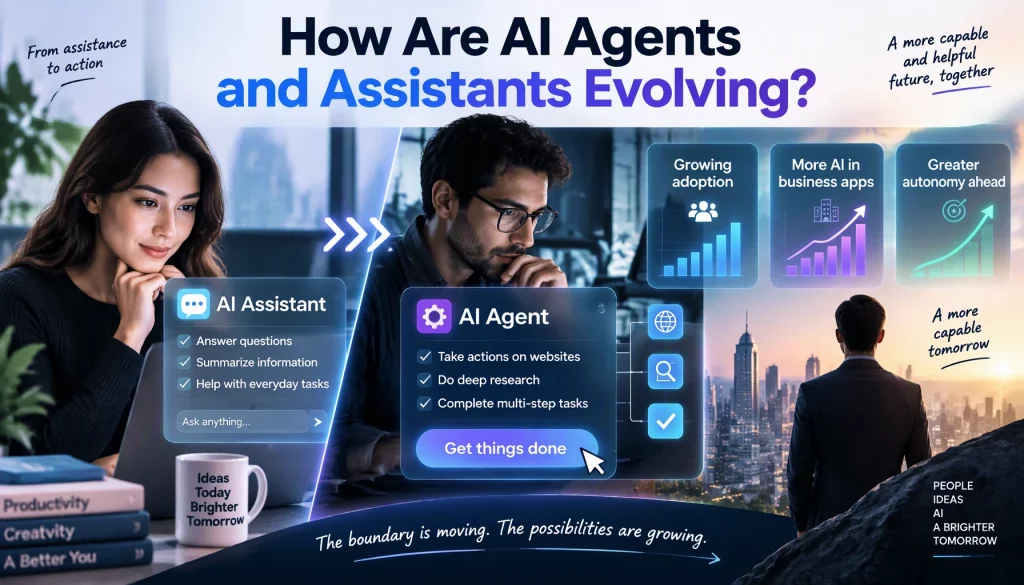
The AI agent vs AI assistant boundary is moving fast because assistants are gaining agent features. OpenAI launched ChatGPT agent on July 17, 2025, combining Operator’s ability to act on websites with deep research, and by August 31, 2025 the standalone Operator product had been folded into it.
Adoption data shows where agents land first. McKinsey’s State of AI in 2026 found that about two in ten respondents are already scaling software coding agents, rising to 31 percent at larger enterprises, because coding tasks have clear tests that tell an agent when it is done.
Analyst forecasts point the same way. Gartner predicted in August 2025 that 40 percent of enterprise applications will feature task-specific AI agents by 2026, up from less than 5 percent in 2025, and it expects at least 15 percent of day-to-day work decisions to be made autonomously through agentic AI by 2028, up from 0 percent in 2024.
Researchers urge caution as autonomy grows. In Fully Autonomous AI Agents Should Not be Developed, Margaret Mitchell and colleagues at Hugging Face argue that risks to people increase with the autonomy of a system: the more control a user cedes to an AI agent, the more risk arises. In our view, the practical reading is that the AI agent vs AI assistant choice will become a question of how much autonomy each task deserves, set per action rather than per product.
Real-World Decision Criteria Used by Buyers
Buyers who get the AI agent vs AI assistant call right judge vendors on evidence, not labels. We have no client survey to publish, so the criteria below come from public guidance and the questions regulated buyers routinely ask before go-live.
| Criterion | What to ask the vendor | Evidence to request |
|---|---|---|
| True autonomy | What happens when step three of five fails, and does the answer place the product on the agent side of the AI agent vs AI assistant line? | A live demo with an injected error |
| Action boundaries | Which actions can the system take without approval? | A written list of allowed actions and limits |
| Audit trail | Can we see every tool call and decision for one run? | A sample log a compliance officer can read |
| Deployment control | Can the agent run in our private cloud or on-premise? | An architecture diagram and hosting options |
| Escalation | How does a case reach a person, and with what context? | A handoff demo with the full case history |
| Exit | Can we export prompts, workflows, and history if we leave? | Contract terms on data portability |
Weight differs by industry. A bank or insurer weighs audit trail, approval gates, and on-premise deployment most, because an agent that moves money or changes an account carries a very different risk from an assistant drafting a reply. A retailer or software company may weigh speed of setup and channel coverage more heavily.
Scale matters too. McKinsey’s State of AI in 2026, based on 1,719 respondents surveyed between May and June 2026, found that 40 percent of large organizations were scaling AI agents against 22 percent of smaller ones, so mid-market buyers often start with an assistant and add agents as their governance matures. In our view, that sequence is sound as long as the AI agent vs AI assistant decision is revisited for each new process.
Conclusion
The AI agent vs AI assistant decision comes down to autonomy you can measure: how often a person steps in, how many steps the system chains alone, and whether it recovers from its own errors. Assistants fit single, approved exchanges; agents fit defined processes you can hand over end to end; and most enterprises end up running both as layers of one governed system. This week, your team should take one workflow, run the three tests in a vendor demo, and write down which actions may run without approval.
The next questions come after that first decision: how much autonomy each action deserves, and how you govern agents as their number grows. If you want to map that line against your own workflows, talk to our team at AI Hive and we will work through it with you.