


The pilot cost a few hundred dollars a month, and the production quote arrives with seats, credits, overage tiers, and an implementation line that matches nothing else on the shortlist. Per-token prices keep falling, yet McKinsey’s 2026 State of AI survey found that about one in five organizations already limit AI use because of operating costs, and most AI agent pricing sheets hide that risk until the second invoice. Normalizing every quote to a unit, adding the hidden costs, and comparing three-year totals turns that pile of pricing models into one number your CFO can approve.
Key Takeaways
|
What Are the Common AI Agent Pricing Models in 2026?
Five pricing models cover almost every AI agent pricing sheet today, and each one shifts cost risk to a different party. The table uses published list prices as examples, read from vendor pages in September 2026.
| Model | How you pay | Who carries the volume risk | Published example |
|---|---|---|---|
| Per seat | A fixed fee per user each month | The buyer, when adoption is low | Microsoft 365 Copilot at $30 per user per month, billed yearly |
| Usage: tokens | A rate per million input and output tokens | The buyer, when tasks grow longer | Claude Sonnet 5 at $2 input and $10 output per million tokens |
| Usage: actions or credits | A price per action, message, or credit | Shared, depending on caps | Salesforce Agentforce Flex Credits at $500 per 100,000 credits |
| Per conversation or outcome | A fee per resolved case or conversation | The vendor, until the outcome definition is loose | Intercom Fin from $0.99 per outcome |
| Platform subscription | A monthly tier with bundled limits | The vendor, up to the tier limit | AI Hive Growth at $149 per month with 250,000 workflow actions |
Most enterprise AI agent pricing blends two of these. A common shape is a platform or seat fee plus a metered layer, such as Claude Enterprise’s $20 seat fee with token charges at API rates, which our breakdown of Claude Enterprise pricing walks through line by line.
Outcome-based AI agent pricing looks like the safest choice because you pay only for results, but it is the hardest to audit. Intercom’s pricing page counts an outcome when a customer confirms the issue is resolved, or when the customer does not ask for more help after the agent responds. That second rule is generous to the vendor, so the definition matters as much as the rate.
What Drives AI Agent Costs?
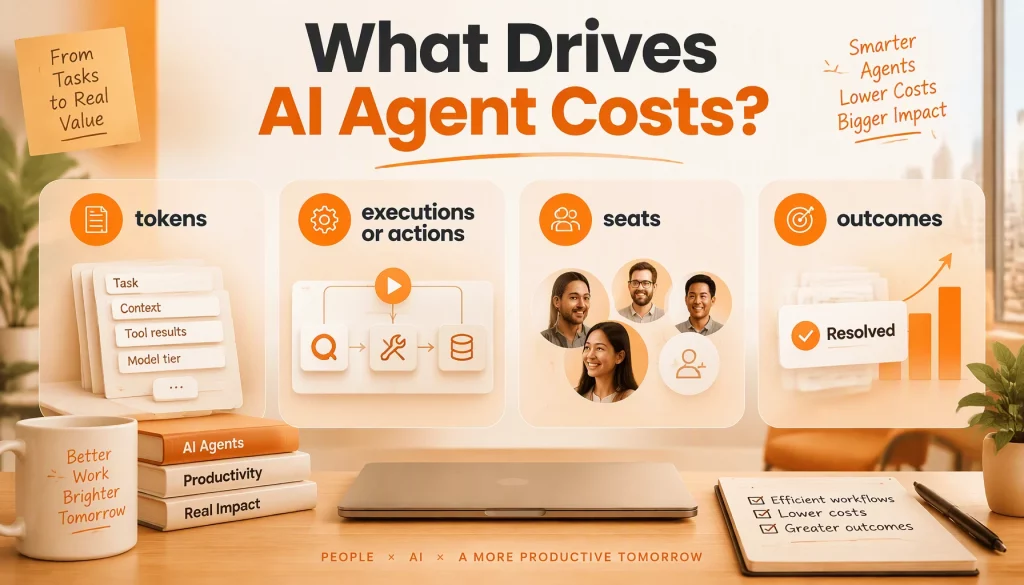
Four meters drive AI agent pricing: tokens, executions, seats, and outcomes. Knowing which meter your vendor uses tells you what makes the bill grow.
Tokens drive the model bill. Anthropic’s Claude API pricing page lists Claude Haiku 4.5 at $1 per million input tokens and $5 per million output tokens, Claude Sonnet 5 at $2 and $10, and Claude Opus 5.5 at $4 and $20. Prices fall over time, but agents use far more tokens than chat: Anthropic measured in June 2025 that agents use about 4 times more tokens than chat interactions, and multi-agent systems about 15 times more.
Variability matters as much as the rate in AI agent pricing. McKinsey’s State of AI in 2026 notes that the same agent task can cost up to 30 times more from one run to another, because an agent may take more steps, retry a tool, or read more context. For budgeting, that means you should forecast from a distribution of real runs, not from the average of a demo.
- Tokens: The bill grows with task length, context size, tool results, and model tier.
- Executions or actions: The bill grows with every tool call or workflow step, which rewards efficient workflow design.
- Seats: The bill grows with headcount, which penalizes agents that run in the background with no human user.
- Outcomes: The bill grows with resolved volume, which is fair only if the outcome definition is tight.
Small settings also move the meter. The Claude API pricing documentation lists a 1.1x multiplier for US-only inference on Claude 4.6 and later models, and it notes that regional endpoints on Amazon Bedrock and Google Cloud carry a 10 percent premium over global ones, so data residency choices appear directly on the invoice.
Typical AI Agent Price Ranges by Category
AI agent pricing clusters into six categories, and the category you buy from sets the range before any negotiation. The figures below come from vendor pages read in September 2026 and will change, so treat them as a snapshot.
| Category | Published price range | What you get |
|---|---|---|
| Model APIs | From $0.10 to $10 per million input tokens across current OpenAI and Anthropic models | Raw model access, with everything else built by your team |
| Self-serve agent and chatbot builders | AI Hive Starter at $29 and Growth at $149 per month, Chatbase from $40 to $500, Botpress Plus at $150 per month billed annually | A hosted builder with usage limits per tier |
| Suite add-ons | Salesforce Agentforce add-on at $125 per user per month, Microsoft Copilot Studio at $200 per month for 25,000 credits | Agents inside a CRM or productivity suite you already own |
| Outcome-priced support agents | Intercom Fin from $0.99 per outcome, with helpdesk seats from $29 per seat per month | Pay per resolution, with a minimum commitment on standalone use |
| Enterprise and custom platforms | AI Hive Custom from $2,500 per month for 10,000 actions, with others quoting on request | Unlimited or high limits, private deployment, and support terms |
| Engineering services | AI Hive lists dedicated FDE hours as an add-on at $150 per hour | People who build and connect the agents |
AI Hive publishes its own AI agent pricing tiers on the AI Hive pricing page, including a free tier with 100 workflow actions and add-ons such as extra actions at $40 per 1,000 and a Compliance Pack at $2,000 per month. We list our prices next to others so that you can check them against the same yardstick.
Which AI agent pricing category fits depends on who you are. The table below shows where each buyer usually starts.
| Your situation | Likely category | Main risk |
|---|---|---|
| CIO standardized on Salesforce or Microsoft 365 | Suite add-ons | Per-user fees for agents that serve customers, not employees |
| VP Engineering with a strong platform team | Model APIs plus your own tooling | The engineering and monitoring cost you now own |
| Head of support with high ticket volume | Outcome-priced support agents | How the vendor defines an outcome |
| Regulated enterprise needing private hosting | Enterprise and custom platforms | Separately billed compliance, residency, and on-premise support |
| Mid-market team testing a first agent | Self-serve builders | Tier limits that force an upgrade in the first busy month |
Which Hidden Costs Should You Watch When Building AI Agent?
Hidden costs are the part of AI agent pricing that no pricing page shows, and they usually outweigh the license over three years. Most of them come from connecting the agent to your business, not from the agent itself.
- Integration work: Connecting an agent to a CRM, ERP, or legacy system often costs more than the software, especially when the old system has no clean API.
- Data preparation: An agent grounded in duplicated or outdated documents gives wrong answers, so cleanup belongs in the budget.
- Tool-use tokens: Every request with tools carries extra tokens; Anthropic lists a tool-use system prompt of 286 tokens on Claude Opus 5.5 and 354 on Claude Sonnet 5, before your own tool definitions.
- Overages and top-ups: Credits and actions run out in busy months, and top-up rates are often higher than the committed rate.
- Compliance and residency: Security reviews, audit evidence, and regional hosting add labor and, in some cases, a direct price multiplier.
- Monitoring and upkeep: Prompts, tools, and evaluation sets need updates as processes and models change.
- Exit costs: Moving prompts, workflows, and conversation history to another vendor can require a rebuild if the contract does not guarantee export.

Seasonal volume is an AI agent pricing trap that hits operations-heavy teams hardest. A usage meter that looks cheap in a quiet pilot month can spike exactly when the agent is most useful, which is common in supply chains; our guide to AI agents for logistics covers the exception-heavy workloads where peaks appear. In our view, any usage-based contract for a seasonal business needs a capped peak tier in writing.
How Do You Calculate AI Agent TCO?
A three-year total cost of ownership turns every AI agent pricing quote into one comparable number. The method has two parts: one-time costs and yearly costs multiplied by your forecast volume.
Three-year TCO equals one-time costs plus the sum of three years of running costs. One-time costs cover implementation, integration, data preparation, and the initial security and compliance review. Running costs cover the platform or seat fees, usage at your forecast volume, infrastructure if you host anything, monitoring and governance labor, and training.
| Cost line | What to ask the vendor | How to estimate it yourself |
|---|---|---|
| Platform or seats | The fee at your expected users or tier, and the renewal cap | Multiply by users or tier for 36 months |
| Usage | The unit rate at 1x, 5x, and 10x pilot volume | Multiply forecast volume by the rate for each year |
| Implementation and integration | A fixed quote per system, not a blended fee | Internal engineering days at your loaded rate |
| Compliance and residency | Itemized review, audit, and hosting charges | Security and legal hours per year |
| Operations | Monitoring, support tier, and change requests | Time of the named owner and reviewers |
A worked example shows why pilot volume misleads AI agent pricing forecasts. The numbers below are illustrative, not quotes. A team that pays $2,500 a month for 10,000 actions, plus $40 per 1,000 extra actions, runs 10,000 actions in the pilot but 40,000 a month in production, so usage adds $1,200 a month and the platform line becomes $44,400 a year instead of $30,000.
Now the other lines. If integration and data work cost $60,000 once, and operations take a quarter of one engineer at a loaded cost of $160,000 a year, three-year TCO comes to about $60,000 plus 3 x ($44,400 + $40,000), or roughly $313,000. The software fee is under half of that. Our guide to AI agent ROI shows how to set this cost against a measured baseline so that finance can approve it.
Negotiation Tips for AI Agent Contracts
The best AI agent pricing terms come from the contract clauses, not the discount line. Vendors expect to negotiate price; fewer buyers negotiate the terms that decide the bill in year two.
- Volume tiers in writing: The contract should state unit prices at 1x, 5x, and 10x your pilot volume, so growth does not trigger a new negotiation when you have no leverage.
- Overage caps: A monthly ceiling on overage charges, or automatic promotion to the next tier, prevents a single busy month from blowing the budget.
- Renewal price protection: A cap on renewal increases, stated as a percentage, keeps the year-two price close to the year-one price.
- Pilot-to-production price lock: Pilot rates should carry into production for a defined period, because the pilot is when you have the most leverage.
- Outcome definitions you can audit: If you pay per outcome, the contract should define it precisely and give you access to the underlying records.
- Model and hosting flexibility: The right to switch models or move to private hosting without repricing protects you as model prices fall.
- Exit and data portability: Export of prompts, workflows, knowledge bases, and conversation history in a usable format, within a stated transition period.
Gartner’s July 2026 forecast adds useful context for AI agent pricing talks. It put worldwide spending on AI platforms and models at $64 billion in 2026, up 63.4 percent from $39 billion in 2025, and pointed to growing focus on usage efficiency and cost control. Vendors know buyers are watching costs, which makes terms like caps and renewal protection easier to win than they were a year ago.
Real AI Agent Pricing Benchmarks From Published Price Lists
We have no client negotiation data that we can publish, so this section does the next most useful thing: it converts published list prices into cost per conversation or per action. That is the comparison AI agent pricing pages rarely make for you.
| Product | Published unit price | Normalized cost | How we derived it |
|---|---|---|---|
| Claude Haiku 4.5 (model only) | $1 input, $5 output per million tokens | About $0.004 per support conversation | Anthropic’s example of about $37 per 10,000 conversations |
| Claude Sonnet 5 (model only) | $2 input, $10 output per million tokens | About $0.007 per support conversation | Both rates are double Haiku’s, so the same usage costs twice as much |
| GPT-6-Luna (model only) | $0.10 input, $0.50 output per million tokens | Well under $0.001 per conversation with the same token counts | Rates are one tenth of Haiku’s |
| Salesforce Agentforce, Flex Credits | 20 credits per standard action at $500 per 100,000 credits | $0.10 per action | 20 x $500 / 100,000 |
| Salesforce Agentforce, conversations | $2 per conversation | $2 per conversation, or the cost of 20 standard actions | Vendor’s published rate |
| Intercom Fin | From $0.99 per outcome | About $0.99 per resolved conversation | Vendor’s published rate |
| AI Hive Custom | $2,500 per month for 10,000 actions, extra actions $40 per 1,000 | $0.25 per included action, $0.04 per extra action | $2,500 / 10,000 and $40 / 1,000 |
The gap in this table is the real AI agent pricing lesson. Raw model cost for a support conversation is under a cent, while packaged agents charge from about $0.10 per action to $2 per conversation. The difference pays for orchestration, integrations, guardrails, hosting, and support, so the question is not whether a platform marks up tokens but whether it replaces work you would otherwise build and run yourself.
These benchmarks come from the OpenAI API pricing page and Claude list prices read on September 28, 2026 and the other vendor pages read on September 24, 2026. Real conversations with tool calls use more tokens than the support example, and the article states the derivation for every number so your team can rerun it with its own volumes.
Conclusion
AI agent pricing becomes manageable once you normalize every quote to a unit, add the hidden costs a pricing page leaves out, and compare three-year totals instead of first-month fees. Models are cheap and getting cheaper; integration, governance, and volume swings decide the budget. This month, your team should rebuild its current or next quote with the TCO table above and send the seven negotiation terms to the vendor before it signs.
Once the contract is in place, the next questions are how to prove the return to finance and how to keep usage efficient as more teams adopt agents. If you want a second view on a quote or a TCO model, talk to our team at AI Hive and we will walk through the numbers with you.