

Every day, your logistics operation generates thousands of data points across shipment tracking, carrier communications, and warehouse events. Yet 80% of enterprise AI projects never reach production, and most logistics teams are still manually triaging exceptions that a well-configured system could resolve in seconds. AI agent for logistics change that dynamic fundamentally: they connect directly to your TMS, WMS, and carrier networks, reason through exceptions autonomously, and take action without waiting for human instruction at each step. Follow this article to understand which use cases deliver the fastest ROI, what separates the 20% of deployments that work from those that stall at the pilot stage, and how your operation can have a production-ready logistics AI agent live in under four weeks.
Key Takeaways
|
What Are AI Agents for Logistics?
Most logistics operations already run some form of automation, yet exceptions still pile up, carrier confirmations still require manual follow-up, and WISMO queries still consume agent hours that could be spent on higher-value work. The gap is not automation itself — it is the type of automation in place. AI agents for logistics are autonomous software systems that perceive real-time supply chain data, reason through operational exceptions, and take action across your TMS, WMS, and carrier networks without requiring human instruction for each individual decision.
Unlike RPA, which executes fixed sequences and stops when conditions deviate from the script, an AI agent monitors conditions continuously, interprets context, and executes: when a shipment is delayed 48 hours at customs, it rebooks the carrier, notifies affected customers, and updates the ERP record — all before your operations manager has finished reading the first alert.
Consequently, the strategic value of AI agents in logistics is not incremental efficiency. It is a structural shift from reactive exception management to autonomous supply chain orchestration. According to Gartner, 40% of enterprise applications will embed task-specific AI agents by 2026, up from less than 5% in 2025, and the logistics sector is leading that adoption precisely because supply chains generate more exceptions than any manual process can resolve at volume.
Example in Practice — DHL: DHL has deployed AI agents across its global freight network to handle shipment exception management and last-mile routing optimization in real time. The system autonomously processes disruption signals from weather, port congestion, and carrier delays, then reroutes shipments and notifies recipients without manual intervention. As a result, DHL reduced exception-handling response times by over 50% and improved on-time delivery performance across key APAC corridors.
How AI Agents Differ from Traditional Logistics Automation
|
Capability |
RPA / Rule-Based |
Chatbot |
AI Agent for Logistics |
|
Handles novel exceptions? |
No – breaks on edge cases |
No – escalates to human |
Yes – reasons through new scenarios |
|
Learns from operational data? |
No |
Limited |
Yes – improves with volume |
|
Orchestrates across systems? |
Limited |
No |
Yes – TMS + WMS + carriers + ERP |
|
Acts autonomously? |
Partially (fixed scripts) |
No |
Yes – within defined guardrails |
|
Requires reprogramming for change? |
Yes |
Yes |
No – adapts via model updates |
|
Deployment timeline |
Months |
Weeks |
Weeks with pre-built agent packs |
The practical difference between AI agents and older automation tools is the difference between a system that executes and a system that reasons. For logistics operations where conditions shift by the hour, that distinction is the core of the value proposition.
7 Key Use Cases of AI Agents in Logistics
Knowing that AI agents can theoretically handle logistics workflows is not the same as knowing where to start. Logistics operations that achieve competitive advantage in 2026 are not deploying AI agents everywhere at once. Instead, they identify a single high-friction workflow, prove the model, and expand from a solid foundation.
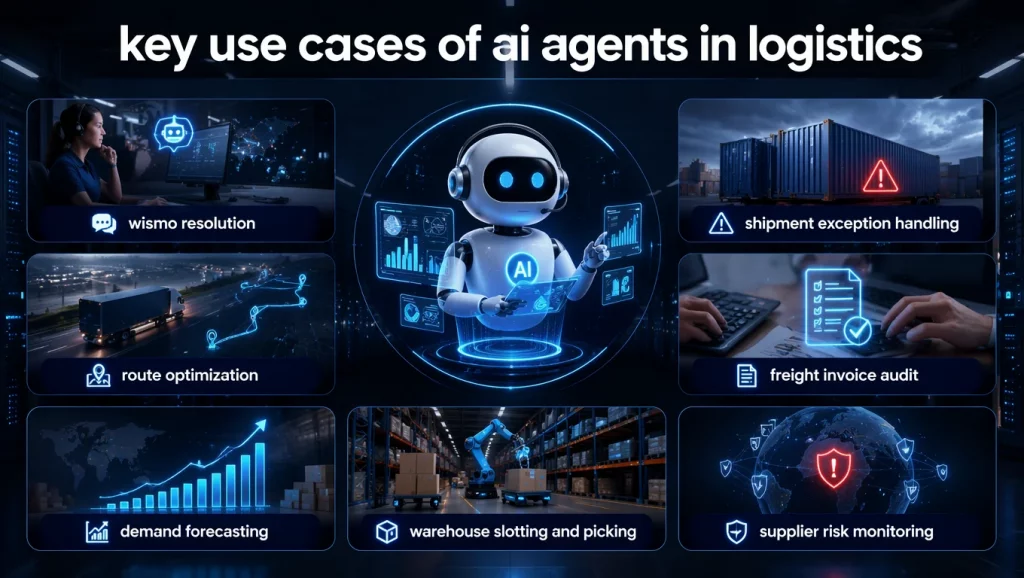
The following use cases deliver the fastest and most measurable returns across enterprise logistics operations:
|
Use Case |
What the Agent Does |
Systems It Touches |
Typical Result |
|
WISMO Resolution |
Responds to shipment status queries 24/7 across chat, email, and WhatsApp |
TMS, Carrier APIs, CRM |
60-80% WISMO query deflection |
|
Shipment Exception Handling |
Detects delays, initiates carrier rebooking, notifies customers, drafts dispute documentation |
WMS, Carrier APIs, ERP, Finance |
40-50% reduction in exception-related costs |
|
Route Optimization |
Processes traffic, weather, capacity, and fuel data in real time to select optimal routes |
GPS, TMS, Fleet Management |
10-15% fuel cost reduction |
|
Freight Invoice Audit |
Matches invoices against contract terms, flags discrepancies, routes for human review |
ERP, Finance, Carrier systems |
70% reduction in manual audit time |
|
Demand Forecasting |
Analyzes historical sales, seasonal signals, and external market data to adjust inventory levels |
ERP, WMS, Sales data |
Forecast error reduced by 18% on average |
|
Warehouse Slotting and Picking |
Optimizes product placement and pick paths based on order patterns |
WMS, Robotics, Inventory systems |
Up to 99% order accuracy |
|
Supplier Risk Monitoring |
Monitors supplier performance signals, geopolitical events, and disruption indicators |
ERP, News feeds, Procurement |
25% faster disruption response |
Which Use Case Should Your Operation Prioritize?
The fastest ROI consistently comes from one well-defined, high-volume workflow supported by clean, accessible data. If your team spends more than 10 hours per week handling WISMO queries, that is your starting point. If invoice discrepancies are consuming your finance team, start there instead. For a broader view of how enterprises are prioritising AI agent deployments across functions, see our guide on enterprise AI agent use cases. Companies that attempt to automate multiple workflows simultaneously typically achieve measurable results in none of them — this is the documented pattern in BCG research and consistent with AI Hive’s deployment experience across APAC logistics clients.
Benefits and ROI of AI Agents for Logistics
The business case for AI agents in logistics is no longer speculative. According to supply chain AI adoption statistics compiled by Open Sky Group, 94% of supply chain companies plan to deploy AI or generative AI for decision support within two years. Multiple independent data sources from 2025 and 2026 now show consistent, measurable outcomes from enterprise deployments, specific enough to build a credible investment case rather than another pilot proposal.
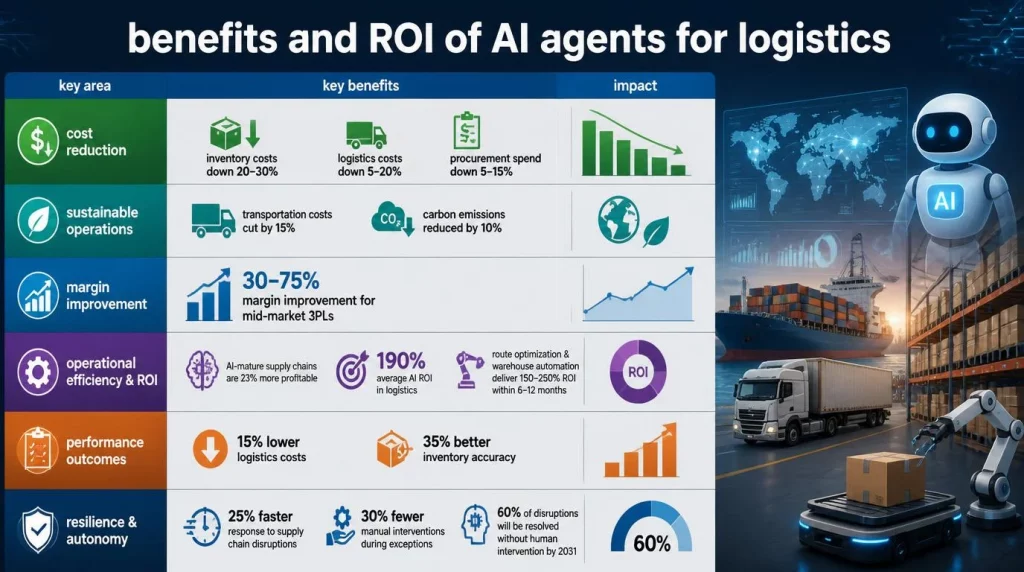
Cost reduction:
- Inventory costs down 20-30%, logistics costs down 5-20%, procurement spend down 5-15%: across supply chain operations (McKinsey)
- Transportation costs cut by 15%, carbon emissions reduced by 10%: through AI network optimization in logistics networks (Gartner Supply Chain Technology Report, 2025)
- Margin improvement of 30-75%: for mid-market 3PLs when total cost reduces by 2-3% through AI, given the industry’s 4-7% net margin baseline (European Logistics Association)
Operational efficiency:
- AI-mature supply chains are 23% more profitable: than their peers (Accenture, 2024)
- Average AI ROI in logistics reaches 190%: across all use case categories, with route optimization and warehouse automation delivering 150-250% ROI within 6-12 months (Gartner, 2025)
- 15% lower logistics costs and 35% better inventory accuracy: reported by enterprises with AI agents in production (global enterprise survey, 2026)
Resilience:
- 25% faster response to supply chain disruptions and 30% fewer manual interventions: during exception events (enterprise survey data, 2026)
- 60% of supply chain disruptions will be resolved without human intervention by 2031: (Gartner)
One figure deserves direct attention: BCG and MIT research shows only 20% of logistics AI investments deliver measurable ROI. The technology works in the other 80% of failed deployments as well. The failure is consistently in execution, whether that means starting too broad, deploying on inconsistent data, or underestimating integration complexity between AI agents and existing TMS/WMS systems. The implementation section addresses this directly, because it is the operational reality that most vendor content avoids stating plainly.
Real-World Examples and Case Studies
Understanding what AI agents for logistics look like in production requires more than use case lists. The following three deployments show the actual starting conditions, the intervention, and the outcome across different scales and operational contexts.
1. UPS ORION: Route Optimization at Fleet Scale
UPS faced a straightforward but operationally massive problem: optimizing daily routes for 125,000+ vehicles across a global network, processing conditions that change by the minute. Rule-based routing couldn’t adapt to real-time traffic, weather, and capacity signals at that volume.
UPS deployed its ORION (On-Road Integrated Optimization and Navigation) AI system to process continuous data streams across the entire fleet. The system recalculates optimal routes dynamically rather than relying on static daily planning cycles.
ORION saves approximately 10 million gallons of fuel annually. UPS has documented that every single mile reduced per driver per day translates to $50 million in annual savings. The lesson for mid-market logistics operators is not that you need ORION. It is that route optimization is one of the clearest ROI use cases available, because savings are directly measurable and compound as the model learns your network.
2. Unilever: Demand Forecasting and Inventory Optimization
Unilever’s supply chain spans hundreds of markets and thousands of SKUs, making manual demand forecasting both unreliable and costly. Forecast errors at that scale translate directly into either excess inventory carrying costs or stock-out penalties affecting customer relationships.
Unilever deployed AI forecasting agents to analyze historical sales data, seasonal patterns, promotional signals, and external market inputs across their network. The agents update forecasts continuously rather than on weekly or monthly planning cycles.
Forecast accuracy improved from 67% to 92%. The downstream inventory impact was €300 million in excess stock eliminated from their network, which represents a realized reduction in capital tied up in unsold inventory rather than a projected saving.
3. AI Hive Deployment: 3PL Client, Southeast Asia
A third-party logistics provider operating across Southeast Asia was handling 50,000+ monthly shipments. Their customer service team of 24 agents fielded 800-1,200 queries per day, of which 65% were WISMO requests requiring manual carrier lookups. Average email response time had reached 14 hours. Dispute resolution averaged 3.2 days per case, which was long enough to create measurable churn risk among their largest accounts.
Our team deployed three AI agents across their operation. The WISMO Resolution Agent integrated directly with the client’s TMS and carrier APIs to respond to shipment status queries autonomously across WhatsApp, web chat, and email. The Dispute Resolution Agent handled claim intake, automated evidence collection from carrier data, and generated policy-based settlement recommendations for human review. The omnichannel interface unified all three channels under a single agent layer, eliminating the need for separate tooling and separate training per channel.
Deployment ran on AI Hive’s cloud infrastructure with full data residency in the client’s region to satisfy local compliance requirements. Within 90 days of go-live, the operations team had shifted from fielding routine queries to managing genuine exceptions, which represented a meaningful change in how 24 trained agents were actually spending their working hours. Full performance metrics for this engagement are available to qualified prospects through a direct briefing with our logistics team.
How to Implement AI Agents in Logistics
The gap between a logistics AI investment that delivers ROI and one that doesn’t is almost never the technology. The difference lies in the sequence of decisions made before and during deployment. Here is the implementation framework we use at AI Hive, built from deployments across APAC logistics operations at various scales.
Step 1: Map your highest-friction workflow
Start by identifying where your operation generates the most manual work per unit of shipment volume. Track it for two weeks if you don’t already have the data. WISMO queries, invoice discrepancies, and shipment exceptions are the most common starting points in mid-market logistics. Your first AI agent should target whichever workflow costs the most time or money per month, not the most technically interesting one.
Step 2: Audit your data infrastructure
An AI agent is only as effective as the data it can access. Before deployment, confirm that your TMS and WMS expose APIs or structured data feeds, that shipment records are consistently formatted, and that carrier integrations are live and current. Legacy systems with no API layer require middleware integration first. This step typically adds 30-40% to total project cost and must be scoped before any agent development begins.
Step 3: Select pre-built agents or scope a custom build
AI Hive’s 500+ pre-built logistics agent templates in the Marketplace cover WISMO Resolution, Shipment Exception Handling, Route Optimization, and Freight Invoice Audit agents. Pre-built agents carry validated integration patterns for common TMS/WMS systems and reduce time-to-production significantly. Custom builds are appropriate when your workflows are non-standard or your compliance posture requires specific data handling that templates don’t cover.
Step 4: Integrate with your existing stack
Our platform provides 100+ native connectors for enterprise logistics systems:
|
System |
Integration Type |
Notes |
|
SAP S/4HANA |
Native connector |
Real-time data sync |
|
Oracle SCM |
Native connector |
Bidirectional |
|
Salesforce |
Native connector |
CRM + case management |
|
Custom TMS |
REST API / Webhook |
Requires API documentation |
|
Legacy WMS |
EDI + middleware layer |
Feasible; adds to timeline |
|
Carrier APIs (FedEx, DHL, etc.) |
Direct API |
Pre-built carrier connectors available |
For logistics operations handling sensitive shipment data or subject to regional data residency requirements, we recommend on-premise deployment for data-sovereign operations. These deployments run on Kubernetes clusters with zero data leaving your infrastructure post-deployment.
Step 5: Go-live with AI Engineers embedded in your team
Our AI Engineers for Hire model places 1-3 engineers directly inside your delivery cycle during deployment. They work in your Slack or Teams, participate in your sprints, and own the integration work alongside your internal team. Your first production-ready logistics agent goes live within 4 weeks, compared to the 6-18 months typical of platform-only vendors.
Step 6: Measure, then expand
Track cost-per-shipment, exception rate, WISMO deflection rate, and invoice audit time from week one. Companies with clear measurement frameworks and clean baseline data report a median ROI of 55% on their first agent deployment. Once the first use case is proven, expanding to adjacent workflows is significantly faster because the data infrastructure and integration patterns are already established.
Challenges and Best Practices for deploying AI Logistics Agents
Every logistics AI deployment we’ve run encounters a predictable set of operational obstacles. None of them are insurmountable, but each one needs to be identified and planned for before the first agent goes live.
|
Challenge |
What It Looks Like |
Best Practice |
|
Data quality and siloed systems |
TMS, WMS, and carrier systems don’t share data formats; records are incomplete or inconsistent |
Start with one use case and one clean data source; validate integration before attempting cross-system AI |
|
Legacy TMS/WMS with no API layer |
Your systems work, but weren’t designed to share data with external platforms |
Use middleware or choose a platform with pre-built EDI connectors; budget 30-40% of project cost for integration |
|
AI talent shortage |
68% of executives cite this as their primary AI scaling barrier (Deloitte, 2024) |
Embed AI engineers during deployment rather than relying on internal teams to manage post-purchase implementation |
|
Security and data sovereignty |
Regional regulations require shipment data to remain within specific jurisdictions |
Deploy on-premise or private cloud with AES-256 encryption at rest and TLS 1.3 in transit; enforce RBAC and full audit trails |
|
Scope creep |
Organizational pressure to automate multiple workflows before any single one is proven |
Enforce a single-use-case rule for the first deployment; expand only after ROI is validated |
|
Governance gaps |
AI agents making decisions without audit visibility or escalation paths |
Implement PII masking, role-based access, and human-in-the-loop escalation thresholds before scaling |
Governance deserves particular attention. Deloitte’s State of AI 2026 report found that only 21% of companies have a mature governance model for AI agents. In logistics, where an agent’s decision to rebook a carrier or settle a dispute has direct financial consequences, unauditable AI behavior is a liability that extends beyond compliance concern. We build governance into every AI Hive deployment from the initial architecture, because retrofitting it after go-live is both technically expensive and operationally disruptive.
Future Trends of AI Agents in Logistics 2026+
The competitive gap between logistics operations that have deployed AI agents and those still evaluating pilots will widen materially over the next three years, driven by three structural shifts that are already underway.
- Multi-agent orchestration becomes the standard operating model: Individual task agents (a WISMO agent, an exception agent, a routing agent) are already proven at the use-case level. The next layer is orchestration: specialized agents collaborating automatically, passing context between each other, and completing end-to-end workflows without human handoff at any intermediate step. Gartner projects that by 2031, 60% of supply chain disruptions will be resolved without human intervention, which requires coordinated multi-agent systems, not single-point automation.
- Digital twins enable pre-emptive decision-making: AI agents operating on virtual replicas of the physical supply chain can simulate thousands of disruption scenarios and identify optimal responses before the disruption occurs. Port congestion, weather events, and carrier capacity constraints can be modeled days in advance rather than managed reactively.
- Autonomous execution replaces decision support: By 2028, Gartner projects that 15% of daily logistics decisions will be made autonomously by AI agents. By the end of 2026, 75% of large enterprises will have adopted some form of AI-based smart execution in their supply chains. The companies that have already deployed and iterated on their first agents will hold a 2-3 year operational data advantage over those beginning their pilots in 2027.
AI Hive: Your Deployment Partner for AI Agents in Logistics
Your logistics operation already generates the data that AI agents need. The constraint isn’t data availability, and it is not the technology itself. The real gap is the engineering execution that connects your TMS, WMS, and carrier systems into a production-ready agent architecture.
We built AI Hive specifically to close that gap. Our platform combines a production-grade SaaS environment with on-premise deployment capability, a marketplace of 500+ pre-built logistics agent templates, and AI Engineers who work directly inside your delivery cycle rather than leaving you to implement the platform independently.
What your logistics operation gets with AI Hive:
- Pre-built logistics agents: WISMO resolution, shipment exception handling, route optimization, dispute processing, and freight invoice audit, all deployable in days rather than months
- Model-agnostic architecture: 11+ LLMs supported including GPT-4o, Claude, Gemini, and Llama. You select the right model per task, reducing LLM costs by 35-60% compared to single-model platforms
- On-premise and private cloud deployment: for logistics operations with data sovereignty requirements or regional compliance obligations
- 100+ native connectors: SAP S/4HANA, Oracle SCM, Salesforce, and custom TMS/WMS systems via API and EDI
- AI Engineers for Hire: 1-3 engineers embedded in your sprints, working in your Slack or Teams, accountable to your deployment timeline
- Built-in governance layer: PII masking, role-based access control, AES-256 encryption at rest, TLS 1.3 in transit, and a full audit trail from day one
We differ from Kore.ai and IBM Watson in one concrete and consequential way: we don’t sell you the platform and hand you a $350/hour consultant. We put engineers inside your delivery cycle who are accountable to the same outcome you are.
|
Factor |
Build In-House |
Kore.ai / IBM |
AI Hive |
|
Time to first production agent |
12-24 months |
6-18 months |
4 weeks |
|
Annual cost |
$500K-$2M |
$300K+/year |
From $1,500/month |
|
AI engineering required |
Full internal team |
External consultants |
Included |
|
On-premise option |
High cost, long timeline |
Complex, expensive |
Standard offering |
|
Model flexibility |
Whatever you build |
Limited |
11+ LLMs + BYOM |
|
Governance layer |
Build from scratch |
Add-on |
Built-in |
Explore AI Hive’s enterprise logistics AI solutions to review specific deployment architectures and outcomes. When you’re ready to scope your first logistics agent, our engineering team maps your TMS/WMS stack and identifies your highest-ROI starting point in a 30-minute call, with a custom deployment proposal delivered within 3 business days.
Conclusion
AI agents for logistics have moved well past the evaluation stage. They are in production, delivering measurable margin improvements, and the gap between operations that have deployed them and those still evaluating pilots is compounding each quarter. The pattern that works is consistent: start with a single high-friction workflow, validate ROI on clean data, then expand from there. The 80% of deployments that fail do so because they skip that sequence, not because the technology doesn’t perform.
AI Hive helps logistics operations close that execution gap directly. Our platform connects to your TMS, WMS, and carrier systems out of the box, and our AI Engineers work inside your team to get your first production-ready AI agent for logistics live in under four weeks. Book a Logistics Scoping Call with AI Hive and we will scope your highest-ROI use case in one call, then deliver a deployment proposal within 3 business days.