

Your engineering team spent months building a customer support agent? Meanwhile, a competitor deployed the same capability in two weeks using a marketplace template – and their agent now handles 65-70% of tickets without human intervention. That’s not a technology gap. It’s a deployment gap. This guide compares the top AI agent marketplaces in 2026, shows what separates a production-ready template from a polished demo, and gives you a practical framework for choosing the right platform for your organization’s scale and risk profile.
Key Takeaways
|
What Is an AI Agent Marketplace?
An AI agent marketplace is a platform where enterprises discover, install, and deploy pre-built AI agent workflows without building from scratch.
The distinction from a conventional app store matters. A standard app store sells software that humans operate. An AI agent marketplace sells autonomous workflows that execute tasks on their own – classifying support tickets, processing KYC applications, routing appointments, managing purchase orders – without waiting for manual input. Agents act; they don’t just respond.
The pricing model shifts accordingly. Traditional SaaS charges per seat. Agent marketplaces charge per task, per outcome, or per deployed agent. The economics scale with the volume of work, not headcount.
Three things separate a marketplace from a library of code templates:
- Production vetting: agents are tested under real enterprise conditions before listing, not just in sandbox demonstrations
- Integration mapping: installation auto-connects the agent to existing systems (CRM, ERP, ticketing tools) without custom connector work
- Ownership model: installed agents belong to the buyer – no ongoing royalties, no platform lock-in on the workflow logic
According to Gartner’s 2026 Hype Cycle for Agentic AI, only 17% of organizations have deployed AI agents so far, but more than 60% expect to within two years – the most aggressive adoption curve among all emerging technologies in the survey. That gap between intent and production deployment is exactly the problem a well-designed marketplace is built to close.
Key Features to Look for in an AI Agent Marketplace
Not every platform calling itself a marketplace deserves the name. Here’s what separates a genuine enterprise-grade option from a template directory with better branding.
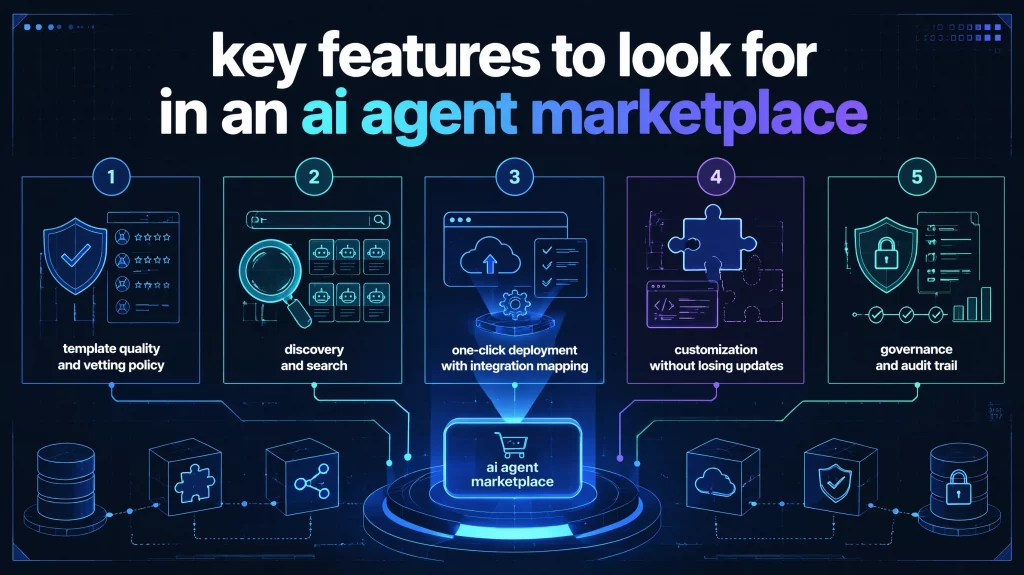
Template quality and vetting policy
The most important signal is what happens before a template gets listed. AI Hive’s marketplace requires peer review covering code quality, security standards, and performance benchmarks before publication. Kore.ai templates are vendor-built and internally validated. Open community platforms may publish with little gatekeeping – which is where supply chain risk enters, and it’s a real risk (see the Security section below).
Discovery and search
A marketplace with 500+ templates is useless if you can’t find the right agent in three minutes. Look for category filters by industry and function, search by use case rather than agent name, and install metrics that show real adoption – not just a star rating from a handful of reviews.
One-click deployment with integration mapping
The best marketplaces auto-map integrations to your connected systems when you install a template. You should be able to go from “found it” to “running against real data” within an hour for standard enterprise tools. If setup requires a services engagement just to connect the agent to your CRM, the workflow friction defeats the speed advantage.
Customization without losing updates
Templates need to be forks you can modify, not locked black boxes. After installation, you should be able to edit prompts, logic, and thresholds in a no-code builder – and receive upstream template improvements without overwriting your customizations. This is an architecture decision, not a UI preference.
Governance and audit trail
Enterprise agents that touch regulated data need a traceable decision record. Every significant action should be logged with model version, tool calls invoked, and decision rationale – so you can replay decisions, trace failures, and produce compliance evidence during audits. Platforms without this layer create problems the first time a regulator asks what your agent decided and why.
Top 5 AI Agent Marketplaces in 2026
The market has split into two tiers: enterprise platforms with governance, deep integration, and compliance coverage – and developer or community platforms with breadth and speed but limited enterprise controls. Let’s explore the 5 best AI agent marketplaces available in 2026 and pick the one that suits your business most:
| Marketplace | Templates/Agents | Target Profile | Deployment | Pricing | Vetting |
| AI Hive | 500+ templates | Mid-market to enterprise (100-2,500+) | Cloud, On-premise, Air-gap | From $29/mo | Peer-reviewed |
| Kore.ai | 100+ agents, 75+ templates | Fortune 2000 | Cloud, On-premise | $300K+/year | Vendor-built |
| Microsoft Marketplace | 3,000+ solutions | Microsoft 365/Azure | Azure cloud | Usage-based/MACC | Partner-vetted |
| Salesforce AgentExchange | 200+ partner apps | Salesforce CRM users | Salesforce cloud | Per-use/subscription | Editorial review |
| Oracle Fusion Marketplace | Partner-built | Oracle ERP/SCM | Oracle Cloud | Included for Fusion | Oracle-certified |
| GPT Store (OpenAI) | 3M+ custom GPTs | Developers, small teams | Cloud only | No monetization | Minimal/community |
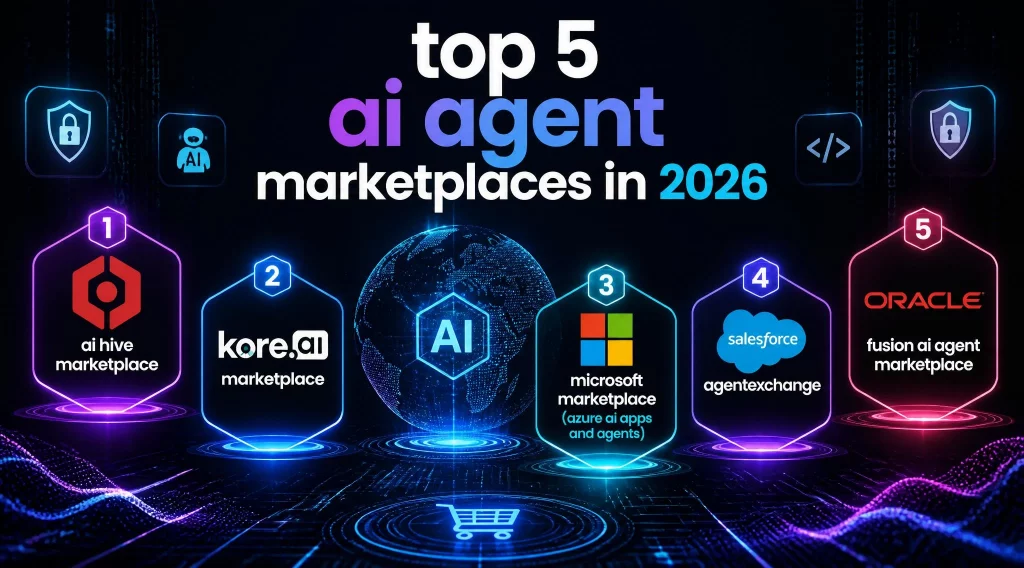
1. AI Hive Marketplace
AI Hive’s marketplace lists 500+ production-tested enterprise templates across BFSI, healthcare, logistics, IT, retail, and manufacturing. Every template is peer-reviewed for code quality, security, and performance before listing. Creators keep 80% of template revenue, making it the most creator-favorable platform among enterprise-focused options.
Real install data from the platform shows actual production adoption, not demo metrics:
- IT Helpdesk Agent: 3,100+ installs, 4.8 stars from verified enterprise users – resolves tier-1 requests (password resets, VPN troubleshooting, access provisioning) within ServiceNow, 24/7
- Customer Support Triage Agent: 2,400+ installs, 4.9 stars – achieves 65-70% autonomous resolution across Zendesk, Freshdesk, and ServiceNow
- KYC Onboarding Agent: 1,800+ installs – document OCR, AML watchlist screening, risk scoring, and compliance report generation
The platform supports cloud, on-premise, and air-gapped deployment. Explore the full template catalog at the AI Hive Agent Marketplace.
Best for: Mid-market to enterprise organizations (100-2,500+ employees) that need production-ready agents with compliance controls, real install history, and flexible deployment including on-premise.
2. Kore.ai Marketplace
Kore.ai offers 100+ agents and 75+ templates, all vendor-built and validated. The platform provides 300+ enterprise application integrations and strong vertical depth in banking, healthcare, retail, HR, and IT. It has been a Gartner Magic Quadrant Leader in Conversational AI for three consecutive years.
The constraint is commercial: Kore.ai contracts start at $300,000+ per year and require dedicated implementation resources and extended timelines.
Best for: Global 2000 enterprises with existing Kore.ai relationships, large implementation budgets, and complex multi-department deployments.
3. Microsoft Marketplace (Azure AI Apps and Agents)
Microsoft unified Azure Marketplace and AppSource in September 2025 into a single hub with 3,000+ solutions at launch. Enterprises with Microsoft Azure Consumption Commitments can apply existing cloud spend to marketplace purchases – a procurement shortcut that significantly reduces friction for Microsoft-native organizations.
Best for: Organizations already running Microsoft 365, Azure, and Dynamics 365.
4. Salesforce AgentExchange
Salesforce launched AgentExchange with 200+ partners at launch, including Google Cloud, Docusign, and Box. The platform is strongest for customer-facing workflows – sales automation, service resolution, marketing orchestration – within the Salesforce ecosystem.
Best for: Salesforce-first organizations where primary agent use cases sit inside CRM and customer service workflows.
5. Oracle Fusion AI Agent Marketplace
Oracle launched the Fusion Applications AI Agent Marketplace in October 2025. Partner-built agent templates are supported by 32,000+ certified AI agent experts. Agents run on Oracle Cloud Infrastructure at no additional cost for existing Fusion Cloud customers.
Best for: Oracle ERP customers who want AI agents embedded into supply chain, procurement, manufacturing, and finance workflows.
BONUS: How to Choose the Right Marketplace for Your Company Size
“Best AI agent marketplace” is the wrong question. The right question is: best for which use case, at which scale, under which governance requirements?
1. Startups and teams under 50 people
Developer-focused platforms – GPT Store, Hugging Face Spaces, Claude Skills – make sense here. The priorities are speed, cost, and flexibility, not enterprise compliance or dedicated support. Governance layers are minimal, which is acceptable when you control the full stack and aren’t handling regulated data.
2. Mid-market: 100-2,500 employees
This is where the marketplace choice becomes consequential. You need production-grade agents, but you can’t afford the $300K+/year that Kore.ai requires, and you probably don’t have an enterprise procurement relationship with Microsoft or Oracle. AI Hive’s marketplace targets this segment specifically: enterprise vetting standards, on-premise deployment where required, 100+ integrations, and pricing that doesn’t require a six-figure annual commitment.
The critical criteria at this scale: integration depth with existing tools, support for data residency requirements, and a governance layer that will hold up during your first enterprise security review. If you’re still evaluating what kind of build vs. buy approach fits your team, the AI agent platform guide for tech leaders covers the underlying platform architecture decisions that affect which marketplace you should choose.
3. Enterprise: 2,500+ employees
At enterprise scale, the marketplace decision often follows existing cloud and software procurement relationships. Microsoft Marketplace makes sense for Microsoft-first organizations. Salesforce AgentExchange makes sense where CRM is the primary deployment surface. Oracle works if you’re already inside the Oracle ecosystem.
Where none of those apply – or where you need multi-cloud, on-premise, or hybrid deployment – AI Hive and Kore.ai are the two platforms with the architecture to support it. Kore.ai takes 6-18 months and $300K+; AI Hive targets weeks with enterprise-accessible pricing.
One criterion applies at every scale: ask the vendor for real install data, not demo metrics. A template with 3,100 verified enterprise installs has survived production environments. A template with 12 reviews from beta users has not.
How to Deploy an Agent from a Marketplace
Deploying a marketplace template should not require a professional services engagement. If it does, reconsider the platform. Here’s what a clean deployment looks like on a production-grade marketplace:
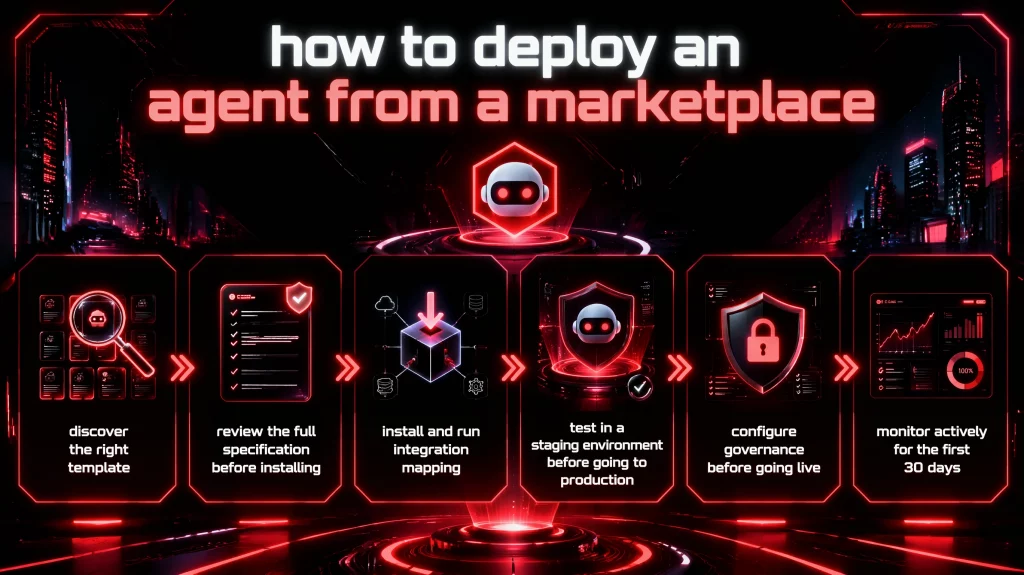
- Discover the right template: Filter by industry and function, then sort by verified enterprise installs – not overall rating.
- Review the full specification before installing: A well-documented template includes integration requirements, performance benchmarks, creator credentials, security review status, and verified user reviews.
- Install and run integration mapping: One-click installation should auto-connect the template to your existing systems. Confirm your CRM, ticketing system, and data warehouse map correctly before testing.
- Test in a staging environment before going to production: Run the agent against a staging dataset for 48-72 hours minimum. Production data surfaces edge cases that demo data never does.
- Configure governance before going live: Set access controls, escalation thresholds, audit log settings, and cost limits on API calls. One organization in 2025 set no cost limits on a research agent; a retry loop bug triggered 47,000 API calls overnight, running up costs equivalent to several months’ payroll.
- Monitor actively for the first 30 days: MIT’s NANDA report found the failures that killed enterprise AI ROI showed up consistently in integration gaps and governance gaps – both visible in the first 30 days if you’re watching. For hands-on support, AI Hive’s modular implementation services include engineers who work directly inside your deployment cycle.
4 Common Use Cases: Where Marketplace Agents Deliver Real ROI
The clearest ROI cases for AI agent marketplaces are high-volume, repetitive workflows where the cost of getting it wrong is moderate and the cost of human labor is significant.
IT operations
IT helpdesk automation is the most consistent ROI story in this market. AI Hive’s IT Helpdesk Agent, with 3,100+ verified enterprise installs, resolves tier-1 tickets autonomously within ServiceNow. For an IT team of 12 handling 5,000 tickets per month where 70% are tier-1, this frees your team to handle the 30% that actually requires expertise.
BFSI: KYC and compliance
KYC Onboarding Agents handle document OCR, AML watchlist screening, and automated eligibility decisions at scale. The 1,800+ installs on AI Hive’s KYC agent represent production deployments in regulated banking environments. If you’re in financial services, the AI Hive BFSI solutions page covers compliance architecture for banking and insurance deployments.
Customer support automation
A logistics company handling 800-1,200 customer queries per day, where 65% are order status requests, can deploy a WISMO agent that handles status lookups, delay notifications, and rerouting requests without human intervention. AI Hive’s Customer Support Triage Agent achieves 65-70% autonomous resolution in production, backed by 2,400+ verified installs.
Healthcare: patient triage and scheduling
Patient triage and appointment management are high-volume workflows where automation reduces call center load without replacing clinical judgment. Deployment details are on the AI Hive healthcare automation page.
Security, Governance, and Compliance When Using Marketplace Agents
This is where most organizations underinvest until something goes wrong. The 2026 security landscape has produced enough documented incidents to make the risks concrete.
What has actually gone wrong
In February 2026, security researchers at Koi Security audited ClawHub – the official skill marketplace for the OpenClaw AI agent. Of 2,857 skills reviewed, 341 were malicious. Of those, 335 traced back to a single coordinated campaign called ClawHavoc, which planted credential-stealing malware disguised as legitimate utilities. By mid-February, follow-up scans confirmed the number had grown to over 800 malicious skills as the marketplace expanded. Separately, CVE-2026-25253 – the first CVE assigned to an agentic AI system – demonstrated remote code execution through a crafted skill package in the same platform. (Sources: Koi Security / The Hacker News, February 2026)
These weren’t theoretical scenarios. ClawHub is a developer-community platform, not an enterprise-grade marketplace – which is precisely why the vetting policy question matters before you choose where to source your agents.
What enterprise governance requires
OWASP’s December 2025 Top 10 for Agentic Applications identifies the three highest-risk categories for deployed agents: prompt injection, memory poisoning, and tool or plugin misuse. Traditional WAFs, DLP tools, and CASB platforms don’t address these attack vectors – they weren’t designed for an agent’s reasoning chain.
Before deploying any marketplace agent on enterprise systems, your governance checklist should cover:
- RBAC configured before the agent goes live – role-based access control, not retrofitted after deployment
- Full audit trail: every significant action logged with model version, tool calls, and decision trace
- Human-in-the-loop checkpoints for high-risk or irreversible actions
- API cost limits to prevent runaway retry loops
- EU AI Act classification: from August 2026, high-risk AI agents touching consequential decisions require mandatory compliance documentation. Penalties reach EUR 35 million or 7% of global annual turnover.
5 Common Mistakes When Selecting AI Agents from a Marketplace
Most AI agent deployments fail not because the technology doesn’t work, but because of decisions made before or during selection.
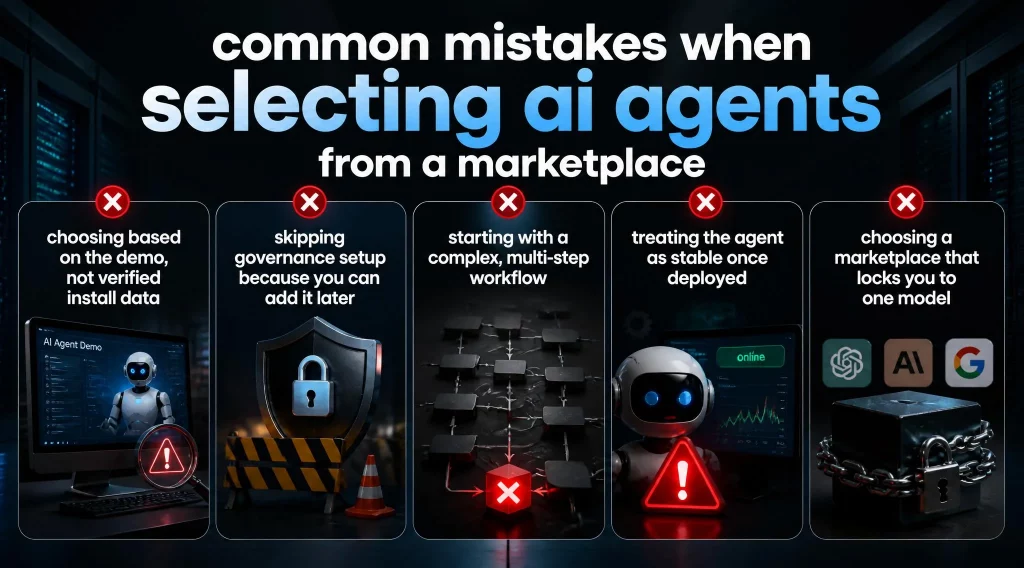
Mistake 1: Choosing based on the demo, not verified install data
Vendor demos show the clean path. Your production environment has messy data, inconsistent input formats, and edge cases the demo never encountered. Always ask for autonomous resolution rate in production, response time under real load, and error rate at the 95th percentile.
Mistake 2: Skipping governance setup because you can add it later
Multiple enterprise deployments studied between May and October 2025 experienced full operational freezes because no one could answer: when the agent makes a wrong call on a high-value decision, who owns the outcome? Building governance into a deployed production agent costs significantly more than building it in from day one.
Mistake 3: Starting with a complex, multi-step workflow
The organizations that consistently achieve ROI from AI agents start narrow. Not “automate customer service” but “handle password reset requests in ServiceNow.” Organizations that begin with end-to-end workflow automation almost always hit integration failures early. For a practical overview of how to structure this incrementally, the no-code AI agent builder comparison covers the build vs. configure decision point most teams face first.
Mistake 4: Treating the agent as stable once deployed
Agents need active supervision in the first 90 days. Research shows user abandonment for agents without persistent memory runs at 47% after the first week. Agents with proper memory management see abandonment drop to 12%. That difference shows up entirely in real usage, not in demos.
Mistake 5: Choosing a marketplace that locks you to one model
The best enterprise marketplaces are model-agnostic. AI Hive supports 11+ LLMs including OpenAI GPT models, Google Gemini, Anthropic Claude, Meta Llama, and Mistral, with different models selectable per agent depending on the task. Locking to a single model means you’re exposed to that provider’s pricing changes, capability gaps, and compliance limitations.
Future Trends in AI Agent Marketplaces
Three structural shifts will define the next 12-18 months of this market.
From templates to outcome contracts
The pricing model for agent marketplaces is moving from “here’s a template you deploy” toward “here’s an agent that completes X tasks at Y price.” Expect pay-per-task and pay-per-outcome models to become standard from major platforms by Q4 2026.
Marketplace as enterprise procurement channel
Enterprise procurement is moving onto marketplace rails. Microsoft’s MACC eligibility and Salesforce’s AppExchange integration mean that a marketplace listing is increasingly a procurement channel, not just a discovery surface.
Regulatory pressure forcing vetting standards up
The EU AI Act’s enforcement from August 2026 and OWASP’s Agentic AI Top 10 (December 2025) are pushing marketplace operators to raise vetting standards. Expect formal certification programs for marketplace agents in regulated industries to emerge in the second half of 2026.
Conclusion
The AI agent marketplace category is past the hype phase. Gartner confirmed the 40% enterprise adoption trajectory. MIT confirmed the 95% failure rate for organizations that deploy without proper integration and governance. The two statistics aren’t contradictory – they describe the same market from different angles. Lots of organizations are deploying agents. Most of them are doing it wrong.
Getting it right comes down to three decisions: choosing a platform with real vetting standards and verified install data rather than demos; starting with one narrow, well-defined task rather than end-to-end workflow automation; and building governance in before the agent goes live, not after the first incident. For mid-market organizations that need production-grade agents without a six-figure annual commitment, AI Hive’s marketplace is the most viable starting point in 2026. Browse production-tested templates across 10+ industries or request a deployment scoped to your use case with AI Hive’s team.
>>> Approach AI Hive solutions and build your customized AI agent that simplify and streamline your business workflow with ease.