

Research in 2026 documents a 37% gap between AI agent lab benchmark scores and real-world deployment performance, with cost variation of up to 50 times for agents delivering similar accuracy. For enterprise buyers, that gap means vendor selection based on published benchmarks alone is insufficient. This article explains how to access AI agent evaluation of the platforms using benchmarks that predict production performance, scoring methods that reflect your business context, and selection criteria that reduce the risk of a costly deployment failure.
Key Takeaways
|
Why Published AI Agent Benchmarks Fall Short for Enterprise Buyers
Published benchmarks serve a specific purpose: they let researchers and vendors communicate model capability improvements in a standardized format. Standard benchmarks such as tau-bench, SWE-Bench, and AgentBench have credible task curation, automated grading, and active leaderboards. However, they were designed to compare general-purpose capabilities across models, not to predict whether a specific agent will succeed in your enterprise environment.
The benchmark-to-production gap emerges from three structural differences. First, public benchmarks use standardized tasks well represented in model training data, while enterprise workflows include domain-specific terminology, proprietary data schemas, and edge cases rarely represented in public datasets. An agent scoring 85% on a public benchmark may score 60% on your actual business tasks. Second, public benchmarks evaluate isolated task performance, while enterprise deployments require reliable multi-step workflows where a failure at step two propagates to every subsequent step. Third, public benchmarks do not assess cost, latency, or compliance behavior.
Benchmark saturation is also a growing concern. Leading models are increasingly trained on or evaluated against major public benchmarks, which inflates scores without a corresponding production improvement. Enterprise buyers need an evaluation approach built around their own workflows rather than published leaderboards.
Designing an Enterprise-Grade Agent Evaluation Framework
The most reliable enterprise evaluation framework replaces generic benchmarks with task suites built from your actual business workflows. Forrester’s root-cause analysis of negative-ROI AI deployments attributes 41% of failures to unclear success criteria, which means defining what a successful outcome looks like for your specific use case is the prerequisite for meaningful evaluation.
We recommend a four-phase evaluation framework that progressively narrows the candidate pool from broad capability screening to production-readiness validation.
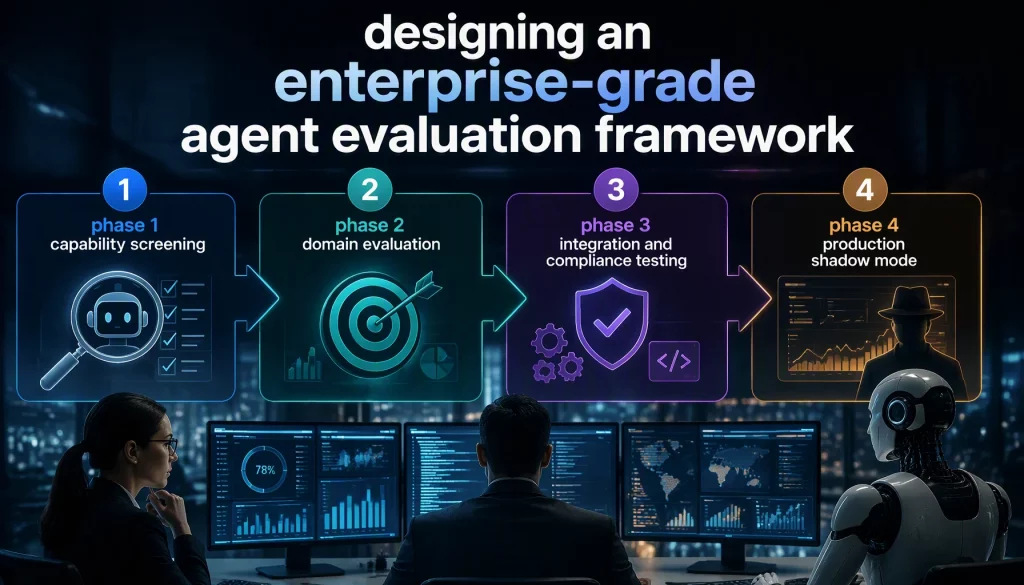
- Phase 1, capability screening: Runs each candidate through 20 to 30 tasks representing your primary use case category. This phase eliminates candidates that cannot perform the core task type and narrows the field to two or three finalists for deeper evaluation.
- Phase 2, domain evaluation: Runs each finalist through 50 to 100 tasks drawn directly from your production data, with human-labeled expected outputs. This phase identifies which candidates handle your domain terminology, data formats, and edge cases accurately, and it’s where the benchmark-to-production gap typically becomes visible.
- Phase 3, integration and compliance testing: Evaluates each finalist in a staging environment connected to your actual enterprise systems, testing tool connectivity, authentication flows, data access controls, audit logging, and latency under realistic load. These are largely the same signals your AI agent observability layer will need to capture continuously once the agent goes live, so it pays to test them together rather than as an afterthought.
- Phase 4, production shadow mode: Runs the finalist agent alongside your existing process for two to four weeks, comparing outputs to the current baseline without routing live users to it. Shadow mode provides the most accurate prediction of production performance while eliminating the risk of a poor agent outcome affecting real users, and the same dashboards you build here typically become the foundation for ongoing AI agent monitoring after go-live.
Key Scoring Methods for AI Agent Evaluation
Once you have defined your evaluation tasks, you need scoring methods that produce reliable, comparable results across candidates. Three approaches suit different performance dimensions.
Exact match and schema validation works for structured output tasks: information extraction, data transformation, classification, and form completion. Exact match scoring is objective, fast, and does not require LLM-as-judge evaluation. We recommend using it wherever your output format is structured, because it eliminates the subjectivity and cost of LLM-based scoring.
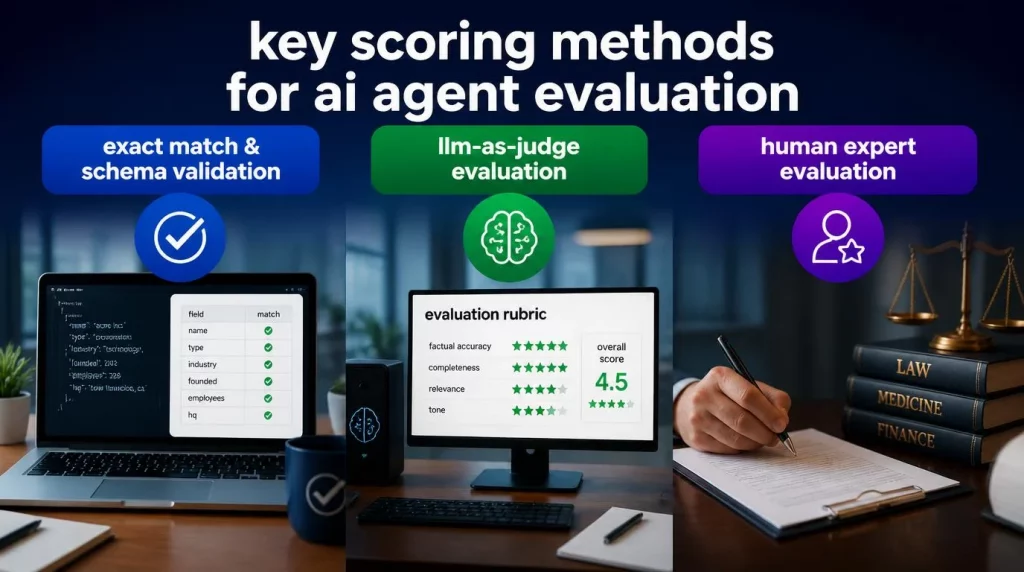
LLM-as-judge evaluation works for prose output tasks: summarization, explanation, recommendation, and conversational response. A secondary model scores agent outputs against a rubric defining quality dimensions such as factual accuracy, completeness, relevance, and tone. Research consistently shows that calibrated LLM judges agree with human reviewers on 85 to 90% of samples, making them sufficiently reliable for production evaluation at scale.
Human expert evaluation applies to high-stakes tasks where automated scoring cannot capture the nuances that matter: contract review in legal contexts, clinical summary accuracy in healthcare, or regulatory advice accuracy in financial services. Human expert evaluation is the only scoring method with sufficient validity for decisions where an incorrect AI output carries meaningful legal or clinical risk.
Total Cost of Ownership: The Evaluation Dimension Most Buyers Miss
Capability scoring answers whether an agent can do the task. TCO analysis answers whether deploying that agent makes business sense. Enterprise buyers who evaluate AI agent platforms on capability alone consistently encounter significant budget surprises after deployment.
A complete TCO analysis covers model API costs at production volume with growth projections, platform licensing including SaaS subscription and usage-based components, integration costs for connecting the agent to existing systems such as ERP, CRM, data warehouse, and authentication infrastructure, operational costs for monitoring tooling and incident response staffing, and compliance costs for audit logging infrastructure and regulatory review.
We recommend requesting that each vendor provide a TCO estimate based on your projected transaction volume, rather than relying on per-seat pricing that does not scale linearly with agent workload. The 50x cost variation documented in 2026 benchmark analysis is largely attributable to differences in how platforms handle token consumption at scale, and this rarely appears in standard pricing sheets.
Security, Data Sovereignty, and Vendor Lock-in in Agent Evaluation
Enterprise buyers in regulated industries face three additional evaluation dimensions that capability benchmarks do not address: security posture, data sovereignty, and vendor lock-in risk.
Security posture evaluation should cover whether the platform supports on-premise or private cloud deployment, what authentication protocols it supports, and the vendor’s SOC 2 certification status. Security evaluation requires your security team to examine architecture documentation and, for finalists, to conduct a formal security review.
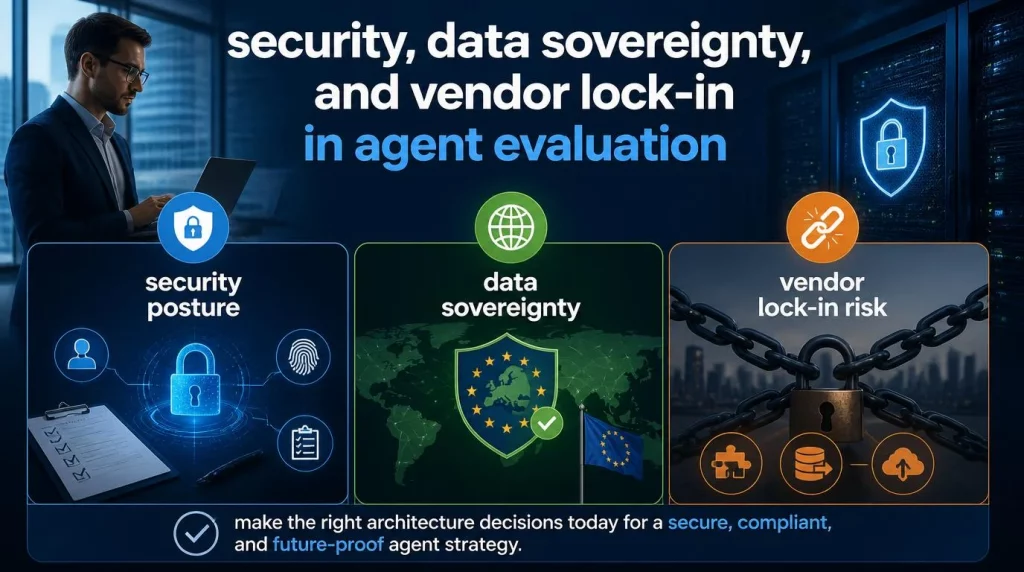
Data sovereignty is critical for enterprises in jurisdictions with strict data residency requirements, including the EU under GDPR. You need clear answers to where the platform stores agent traces and logs, whether it can be configured for in-country data residency, and whether it routes your data through the model provider’s infrastructure or can be configured with a self-hosted model.
Vendor lock-in risk is a structural concern affecting the long-term economics of your deployment. The enterprise AI agent landscape is evolving rapidly, and a platform that locks your agent logic, data, and integrations into a proprietary format creates substantial switching costs. We recommend evaluating whether the platform supports open standards for agent configuration, whether you can export your agent definitions and evaluation datasets, and whether you can bring your own model. These architecture decisions are best made during the selection phase, not after a multi-year dependency has been established, and they carry through the rest of the agent’s lifecycle long after the initial deployment decision is signed off.
How AI Hive Approaches Agent Evaluation and Selection
At AI Hive, we apply this framework to every enterprise agent deployment and vendor selection process we support. Our evaluation process begins with the business outcome definition, maps backward through all four evaluation phases, and produces a selection recommendation with quantified TCO estimates and risk documentation for each finalist.
Our platform is built specifically to avoid vendor lock-in. We support multiple LLM providers, export agent configurations in open formats, and provide on-premise deployment for organizations that require data sovereignty. We also provide AI Engineers for Hire who can run your evaluation process with you if your team lacks the in-house capacity to design and execute a four-phase evaluation program at enterprise scale.
Conclusion
AI agent evaluation is the discipline that closes the gap between what vendors promise and what your enterprise actually needs. The four-phase framework, scoring methods, and selection criteria in this guide give your procurement and technology leadership teams a structured process for moving from vendor shortlist to a confident production decision. With research showing that 37% of enterprises experience a significant performance gap between evaluated and deployed agents, rigorous evaluation is not optional risk management. It is the prerequisite for successful enterprise AI investment.
Our team at AI Hive has guided enterprise deployments through exactly this evaluation process, from initial capability screening to production shadow mode. If your organization is selecting an AI agent platform and wants a structured, independent evaluation process, get in touch with our AI engineers today.