

Manufacturing operations run on margins that leave little room for unplanned downtime, quality failures, or scheduling that reacts to problems rather than preventing them. Physical AI adoption in manufacturing is set to more than double within two years, and manufacturing executives are already redirecting improvement budgets toward it.
Your enterprise is likely feeling the pressure behind those numbers: quality defects that consume revenue, skilled-trades shortages, and scheduling models built for a supply chain that no longer behaves the way it used to.
An AI agent for manufacturing addresses these inefficiencies at the workflow level by scheduling maintenance before failures occur, flagging defects in real time, and adjusting production schedules based on demand and capacity constraints. This guide explains how enterprise manufacturers are deploying AI agents in production today, what the architecture requires, and where AI Hive’s platform fits.
Key Takeaways
|
The Manufacturing Productivity Gap That AI Agents Are Designed to Close
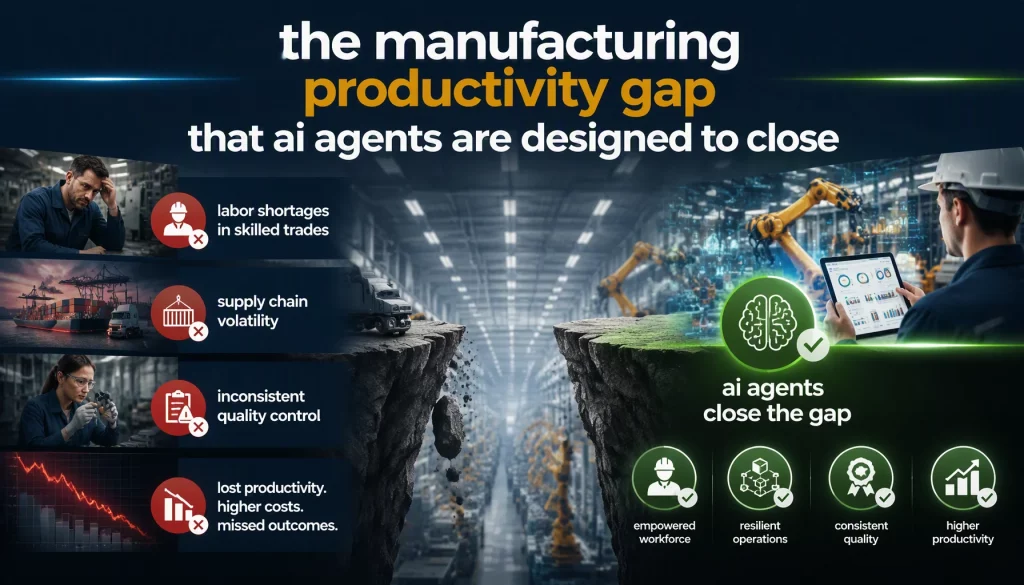
Manufacturing faces pressures that legacy automation cannot fully address. Labor shortages in skilled trades mean fewer technicians are available to diagnose equipment behavior before failures escalate. Supply chain volatility since 2020 has made static production planning obsolete, so schedules built around stable lead times now generate chronic shortfalls and excess inventory at once.
Quality control workflows that depend on human inspection struggle to hold consistency across high-volume runs, and one quality escape reaching a customer can dwarf the cost of defects caught internally. This pressure shows up clearly in the data: Deloitte’s 2026 Manufacturing Industry Outlook found that physical AI adoption among manufacturers is set to rise from 9 percent today to 22 percent within two years, and that 80 percent of the 600 executives it surveyed in 2025 plan to commit at least 20 percent of their improvement budgets to smart manufacturing initiatives.
Traditional automation, including programmable logic controllers (PLCs), MES systems, and ERP-driven scheduling, executes defined rules against known inputs. It cannot reason across data sources, adapt to novel conditions, or coordinate decisions across functional boundaries. An AI agent for manufacturing does all three: it reads sensor streams, maintenance history, quality data, demand signals, and supply chain status simultaneously, then optimizes the whole system rather than one variable at a time.
Most manufacturing teams do not need to build these capabilities from a blank page. Our team maintains a library of pre-built manufacturing agent templates covering sensor monitoring, defect classification, and demand-driven scheduling, which shortens the path from pilot to production compared with a custom build. McKinsey’s operations research on industrial maintenance reaches a similar conclusion: shifting a plant from reactive to predictive maintenance measurably raises uptime while cutting the preventative work that inflates maintenance budgets, a pattern consistent with what our manufacturing clients report once an agent has run a full production cycle.
The organizations capturing the largest gains are not running AI as a separate analytics layer nobody acts on; they run agents embedded directly in operational workflows.
AI Agents for Predictive Maintenance
Predictive maintenance is the highest-ROI entry point for AI agents in manufacturing: an emergency repair costs several times more than the same job done on a planned schedule. If your organization is building the financial case for a broader program, it is worth reviewing how AI agent ROI compounds across use cases before committing budget to one pilot, since the payback model for maintenance differs from that of quality or scheduling agents.
Sensor Data Analysis and Anomaly Detection
Every piece of rotating or electrical equipment in a facility generates continuous data: vibration signatures, temperature profiles, current draw, acoustic emissions, and oil analysis results. Rule-based monitoring compares these readings against fixed thresholds, and an alert fires only once a reading crosses a limit.
Threshold alerting captures only the obvious failures, the ones severe enough to exceed a pre-defined limit; gradual degradation and subtle pattern shifts go undetected until the failure is already imminent.
An AI agent for predictive maintenance processes raw sensor streams continuously, builds a baseline behavioral model for each asset, and detects deviations long before any fixed threshold is crossed.
A bearing showing a 3 percent shift in vibration frequency at a specific load condition is invisible to threshold alerting, yet an agent trained on the asset’s history recognizes it as early-stage fatigue and generates a recommendation with a confidence score and an intervention window.
Planners receive a prioritized work order with the reasoning behind it, not a raw alarm to interpret manually. McKinsey’s research on scaling predictive maintenance frames this shift as moving from generic uptime metrics toward the small number of high-value failure modes that drive most downtime cost, exactly what an anomaly-detection agent is built to surface.
Work Order Automation and Parts Coordination
Detection without execution is incomplete. When the AI agent identifies a developing fault, it queries the CMMS (computerized maintenance management system) for parts availability, cross-references technician schedules and certifications, and creates a fully populated work order, including procedure, parts, labor hours, and a scheduling window tied to production demand.
The coordinator reviews and approves rather than building the order from scratch. Across the deployments our team has supported, this workflow has cut mean time between detection and resolution by 40 to 60 percent, largely because the lag between alert and action disappears.
AI Agents for Quality Control
Quality control is a domain where AI agents deliver both cost savings and revenue protection. A defect caught on the line costs a fraction of what it costs once it escapes to the customer as a warranty claim, a recall, or lasting relationship damage.
Vision-Based Defect Detection at Production Speed
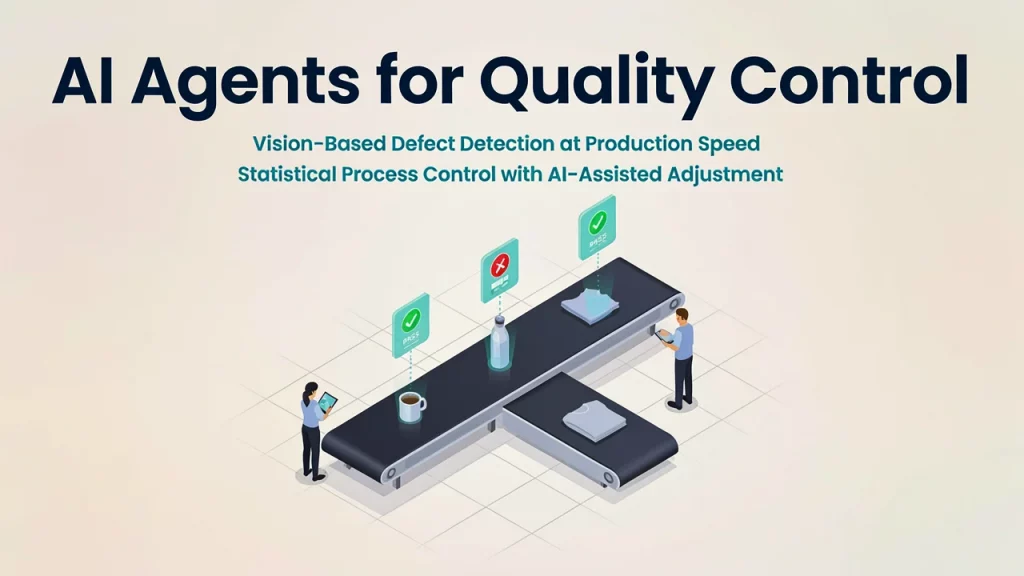
Machine vision has existed in manufacturing for decades, but rule-based vision systems require engineers to manually define what defects look like, and they fail on novel defect types outside their training library. An AI vision agent instead uses deep learning models trained on thousands of conforming and non-conforming examples to classify defects in real time at line speed.
It detects surface scratches, dimensional variation, assembly errors, and material inconsistencies that human inspectors miss after hours of repetitive checking, and it holds that accuracy through an entire shift, not just the first two hours.
In the automotive and electronics programs AI Hive has supported, false-positive rates have consistently landed below 2 percent, versus 10 to 15 percent for the threshold-based systems those plants replaced, and defect escape rates have fallen 60 to 80 percent from pre-AI baselines.
Every inspection decision is logged with its supporting image data, building a complete quality record for regulatory submissions with no extra manual step.
Statistical Process Control with AI-Assisted Adjustment
Beyond inspection, AI agents monitor process parameters upstream and recommend adjustments before defects form. By correlating variables such as temperature, pressure, cycle time, material viscosity, and tooling wear with downstream quality outcomes, the agent identifies which conditions predict non-conformances and recommends adjustments before the process drifts out of control.
This shifts quality management from reactive detection to proactive prevention. We should be candid that this capability matures slower than defect detection: the agent needs several months of correlated data before its recommendations are reliable enough to act on without a supervisor sign-off.
AI Agents for Production Planning and Scheduling
Production planning is a coordination problem of enormous complexity. A manufacturer with 50 active SKUs, 12 production lines, and 300 active suppliers cannot optimize the schedule by hand. Static ERP-driven scheduling produces plans that are accurate at the moment of generation and wrong by the time the shift starts.
An AI agent for production planning continuously updates the plan based on demand signals, supply chain changes, machine availability, and quality hold data, then executes rescheduling automatically within defined parameters.
Demand-Driven Dynamic Scheduling
The scheduling agent monitors demand signals from multiple sources at once: confirmed purchase orders, sales forecasts refined through AI sales agent pipeline data on customer intent and order timing, historical demand patterns by channel, and early indicators from distribution partners.
When demand shifts, such as an unexpected large order or a customer revising a forecast downward, the agent calculates the impact, identifies the optimal rescheduling sequence, and proposes an updated plan with trade-offs quantified. Production managers see what changes, why, and what each alternative costs, rather than discovering a crisis at the weekly planning meeting.
Supply Chain Coordination and Constraint Management
AI agents for production planning do not operate in isolation from the supply chain. Our platform integrates with supplier portals, EDI systems, and logistics tracking to maintain a real-time view of inbound material availability.
When a key component is delayed by 72 hours, the agent calculates the production impact, identifies which orders can be resequenced to use available inventory, and generates revised delivery commitments before the delay reaches the shop floor.
Deployment Architecture: Cloud, On-Premise, and Hybrid Options for Manufacturing AI
Manufacturing environments present constraints that generic cloud-first AI architectures do not address well. Many facilities operate air-gapped or restricted networks for cybersecurity reasons, particularly in defense, aerospace, and pharmaceutical manufacturing, and edge latency requirements often make cloud-based inference too slow for in-line defect detection at high line speeds.
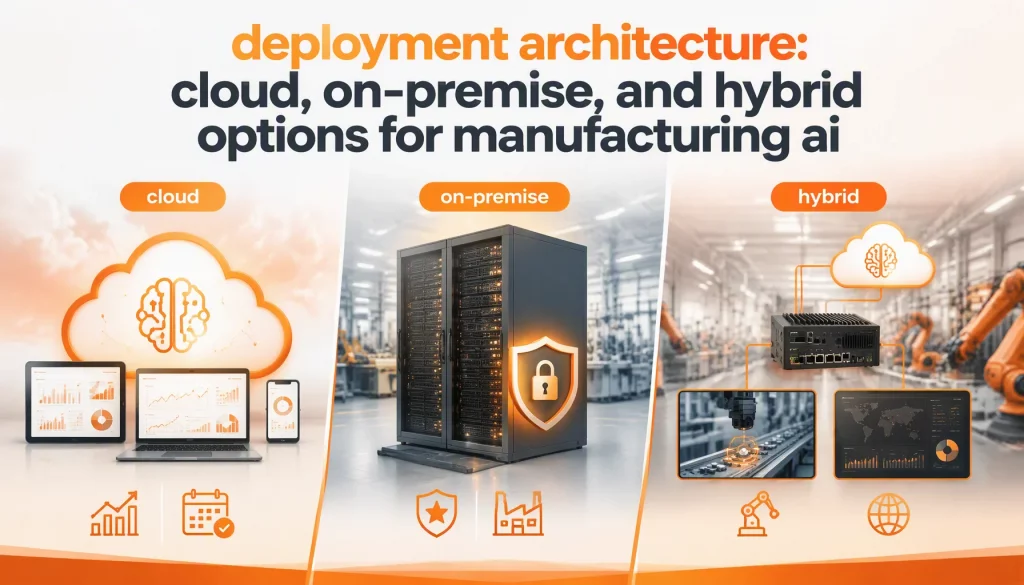
AI Hive’s Modular Implementation approach supports three deployment configurations for manufacturing clients:
- Cloud deployment: Fits use cases where latency is not critical, such as demand forecasting and maintenance scheduling, and where data can move to the cloud without security constraints.
- On-premise deployment: Keeps all data and inference inside the facility’s network, meeting the requirements of regulated environments such as defense and pharmaceutical production.
- Hybrid deployment: Runs latency-sensitive workloads, including quality inspection inference, on edge hardware, while connecting planning and reporting to the cloud for enterprise-wide visibility.
All three configurations run on the same AI Hive orchestration platform, with no vendor lock-in on the underlying LLM or computer vision models. Your organization retains ownership of the workflow logic and keeps the right to switch model providers, whether that means moving between GPT-4o, Claude, Llama, or Gemini as pricing and capability shift.
How AI Hive Supports Manufacturing AI Agent Deployments
AI Hive brings together capabilities that manufacturers typically cannot assemble on their own through our AI agent platform built for manufacturing operations. Our orchestration layer coordinates specialized agents, covering sensor processing, anomaly detection, work order generation, quality inspection, and scheduling, passing structured context between them without data loss.
Our AI Engineers for Hire program supplies manufacturing-experienced engineers for organizations that need custom integration with proprietary MES, SCADA, or ERP systems.
We have supported manufacturers across automotive, electronics, food and beverage, pharmaceutical, and industrial equipment sectors moving AI agent programs from proof of concept to production, typically within 60 to 90 days for standard configurations, provided the client scopes one or two use cases first rather than digitizing every workflow at once.
Conclusion
The manufacturing productivity gap, made up of unplanned downtime, quality escapes, and reactive scheduling, is not a data problem. Manufacturers already generate enormous volumes of operational data; the real problem is converting that data into autonomous decisions at a speed human workflows cannot match.
An AI agent for manufacturing closes that gap by embedding decision intelligence directly into operations: predicting failures before they occur, detecting defects in real time, and adjusting production plans as conditions change. The manufacturers that deploy production-grade AI agents in 2026 will not simply operate more efficiently.
They will build capabilities that define competitive advantage in their markets. Connect with AI Hive’s manufacturing specialists to map your highest-priority use cases to our agent templates and deployment architecture. Start the conversation with our team today.