


Finance has flagged another quarter of rising AI spend, and engineering insists every workload still needs the strongest model available. Both can be right at once, but sending a password-reset question and a credit-file analysis to the same premium model means paying top rates for routine work, while nobody can say which model answered which request when an auditor asks. LLM routing resolves that tension by sending each request to the model that fits its difficulty, sensitivity, and latency budget, with a fallback when the cheaper model is unsure. Done well, it cuts cost on routine traffic, keeps sensitive data on approved infrastructure, and leaves a log of every routing decision.
Key Takeaways
|
What LLM Routing Is?
LLM routing is the practice of directing each incoming request to the large language model best suited to handle it, based on factors such as task complexity, required accuracy, latency tolerance, data sensitivity, and cost. Instead of hard-coding every application to one model, a routing layer evaluates the request and forwards it in real time.
The idea resembles triage. A routine data-extraction request goes to a small, fast model, while multi-step financial analysis or legal review goes to a frontier reasoning model where errors are costly.
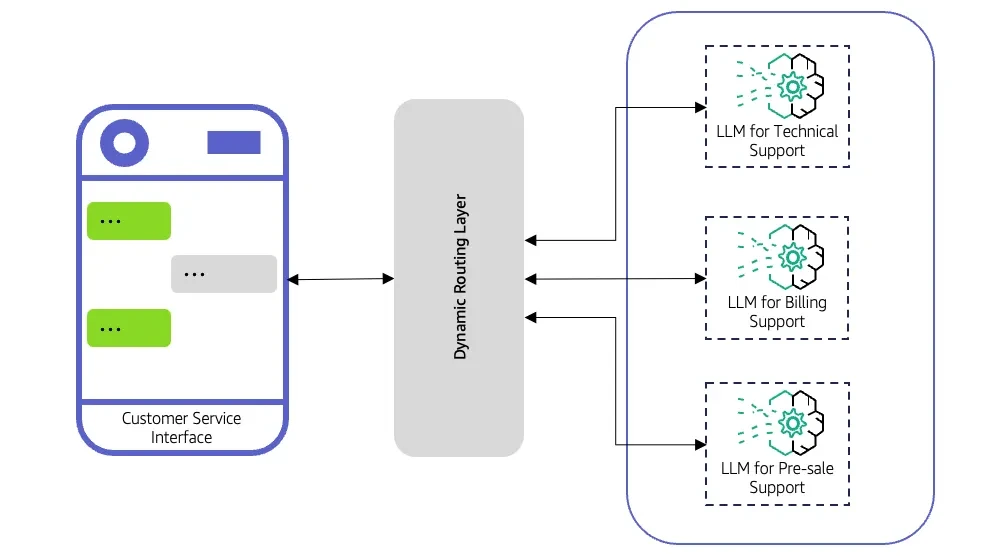
Model-agnostic architecture is the precondition. If an application can call only one provider’s API, there is no routing decision to make, so enterprises add an abstraction layer, often called a model gateway or LLM proxy, that can swap models per request without rewriting code.
Why Enterprises Need a Routing Layer to Control Inference Spend
Without LLM routing, enterprise AI spend rarely spirals because of one expensive project. It spirals because many teams each choose the most capable model for their use case, and nobody tracks the combined token bill until a budget review.
Three patterns drive the problem. Teams default to the newest model because it feels safe, few organizations log which model handled which request, and single-vendor agreements remove the flexibility to shift workloads when cheaper or faster models appear.
Lock-in compounds the problem. When every application calls one provider directly, a price change, rate limit, or outage at that provider affects every workflow at once, and moving even one workload to another model means touching application code.
Price spreads make the opportunity concrete. Within one provider’s current lineup, Claude Haiku 4.5 is priced at $1 per million input tokens and $5 per million output tokens, while Claude Opus 5.5 is priced at $4 and $20, a fourfold difference before any open model is considered.
Routing also matters beyond cost. Many organizations already use several model families, for example the Claude models our guide to Claude for business describes alongside others, and a routing layer is where model choice, data rules, and logging come together in one place.
4 Common LLM Routing Strategies: Rules, Classifiers, Semantic, Cascades
Four LLM routing strategies cover nearly every production design, and they can be combined.
| Strategy | How it decides | Added latency (planning range) | Best when |
|---|---|---|---|
| Rule-based | Fixed rules on application, task type, or data label | Negligible | Task types are known and stable |
| Difficulty classifier | A small model or trained router predicts whether a weaker model will suffice | Tens to a few hundred milliseconds | Mixed traffic with varying difficulty |
| Semantic routing | Embedding similarity to example requests for each route | Tens of milliseconds | Many intents that map to known categories |
| Cascade with fallback | A cheaper model answers first, and low-confidence answers escalate | A full extra call on escalated requests | Quality matters more than latency on hard cases |
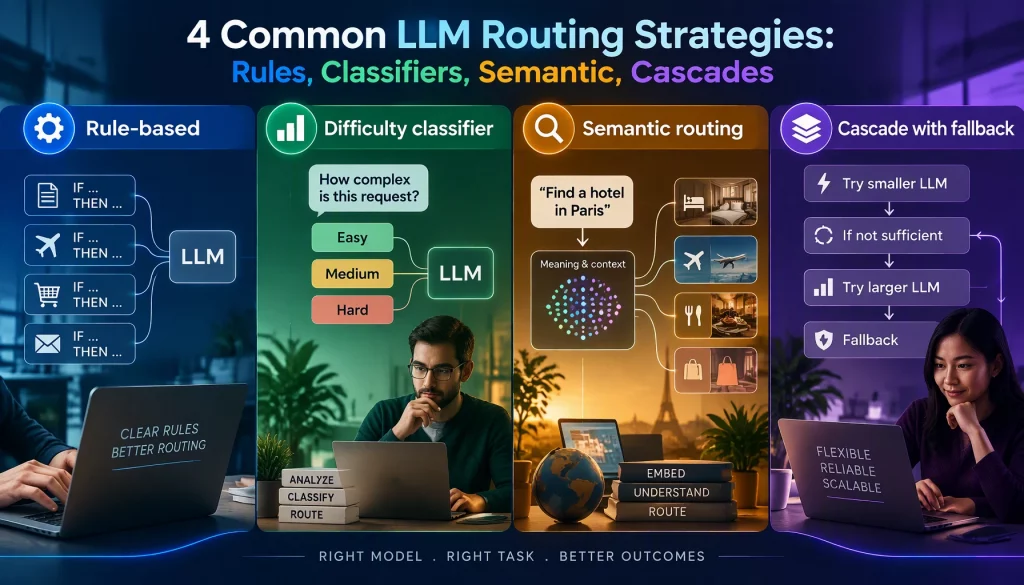
The latency ranges are planning assumptions rather than measurements, and they depend on hardware and model size. What matters is the order of magnitude: rules cost nothing, while cascades add a second model call whenever they escalate.
Research on LLM routing supports the two learned approaches. The RouteLLM study, presented at ICLR 2025, trained routers on human preference data and cut costs by up to 85 percent on MT Bench while keeping 95 percent of GPT-4’s quality, with smaller savings of 45 percent on MMLU and 35 percent on GSM8K.
Cascades have their own evidence. Chen, Zaharia, and Zou’s FrugalGPT paper (2023) showed that a learned cascade could match the best single model with up to 98 percent cost reduction on some datasets, though savings varied widely by task.
4 Stages of Request Handling: Classify, Match, Dispatch, Monitor
A production LLM routing layer runs four stages for every request, and each one should be visible in logs.
- Classification: The router determines task type, difficulty, and data sensitivity, using rules, a classifier, or embeddings.
- Policy matching: The request is checked against routing policy, which sets the allowed model tiers, latency budget, and data rules for that category.
- Dispatch: The request goes to the selected endpoint, which might be a hosted frontier model, a mid-tier model, or an open model running on your own infrastructure.
- Monitoring and fallback: Responses are scored, and low-confidence or failed answers escalate to a stronger model before they reach the user.
Hybrid LLM routing handles sensitive data. Requests labeled as containing personal, financial, or health data are restricted to approved endpoints, often an open model self-hosted in a private cloud, while unlabeled requests can use any approved hosted model.
Healthcare shows why. A clinical workflow that touches protected health information must stay on compliant endpoints even for simple tasks, a constraint our guide to Claude for healthcare explores for clinical use cases.
Quality evaluation keeps routing honest. An internal evaluation set of real requests with reference answers, run against each model tier, shows where a cheaper model is good enough, and an acceptance threshold, for example no more than a set drop in task score compared with the premium model, decides which categories may be routed down.
Cost and Performance Benefits: Premium, Mid-Tier and Routed Spend
LLM routing savings depend heavily on the starting point. The illustrative table uses published Claude prices and assumes 2,000 input and 500 output tokens per request.
| Architecture | Cost per 1,000 requests | Saving versus premium only |
|---|---|---|
| Premium only, Claude Opus 5.5 at $4 and $20 | About $18.00 | Baseline |
| Mid-tier only, Claude Sonnet 5 at $2 and $10 | About $9.00 | About 50 percent |
| Routed: 65 percent Haiku, 25 percent Sonnet, 10 percent Opus, plus a small classifier call | About $7.30 | About 60 percent |
The routed mix saves about 60 percent against a premium-only baseline but only about 19 percent against a mid-tier default. That difference is why savings claims should always state the baseline they compare against.
Routing has fixed costs as well. Engineering, evaluation sets, monitoring, and periodic re-tuning might cost, illustratively, $8,000 a month; at a saving of about $10.70 per 1,000 requests against a premium baseline, the router breaks even near 750,000 requests a month, and at lower volume a simpler rule-based setup is usually the better choice.
Token assumptions move the LLM routing result. Long prompts with retrieved documents raise input tokens for every tier, which narrows the gap between models in absolute dollars, while short classification calls make the small model’s advantage larger, so the calculation should use your own logged token counts.
Performance can improve too. Smaller models often respond faster, so routing routine traffic down can cut average latency, while the cascade’s extra call adds delay only to the minority of requests that escalate. Workflows built with Claude automation are a common starting point, because many of their steps are classification or extraction tasks a smaller model handles well.
5 Routing Tools and Platforms: Open-Source and Managed Options
LLM routing tools range from open-source libraries to managed cloud features. The table compares common options based on public documentation read on October 2, 2026.
| Option | Type | What it offers |
|---|---|---|
| RouteLLM | Open-source framework | Trained routers and an OpenAI-compatible server for routing between a strong and a weak model |
| LiteLLM | Open-source gateway | A unified API across providers with routing, fallbacks, budgets, and logging |
| OpenRouter | Hosted gateway | One API to many hosted models with provider fallback |
| Amazon Bedrock Intelligent Prompt Routing | Cloud service | Routing between two models in the same family, generally available since April 2025 |
| Azure AI Foundry Model Router | Cloud service | A trained router choosing among deployed models with balanced, cost, and quality modes |
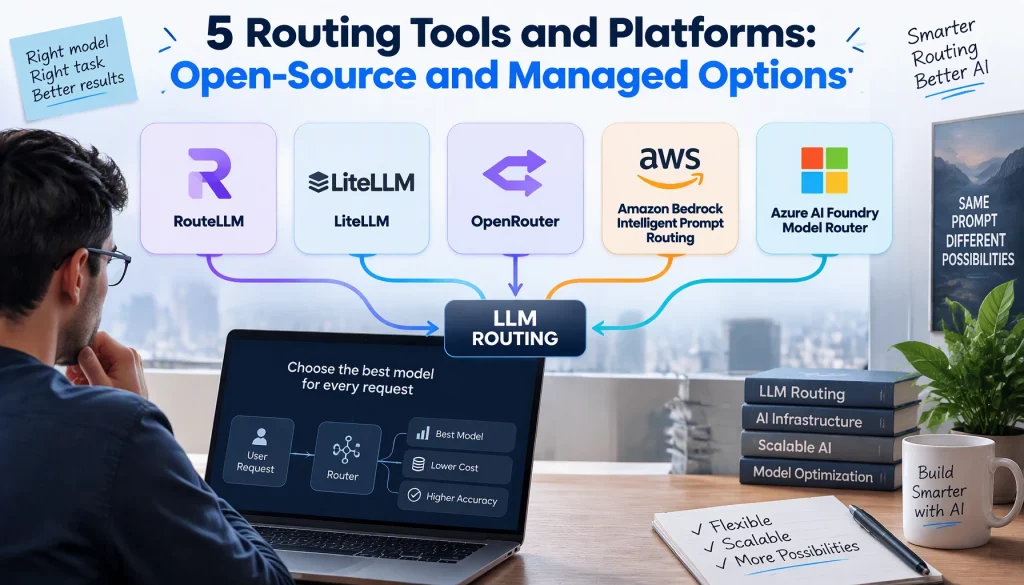
Managed routers are quick to adopt but narrow. The Bedrock router chooses between two models in one family, and cloud routers keep traffic inside one provider’s ecosystem, which may not satisfy residency rules or the need to include self-hosted models.
Self-hosted LLM routing tools give full control at the cost of your own evaluation data and operations. The RouteLLM framework, for example, ships trained routers and a compatible server, but its routers were trained on public preference data and should be checked against your own requests before production use.
Gateways solve a different problem. They give every application one API and one log, which is the foundation that policy-based routing and audit both need.
Cost Savings and Quality Trade-offs Observed in Research
We are not publishing client results here. Published research and vendor documentation show consistent trade-offs that should shape any LLM routing program.
- Savings shrink on harder tasks: RouteLLM’s savings fell from 85 percent on MT Bench to 35 percent on GSM8K math, so reasoning-heavy workloads route down less often.
- Benchmarks are not your traffic: Routers trained on public preference data may misjudge domain requests such as credit files or clinical notes until they are retrained or tested on your own samples.
- Escalation hides cost: A cascade that escalates often can cost more than calling the strong model directly, so escalation rates need monitoring.
- Routing errors are silent: A request routed to a weaker model that produces a plausible but wrong answer looks like a success unless quality is sampled.
Governance answers the question benchmarks ignore: who is accountable when the router picks the wrong model for a credit decision. The organization remains accountable, so routing policy should be owned by a named team, tied to data classification, and every routing decision logged with request category, chosen model, policy version, and confidence.
High-stakes categories deserve a fixed rule. Credit decisions, clinical summaries, and legal advice can be pinned to an approved strong model or sent to human review, which removes cost optimization from decisions where the downside is largest.
Monitoring keeps LLM routing policy healthy after launch. Four numbers per category tell the story: the share of requests routed to each tier, the escalation rate, sampled quality scores against the strong model, and cost per request, reviewed monthly and after every model release.
If you want help designing routing policy for your workloads and data classes, you can talk to our team.
Conclusion
LLM routing treats model selection as an architecture decision: rules, classifiers, semantic routes, and cascades send each request to a model that fits its difficulty and data class, with a fallback when confidence is low. Published research shows large savings on suitable tasks, but real savings depend on the baseline, the share of hard requests, and the fixed cost of running the router. This quarter, your team can log model usage by request category, build a small evaluation set for the two highest-volume categories, and test whether a cheaper model meets the acceptance threshold.
The next question is how routing, logging, and data rules work across every model and system you use. Our platform integrations page shows how AI Hive connects models from several providers, including self-hosted ones, under one policy.