


Clinical abstractors at one 14-hospital network used to spend over 11,000 hours per year manually hunting through surgical records – thirty minutes per routine case, and up to six hours on complex ones. After deploying Claude for Healthcare, that same workload now runs at less than half the time, with Inter-rater Reliability scores holding at 99 percent. Results like that are real and repeatable, but they do not happen by accident. They depend on understanding exactly what Claude for Healthcare can do, how HIPAA compliance actually works in practice, and what infrastructure decisions your team needs to make before going to production. This article covers all three.
Key Takeaways
|
What Is Claude for Healthcare?
Most enterprise AI evaluations start with the wrong question. Teams spend weeks comparing benchmark scores across models when the decision that actually determines deployment success is whether the platform connects to the clinical data your workflows already run on. Claude for Healthcare was built to answer that question directly.
Claude for Healthcare is Anthropic’s AI solution built specifically for healthcare organizations. It provides HIPAA-ready infrastructure, native integrations with clinical data systems, and pre-built workflows covering the highest-volume administrative and documentation tasks in most health systems. Healthcare teams access it through Claude for Enterprise for managed deployments, or programmatically via the Claude Platform API for custom integrations. For a broader overview of how Claude performs across business contexts, see our guide on Claude for Business: enterprise AI deployment strategies.

The platform runs on Anthropic’s Constitutional AI architecture, which embeds safety constraints into the model’s core reasoning process rather than applying them as an output filter after the fact. In clinical settings, that design choice produces outputs where every claim traces back to a specific passage in the source document. For prior authorization reviews and medical coding workflows where every decision must be auditable, that traceability is what makes the output clinically usable.
5 Key Use Cases in Claude for Healthcare
Claude for Healthcare targets five workflow categories that account for a significant share of administrative overhead in most health systems. Each represents a high-volume, rules-based process where accurate information retrieval matters more than open-ended reasoning:
- Prior authorization: Claude for Healthcare validates CPT codes, ICD-10 diagnosis codes, and NPI provider credentials against CMS coverage policies, identifies documentation gaps in submitted requests, and generates draft authorization packets ready for physician review and sign-off.
- Clinical documentation and ambient scribing: Claude for Healthcare converts visit recordings or clinical notes into structured SOAP notes, assessment-and-plan sections, and billing-ready documentation, typically within under a minute.
- Insurance claims appeals: Claude for Healthcare analyzes denied claims, maps each denial reason to the applicable policy criteria and clinical evidence in the patient record, and produces comprehensive appeal summaries ready for attorney or clinical review.
- Patient messaging triage: Claude for Healthcare processes high-volume patient portal messages, assigns urgency levels based on clinical content, drafts staff-reviewable responses for routine queries, and routes complex or sensitive cases to the appropriate clinical department.
- Clinical data abstraction: Claude for Healthcare extracts structured answers to clinical registry questions from unstructured physician notes, lab results, and surgical records – the kind of work that previously required trained abstractors to spend hours per case manually searching through documentation.
HIPAA Compliance and Security in Claude for Healthcare
The compliance question is always the first one health system CIOs raise when evaluating AI, and it is usually answered too quickly. Understanding what HIPAA-ready actually means for Claude for Healthcare, and specifically where its coverage ends, is the difference between a deployment that clears governance review and one that stalls for months.
Yes, Claude for Healthcare supports HIPAA compliance. Anthropic offers a Business Associate Agreement for Claude for Enterprise customers. The BAA establishes the contractual basis for handling Protected Health Information under HIPAA and explicitly prohibits Anthropic from using customer data for model training or improvement. Additionally, Claude for Healthcare is accessible via Amazon Bedrock and Microsoft Azure, both of which layer infrastructure-level controls on top of the core BAA protections.
That said, the scope of what the BAA covers is narrower than most IT teams assume. As HHS guidance on HIPAA compliance for cloud service providers makes clear, a signed BAA establishes contractual accountability between the covered entity and the cloud service provider, but it does not eliminate the obligation for the health system to configure the deployment correctly and verify where data physically transits. For health systems subject to national data localization laws or Ministry of Health data residency requirements, that transit is a compliance exposure with regulatory and legal consequences – not a minor technical footnote.
How Claude for Healthcare Handles PHI and Data Residency
Before any production deployment, enterprise teams should verify three specific points with Anthropic directly. Each of these shapes the risk profile of the deployment:
- No training on customer data: Anthropic’s enterprise agreements prohibit the use of customer conversations or PHI for model training or improvement. Confirm this prohibition is stated explicitly in your BAA addendum, not only in general documentation.
- BAA availability and scope: A HIPAA BAA is available for Claude for Enterprise plans. Confirm which plan tier and API access level your intended deployment requires before signing any agreement.
- Regional data residency options: Claude for Healthcare on Amazon Bedrock and Microsoft Azure supports regional deployment configurations that limit where inference requests are physically processed. Confirm the specific inference region with your cloud provider before your go-live date.
For Anthropic’s published security certifications, SOC 2 Type II documentation, and full compliance posture, visit trust.anthropic.com.
Top 7 Claude for Healthcare Connectors and Integrations
One of the most time-consuming phases of any healthcare AI deployment is building the data integration layer – the pipelines that give the model access to the clinical reference data it needs to produce accurate, auditable outputs. Claude for Healthcare reduces that burden significantly through a set of native connectors built specifically for clinical workflows.
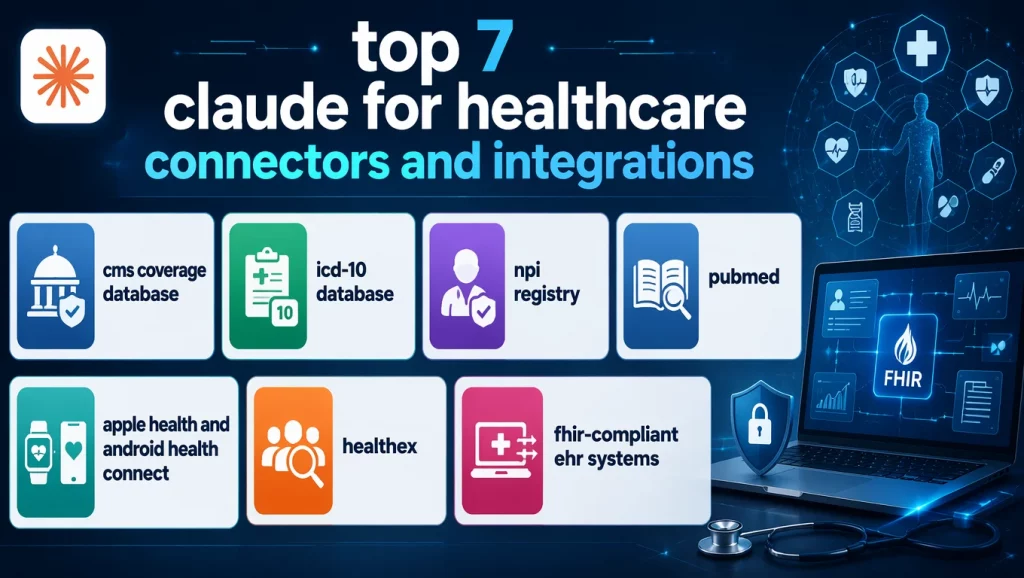
Claude for Healthcare connects natively to the clinical data sources that clinicians and administrative staff use every day. This native connectivity is one of its most significant practical advantages over general-purpose AI models, which require custom integration work before they can reason accurately about clinical content. The list of confirmed connectors covers the core systems involved in most administrative and documentation workflows:
- CMS Coverage Database: Real-time lookup of Medicare and Medicaid coverage policies during prior authorization reviews and claims processing workflows.
- ICD-10 Database: Diagnosis code validation and clinical definition retrieval during medical documentation and coding tasks.
- NPI Registry: Provider credential and specialty verification, triggered automatically during prior authorization and claims review workflows.
- PubMed: Peer-reviewed clinical literature retrieval to support evidence-based decision support outputs.
- Apple Health and Android Health Connect: Patient-generated health data ingestion for care coordination and chronic disease management applications.
- HealthEx: Clinical dataset connectivity for population health identification and screening workflows.
- FHIR-compliant EHR systems: Through Claude’s FHIR Developer Agent skill, Claude for Healthcare reads and writes to Fast Healthcare Interoperability Resources endpoints, enabling direct EHR integration without requiring a custom middleware layer.
In practice, the value of this connector ecosystem is best understood by what it removes from your engineering team’s roadmap. For organizations that need FHIR connectivity within a private infrastructure, see AI Hive’s Platform Integrations for the full supported connector list.
Real-World Claude for Healthcare Case Studies
Benchmark scores tell you what a model can do in a controlled test environment. Production case studies tell you whether it holds up when the data is messy, the workflows are complex, and clinical staff are the ones whose time and judgment are on the line. The two most publicly documented deployments of Claude for Healthcare come from Carta Healthcare and Qualified Health, and both meet that standard.
Carta Healthcare: Clinical Data Abstraction Across 14 Hospitals
The problem Carta Healthcare was solving is one that most large health systems recognize immediately. Trained clinical abstractors at a 14-hospital network were spending 30 minutes per routine surgical case and up to six hours on complex ones. For a system running 22,000 surgical cases annually, that added up to over 11,000 hours of manual labor per year, with significant cost and accuracy risk embedded in every case.
Carta built its Lighthouse platform on Claude for Healthcare using a two-phase extraction pipeline. Claude Haiku handled initial extraction from unstructured clinical notes and structured records, while Claude Sonnet synthesized the extracted evidence and scored each finding against registry criteria. This approach reflects the kind of enterprise-grade Claude deployment that AI Hive helps health systems implement on their own infrastructure.

After deployment, routine abstraction time dropped from 30 minutes to 15-22 minutes per case. Complex cases fell from six hours to 90 minutes. Annual time savings reached between 3,667 and 6,050 hours, with Inter-rater Reliability scores holding at 99 percent and abstraction costs dropping 50 percent against the pre-deployment baseline. Carta now reports 100 percent customer retention, with 90 percent of health system clients expanding scope beyond their initial deployment. One detail that does not appear in those headline metrics is worth noting: an experienced abstractor who was openly skeptical of Claude at the start became one of Lighthouse’s strongest internal advocates after working with it daily for several weeks. That kind of earned operational trust is ultimately what determines whether a clinical AI deployment sustains or gets quietly shelved.
Qualified Health and the University of Texas Medical Branch: Screening at Population Scale
Qualified Health’s deployment at the University of Texas Medical Branch addresses a structurally different problem: the gap between what is clinically known and what actually gets acted on at population scale. In Texas, an estimated four to six million patients per year qualify for evidence-based interventions but are never identified as candidates. The clinical protocols exist. The patient data exists in their EHR records. The barrier is that no clinical team, regardless of size, can manually review fragmented records across a patient population of millions.
To close that gap, Qualified Health built a patient identification platform on Claude for Healthcare that screens populations against guideline-based clinical criteria and surfaces eligible patients directly into clinician workflows, along with the supporting documentation from the patient’s own record. Claude for Healthcare does not make clinical decisions in this workflow. It flags candidates, shows the evidence, and routes each finding to the appropriate clinician for review. Every output goes through human review before any clinical action is taken.
In the first month of deployment at UTMB’s Sealy Heart and Vascular Institute, the platform identified that roughly a third of heart failure patients on the system had opportunities to improve adherence to guideline-directed medical therapy. Over one million patients in the UT System are now being screened by clinical protocols built on Claude for Healthcare, and the initiative is expanding from cardiology into primary care, vascular, GI, rheumatology, and neurology by the end of 2026. As Dr. Peter McCaffrey, Chief Digital and AI Officer at UTMB, described the core problem: “It’s 90 percent of what we do. It’s where so much of our workforce gets burned out and it’s where most care gaps accumulate.”
Claude for Healthcare vs. Other AI Models: An Enterprise Comparison
Healthcare IT teams evaluating Claude for Healthcare alongside GPT-4o and Google’s MedLM Enterprise should know upfront: the benchmark performance gap between these three models is narrower than any vendor’s marketing suggests. For a detailed breakdown of how Claude stacks up against the most common alternative, see our dedicated Claude vs ChatGPT enterprise comparison. The differences that determine which model fits your organization appear in clinical tooling depth, published safety research, and on-premise deployment flexibility – not raw reasoning scores.
All three models handle clinical reasoning tasks competently. The meaningful differences emerge when you examine what each model brings to a clinical deployment out of the box, before your team starts building integrations:
| Evaluation Criterion | Claude for Healthcare | GPT-4o (Azure OpenAI) | MedLM Enterprise (Google) |
|---|---|---|---|
| HIPAA BAA Available | Yes (Enterprise plan) | Yes (Azure OpenAI Enterprise) | Yes (Vertex AI Healthcare) |
| Data Not Used for Training | Yes (confirmed via BAA) | Yes (Enterprise agreement) | Yes (Vertex AI agreement) |
| Source-Traceable Outputs | Yes – citations built into core reasoning | Partial – requires prompt engineering | Partial |
| Clinical Reasoning Depth | High, Constitutional AI multi-step reasoning | High | High, trained on medical literature |
| Native Healthcare Connectors | Yes: CMS, ICD-10, NPI, PubMed, FHIR, Apple Health | No native clinical connectors | No native clinical connectors |
| On-Premise / Air-Gap Support | Via AWS or Azure; no native self-hosted option | Via Azure OpenAI Service | Via Vertex AI on Google Cloud |
| Published Safety Research | Extensive (Constitutional AI papers, model cards) | Moderate (system cards) | Moderate (technical reports) |
| Multi-Model Orchestration | Requires an orchestration layer | Requires an orchestration layer | Requires an orchestration layer |
Based on this comparison, Claude for Healthcare is the strongest choice for organizations prioritizing native clinical tooling and documented AI safety research. MedLM Enterprise is the better fit for organizations already running significant clinical workloads on Google Cloud. GPT-4o makes the most sense for teams deeply invested in Azure infrastructure with established OpenAI integrations. All three share one consistent limitation: none offers native on-premise deployment for regulated health systems that legally cannot route PHI through external cloud endpoints.
Why Claude for Healthcare Alone Is Not Enough for Regulated Enterprises
The compliance conversation that healthcare CIOs have with AI vendors usually starts with one question and ends with a different one. It starts with “do you have a HIPAA BAA?” But in our experience deploying AI for regulated enterprises across Southeast Asia and international markets, it always escalates to “where does the inference actually run?” The two questions have different answers, and the gap between them is where regulated deployments most commonly stall or fail governance review.
A Business Associate Agreement establishes who is contractually responsible for Protected Health Information under HIPAA. It does not prevent patient data from transiting Anthropic’s cloud infrastructure during model inference. Vietnam’s AI Law 134/2025, which took effect on March 1, 2026, classifies AI systems by risk tier under Article 13, and high-risk healthcare AI deployments carry data handling obligations that cloud-only deployment does not satisfy by default. Similarly, GDPR Article 44 restricts cross-border PHI transfers for EU health systems routing data to non-EU inference endpoints, regardless of BAA status.
Carta Healthcare understood this distinction when selecting their deployment architecture. Their engineering team chose Amazon Bedrock specifically to achieve infrastructure-level data isolation – a BAA alone was not sufficient to clear their hospital IT and AI review board. Qualified Health built mandatory physician review into every output workflow by design, because model compliance and operational compliance are genuinely separate engineering problems that require separate solutions. Resolving both before production is significantly cheaper than discovering the gap after your legal team reviews the architecture.
What Regulated Enterprises Need Beyond a HIPAA BAA
Health systems that need Claude for Healthcare workflows without routing PHI through external infrastructure require four capabilities from their deployment stack. Each addresses a specific point of risk that a cloud BAA leaves open:
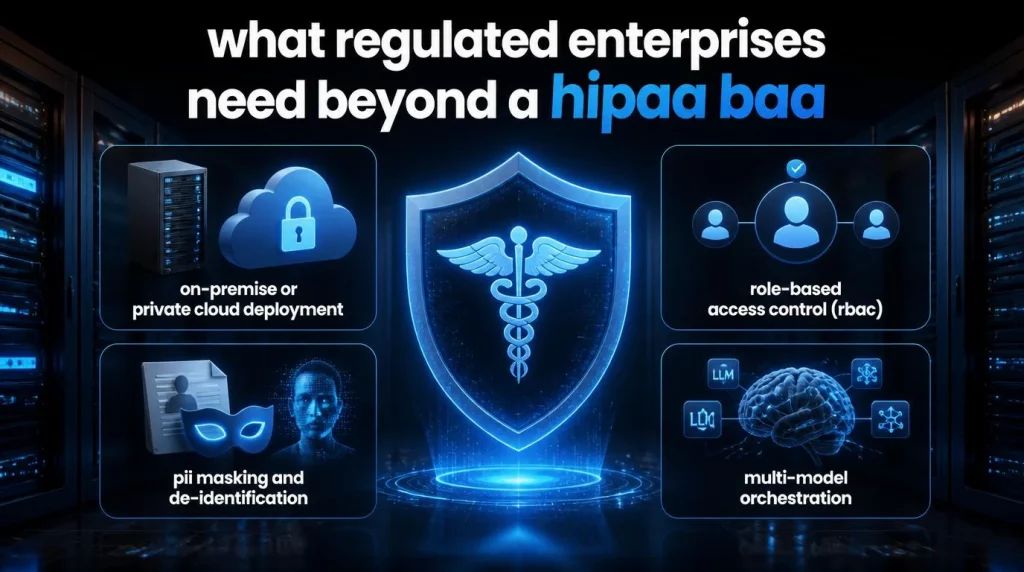
- On-premise or private cloud deployment: All model inference runs inside your own Kubernetes cluster. No PHI reaches an external endpoint at any stage of the clinical workflow.
- PII masking and de-identification: Personally identifiable information is detected and masked automatically before any model processes it. Re-identification is available only within explicitly authorized and fully audited workflow steps.
- Role-based access control (RBAC): Clinicians, abstractors, billing staff, and administrators each access only the data scoped to their specific clinical role. Cross-role data access requires explicit administrator authorization.
- Multi-model orchestration: Different workflow tasks route to the model best suited for the job. Claude Sonnet handles complex multi-step clinical reasoning, while Claude Haiku handles high-volume triage queues where throughput matters more than depth. This routing approach reduces LLM inference costs by 35-60 percent compared to running all tasks through a single model at scale.
AI Hive’s healthcare deployment stack delivers all four capabilities as part of the standard implementation. For implementation details, see AI Hive’s On-Premise Deployment model and data sovereignty architecture.
How to Get Started with Claude in Healthcare via AI Hive
Getting Claude for Healthcare into production at a regulated health system is a three-step process. Most organizations move through steps one and two quickly and then stall at step three, because they underestimate the gap between what their cloud vendor’s BAA covers and what their compliance team actually requires to approve a production deployment.
- Step 1: Identify the workflow with the highest manual hour cost. Starting with a single, well-defined workflow is more likely to succeed than a multi-use-case pilot. Prior authorization, clinical documentation, and patient message triage consistently deliver the fastest ROI because each is high-volume, rules-based, and produces measurable output. Choose the workflow where your team currently spends the most weekly hours on tasks that do not require direct clinical judgment to complete.
- Step 2: Choose your deployment model based on your actual compliance requirements, not your preferred timeline. Organizations without strict data localization constraints can connect to Claude for Enterprise and route workflows through AI Hive’s agent orchestration layer via API. By contrast, organizations subject to Vietnam’s AI Law 134/2025, GDPR Article 44, or Ministry of Health data residency mandates need AI Hive’s on-premise stack, where the full inference layer runs within your own network and no PHI leaves the perimeter.
- Step 3: Deploy with AI Hive’s healthcare agent stack. Our pre-built agents cover patient triage, prior authorization review, medical coding assistance, appointment no-show reduction, and clinical documentation. All agents connect to your existing EHR through FHIR connectors and are configured to your organization’s specific payer policies and clinical protocols. Our engineering team works directly inside your delivery cycle from project kickoff, not as a quarterly consultant brought in for status reviews. A production-ready agent reaches go-live in four weeks.
Conclusion
Claude for Healthcare delivers verified, measurable improvements across the workflows that cost health systems the most in manual staff hours – prior authorization, clinical data abstraction, documentation, and patient messaging triage. The results from Carta Healthcare and Qualified Health are public, traceable to primary sources, and consistent: 66 percent reduction in abstraction time, 99 percent data quality scores, and population-level patient screening that was not operationally feasible before AI at that scale.
For regulated enterprises, deploying Claude for Healthcare effectively means solving two problems together rather than one at a time: getting the model right and getting the infrastructure right. We built AI Hive’s healthcare platform specifically to address the second problem – on-premise deployment, PII masking, RBAC, and multi-model orchestration configured for your compliance requirements from day one, not retrofitted after the fact. If your organization is ready to move from evaluation to production, the right starting point is AI Hive Healthcare Solutions.