

Every voice AI agent sounds fluent in a vendor demo, then the first real caller interrupts, mumbles an account number, and asks for a human. Each of those moments costs you: a pause much longer than the roughly 200 milliseconds people leave between turns reads as robotic, a caller who gets talked over hangs up, and a recording stored in the wrong country can stall a bank’s compliance review for months. The platforms that survive production are the ones you test on latency, interruption, handoff, real cost per minute, and data residency before you sign. The numbers and checklists below let your team run that test on any shortlist.
Key Takeaways
|
What Are Voice AI Agents?
A voice AI agent is a phone-capable system that holds an open conversation, completes tasks in your systems, and escalates when needed. It is neither a legacy IVR, which routes callers through fixed menus, nor a text chatbot with a voice added on top.
The difference shows up in the first unexpected answer. An IVR can only match a caller to a menu branch, while a voice AI agent can handle a question it was not scripted for, check an account, and move the call forward.

A voice AI agent is also one category in a much larger tooling market, which our roundup of AI agent tools maps across builders, frameworks, and platforms.
Interest is driven by cost. Gartner predicted in 2022 that conversational AI in contact centers would cut agent labor costs by $80 billion in 2026, which is why contact-center leaders are being pushed beyond pilots.
Key Capabilities of Voice AI Agent: Speech, Latency, and Context
Three capabilities decide whether callers accept a voice AI agent: understanding speech, answering fast enough, and keeping context through interruptions. Your team should ask every vendor for evidence on each one.
- Speech understanding: The agent must transcribe accents, numbers, and names accurately, including when callers switch languages mid-sentence.
- Latency: The full turn, from the caller stopping to the agent starting to speak, must feel natural.
- Barge-in: The agent must notice when a caller starts talking over it and stop immediately, rather than finishing its sentence.
- Context: The agent must remember what was said earlier in the call and what the caller’s account shows.
Barge-in deserves a live test. It works through voice activity detection running against the incoming audio while the agent is speaking, and cheaper implementations that only listen between turns will talk over callers.
Handoff time completes the picture. When the agent cannot resolve an issue, a person should receive the call, the transcript, and the detected intent at the same moment, and these escalation rules are usually configured in an AI agent builder with confidence thresholds and trigger phrases.
Which Use Cases Fit a Voice AI Agent?
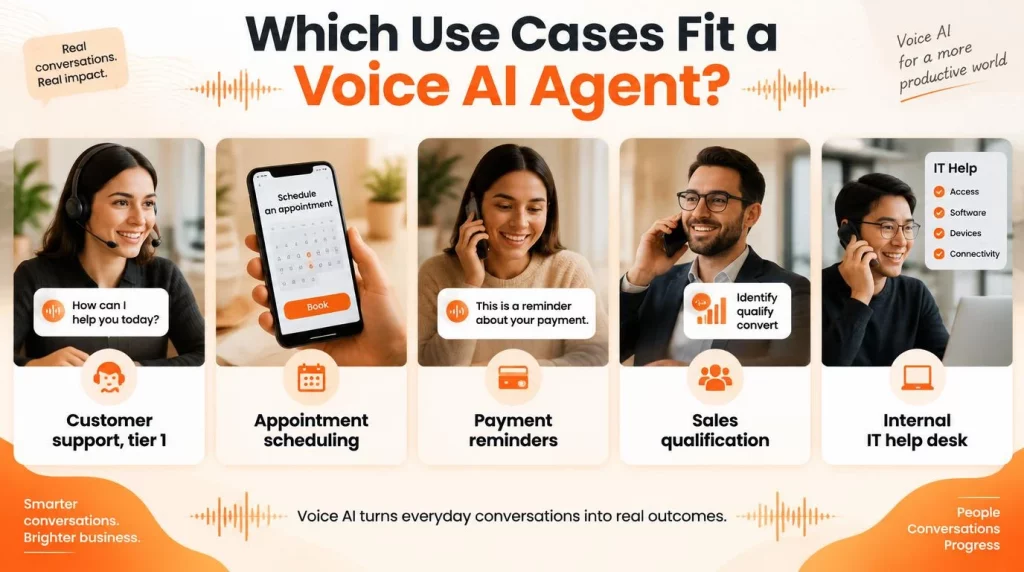
The best use cases are high-volume calls with a clear goal and a safe fallback to a person. The table maps common calls to what the agent does and where a human should step in.
| Type of call | What the voice AI agent does | Human checkpoint |
|---|---|---|
| Customer support, tier 1 | Answers order, delivery, and policy questions and updates records | Complaints, refunds above a limit |
| Appointment scheduling | Books, moves, and confirms appointments in the calendar system | Clinical questions in healthcare |
| Payment reminders | Calls about due payments and takes promises to pay | Disputes and hardship requests |
| Sales qualification | Asks qualifying questions and books a meeting for a salesperson | Pricing negotiations |
| Internal IT help desk | Resets passwords and opens tickets for employees | Access to sensitive systems |
Regulated industries should start with the low-risk rows. A bank can automate payment reminders and appointment booking long before it lets an agent handle a fraud claim, which should go to a person by policy.
Technology Stack Requirements
A voice AI agent is a pipeline of four or five services, and each one adds time and cost. Transcription is usually the cheapest layer: Deepgram’s published pricing lists streaming speech-to-text from $0.0048 per minute, while the model and the voice cost several times more.
| Layer | What it does | Question to ask |
|---|---|---|
| Telephony | Connects to the phone network or your PBX over SIP | Can it use our existing SIP trunk or contact-center platform? |
| Speech-to-text | Turns the caller’s speech into text in real time | How accurate is it on our accents, numbers, and product names? |
| Language model | Understands the request and decides the response or action | Which models are supported, and can we switch them? |
| Text-to-speech | Turns the reply into a natural voice | How quickly does the first audio start playing? |
| Orchestration and tools | Manages turn-taking, barge-in, memory, and calls to your systems | How are tool permissions scoped and logged? |
Integration decides the real go-live date of a voice AI agent more than any vendor promise. Your team should check five items against every shortlisted platform:
- SIP and PBX connectivity: The platform connects to your PBX or contact-center provider over standard SIP, not a proprietary layer that forces a carrier migration.
- CRM synchronization: The agent reads caller history before the call and writes outcomes right after, not in a nightly batch.
- Ticketing handoff: An escalation opens or updates a ticket with the full transcript and detected intent.
- Knowledge base access: The agent retrieves answers from current policy documents, not a static script.
- Identity verification: The platform shows how it verifies callers for account-specific requests, where payment and KYC rules apply.
Testing this mapping before go-live catches most gaps while mistakes are still cheap, which is what an AI agent studio environment is for.
What Are the Main Challenges?
The hardest problems for a voice AI agent are accuracy on real speech, delay that compounds across the stack, and emotion that the agent cannot read well. Each one has a design answer.
Accuracy drops on noisy lines, strong accents, and numbers read aloud, so the agent should confirm critical details such as account numbers before acting. Multilingual callers add another layer: in markets such as Vietnam, one call can move between Vietnamese and English, so the speech model must handle the switch without restarting the conversation. Delay compounds because every layer adds time, and a slow model or a voice that takes long to start speaking can push a turn past what feels natural.
Emotion is the subtlest gap. An upset caller needs a person sooner, and three conditions should trigger an automatic handoff, each with its own threshold:
- Low confidence: The agent’s confidence in the caller’s intent falls below a threshold your team sets from real call data.
- Explicit request: A caller who asks for a person is transferred immediately, without another prompt.
- High-risk topic: Fraud claims, complaints that could become legal matters, and similar topics go to a person by policy.
Failures need a plan too. If the model or network drops mid-call, the safest design routes the caller to a human queue with whatever transcript was captured, rather than playing an apology and hanging up.
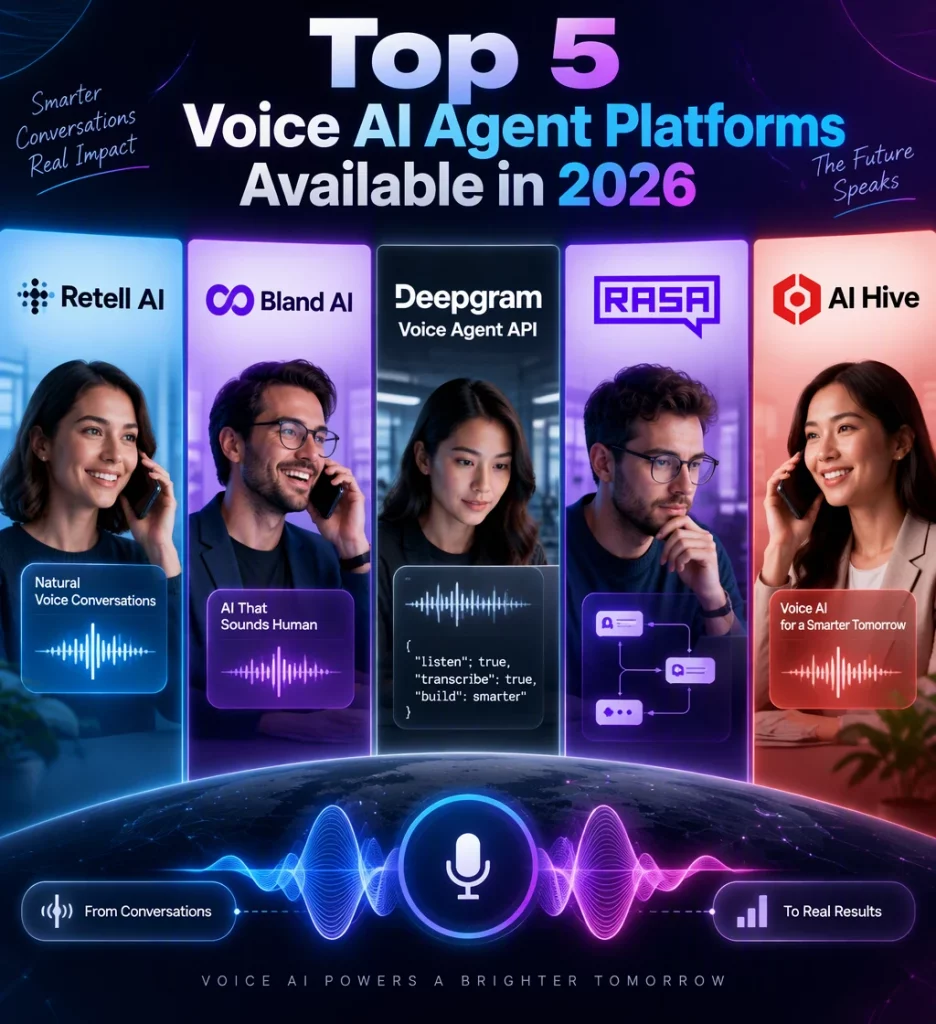
Top 5 Voice AI Agent Platforms Available in 2026
Voice AI agent platforms differ less in voice quality than in what their price covers and where they run. The table compares published pricing and hosting, read from vendor pages on October 2, 2026, and latency claims are left out because none of these pricing pages publish them.
| Platform | Published price | What the rate covers | Hosting |
|---|---|---|---|
| Retell AI | $0.055 per minute for voice infrastructure, plus the model and telephony rates | Voice engine, with the model and phone line priced separately | Cloud |
| Bland AI | $0.14 per minute on Start, $0.12 on Build with a $299 monthly platform fee | Model, speech-to-text, and text-to-speech in one rate | Cloud |
| Deepgram Voice Agent API | $0.075 per minute on the Standard tier | Speech-to-text, model orchestration, and text-to-speech | Cloud |
| Rasa | An open-source core, with commercial plans on request | Conversation framework; speech services added separately | Cloud or self-hosted |
| AI Hive | Custom for enterprise voice programs | Agent platform with switchable speech and model providers, including Deepgram and ElevenLabs | Cloud, private cloud, or on-premise |
The table shows one pattern clearly: most voice-first vendors run on shared cloud infrastructure. If residency is a requirement, that narrows the field quickly, which is why many enterprises compare broader enterprise AI agent platforms alongside voice point solutions before choosing a voice AI agent vendor.
Latency Budgets and Cost Benchmarks You Can Verify
We have no deployment benchmarks to publish, so this section gives you two things you can check yourself: a latency budget grounded in research, and a monthly cost built only from published rates.
The latency target comes from conversation research. Stivers and colleagues, in a 2009 study in the Proceedings of the National Academy of Sciences covering ten languages, found that most answers begin within 200 milliseconds of a question ending, with a cross-language average of about 208 milliseconds. A voice AI agent will not match that, but every millisecond above it is felt.
| Pipeline stage | Illustrative budget | Main lever |
|---|---|---|
| Detecting that the caller stopped | 100 to 300 ms | End-of-speech detection tuned on real calls |
| Speech-to-text final result | 100 to 300 ms | Streaming transcription |
| Model response start | 200 to 600 ms | A smaller model for routine turns, with streamed tokens |
| Voice playback start | 100 to 300 ms | A streaming voice and short first sentences |
These ranges are our planning assumptions, not vendor measurements, and your proof of concept should replace them with numbers measured on your own calls.
The cost benchmark uses 10,000 calls a month at four minutes each, or 40,000 minutes, and only rates published on vendor pages read on October 2, 2026.
| Option | Rate per minute | Monthly cost for 40,000 minutes |
|---|---|---|
| Deepgram Voice Agent API (Standard) plus Twilio inbound local calls | $0.075 plus $0.0085 | About $3,340 |
| Bland AI on the Build plan | $0.12, plus a $299 platform fee | About $5,100 |
| Retell AI voice infrastructure, Claude 5 Sonnet, and US telephony | $0.055 plus $0.064 plus $0.015 | About $5,360 |
Two variables move the total more than any headline rate: average call length, and how often calls escalate, because escalated minutes still accrue fees before the transfer.
Compliance and Data Residency
Almost no vendor comparison says where recordings, transcripts, and derived caller data are stored. For banks, insurers, and healthcare providers, that question can block a voice AI agent project on its own.
Three questions should be in every voice AI agent evaluation: does recorded voice data leave your country, are personal details masked in transcripts before storage, and does the call flow give the caller notice your jurisdiction requires before recording.
Vietnam made the disclosure question concrete. Law No. 134/2025/QH15 on Artificial Intelligence, passed on December 10, 2025 and in force since March 1, 2026, requires in Article 11 that providers ensure users can recognize they are interacting with an AI system, and it requires conformity assessment and human supervision for high-risk systems. Your opening script should carry that notice from day one.
Masking matters as much as location. Transcripts often contain card numbers, dates of birth, and addresses, so personal details should be redacted before transcripts are stored or used for analytics, and recordings should follow a retention period your legal team sets.
On-premise deployment is the strongest answer to residency, because speech-to-text, the model, and text-to-speech run on infrastructure you control. It costs more upfront than a cloud subscription, and in our view that trade-off is usually worth it for regulated caller data.
Conclusion
A voice AI agent is an engineering and compliance decision, not a contest of demo voices. Latency budgets, barge-in, handoff with full context, a cost model built from real rates, and a clear answer on where recordings live decide whether the agent survives real callers. This month, your team should record 50 real calls, replay them through two shortlisted platforms, and compare measured latency, handoff quality, and monthly cost.
After the pilot, the next questions are how you scale across languages and channels and how you keep recordings compliant as volume grows. If on-premise hosting or data residency is non-negotiable for you, explore our enterprise AI agent platform and its private and on-premise deployment options.