

Nowadays, a lot of enterprise teams evaluating an AI agent studio aren’t starting from zero – they’re already running ServiceNow, Oracle Fusion, or Automation Anywhere, and wondering whether the studio bundled with their current platform is enough, or whether they need something independent. The answer depends entirely on your stack, your industry’s compliance requirements, and how much internal AI engineering capacity you actually have.
This guide compares five enterprise AI agent studio platforms across what matters in production – multi-agent orchestration, governance depth, LLM flexibility, integration scope, and realistic total cost – so you can make that call with real data instead of vendor demos.
Key Takeaways
|
What Is an AI Agent Studio?
An AI agent studio is an enterprise-grade environment for building, testing, deploying, and governing autonomous AI agents across complex business workflows.
The key distinction from a basic agent builder: a builder creates an agent and runs it. A studio manages the full agent lifecycle – visual workflow construction, multi-agent orchestration, integrated testing against real enterprise data, deployment with access controls and audit trails, and ongoing monitoring. Enterprise teams need that governance layer because agents running without controls in a large organization create audit and compliance exposure that shouldn’t fall on a business analyst.
The five platforms in this comparison all use the term “AI Agent Studio” – but they serve different architectures, ecosystems, and buyer profiles. Choosing based on feature count alone is how enterprises end up with a deployment that works in the demo and stalls in production.
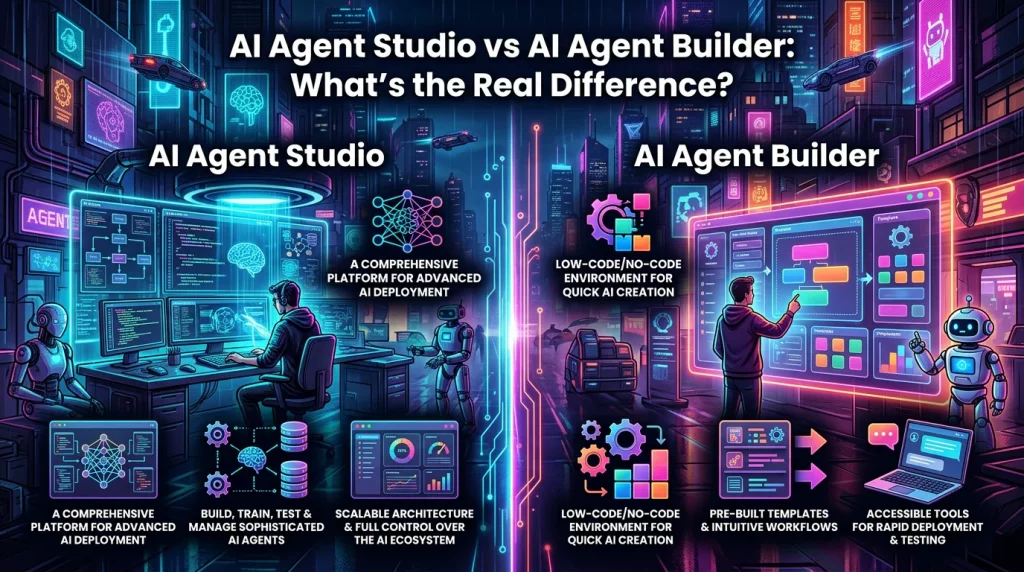
AI Agent Studio vs AI Agent Builder: What’s the Real Difference?
If your team has been looking at no-code builders like Relay.app, Gumloop, or Zapier’s agent features, you’re solving a different problem than what this article covers. Here’s how the two categories actually differ:
|
Dimension |
AI Agent Builder |
AI Agent Studio (Enterprise) |
|---|---|---|
|
Primary user |
Business analyst, citizen developer, startup team |
IT architect, enterprise developer, automation lead |
|
Scope |
Create and run individual agents |
Full lifecycle: build, test, deploy, monitor, govern, iterate |
|
Embedded context |
Starts from scratch |
Inherits existing platform data, permissions, and workflows |
|
Governance |
Basic or none |
Audit trails, RBAC, PII masking, compliance controls |
|
Multi-agent support |
Limited |
Native orchestration of agent teams |
|
Integration depth |
SaaS connectors |
Enterprise systems (ERP, CRM, ITSM, legacy databases) |
|
Deployment |
Cloud-only |
Cloud, on-premise, air-gap options |
The embedded context advantage is the most underappreciated difference. ServiceNow AI Agent Studio draws on 85 billion workflows already in the Now Platform. Oracle AI Agent Studio inherits Fusion’s full security configuration automatically. For mid-market enterprises without an existing Tier 1 stack, AI Hive replicates this context layer through RAG and knowledge engine integration with your CRM, ERP, and document repositories.
The right question when evaluating any studio: not “can it build an agent?” but “what does it already know about my business before I start building?”
Key Features of an Enterprise AI Agent Studio
Before comparing specific platforms, these are the capabilities that separate a production-ready enterprise studio from a demo-friendly one:
- Visual workflow builder (no-code/low-code) Drag-and-drop canvas for multi-step agent logic, If/Else branches, triggers, and events. Business analysts should be able to configure standard workflows without writing code.
- Agent creation and template library Pre-built agent templates by industry and function – customer service, KYC, IT helpdesk, HR onboarding. Templates cut time-to-first-agent from weeks to hours.
- Integrated testing environment Simulate agent behavior against real enterprise data before deployment. The ability to test at design time (not just in production) is what separates mature studios from early-stage tools.
- Multi-agent orchestration Coordinate teams of specialized agents working on complex, multi-step processes. A KYC workflow that spans document OCR, watchlist screening, and credit evaluation needs agents handing off to each other cleanly under central oversight.
- Deployment governance Role-based access controls (RBAC), PII masking, audit trails, and approval checkpoints. These aren’t optional for regulated industries – they’re the difference between a production deployment and a compliance risk.
- Security and compliance controls Encryption at rest and in transit, SSO integration (Okta, Azure AD), SOC 2 and HIPAA BAA capability, on-premise or air-gap deployment for regulated environments.
- LLM flexibility The ability to assign different language models to different agents within the same studio. Single-model platforms lock you into one provider’s pricing and capability ceiling.
- Monitoring and iteration Real-time performance dashboards, output monitoring, A/B testing for prompts, and version control. Agents that can’t be measured can’t be improved.
The 5 Enterprise AI Agent Studios Compared (2026)
Let’s take a brief look at the 5 best AI Agent studios first before we examine them further:
|
Platform |
Best For |
Deployment |
LLM Flexibility |
Governance |
Entry Cost |
|---|---|---|---|---|---|
|
AI Hive |
Mid-market, APAC, regulated industries |
Cloud + On-premise + Air-gap |
11+ LLMs, switchable per agent |
RBAC, PII masking, AES-256, audit trails, SSO |
From $29/mo |
|
Oracle AI Agent Studio |
Oracle Fusion Cloud customers |
Oracle OCI only |
Llama, Cohere + external LLMs |
Inherits Fusion security configs |
Free for Fusion customers |
|
ServiceNow AI Agent Studio |
Fortune 500 ITSM/HR teams |
ServiceNow cloud only |
Now Platform models + LLM layer |
AI Control Tower, scoped permissions, RBAC |
Pro Plus / Enterprise Plus |
|
Automation Anywhere |
RPA-heavy enterprises |
Cloud + On-premise |
Multi-LLM via Process Reasoning Engine |
AI Evaluations, Process Simulation, lifecycle governance |
Custom enterprise pricing |
|
Workato Agent Studio |
Integration-first enterprises |
Cloud |
Via Workato AI layer + MCP Gateway |
Enterprise security, role-based access |
Custom pricing |
1. AI Hive Agent Studio – Best for Mid-Market and Regulated Deployments
AI Hive Agent Studio sits within a four-layer platform architecture: Application Layer (chat, voice, web, CRM, mobile, robotics), Agent and Service Layer (BaaS platform, autonomous agent servers, plugin ecosystem), AI Engine Layer (the studio, RAG engine, Prompt IDE, Agent Brain), and Model Layer (commercial and open-source LLMs including OpenAI, Gemini, Grok, DeepSeek, Kimi, and Qwen). The studio handles multi-step workflows, If/Else/Trigger logic, and Action/MCP integrations across 100+ enterprise connectors.
Key capabilities:
- Model-agnostic: assign different LLMs to different agents within one studio session
- On-premise Kubernetes deployment with air-gap support – data stays in your infrastructure
- Prompt IDE with versioning, A/B testing, and Agent Brain (planning, short/long-term memory, ReAct/Tool Calling)
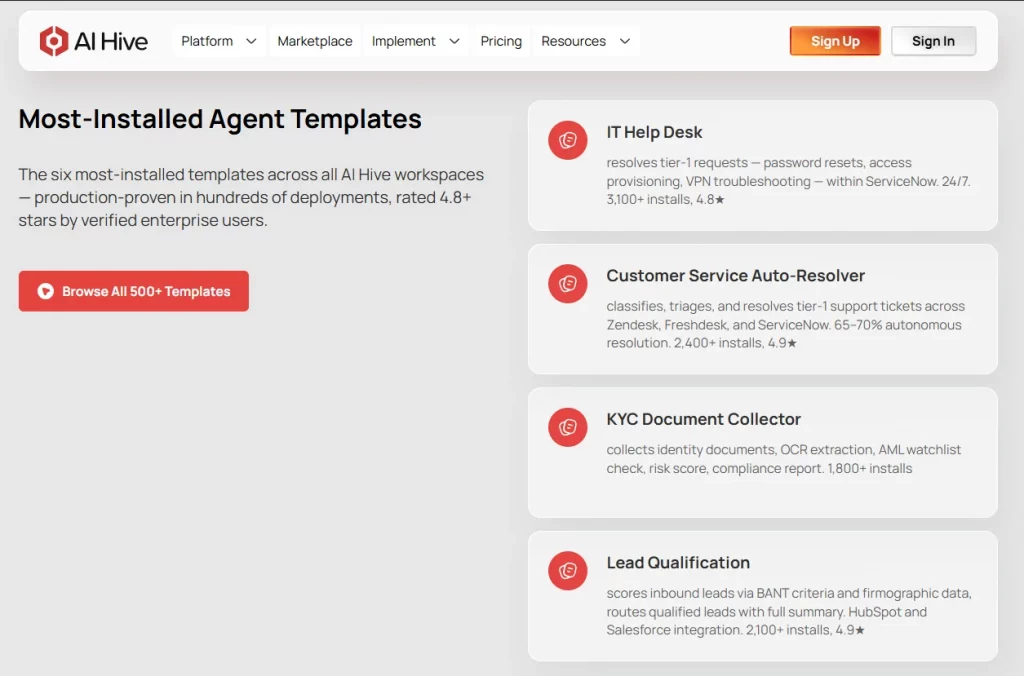
- 500+ pre-built templates in the marketplace; enterprise AI agent platform designed for regulated industry deployment
- Engineers for Hire: senior AI engineers embedded in your delivery cycle if you need them
Pros:
- Most flexible LLM routing of any platform in this comparison
- On-premise and air-gap deployment available from day one – not an add-on
- Transparent public pricing with enterprise tier available
- Implementation support (Engineers for Hire) closes the gap for teams without internal AI engineering
Cons:
- Less brand recognition than Oracle, ServiceNow, or Automation Anywhere – relevant if procurement requires Tier 1 vendor approval
- Reaching the 4-week deployment target requires upfront data coordination from your team
- Not the right fit if your workflows are already centered on Oracle Fusion or ServiceNow
Real deployment results:
A regional banking group (15,000+ applications/month) reduced KYC processing time 78% after deploying AI Hive agents fully on-premise. A national healthcare network with 800,000+ patients cut call center wait times from 18 minutes to under 3 minutes with the Patient Triage Agent. Full methodology in AI Hive enterprise case studies.
Best for: Mid-market enterprises (100-2,500 employees) in BFSI, healthcare, logistics, or manufacturing – particularly in Vietnam, Southeast Asia, and APAC – that need on-premise capability, model flexibility, and implementation support not available from incumbent vendors.
Not best for: Organizations already running Oracle Fusion or ServiceNow as their primary workflow system, or those requiring a globally recognized Tier 1 vendor name on procurement forms.
2. Oracle AI Agent Studio – Best for Oracle Fusion Cloud Customers
Oracle launched AI Agent Studio for Fusion Applications in March 2025, positioning it explicitly for Fusion Cloud customers and partners – not as a standalone enterprise platform. It uses the same technology stack Oracle’s own AI team uses to build the 50+ pre-packaged Fusion AI agents already embedded in the platform.
Key capabilities:
- Agent template libraries with natural language prompts
- Agent team orchestration with pre-configured checkpoints and approval gates
- Extensibility: modify and extend existing Oracle Fusion AI agents
- LLM choice: Llama and Cohere optimized for Fusion, plus external LLMs for specialized cases
- Native Fusion integration that preserves enterprise business logic automatically
Pros:
- Available at no additional cost for Fusion Cloud customers – most cost-effective option if you’re already on Fusion
- Security inheritance: agents operate under existing Fusion access controls, no reconfiguration needed
- Accenture, Deloitte, and PwC all spoke at the March 2025 launch, signaling real SI adoption
Cons:
- Locked to Oracle OCI – no on-premise or multi-cloud deployment
- No value outside the Oracle Fusion ecosystem
- LLM flexibility is limited compared to model-agnostic platforms
Best for: Oracle Fusion Cloud customers (ERP, HCM, SCM) wanting to extend automation with AI agents without additional licensing. Healthcare and manufacturing organizations running Oracle who need agents grounded in Fusion data.
Not best for: Any enterprise not on Oracle Fusion Cloud. Teams that need on-premise deployment, model-agnostic LLM routing, or deployment across non-Oracle systems.
3. ServiceNow AI Agent Studio – Best for ITSM, HR, and Service Desk Workflows
ServiceNow AI Agent Studio launched January 2025, reimagined at Knowledge 2026 (May 2026). Part of a three-layer agentic architecture: Studio for building, AI Agent Orchestrator for multi-agent coordination, and AI Agent Fabric for cross-system communication via MCP and Agent2Agent (A2A). Gartner ranked ServiceNow #1 in Building and Managing AI Agents in its 2025 Critical Capabilities report.
Key capabilities:
- Context Engine: access to 85 billion workflows and 7 trillion transactions from the Now Platform
- AI Control Tower: governance layer covering every agent identity, permission scope, and action audit trail
- Thousands of pre-built agents across ITSM, HR, and customer service
- Build Agent available in Cursor, Windsurf, Claude Code, and GitHub Copilot (Knowledge 2026)
- Autonomous Workforce line: AI specialists with defined organizational roles (launched February 2026)
Pros:
- Deepest embedded enterprise context of any platform in this comparison
- Governance depth from 20 years of enterprise process enforcement
- City of Raleigh: IT service desk costs down 66%. Honeywell: 75% faster compliance attestation
- Gartner #1 ranking is meaningful when comparing platforms in the same MQ category
Cons:
- Agents can’t be exported – platform lock-in is real and expensive if you switch
- Included in Pro Plus/Enterprise Plus plans that carry $100K-$500K+ annual base costs
- Non-ServiceNow developers face a steep learning curve even with the simplified studio
Best for: Fortune 500 enterprises already running ServiceNow for ITSM, HR service delivery, or customer workflows – particularly where the 85 billion workflow context would improve agent accuracy from day one.
Not best for: Mid-market teams not already on ServiceNow. Organizations needing on-premise deployment, model flexibility, or multi-cloud options.
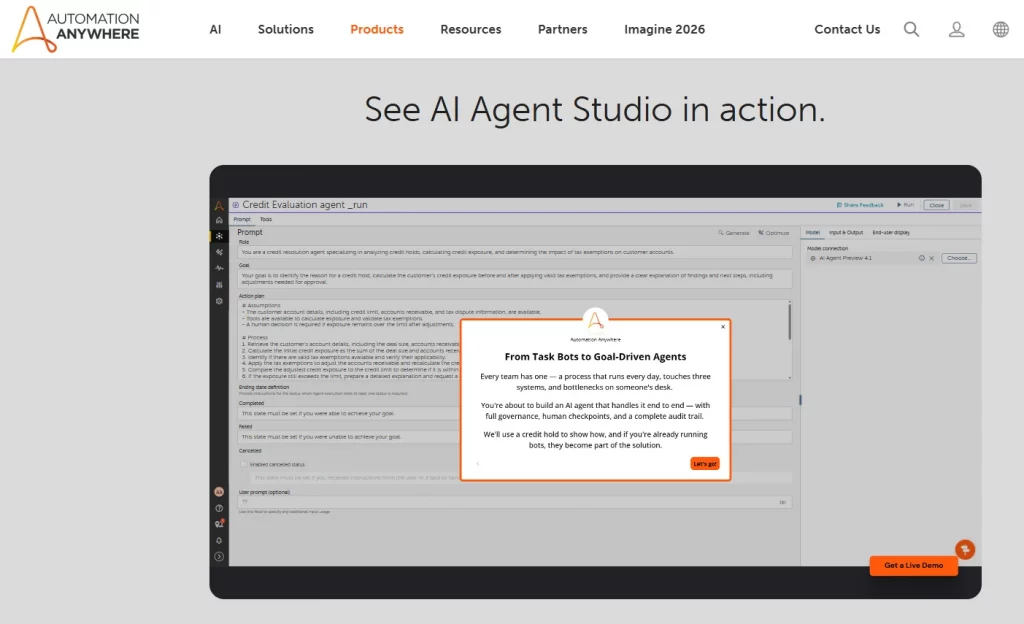
4. Automation Anywhere AI Agent Studio – Best for RPA-Heavy Enterprises
Automation Anywhere positions AI Agent Studio within its Agentic Process Automation (APA) system – bridging 20 years of RPA with autonomous AI agent capability. The platform earned its seventh consecutive Gartner Magic Quadrant Leader designation for RPA in 2025. In Q4 2025, 61% of software bookings came from AI, signaling real enterprise deployment rather than evaluation.
Key capabilities:
- Process Reasoning Engine (PRE): goal-driven reasoning across bots, APIs, documents, and other agents in real time
- Context Intelligence Graph: 30%+ accuracy improvement vs. agents without it (internal evaluation, May 2026)
- Universal orchestration: coordinates work across Salesforce, ServiceNow, SAP, and custom apps in a single process
- AI Evaluations at design time and runtime; Process Simulation for testing entire workflows before deployment
- AAI Code: low-code tool to build enterprise-grade applications with UI, processes, agents, and security in as little as one week
Pros:
- Most mature option for enterprises that need bots and agents coexisting in the same process
- Process Simulation lets you test full workflows against real failure scenarios before deployment
- University Hospitals of Leicester NHS Trust: targeting £1M annual savings, 22-day reduction in recruitment time
- Strong governance across the full agent lifecycle – not just at deployment
Cons:
- Platform complexity reflects RPA heritage; higher onboarding overhead than Oracle or ServiceNow
- No public pricing – requires enterprise sales engagement
- For organizations without existing bot infrastructure, APA positioning adds cost for capability they won’t use
Best for: Large enterprises with existing Automation Anywhere RPA investment needing to evolve to agentic AI without a platform migration. Healthcare, financial services, and shared services with high-volume, complex multi-step processes.
Not best for: Teams new to automation without existing bot infrastructure. Organizations needing transparent pricing before a sales engagement.
5. Workato Agent Studio – Best for Integration-First Enterprises
Workato Agent Studio sits at the intersection of enterprise iPaaS and agentic AI – one platform for connectivity and intelligence. It targets IT and operations teams already standardized on Workato for integration, where adding Agent Studio is an incremental upgrade rather than a new vendor relationship.
Key capabilities:
- Multi-agent workflows with event-driven automation
- MCP Gateway for cross-system agent communication
- 1,000+ enterprise application connectors from the existing Workato integration library
- Enterprise security with role-based access and audit controls
Pros:
- Eliminates the integration-plus-AI vendor split for teams already on Workato
- MCP Gateway adds meaningful extensibility for cross-system agent workflows
- Familiarity for integration engineers with the existing platform surface
Cons:
- Less mature agentic AI governance depth compared to ServiceNow or Automation Anywhere
- Limited public case study data specifically for agentic deployments
- Cloud-only – rules out regulated industries with on-premise requirements
Best for: Enterprises already using Workato as their integration platform that want to add agentic AI without a new vendor relationship.
Not best for: Regulated industries needing on-premise deployment. Teams prioritizing governance depth or deep multi-agent orchestration over integration breadth.
Real-World AI Agent Studio Workflows: Before and After
Case 1 – Banking: KYC and AML Processing
- Before: A regional banking group across six countries processed 15,000+ account applications monthly. KYC averaged five days per application. The compliance team spent 50+ hours weekly on manual AML screening. Two countries required full data residency, ruling out cloud-only vendors.
- After (AI Hive, on-premise): The KYC Onboarding Agent handles document OCR at 99.8% accuracy, runs AML watchlist screening, and generates eligibility decisions autonomously. KYC processing time dropped 78%. All data remained within the bank’s infrastructure. See AI agent solutions for BFSI for deployment architecture details.
Case 2 – IT Service Management: City of Raleigh
- Before: The City of Raleigh’s IT service desk processed high volumes of repetitive Tier 1 tickets, consuming staff time on requests that didn’t require human judgment.
- After (ServiceNow AI Agents): AI specialists handle Tier 1 requests autonomously, routing 98% of requests to the correct destination on first contact. IT service desk costs dropped 66%. The CIO cited the Now Platform’s embedded workflow context as the reason accuracy was high from day one.
Case 3 – Healthcare: Administrative Automation
- Before: University Hospitals of Leicester NHS Trust ran administrative operations heavily dependent on manual processes and temporary staffing.
- After (Automation Anywhere APA): The trust is targeting 50-70% autonomous administrative work. Projected outcomes: 22-day reduction in recruitment time and £1 million annual reduction in temporary staffing costs.
How to Choose the Right AI Agent Studio for Your Enterprise
Getting this decision wrong is expensive – not just the platform cost, but integration labor, governance setup, and migration cost if you switch 12 months in.
|
Your situation |
Best fit |
|---|---|
|
Already on Oracle Fusion Cloud (ERP, HCM, SCM) |
Oracle AI Agent Studio – it’s already included |
|
Fortune 500, workflows centered on ServiceNow (ITSM/HR) |
ServiceNow AI Agent Studio – the context advantage is real |
|
Heavy RPA investment, need bots and agents in one process |
Automation Anywhere AI Agent Studio |
|
Already on Workato, integration is the primary constraint |
Workato Agent Studio |
|
Mid-market, APAC, regulated industry, or no Tier 1 lock-in |
AI Hive Agent Studio |
|
Any of the above + no internal AI engineering team |
AI Hive with Engineers for Hire |
One point worth stating clearly: Oracle and ServiceNow studio environments are most valuable when your primary workflows already live in those platforms. Using them outside their native ecosystems adds integration complexity that typically outweighs the cost savings. Conversely, AI Hive is least useful for teams whose processes are already deeply embedded in Oracle Fusion or ServiceNow workflows.
Getting Started with an AI Agent Studio
The first deployment matters more than which platform you choose. Teams that start too broad – ‘automate all of customer service’ – stall faster than teams that pick one high-volume workflow and execute it well.
Step 1: Define one workflow, not a department
Choose the highest-volume, most repetitive process your team handles. ‘Process inbound returns requests’ is a workable starting point. ‘Transform customer operations’ is not. Specificity determines whether the first agent succeeds.
Step 2: Audit your data access
Which systems does the agent need to read from and write to? Map these before touching the studio. Integration gaps discovered mid-build – particularly with legacy ERPs or custom internal databases – are the primary reason first deployments run over timeline.
Step 3: Start with a template
All five platforms in this comparison offer pre-built agent templates by function. Use one. Customizing a working template takes hours. Building from scratch when a template exists takes weeks.
Step 4: Set approval gates before going live
Decide which outputs the agent handles autonomously and which require human review. For first deployments, set more gates than you think you need. You can remove them as confidence builds – you can’t add them back after a costly autonomous error.
Step 5: Run 50 real test cases before deployment
Simulate the three most common edge cases your team handles manually. Missing input fields, ambiguous requests, and exception scenarios will surface things no demo environment can catch.
Step 6: Deploy narrow, monitor closely, then expand
Run the agent on one workflow for two weeks before extending scope. What you learn from real production traffic in week one typically reshapes what you build in month two. For AI Hive specifically, the enterprise AI agent platform documentation covers technical setup, integration configuration, and governance controls in detail.
In Conclusion
Every platform in this comparison can build an AI agent. The difference is what happens after – whether governance holds, whether integration with your actual stack works, and whether agents reach production or stay stuck in a pilot that never scales.
If you’re running Oracle Fusion, the studio that ships with it is free and well-integrated. If ServiceNow is your workflow core, its context advantage is real. For RPA-heavy organizations, Automation Anywhere’s APA architecture handles the bot-to-agent transition better than anything else on this list.
And for mid-market enterprises, regulated industries, and APAC deployments that don’t want to inherit Tier 1 vendor pricing and lock-in, AI Hive is purpose-built for exactly that situation – with on-premise deployment, model flexibility, and engineering support that gets agents into production rather than keeping them in slide decks.
If you want to explore how AI Hive Agent Studio fits your specific environment, contact our team for a free consultation – we’ll scope your deployment, map the right agent architecture for your industry, and provide a proposal within three business days.