

Your agent reasons well in the demo, then hits the wall every enterprise pilot meets: it cannot pull a customer record or update a CRM field without a person copying data between windows. An AI agent API closes that gap, and its foundations moved fast this year, with a stateless MCP specification released on July 28, 2026 and August 26, 2026 set as the sunset date for the OpenAI Assistants API. This guide explains how function calling, MCP, and REST fit together, where the major providers really differ, and which pattern your stack can carry without a rebuild. You will leave with a decision framework for your next architecture review.
Key Takeaways
|
What Does an AI Agent API Provide?
An AI agent API gives a language model a controlled way to act. It exposes the endpoints, schemas, and protocols through which a model requests an action from an external system and receives a structured result it can reason over again. A chatbot API is a different thing: it returns text for a person to read, while this layer returns data that the model itself consumes, decides on, and acts on, often in a loop that runs several times before the final answer.
The distinction changes what you build. A traditional integration assumes a person clicks a button at a known point in a known flow. In contrast, an AI agent API assumes the model decides at run time which endpoint to call, in what order, and with which parameters, so permissioning and scoping matter more here than in almost any other integration pattern.
An AI agent API sits between two things your enterprise already owns: your LLM provider and your systems of record. It translates the model’s intent, expressed as a function call, into an authenticated request against Salesforce, a data warehouse, or an internal microservice, and then translates the response back into something the model can read.
Adoption data explains why this layer is becoming standard. Gartner predicted in August 2025 that 40 percent of enterprise applications will feature task-specific AI agents by 2026, up from less than 5 percent in 2025. In practice, the layer gives you three things.
- Action: The agent can create, update, and trigger things in other systems instead of describing what a person should do.
- Grounding: Live records replace stale training data, so answers reflect the current state of an order, a ticket, or an account.
- Auditability: Each call is a discrete event that you can log, replay, and review, which a free-text conversation never gives you.
What Are the Core Endpoints and Capabilities of an AI Agent API?
Five mechanisms carry agent-to-system communication in an AI agent API, and teams that blur them usually design the wrong layer.
Function calling comes first. You define a tool’s name, description, and parameters as a JSON schema and pass it to the model with the prompt. The model returns a structured object that names the function and its arguments, and your application code executes the call and returns the result. Strict modes tighten this loop: OpenAI’s strict setting requires `additionalProperties` to be false and every property to be listed as required, and Anthropic’s `strict: true` guarantees that a tool call matches the tool’s input schema.
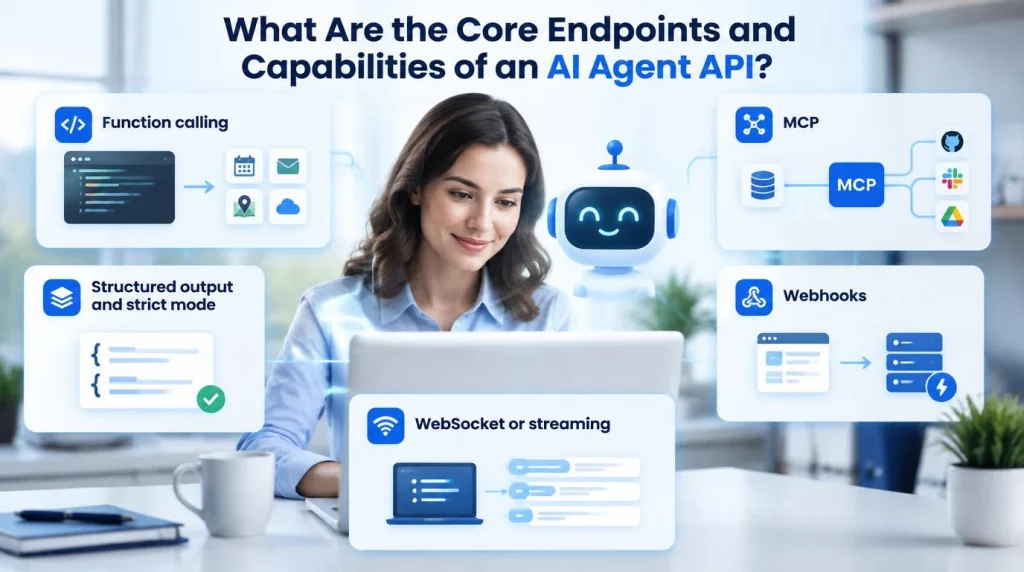
The Model Context Protocol (MCP), introduced by Anthropic in late 2024 and now hosted under the Linux Foundation, standardizes how any AI agent API exposes tools and how an agent discovers them across many systems. The 2026-07-28 MCP specification makes the protocol stateless: sessions and the initialize handshake are gone, each request carries its own protocol version and capabilities, and gateways can route on the `Mcp-Method` and `Mcp-Name` headers. As a result, any request can land on any server instance behind a plain round-robin load balancer.
| Capability | What it does | Where it runs |
|---|---|---|
| Function calling | The model requests a named tool with JSON arguments | The provider’s chat or responses endpoint |
| Structured output and strict mode | The endpoint forces arguments or replies to match a JSON schema | The same endpoint, set per tool or per response |
| MCP | The agent discovers and calls tools across many systems through one protocol | HTTP requests to an MCP server or gateway |
| Webhooks | An external system notifies the agent when an asynchronous job finishes | An inbound HTTP callback |
| WebSocket or streaming | A channel stays open for partial results and live updates | A persistent connection or server-sent events |
A typical AI agent API loop looks like this: the user asks a question, the model emits a function call, your backend runs it, the structured result returns, and the model either calls another function or answers. A support workflow that checks an order, reads a refund policy, and then issues a refund can chain four or five such calls before the user sees a word.
Webhooks and WebSockets solve a different problem, which is how the agent stays updated on long-running work. A WebSocket keeps a channel open so a voice agent or live dashboard can stream partial results, whereas a webhook lets an external system notify the agent once a batch job or payment settles hours later. Most production architectures use all three: REST or MCP for synchronous tool calls, webhooks for completion events, and WebSockets only where streaming is a real requirement.
How Do You Handle Authentication, Rate Limits, and Security?
Three separate failure classes hide behind this question: who the agent is acting as, how the provider protects its capacity, and what a compromised agent could do. Each needs its own control in an AI agent API, and a single API key does not cover any of them.
On authentication, an agent acting for a specific user needs scoped, short-lived credentials tied to that user’s real permissions, not a shared service account with broad access. A shared account turns one prompt injection into a company-wide incident. The MCP 2026-07-28 release points the same way: it requires RFC 9207 issuer validation, prefers Client ID Metadata Documents over dynamic client registration, and binds client credentials to the authorization server that issued them.
Rate limits behave differently in an AI agent API loop because one user request fans out into several API calls. Anthropic’s documentation describes a 429 `rate_limit_error` for limit hits and a 529 `overloaded_error` for capacity problems, and its SDKs retry transient failures twice by default with exponential backoff while honoring the `retry-after` header. However, a 429 caused by a spend cap has no `retry-after` header and keeps failing until access resumes, so blind retries only add noise. You should budget limits per agent loop, not per request, and treat a persistent 429 as an alert.
Security is where most enterprise reviews focus, and for good reason. The OWASP Top 10 for Agentic Applications lists Tool Misuse (ASI02) and Identity and Privilege Abuse (ASI03) among its ten risks, and its guiding idea is least agency: give the agent only the permissions its declared task needs. Four controls follow from that principle.
- Least privilege per tool: Each tool gets its own scoped credential, so a hijacked agent cannot reach systems outside its task.
- Argument validation in the function: The function checks every argument as untrusted input before it touches a system of record.
- Approval for sensitive actions: Refunds, account changes, and deletions above a defined threshold wait for a human decision.
- Full audit logging: Every call records who asked, which tool ran, with what arguments, and what came back.
Should You Build or Consume an AI Agent API?
Two jobs hide behind the phrase AI agent API, and most enterprises end up doing both. Consuming means your agent calls provider APIs, vendor APIs, or a platform’s connectors. Building means exposing your own systems as endpoints that a model can call safely.
Consuming is the faster path when a maintained connector already exists for a standard SaaS system such as a CRM or a ticketing tool. The trade-off is dependency: you inherit the vendor’s coverage, permission model, and update cadence. Our guide to AI agent integration compares five integration platforms and shows how to stage read-only access before an agent gets write permissions.
Building pays off for internal systems and proprietary workflows, where the vendor route does not exist. In our view, the design goal changes when you build an AI agent API, because the caller is a model. Endpoints should be narrow and verb-oriented, described by an OpenAPI document with plain-language descriptions, and they should accept idempotency keys on writes. They should also return structured errors that the model can act on, and enforce authorization on the server instead of trusting the prompt.
| Question | Consume | Build |
|---|---|---|
| Who owns the contract | The provider or vendor | Your engineering team |
| Time to a first working tool | Faster when a maintained connector exists | Slower, because it needs API design and a security review |
| Control over permissions | Limited to what the vendor exposes | Full, enforced in your own code |
| Best fit | Standard SaaS systems | Internal systems and proprietary workflows |
Most teams should start by consuming and build only where a connector does not exist or a permission model is too coarse.
REST, MCP Gateway, or Unified API: Which Pattern Fits?
Once function calling works in a demo, a harder question appears for any AI agent API: how do you wire many agents to many systems without every pairing becoming its own maintenance burden? Three patterns dominate, and each trades simplicity for flexibility.
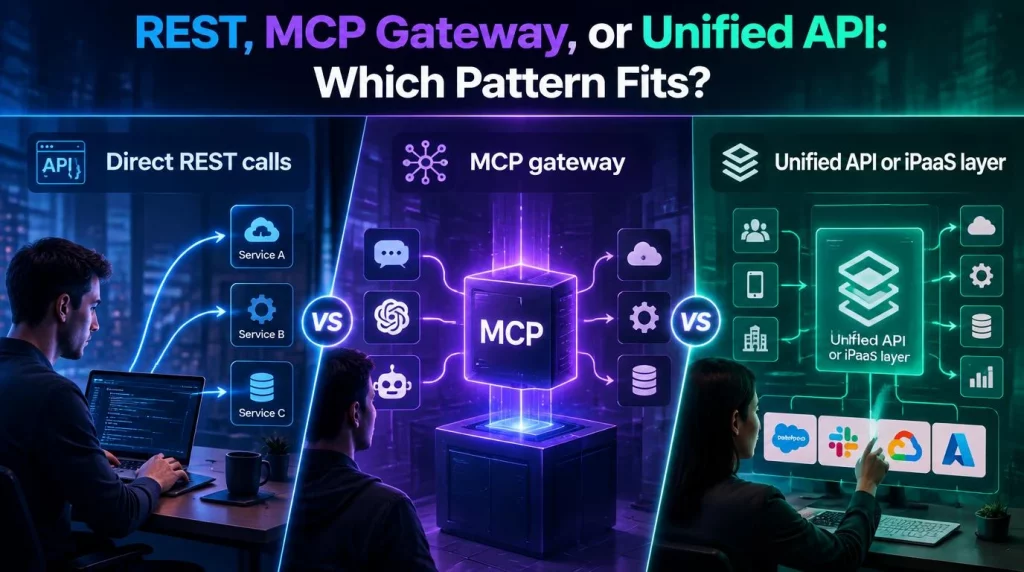
| Pattern | How it works | Best fit | Main trade-off |
|---|---|---|---|
| Direct REST calls | The agent framework calls each endpoint directly, with custom auth and error handling per integration | One or two well-known, stable APIs | The integration count grows with the system count, and every API change breaks a specific integration |
| MCP gateway | A central MCP server exposes tools and resources, and agents discover and call them through one protocol | Three or more systems, dynamic tool discovery, central governance | You must run the gateway, and not every legacy system has an MCP server |
| Unified API or iPaaS layer | A third-party platform normalizes many backends behind one consistent interface | Fast time to market across many SaaS integrations | You depend on the vendor’s coverage and update cadence |
Direct REST access still makes sense for a narrow, high-throughput case, such as an agent that only queries one internal pricing service. Once your AI agent API traffic spans a CRM, a warehouse, a ticketing system, and two microservices, the N-times-M problem becomes real, because N agents times M systems is a maintenance burden nobody signed up for. A governed enterprise integration platform that combines MCP-style tool discovery with audited connections turns that problem back into something closer to N plus M.
The right answer depends on who you are and what you run, and the table below is a starting point rather than a rule.
| Your situation | Start with | Why |
|---|---|---|
| Mid-market team, two systems, one squad | Direct REST with strict tool schemas | Fewest moving parts and the fastest path to a first agent |
| VP Engineering, five or more systems, several agent teams | An MCP gateway | One place for credentials, policy, and audit across teams |
| CIO in a regulated industry | A gateway with approval gates and exportable audit logs | Evidence your auditors can inspect |
| Product team serving many customers’ SaaS accounts | A unified API | The vendor handles per-tenant credentials and connector upkeep |
The three-system threshold is our rule of thumb, not a benchmark. For an AI agent API, latency tolerance and how often your tool set changes should move you either way, and a sub-second requirement usually keeps the hot path on direct REST.
4 Popular Agent API Providers Compared: OpenAI, Anthropic, Gemini, and Mistral
Every major provider supports function calling, but an AI agent API built for one provider does not port cleanly to another, because the wire formats are not interchangeable. This is where implementation teams lose the most time, since a configuration tuned for one provider can fail outright on another.
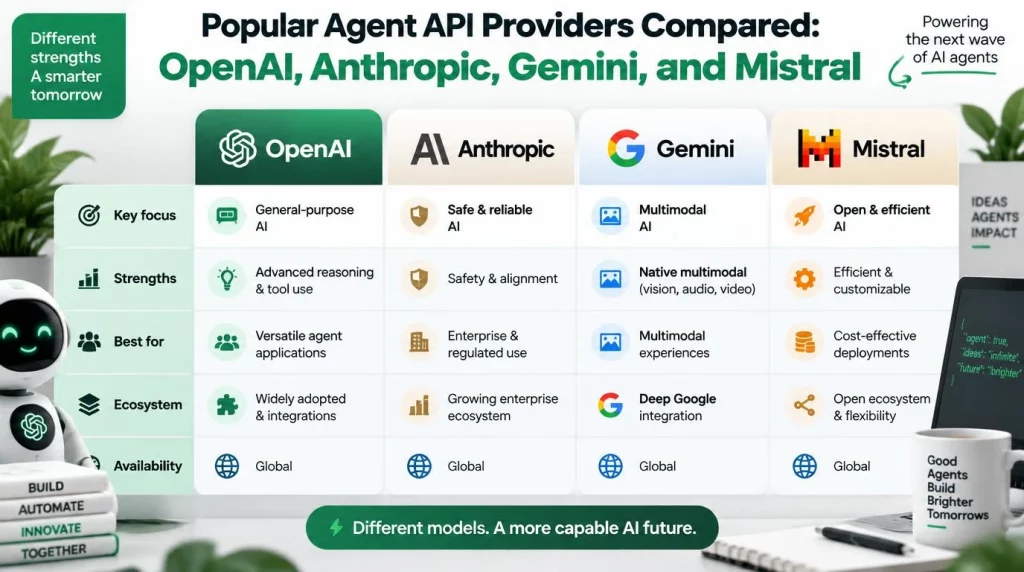
| Provider | Tool definition | Call and result loop | Tool choice and parallelism |
|---|---|---|---|
| OpenAI (Responses API) | A flat tool object with type, name, description, parameters, and strict | The response holds a function_call item with a call_id, and you return a function_call_output with the same call_id | Modes are auto, required, a forced function, allowed_tools, and none, and parallel_tool_calls can be set to false |
| Anthropic (Messages API) | A tool with name, description, and input_schema, plus optional strict | The response holds a tool_use block and a stop_reason of tool_use, and you return a tool_result block in a user message | Modes are auto, any, tool, and none, and disable_parallel_tool_use limits parallel calls |
| Google Gemini | A function tool with name, description, and parameters | The model returns a function_call step with an id, and you send a function_result step keyed by call_id | Modes are auto, any, none, and validated, with parallel and compositional calls supported |
| Mistral | A tool with a nested function object holding name, description, and parameters | Results return in a message with the tool role and a tool_call_id | Modes are auto, any, and none, and parallel_tool_calls defaults to true |
The same `get_order` tool shows how much an AI agent API definition changes between providers. The OpenAI Responses API defines it like this:
{“type”: “function”, “name”: “get_order”, “description”: “Retrieve order details by ID”, “parameters”: {“type”: “object”, “properties”: {“order_id”: {“type”: “string”}}, “required”: [“order_id”], “additionalProperties”: false}, “strict”: true}
The Anthropic Messages API defines the same tool like this:
{“name”: “get_order”, “description”: “Retrieve order details by ID”, “input_schema”: {“type”: “object”, “properties”: {“order_id”: {“type”: “string”}}, “required”: [“order_id”]}}
Behavior differs as well as syntax. Anthropic’s error documentation states that Claude Opus 5.5, Claude Fable 5.1, and Claude Mythos 5.1 reject forced tool use, so a request with `tool_choice` set to any or tool returns a 400 error on those models. The safe pattern there is the default auto mode combined with strict tool use. Provider APIs also get retired: OpenAI announced on August 26, 2025 that the Assistants API would sunset on August 26, 2026, and it pointed developers to the Responses API.
For a deeper look at how Claude pricing, governance controls such as SSO and audit logs, and setup work at enterprise scale, read our guide to the Claude API for enterprise teams. Whatever you choose for your AI agent API, your team should keep provider-specific code in one adapter module, because the cost of a migration is proportional to how many places know the wire format.
Best Practices for Production Use
The problems below appear as soon as an AI agent API leaves the sandbox, and none of them is about model quality. Each is a property of chaining calls to real systems.
- Latency budgeting: Sequential calls add up. As illustrative arithmetic, four calls at 500 milliseconds each add two seconds before the model writes a word of its answer, which feels slow in a chat interface.
- Idempotent writes: A retry after a timeout can issue a second refund, so write tools should accept an idempotency key and ignore repeats.
- Structured errors: A function that returns a clear error message lets the model retry with corrected arguments, whereas an unhandled exception fails the whole interaction.
- A small visible tool set: Every tool definition adds input tokens, and Anthropic now ships a tool search tool for very large tool sets so that tools load on demand instead of all at once.
- Call-level logging: Every call should record the user, tool, arguments, result, and latency, since agent failures are non-deterministic and you cannot reproduce them from the prompt alone.
Enterprise leaders already feel this gap. In IBM’s June 2025 survey of 2,900 executives, 70 percent said agentic AI is important to their organization’s future, yet 49 percent cited data concerns and 46 percent cited trust as barriers. In our view, most of that trust problem in an AI agent API rollout reduces to the controls above, not to the reasoning ability of the model.
Model choice adds a further trade-off. A cheaper model lowers per-call cost across a long chain, but it can raise the cost per completed task if it misformats tool calls and forces retries. Our Claude Sonnet vs Opus comparison shows how to route planning and execution steps across models for regulated, multi-step workflows.
Real API Design Patterns That Scale
Every AI agent API pattern that survives production shares one trait: the safety rule lives in code, not in the prompt. The reference flow below is illustrative, not a client case, and it shows those rules in a support agent that handles the request “What’s the status of my order, and can you email me the invoice?”
- Tools offered: The model receives two tools, `get_customer_order(customer_id)` and `send_email(to, subject, body, attachment_id)`.
- First call: The model calls `get_customer_order` with a customer ID taken from the authenticated session, not from the user’s text.
- Result: Your backend runs the call against the order system and returns structured JSON with the status, the items, and an invoice reference.
- Second call: The model summarizes the result and calls `send_email` with the invoice reference and a drafted subject line.
- Confirmation: Your backend sends the email and returns a delivery confirmation, which the model reports back in plain language.
Two details separate a production AI agent API flow from a demo. First, the customer ID never comes from the model’s reading of free text, so the agent cannot be prompted into pulling someone else’s order. Second, `send_email` checks that the recipient matches the account on file. Neither guardrail lives in the prompt, because both live in the function’s own validation logic.
| Pattern | Problem it solves | How it works |
|---|---|---|
| Identity-bound arguments | Prompt injection that redirects an action to another customer’s data | The customer ID comes from the authenticated session and never from model text |
| Approval gate | Irreversible or high-value actions | The function returns a pending state above a threshold, and a human confirms it |
| Idempotent writes | Duplicate actions after retries or timeouts | The client sends an idempotency key that the server stores and checks |
| Asynchronous completion | Long jobs that block the agent loop | The function returns a job ID, and a webhook notifies the agent when the job ends |
How We Approach Agent API Integration at AI Hive
Most enterprises do not start from a clean slate. They run years of REST endpoints, a few SOAP services, and several authentication standards at once, so we put the controls for an AI agent API at the connector layer instead of asking each agent team to rebuild them.
AI Hive’s integrations page describes the current setup, and we summarize it here so that you can check it against your own requirements.
- Coverage: The page lists more than 100 integrations with pre-built connectors for CRM, ERP, ITSM, data platforms, payments, HR, and eCommerce, plus a no-code connector builder that starts from any OpenAPI spec.
- Access control: The platform supports OAuth 2.0, API keys, SSO, and field-level permissions, and it stores tokens in HashiCorp Vault or Kubernetes Secrets.
- Audit trail: Every integration action is logged with user identity, timestamp, request, and response, retained for two years, and exportable to a SIEM.
The page quotes a typical turnaround of one to two weeks for a custom connector, though the right figure for your stack depends on how clean the underlying API is. The practical benefit of a governed AI agent API layer is that your application team writes the business logic for what the agent should do, while credential scoping and audit logging stay in one governed place.
Conclusion
The pattern you choose for an AI agent API, whether direct REST, an MCP gateway, or a unified API, should follow your system count and governance needs rather than whatever is trending this quarter. Security rules belong inside the functions, provider-specific code belongs behind your own adapter, and the endpoints under you will change. This week, your team should list every system your agents will touch, count them, and mark which actions need an approval gate before the first production launch.
Once your agent can act, the next questions are how you keep it working through model upgrades and how you measure cost per completed task instead of cost per call. If your team is weighing REST against MCP for a live integration, talk to our team at AI Hive and we will walk through your specific systems with you.