


Your finance team is drowning in reconciliation queues, manual invoice coding, and compliance checklists that never seem to shrink, even after two rounds of robotic process automation. An AI agent for finance changes that equation because it does not just execute a fixed script; it perceives data, reasons about exceptions, and takes the next correct action inside your existing systems, working around the clock on treasury reconciliation, compliance monitoring, and financial reporting automation without a headcount increase.
This blog breaks down what makes these agents different from the automation you already tried, which platforms are worth evaluating, and how to choose the right one for your organization’s size and risk profile.
Key Takeaways
|
What Is an AI Agent for Finance, and How Is It Different from Traditional Automation?
An AI agent for finance is a software system that combines a large language model with tool access, memory, and a defined goal, so it can plan a sequence of actions rather than follow a single hardcoded workflow. It is not the same thing as robotic process automation wearing a new label; RPA replays a recorded set of clicks or API calls and has no way to handle a document it has not seen before. Consequently, when an invoice arrives in a slightly different format, RPA scripts fail silently or route everything to a human queue, while an agent can classify the anomaly, cross-check it against policy, and either resolve it or escalate it with a clear explanation of why.
Specifically, three capabilities separate an agent from a script. First, an agent maintains context across a multi-step task, remembering what it found in step one when it reaches step four. Second, an agent can call external tools such as your ERP, your treasury management system, or a fraud database, and interpret the results rather than just passing data through.
Third, an agent can reason about ambiguous cases using natural language understanding, which means it can read a vendor contract clause or a suspicious transaction narrative and make a judgment call that a rules engine cannot make. In our work advising enterprise finance teams, we have seen the same reconciliation workflow drop from an 18% manual exception rate under RPA to under 6% once an agentic layer took over, because the agent resolved mismatched line items that the script had simply flagged and abandoned.
Why Finance Leaders Are Moving from RPA to Agentic AI
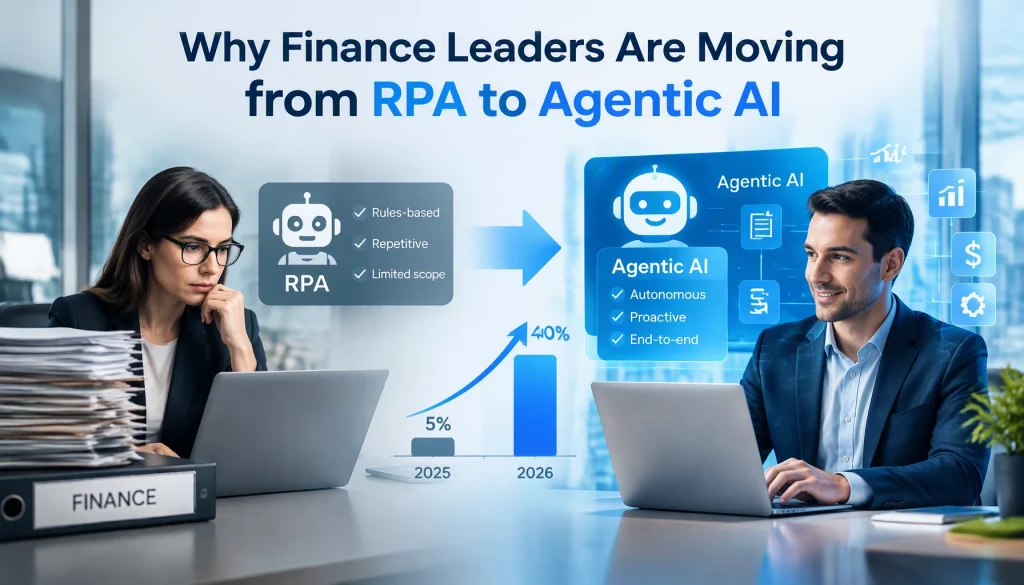
Finance leaders are not replacing automation for its own sake; they are responding to a measurable gap between what legacy automation delivers and what the finance function now needs. According to Gartner, forty percent of enterprise applications will be integrated with task-specific AI agents by the end of 2026, up from less than five percent in 2025, a shift moving through finance functions faster than most other departments because finance already runs on structured, high-volume, rules-adjacent data.
Moreover, the economics are becoming hard to ignore at the banking level. McKinsey’s analysis of agentic AI in banking finds that in the most probable adoption scenario, banks deploying AI agents across IT and operating functions could see cost reductions of 15 to 20 percent, with an agent-to-human ratio near 20 to 1 in functions where agents take over routine execution. This pattern is not limited to banks. Your enterprise, whether a growth-stage fintech or an established insurer, faces the same underlying cost structure of manual review on high-volume, low-complexity tasks, which is exactly where treasury, compliance monitoring, and financial reporting automation live.
Where AI Agents for Finance Deliver Real Value: Common Use Cases
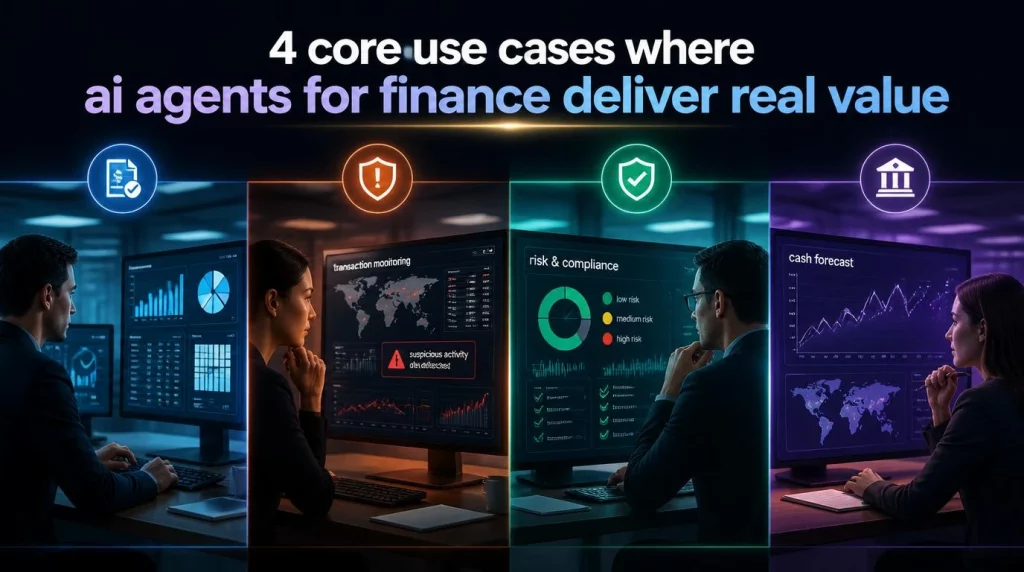
Finance functions are a collection of distinct processes with different risk profiles and different automation ceilings. We break down the four areas where enterprises see the clearest return today.
Accounting and Financial Close Automation
An AI agent assigned to the financial close can read invoices and receipts, match them against purchase orders, code them to the correct general ledger account, and flag any line item outside historical spending patterns. As a result, close cycles that used to take eight to ten business days can compress to three or four, because the accounting team spends its time on exceptions that require judgment rather than on data entry.
Fraud Detection and Transaction Monitoring
Fraud detection is where agentic AI shows its clearest advantage over manual review and rules-based monitoring, because fraud patterns evolve constantly and a static rule set goes stale within months. An agent trained on transaction behavior scores every transaction in real time, weighs device signals, location, and history together, and approves, holds, or escalates the case without waiting for a human analyst to open a file. A mid-size payments company we advised cut its average fraud investigation time from 40 minutes per case to under 6 minutes after adding an agentic triage layer that pre-assembled the evidence the analyst needed.
Risk Management and Compliance Monitoring
Compliance monitoring agents continuously scan transactions, communications, and filings against requirements such as know-your-customer (KYC) verification, anti-money laundering rules, sanctions lists, and internal policy limits. Rather than running a nightly batch report that surfaces yesterday’s violations, an agent flags a policy breach the moment it happens and routes it to the right compliance officer with the supporting evidence already attached.
Consequently, this shift from retrospective reporting to real-time monitoring matters most where a delayed detection means a regulatory finding, not just an internal cleanup task. If your organization operates in banking, insurance, or another regulated segment, this real-time posture is exactly what a well-configured compliance monitoring agent should deliver for your risk team.
Treasury Operations and Cash Forecasting
Treasury teams manage liquidity across multiple accounts, currencies, and banking relationships, and the forecasting behind that has historically depended on spreadsheets rebuilt every week. An AI agent can pull live balances, categorize upcoming payables and receivables, and produce a rolling cash forecast that updates as new data arrives, giving the treasurer a current view instead of a snapshot that is already stale by meeting time. Additionally, agents can flag when a subsidiary’s cash position is trending toward a covenant breach, letting the treasury team act weeks before the problem would surface in a standard monthly report.
6 Leading AI Agents and Platforms for Finance Teams
Choosing among the growing field of finance-focused AI agents starts with understanding what each platform is built to do, since no single vendor covers accounting, fraud, and treasury equally well. The table below summarizes six platforms enterprises evaluate most often, along with the specific strength each one brings.
| Platform | Primary Focus | Key Strength |
|---|---|---|
| Vic.ai | Accounts payable and invoice processing | Autonomous general ledger coding that improves accuracy the longer it runs on your data |
| DataSnipper | Audit and financial reporting | Evidence extraction and reconciliation embedded directly inside Excel workflows auditors already use |
| Sardine | Fraud and identity risk | Behavioral biometrics and device intelligence combined into a single real-time risk score |
| Feedzai | Enterprise fraud and financial crime | Deep transaction network analysis built for banks handling cross-border payment volume |
| HighRadius | Treasury and order-to-cash | Autonomous cash application and collections agents tuned for high-volume receivables |
| Kyriba | Treasury and liquidity management | Centralized cash visibility across banking partners with AI-driven forecasting layered on top |
Specifically, an enterprise with heavy invoice volume should start with Vic.ai or a comparable AP-focused agent, while one with cross-border payment exposure should prioritize a fraud platform like Feedzai before investing further in treasury tooling. In our experience, teams that try to solve accounting, fraud, and treasury with one generalist platform tend to replace at least one module within eighteen months, because generalist tools rarely match a category-specific agent’s depth.
AI Agent for Finance: Pricing, Integration, and Performance Comparison
Most comparison content in this space stops at feature lists and skips the operational detail that determines total cost of ownership. The table below closes that gap, comparing typical pricing structure, integration effort, and realistic performance across the three most common deployment categories.
| Category | Typical Pricing Model | Integration Effort | Realistic Performance Range |
|---|---|---|---|
| AP or close automation agents | Per-invoice or per-transaction fee, often $0.10 to $0.50 per document processed | Low to moderate; most connect to major ERPs such as NetSuite, SAP, or Oracle within 4 to 8 weeks | 85% to 95% straight-through processing rate after a 60- to 90-day tuning period |
| Fraud and transaction monitoring agents | Per-transaction or tiered monthly platform fee based on volume | Moderate to high; requires access to payment rails and historical fraud labels for model tuning | 20% to 40% reduction in false positives compared with rules-based systems, per vendor-reported benchmarks |
| Treasury and cash forecasting agents | Annual platform license, typically scaled by number of bank accounts or entities managed | Moderate; requires bank API or SWIFT connectivity setup, usually 6 to 12 weeks | Forecast accuracy improvements of 10 to 15 percentage points over spreadsheet-based forecasting, per vendor case studies |
Treat vendor-reported performance figures as a starting point, not a guarantee, and negotiate a paid pilot with your own transaction data before signing a multi-year contract. Your integration timeline also depends on how clean your ERP and banking data already are; fragmented chart-of-accounts structures across subsidiaries push you toward the higher end of every estimate above.
How to Choose the Right AI Agent for Your Enterprise Size
The right AI agent for your finance function depends far more on your company’s size, regulatory exposure, and data maturity than on which vendor has the most polished demo.

Startups and Growth-Stage Companies
If your finance team is under 15 people, prioritize a single narrow agent that solves your highest-volume pain point, usually invoice processing or expense categorization, rather than a platform promising to cover the entire finance stack. Growth-stage companies rarely have the data engineering capacity for a complex multi-agent deployment, and a narrow tool that deploys in weeks returns value faster than a broad platform that takes six months to configure.
Mid-Market Financial Institutions
At the mid-market stage, typically 200 to 2,000 employees, you can support two or three specialized agents running in parallel: one for close automation, one for fraud or compliance monitoring, and one for treasury forecasting. Prioritize integration quality here; an agent that connects cleanly to your existing ERP and treasury management system outperforms a feature-rich one that needs custom middleware.
Large Enterprises and Regulated BFSI Organizations
If you operate a bank, insurer, or another regulated financial institution, your evaluation criteria change substantially. Beyond raw accuracy, you need audit trails on every agent decision, configurable human-in-the-loop checkpoints, and certifications such as SOC 2 Type II that your risk team will require before approving a production deployment. Our team at AI Hive builds finance agents specifically for this tier of requirement, and our solutions for BFSI organizations detail the governance framework we apply to every regulated deployment, including how we structure approval workflows so no financial statement, transaction, or regulatory filing moves without a documented human checkpoint where policy requires one.
Implementation Roadmap: From Pilot to Production
A successful rollout does not start with a full department-wide deployment; it starts with one workflow, one owner, and a clear success metric.
- Stage 1, select a single workflow: Choose the process with the highest transaction volume and the lowest decision complexity, such as invoice coding or basic transaction screening.
- Stage 2, run a parallel pilot: Operate the agent alongside your existing manual or RPA process for 60 to 90 days, comparing its output against the human baseline before letting it act independently above a defined dollar threshold.
- Stage 3, expand with guardrails: Once the pilot clears your accuracy threshold, expand the agent’s scope in defined increments rather than switching on the entire finance function at once.
- Stage 4, institutionalize monitoring: Establish a monthly review cadence for the first two quarters where compliance and finance leadership review agent decisions and near-miss incidents together.
Where Finance AI Deployments Actually Fail
Most of what derails a finance AI agent deployment has little to do with model quality and everything to do with scope and governance choices made in the first ninety days. Four patterns show up repeatedly across enterprise rollouts, and recognizing them before you start costs far less than fixing them after a pilot stalls.
- Scoping the pilot too broadly: Teams that automate an entire finance function at once, instead of one workflow, lose the clean before-and-after comparison that proves value, which makes a stalled rollout hard to diagnose.
- Skipping the approval threshold conversation: A deployment that goes live without a written, jointly agreed dollar or risk threshold for autonomous action tends to either sit unused because nobody trusts it, or run past its intended guardrails because nobody defined them.
- Underestimating data quality debt: An agent connected to a fragmented chart of accounts or inconsistent vendor master data inherits that mess, and inherits it faster than a human reviewer would, which is why integration timelines skew longer for organizations with messy source data.
- Treating the pilot as permanent instead of a decision point: Enterprises that never formally decide to expand, contract, or kill a pilot after the measurement window end up running an indefinite proof of concept that never reaches the return a full deployment would generate.
Building your rollout around the four-stage roadmap above, with an honest measurement window at each stage, is what keeps a finance AI deployment off this list.
For a closer look at this rollout in adjacent regulated sectors, our breakdown of AI agents for banking covers a comparable rollout inside core banking operations, and our guide to AI agents for insurance applies the same phased approach to claims and underwriting.
Risks, Compliance, and Governance You Cannot Skip
Deploying an AI agent inside a financial function introduces a governance obligation many teams underestimate at first. Your agent needs a documented audit trail showing what data it accessed, what decision it made, and why, because a regulator or auditor will eventually ask for exactly that record. You also need human-in-the-loop checkpoints for any action touching customer funds, financial statements, or regulatory filings, regardless of how confident the model appears in testing. This is a permanent design requirement for regulated finance, not a limitation to work around.
Data residency and model training practices also deserve scrutiny before you sign a contract. Confirm whether the vendor trains its model on your transaction data, whether that data leaves your jurisdiction, and whether it can produce a SOC 2 report on request. A vendor that cannot answer these three questions clearly is not ready for a regulated finance deployment, no matter how strong its demo looks.
How AI Hive Helps Enterprises Deploy Finance AI Agents
Our team at AI Hive builds agentic systems for enterprise finance functions with BFSI compliance requirements built in from the start rather than bolted on afterward. We design each deployment around a human-in-the-loop approval layer that your risk and compliance teams configure themselves, so the agent’s autonomy expands only as fast as your governance framework allows.
Consequently, our clients typically move from pilot to production on one focused workflow, most often invoice processing or transaction monitoring, within 8 to 12 weeks, rather than the six-month timelines we see with generalist vendors never built for regulated finance. If you are evaluating where to start, begin with the workflow carrying the highest transaction volume and the clearest audit requirement.
Conclusion
An AI agent for finance is not a faster version of the RPA you already tried; it is a fundamentally different approach that reasons through exceptions instead of failing on them, which is why treasury, compliance monitoring, and financial reporting are becoming the proving ground for agentic AI inside the enterprise. Your next step should be a focused pilot on your highest-volume, lowest-complexity workflow, measured against your current manual baseline, not a department-wide rollout on day one.
If you want a governance framework built for regulated finance from the outset, contact our finance AI team about how AI Hive structures a compliant, phased deployment for your risk profile.