

Law firms and corporate legal departments share a structural problem. Billable work grows faster than the capacity of qualified attorneys to perform it, yet every additional hire compounds overhead. Associates spend 30 to 40 percent of their time on tasks that follow consistent patterns: reviewing contracts for standard clause sets, searching case law for precedent, and assembling time records into billing narratives.
An AI agent for legal does not replace attorney judgment on those tasks. Instead, it executes the pattern-following work autonomously, surfacing only the exceptions, ambiguities, and strategic decisions that genuinely require human expertise.
The result is a practice that scales throughput without proportional headcount growth, delivers consistent quality across matters, and recovers billable time from administrative overhead that currently erodes margin.
This guide explains where AI agents deliver the highest impact in legal workflows, what governance requirements matter, and how AI Hive’s enterprise platform enables compliant deployment for law firms and in-house legal teams.
Key Takeaways
|
The Legal Industry’s Productivity Problem and Why Current Tools Fall Short
The legal industry has experimented with AI tools for over a decade, yet most deployments remain narrow. A contract analysis tool handles one task, an e-discovery platform handles another, and a time-entry assistant still requires manual review of everything it produces. Consequently, the fragmentation of AI tooling in legal creates its own overhead: attorneys manage logins and outputs across multiple disconnected platforms, and the tools do not coordinate with each other.
According to Thomson Reuters’ 2025 State of the US Legal Market report, the average law firm loses 35 to 40 percent of potentially billable time to non-billable administrative work, including research coordination, document formatting, and billing reconciliation. Moreover, McKinsey’s analysis of professional services found that generative AI can automate 60 to 70 percent of the time attorneys currently spend on document analysis and legal research drafting. This is not about replacing the attorney’s judgment; it is about handling the execution of well-defined tasks that consume expert time without requiring expert reasoning at every step.
The gap between what law firms have deployed and what AI agents can actually do in 2026 is substantial. A single AI agent for legal can operate simultaneously across contract review, case research, and billing, coordinating its outputs and passing context between tasks without requiring human hand-offs at each boundary.
This integrated operation is fundamentally different from running three separate AI tools in sequence, and it is the distinction that separates a genuine production deployment from a pilot that never scales.
AI Agents for Contract Review and Analysis
Contract review is the canonical high-volume, pattern-intensive legal task, and it is ideal for AI agent automation.
A corporate legal team reviewing 500 vendor contracts per quarter faces a workload that consumes significant associate attorney time for tasks that follow consistent logic: identify which clauses are present, flag deviations from standard positions, assess risk concentration, and escalate non-standard terms for senior review.
Clause Identification, Risk Flagging, and Deviation Scoring
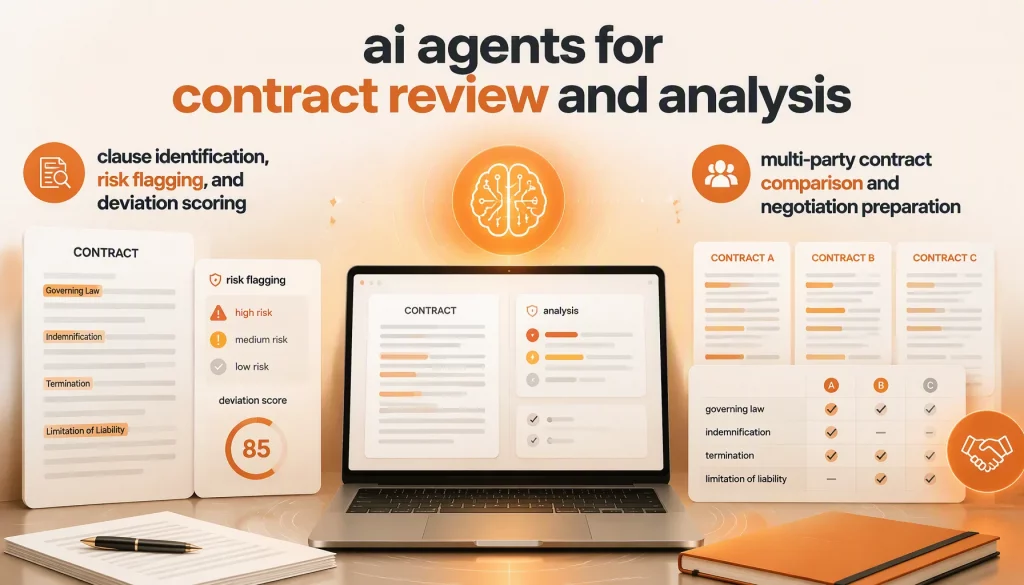
An AI agent for contract review reads the full document, identifies clause types (indemnification, limitation of liability, governing law, data processing, IP assignment, termination rights), and scores each clause against the organization’s standard playbook positions.
Clauses that match standard positions pass automatically. Clauses that deviate from the playbook are flagged with the specific deviation identified and a risk score based on the magnitude of the deviation. Non-standard clauses that exceed a defined risk threshold are escalated to a human attorney with the flagged language highlighted and a summary of the playbook position it departs from.
Notably, Gartner’s October 2025 survey of general counsel ranks AI and contract analytics among the most urgent technology priorities for legal leaders today.
In practice, this workflow reduces the time required to process a standard commercial contract from two to four attorney hours to 20 to 45 minutes for attorney review of the AI output, a compression of 75 to 90 percent of the time for clause identification and initial risk assessment.
Attorneys invest their time in reviewing the exception set rather than reading every line of every document.
Multi-Party Contract Comparison and Negotiation Preparation
For transactions involving multiple agreements, such as supply chain contracts across dozens of vendors, franchise agreements across hundreds of locations, or financial agreements with consistent terms across a portfolio, AI agents provide a comparison capability that manual review cannot match.
The agent reads all contracts in the set simultaneously, extracts the key commercial terms from each, and produces a structured comparison matrix showing where terms align and where they diverge. Negotiators enter counterparty discussions with a complete picture of their exposure across the full agreement set rather than reviewing contracts sequentially and maintaining a manual tracking spreadsheet.
Legal teams wanting a faster starting point typically draw on pre-built AI agent templates for legal workflows instead of configuring this comparison logic from scratch.
AI Agents for Case Research and Legal Analysis
Legal research is time-intensive by nature. Case law is vast, jurisdiction-specific, and frequently updated by new decisions. Associates and paralegals spend substantial time searching databases, reading cases for relevant holdings, and synthesizing research into memos that attorneys can use for argument development.
An AI agent for legal research executes this workflow at a fraction of the time cost, without sacrificing coverage.
Precedent Search, Synthesis, and Reliability Assessment
When an attorney defines a research question, for example, “what is the current state of New York courts on the enforceability of non-compete clauses for mid-level employees in the technology sector,” the AI agent searches relevant case law databases, identifies the leading cases, extracts the key holdings and distinguishing facts, and assesses subsequent treatment: whether cases have been followed, limited, overruled, or distinguished.
It then synthesizes the results into a structured research memo. The memo identifies the strongest precedent, notes jurisdictional splits where they exist, and flags recent decisions that may have shifted the analysis. A memo is only as trustworthy as the reliability checks behind it, so legal teams should apply a framework for evaluating AI agent reliability before relying on the output for a matter of consequence.
The AI agent does not replace the attorney’s judgment about which cases are strategically most useful for a specific argument. Rather, it eliminates the search and initial synthesis work, which can consume 8 to 16 hours on a complex question, and compresses it to 60 to 90 minutes of review time.
The attorney evaluates the research rather than building it from scratch.
Document Classification and Evidence Preparation
In litigation, document review and classification is one of the largest cost drivers. AI agents for legal review classify documents by relevance, privilege status, and issue coding simultaneously, processing thousands of documents per hour with consistent application of the classification criteria.
They identify documents that require human privilege review, surface documents that are highly relevant to specific issues, and maintain a complete chain of custody record for each classification decision. This shifts attorney time from reading every document to reviewing and adjudicating the AI agent’s classification decisions on the exception set.
According to RAND Corporation research on legal AI adoption, organizations using AI-assisted document review in litigation reduced document review costs by 20 to 60 percent compared to fully manual review, while maintaining or improving recall rates for relevant documents.
Firms that tune the classification criteria against their own privilege log conventions land at the high end of that range; firms running default settings with no review cycle land closer to the low end.
AI Agent for Legal Billing and Matter Management
Billing is where time, money, and firm reputation converge, and it is where administrative overhead consistently erodes all three. Attorneys who capture time inaccurately or incompletely leave revenue on the table, while those whose time entries are rejected or reduced in client bill review create write-downs that affect firm profitability.
An AI agent for legal billing addresses both problems simultaneously.
Time Capture Automation and Narrative Generation
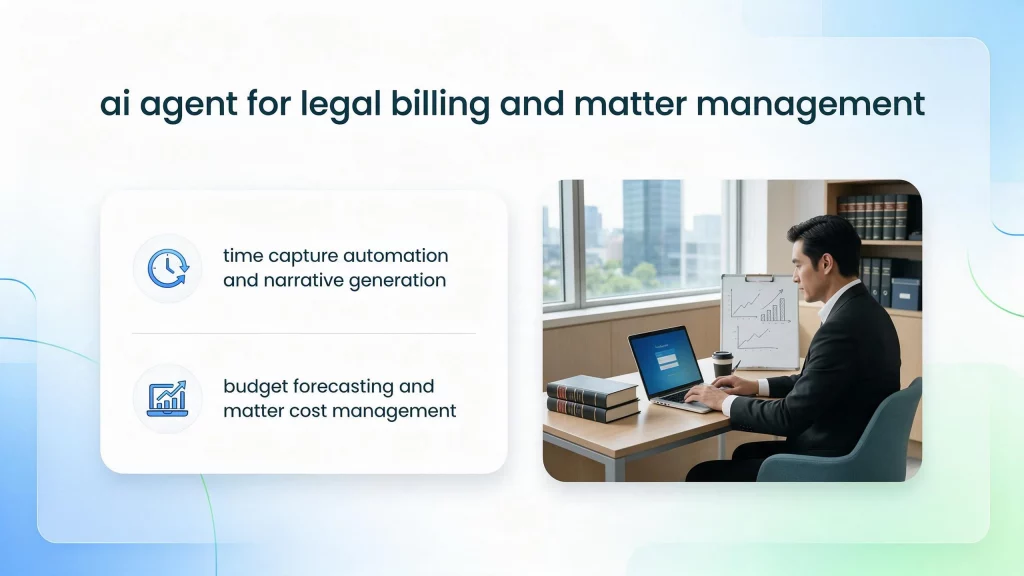
AI agents monitor attorney activity, including documents opened, emails sent and received, meetings attended, and research queries executed, and generate draft time entries with structured narratives at the end of each workday. The attorney reviews and confirms the entries rather than reconstructing their day from memory.
This eliminates the single most common source of billing leakage: work performed but never entered because the attorney did not have time to write up their entries before moving to the next matter.
For billing narrative quality, AI agents apply the firm’s billing guidelines and client-specific instructions automatically, ensuring that entries meet the description length and specificity requirements that particular clients enforce. Entries that do not meet guidelines are flagged before they reach the billing department, reducing write-down rates at client billing review.
Budget Forecasting and Matter Cost Management
For matters operating under fixed-fee or budget-capped arrangements, AI agents monitor matter spend in real time and forecast cost trajectory against budget. When a matter is tracking to exceed budget based on current pace, the AI agent flags the variance to the responsible partner before the overage occurs, providing time to renegotiate, adjust staffing, or revise scope.
This forward-looking cost monitoring converts budget management from a reactive reconciliation exercise into a proactive tool, and matter budgets already give you the baseline for measuring AI agent return on investment.
Data Privacy, Confidentiality, and Ethics in Legal AI
Legal AI deployment carries confidentiality obligations that do not apply to most other industries. Attorney-client privilege, work product protection, and jurisdictional data protection requirements mean that legal organizations must maintain rigorous control over where client data goes and how it is processed.
Generic cloud-based AI tools that send client documents to third-party servers for processing create confidentiality risks that many legal departments and law firm risk management committees will not accept.
We address this through on-premise and private cloud deployment options that keep all document processing within the organization’s own infrastructure. No client data leaves the firm’s network boundary. All agent actions are logged with complete audit trails, supporting the supervision obligations that bar regulations impose on technology-assisted legal work.
Our platform is designed to operate consistently with the ABA’s Model Rules guidance on supervision of technology-assisted legal work, with human review integrated at every decision point where attorney professional judgment is required.
Additionally, our model-agnostic architecture means that law firms are not dependent on a single AI model provider. The regulatory landscape for AI in legal practice is still evolving, and it is evolving quickly. As a result, the ability to switch underlying models without rebuilding workflows has become a material risk management capability rather than a technical nicety.
How AI Hive Deploys AI Agents for Legal Organizations
AI Hive’s enterprise AI agent platform brings three elements that legal organizations need for production-grade deployment. Specifically, our AI agent platform for legal teams orchestrates specialized agents for contract analysis, research synthesis, document classification, and billing, coordinating their outputs without requiring human hand-offs between tools.
Our Agent Marketplace includes pre-built templates configured for common legal workflows, reducing deployment time for standard use cases. Our AI Engineers for Hire program supports custom integration with document management systems (iManage, NetDocuments, SharePoint), practice management platforms, and billing systems (Aderant, Elite 3E, Thomson Reuters Elite) for organizations that need tailored implementations.
For legal leaders weighing a pilot against a full rollout, our view is direct: a narrow pilot proves the concept but rarely survives contact with a real caseload, while a production deployment costs more upfront and pays back faster because it is built for exception volume from day one.
Conclusion
The legal industry’s productivity challenge is not a shortage of work. It is a shortage of attorney capacity to execute pattern-following tasks at the volume the business demands.
An AI agent for legal changes the ratio between what your attorneys can accomplish and what they spend their time on, by handling contract review, case research, document classification, and billing administration autonomously and routing only the decisions that genuinely require professional judgment to a human reviewer.
Law firms and corporate legal departments that deploy AI agents in 2026 will not simply work more efficiently. They will build a structural throughput advantage that allows them to serve more clients, handle more matters, and maintain quality without proportional cost growth.
We invite you to explore how AI Hive’s legal AI agent platform can be configured for your organization’s specific practice areas and matter types. Connect with our legal AI specialists to schedule a consultation.