

Your enterprise AI project just hit a wall. The model forgot critical instructions halfway through a document review, or your API bill spiked because you stuffed 800,000 tokens into every request. The Claude context window determines how much information the model can process in a single conversation turn, and understanding its real-world boundaries is the difference between a production-grade system and an expensive prototype. This blog breaks down the actual capabilities, per-model limits, and cost optimization patterns that engineering teams need for 2026 deployments.
What Is the Claude Context Window and Why Does It Matter?
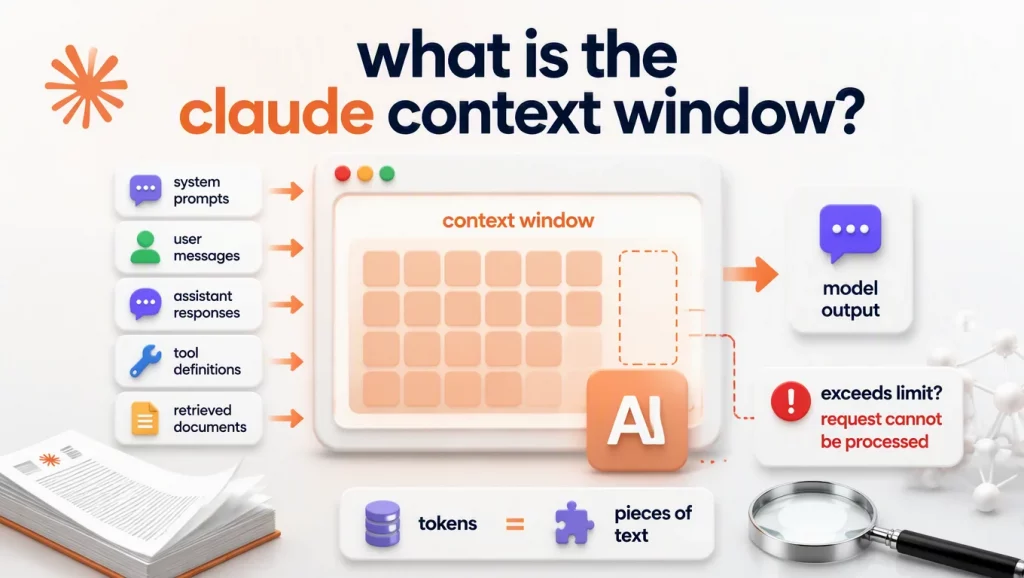
The Claude context window refers to the maximum number of tokens that Anthropic’s Claude models can accept as input and produce as output within a single API call. Tokens include every piece of text in the conversation: system prompts, user messages, assistant responses, tool definitions, and retrieved documents. When the total token count exceeds the context window, the model cannot process the request at all.
This constraint has direct implications for enterprise applications. A contract review agent that needs to reason across a 200-page agreement requires a context window large enough to hold the entire document. A customer support system that references a knowledge base of 10,000 articles needs an architecture that works within token limits while still delivering accurate responses. Understanding these boundaries prevents teams from building systems that fail silently when real-world data volumes arrive.
Claude Context Window Sizes by Model in 2026
Anthropic has expanded the Claude context window significantly over the past year. As of mid-2026, the flagship models support context windows that were unthinkable just eighteen months ago. Here is the current breakdown across the model family.
| Model | Context Window | Max Output | Best For |
| Claude Opus 4.8 | 1,000,000 tokens | 128K tokens | Deep reasoning, long-document analysis, complex agentic workflows |
| Claude Sonnet 5 | 1,000,000 tokens | 64K tokens | Balanced performance and cost for most production workloads |
| Claude Sonnet 4.6 | 1,000,000 tokens | 64K tokens | Cost-efficient production tasks with full context access |
| Claude Haiku 4.5 | 200,000 tokens | 8K tokens | High-volume, low-latency tasks like classification and routing |
One million tokens translates to roughly 750,000 words. In practical terms, that is enough capacity to hold a 1,500-page book, an entire mid-sized codebase of 250,000 to 350,000 lines, or a full year of customer support transcripts in a single prompt. For code-heavy workloads, 200K tokens accommodate approximately 50,000 to 70,000 lines depending on language density.
What One Million Tokens Actually Enables in Production
Raw token counts are meaningless without production context. Enterprise teams need to understand what a 1M-token Claude context window enables across real deployment scenarios, and where it still falls short.
Document-Scale Reasoning
Legal teams can now load an entire merger agreement, all referenced exhibits, and the relevant regulatory framework into a single Claude call. The model reasons across the full document set rather than processing chunks in isolation. According to Anthropic’s internal benchmarks, Claude Opus 4.8 maintains strong recall accuracy across the first 500K tokens, with measurable degradation beginning around 700K tokens for needle-in-a-haystack retrieval tasks.
Codebase-Wide Analysis
Engineering teams can submit an entire microservice architecture for review. A 200,000-line codebase fits within the 1M window, allowing Claude to trace dependencies across files, identify architectural inconsistencies, and suggest refactoring patterns that single-file analysis would miss. Our team at AI Hive has observed that this capability reduces code review cycles by 40% for clients with complex, interconnected service layers. Organizations exploring enterprise AI agent deployments can leverage this full-context analysis as a foundation for their agentic architecture.
Multi-Turn Agent Memory
Agentic workflows benefit from extended context windows because the model retains the full history of tool calls, intermediate reasoning, and previous decisions. A financial analysis agent that queries multiple databases, processes spreadsheets, and generates reports can maintain coherent reasoning across dozens of steps without losing track of earlier findings.
Context Window Limitations That Most Guides Skip
Larger context windows do not automatically translate to better performance. Several well-documented limitations affect how enterprises should architect their systems around the Claude context window.
Context Rot Is Real and Measurable
Research published in early 2026 tested 18 frontier models, including the Claude 4 family, and found that accuracy drops non-uniformly as input length grows. Some models showed 30% to 50% accuracy degradation well before their documented context limit. The phenomenon, known as context rot, means that information placed in the middle of a very long prompt receives less attention than information at the beginning or end.
Gartner’s 2026 report on enterprise AI deployment noted that 62% of organizations experienced unexpected quality degradation when scaling from prototype context sizes (under 50K tokens) to production volumes. The recommendation is to test retrieval accuracy at your actual production context lengths, not just at small scales.
Cost Scales Linearly with Context Length
Every token in the context window costs money. Loading a 500-page document into Claude Opus at $5 per million input tokens costs approximately $2.50 per request. If your application processes 1,000 documents per day, that single operation costs $2,500 daily before accounting for output tokens. Teams that ignore this arithmetic discover their AI budget is exhausted within weeks of production launch.
Latency Increases with Context Size
Larger contexts mean longer time-to-first-token and slower overall response generation. For customer-facing applications where sub-second latency matters, stuffing the full 1M window is counterproductive. Benchmarks show that inference with a 100K context runs 2x to 5x faster than inference with a 500K context on the same model.
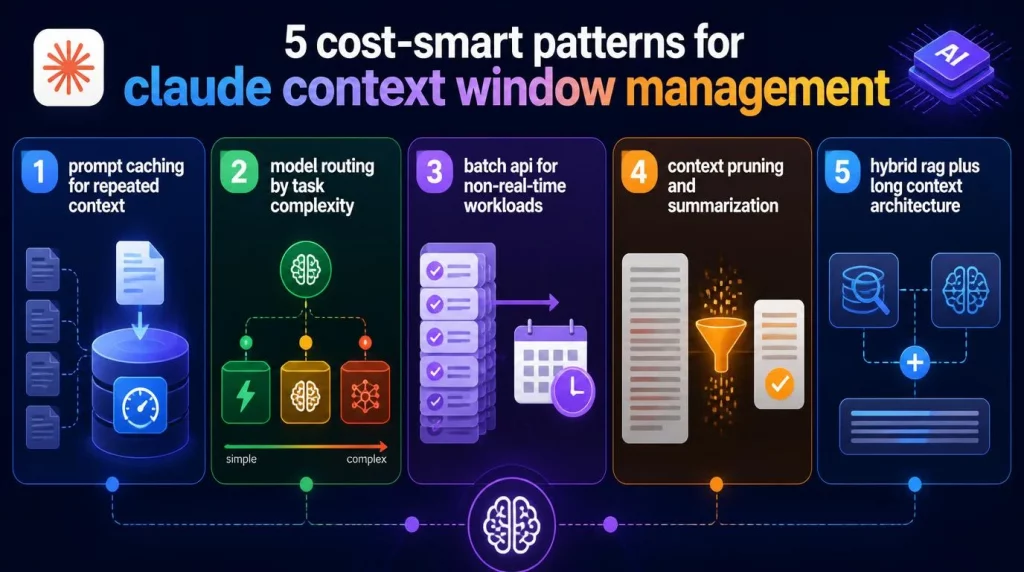
5 Cost-Smart Patterns for Claude Context Window Management
Production teams that manage their Claude context window strategically can reduce API costs by 60% to 90% without sacrificing output quality. These patterns are not theoretical; they reflect what our engineering team at AI Hive implements across client deployments.
Pattern 1: Prompt Caching for Repeated Context
Anthropic’s prompt caching feature reduces input costs by up to 90% for tokens that repeat across requests. System prompts, tool definitions, and reference documents that remain constant across conversations should be cached. A typical enterprise deployment with a 20K-token system prompt serving 10,000 daily requests saves approximately $900 per month through caching alone.
Pattern 2: Model Routing by Task Complexity
Not every task requires Opus. Classification, routing, and simple extraction tasks perform equally well on Haiku 4.5 at $1 per million input tokens compared to $5 for Opus. Intelligent routing systems that direct requests to the appropriate model tier based on task complexity can reduce blended costs by 70%. Your enterprise should reserve Opus for multi-step reasoning and complex analysis while routing high-volume, straightforward tasks to Haiku. For teams integrating Claude into their existing tech stack, our guide to Claude API enterprise integration covers the routing architecture in detail.
Pattern 3: Batch API for Non-Real-Time Workloads
The Batch API offers a 50% discount on both input and output tokens. Document processing pipelines, nightly report generation, and bulk data extraction are ideal candidates. A document processing workflow that handles 5,000 contracts per month can cut costs in half by batching requests during off-peak hours.
Pattern 4: Context Pruning and Summarization
Rather than maintaining the full conversation history in the context window, teams should implement rolling summarization. After every N turns, a lightweight model like Haiku summarizes the conversation so far, and the summary replaces the raw history. This technique keeps context usage under 50K tokens even for conversations that would otherwise grow to 200K or more.
Pattern 5: Hybrid RAG Plus Long Context Architecture
The most cost-effective architecture in 2026 combines retrieval-augmented generation with long context reasoning. RAG retrieves 50K to 200K relevant tokens from your knowledge base, and the model reasons over that curated context rather than ingesting the entire corpus. This hybrid approach delivers the accuracy benefits of full-context reasoning at a fraction of the cost. We explore the specific retrieval patterns for Claude in our dedicated guide to production-grade Claude RAG workflows.
When to Use the Full Context Window vs. RAG
The decision between leveraging the full Claude context window and implementing a RAG architecture depends on three factors: document volume, cost tolerance, and reasoning requirements.
| Scenario | Recommended Approach | Why |
| Single document under 200 pages | Full context | Simpler architecture, better cross-document reasoning |
| Knowledge base of 1,000+ documents | RAG | No context window can hold the full corpus |
| High-volume queries (1,000+/day) | RAG + caching | Cost scales linearly with context; RAG keeps per-query cost low |
| Complex reasoning across related docs | Hybrid | Retrieve relevant chunks, then reason across them in full context |
| Real-time customer support | RAG with Haiku routing | Latency and cost require minimal context per request |
McKinsey’s 2026 analysis of enterprise AI deployments found that organizations using hybrid architectures achieved 3.2x higher ROI compared to those relying exclusively on long-context approaches. The hybrid model reduced infrastructure costs while maintaining accuracy benchmarks above 92% for knowledge-intensive tasks.
Enterprise Implementation Checklist for Context Window Optimization
Before your team deploys a Claude-powered system in production, validate these architectural decisions against your actual data volumes and performance requirements.
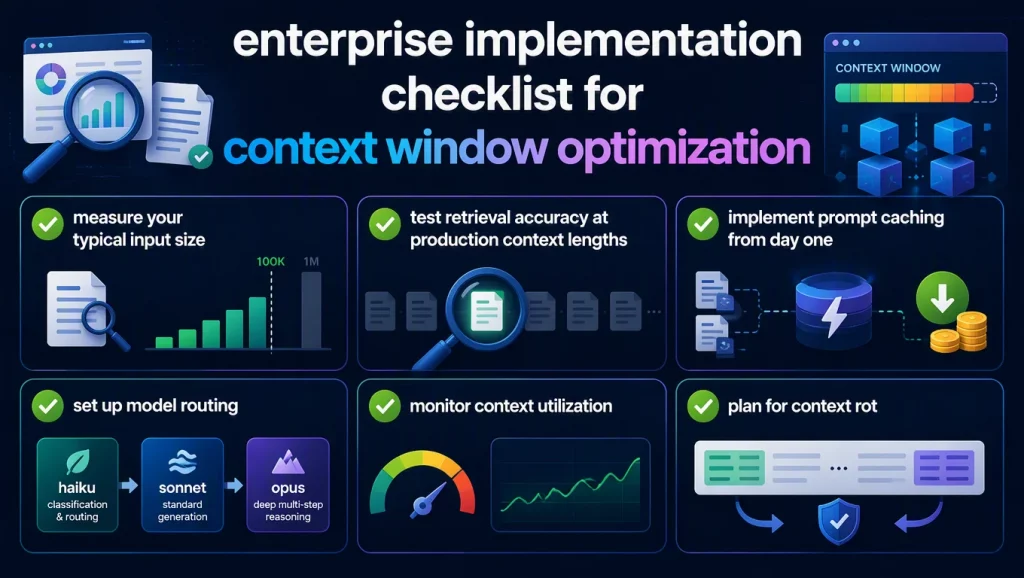
- Measure your typical input size: Profile your actual documents, not hypothetical maximums. If 95% of your inputs are under 100K tokens, architect for that rather than the 1M ceiling.
- Test retrieval accuracy at production context lengths: Run needle-in-a-haystack tests at your expected token counts, not just at 10K or 50K.
- Implement prompt caching from day one: The cost savings compound immediately and require minimal architectural changes.
- Set up model routing: Use Haiku for classification and routing, Sonnet for standard generation, and Opus only for tasks that genuinely require deep multi-step reasoning.
- Monitor context utilization:Track how much of your allocated context window each request actually uses. Over-provisioning wastes budget; under-provisioning causes failures.
- Plan for context rot: Place critical instructions at the beginning and end of prompts. Test whether your system degrades gracefully when context approaches the limit.
Conclusion
The Claude context window has evolved from a limiting constraint into a powerful architectural tool for enterprise AI. With 1M tokens available across Opus and Sonnet models, your team can build systems that reason across entire codebases, legal document sets, and multi-step agentic workflows. The teams that succeed in production are those that pair large context capabilities with cost-smart patterns: prompt caching, model routing, batch processing, and hybrid RAG architectures. Understanding when to use the full window and when to retrieve selectively is what separates a sustainable deployment from an expensive experiment.
If your enterprise is planning a Claude deployment and needs guidance on context window architecture, cost optimization, or production-grade agent design, our AI engineering team can help you move from prototype to production in weeks rather than months. Approach the AI Hive team to discuss your specific requirements.