

Three questions consistently slow down Claude Code Enterprise procurement more than anything else: whether it outperforms GitHub Copilot Enterprise and Cursor Enterprise on the dimensions that matter to regulated industries, what the real cost looks like at 50 or 200 seats (not the $20 individual Pro price that keeps appearing in Reddit threads), and how to deploy it without generating a three-month security review backlog. This playbook addresses all three in sequence, drawing on verified pricing data and production outcomes from engineering teams at Spotify, LG CNS, Rakuten, and Ramp.
Key Takeaways
|
What Is Claude Code for Enterprise?
Claude Code for Enterprise is Anthropic’s autonomous coding agent built for large engineering organizations that require centralized governance, verified security controls, and measurable productivity output. Claude Code understands your entire codebase (not just the open file), writes and debugs code, generates tests, and opens pull requests autonomously. It runs across terminal, any IDE, Slack, and the web.
The Enterprise plan extends the standard Claude Code product with organization-wide controls that the Team plan does not include: SCIM provisioning, audit trails, role-based permissions, IP allowlisting, custom data retention, and BYOK deployment through existing cloud infrastructure. For regulated industries, these are not optional upgrades. They are the features that determine whether Claude Code can pass a security review at all.
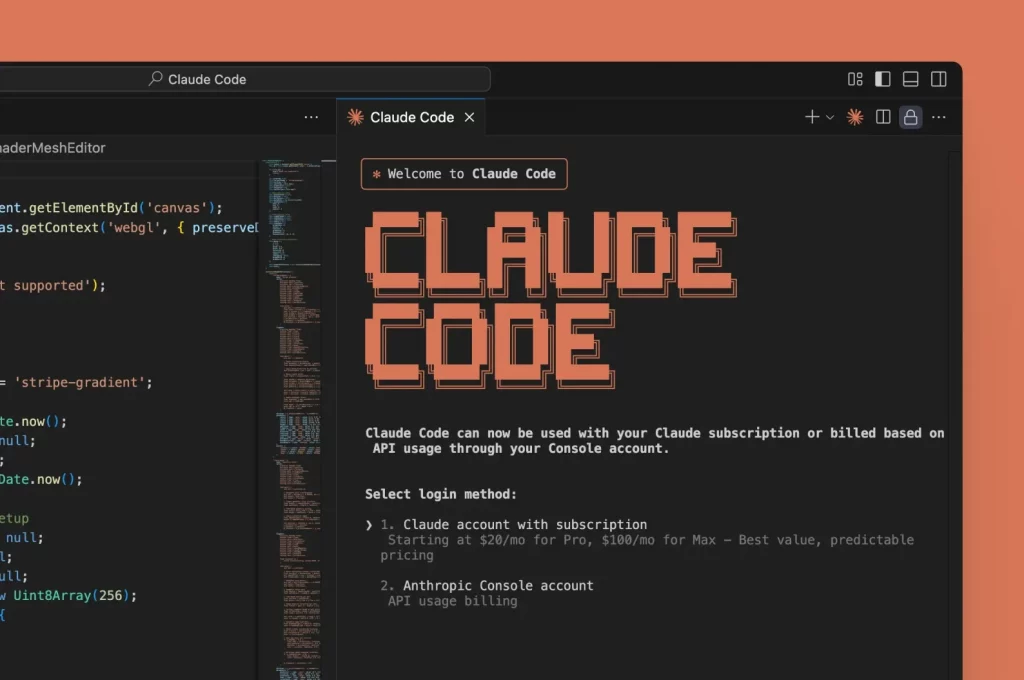
How Claude Code Enterprise Differs from the Team Plan
The most common misconception about Claude Code’s pricing is treating the Team plan’s $100 per seat per month as the enterprise price. It is not. Claude Code is included in both plans, but the governance layer that enterprise security teams require lives only in the Enterprise tier.
| Feature | Team Plan | Enterprise Plan |
|---|---|---|
| Pricing | $100/person/month (min. 5 seats) | Custom – contact sales |
| Claude Code included | Yes | Yes |
| SSO (SAML 2.0) | Yes | Yes |
| SCIM provisioning | No | Yes |
| Role-based permissions (RBAC) | Basic | Fine-grained |
| IP allowlisting | No | Yes |
| Custom data retention | No | Yes |
| Audit trails | No | Yes |
| BYOK (Bedrock / Vertex / Foundry) | No | Yes |
| OpenTelemetry export | No | Yes |
| Dedicated support and onboarding | No | Yes |
The decision rule is simple. If your security team requires SCIM, audit trails, or IP allowlisting before approving a coding tool, the Team plan will not survive procurement review. You need the Enterprise plan.
Key Features of Claude Code Enterprise
Claude Code Enterprise ships with four capabilities that engineering leaders at production-scale organizations cite most often as the deciding factor when choosing it over alternatives.
- Agentic task execution across the full development cycle. Claude Code is not an autocomplete engine. It writes entire features from natural language instructions, creates tests, and opens PRs without requiring an engineer to supervise each step. Your senior engineers define what needs to happen, and Claude Code handles the implementation. This shift matters because it changes how you measure productivity: you are no longer counting accepted suggestions, you are measuring features shipped per engineer per sprint. Engineering teams using Claude Code for automated code review report that senior engineers consistently redirect that reclaimed time toward architecture decisions and system design rather than line-by-line implementation.
- Server-managed settings for organization-wide standards. Enterprise administrators configure Claude Code’s behavior from a single admin panel: tool permissions, file access restrictions, MCP server configurations, and CLAUDE.md standards files. When a new engineer is provisioned through SCIM, they inherit your organization’s coding standards automatically. The standards travel with the tool, which means no onboarding documentation, no individual setup calls, and no drift between team practices over time.
- OpenTelemetry integration for cost and usage visibility. Claude Code exports real-time session activity, token usage per team, and per-project costs directly to your existing observability stack, whether that is Datadog, Grafana, or Splunk. Engineering leaders can answer “what is our AI coding investment producing?” from the same dashboard they use to monitor service health. There is no need to build custom integrations or wait for a monthly billing report to understand spend.
- Bring Your Own Keys (BYOK) on existing cloud infrastructure. Enterprise teams route Claude Code through Amazon Bedrock, Google Cloud Vertex AI, or Microsoft Foundry. All requests stay inside your existing VPC configurations, IAM policies, and CloudTrail logging. For organizations in financial services, healthcare, or government, this matters in procurement: instead of evaluating Claude Code as an external tool requiring a new trust boundary, your security team approves a configuration change inside infrastructure they already own and audit.
Claude Code Enterprise Pricing and Seat Management
Claude Code Enterprise pricing is custom and requires a sales conversation. Anthropic does not publish a standard per-seat Enterprise price because the number scales based on seat count, deployment model (Anthropic Cloud vs. Bedrock vs. Vertex vs. Foundry), support tier, and contract terms. Organizations evaluating how Claude API integrates with enterprise infrastructure often find that the Enterprise plan’s BYOK option is the tipping point in security review.
The tier that generates the most pricing confusion is the Team plan at $100 per seat per month. Many engineering managers treat this as the enterprise rate. It is actually the self-serve tier that includes Claude Code but omits the governance layer. The table below shows where each plan fits.
| Plan | Price | Min Seats | Enterprise-Ready? | Key Gap |
|---|---|---|---|---|
| Pro | $20/person/month | 1 | No | No team management, no SSO |
| Max (individual) | $100-$200/person/month | 1 | No | Individual billing only |
| Team | $100/person/month | 5 | Partial | No SCIM, no audit trails, no IP allowlist |
| Enterprise | Custom – contact sales | Flexible | Yes | Full governance tier |
One budget variable that catches engineering leaders off guard: when you run Claude Code through Amazon Bedrock or Google Vertex AI, API token costs bill through your cloud provider account, not through your Anthropic contract. Your Enterprise seat cost covers access and governance. Token burn from actual agent sessions appears as a separate line item under your cloud spend. Build both into your cost model before the first budget review cycle.
Claude Code Enterprise vs GitHub Copilot Enterprise vs Cursor Enterprise
Every engineering leader running this comparison in 2026 focuses on five dimensions: pricing, security controls, model flexibility, deployment options, and autonomous agent capability. The table below uses verified data from official product pages as of July 2026.
| Dimension | Claude Code Enterprise | GitHub Copilot Enterprise | Cursor Enterprise |
|---|---|---|---|
| Pricing | Custom (contact sales) | $39/seat/month | Custom (contact sales) |
| Model | Claude Opus 4.7 (Anthropic-only) | GPT-5, Claude, Gemini, o4 (selectable) | Claude Opus, GPT-5, Gemini, Cursor’s own |
| SSO / SCIM | Yes / Yes | Yes / Yes | Yes / Yes |
| Audit logs | Yes | Yes | Yes |
| BYOK / VPC isolation | Yes (Bedrock, Vertex, Foundry) | Yes (Azure, GitHub API) | Limited |
| No training on code | Yes – all paid tiers | Business/Enterprise only; Pro/Free may train | Privacy mode required (opt-in) |
| Autonomous agent depth | Full agentic: write, test, PR, migrate | Copilot Agent (newer, improving) | Agent mode in Composer |
| IDE support | Terminal + any IDE + Slack + web | VS Code, JetBrains, Vim, Neovim, others | VS Code fork (Cursor app only) |
| Full codebase context | Yes – whole repo, not just open file | Workspace context (partial) | Full project index |
Our verdict for regulated enterprises: Claude Code Enterprise is the strongest choice for organizations where data privacy, VPC isolation, and autonomous agent execution are the primary requirements. GitHub Copilot Enterprise is the strongest choice for teams embedded in the GitHub ecosystem that need multi-model flexibility. Cursor Enterprise fits teams that prefer a visual IDE experience and want model choice within a single coding environment.
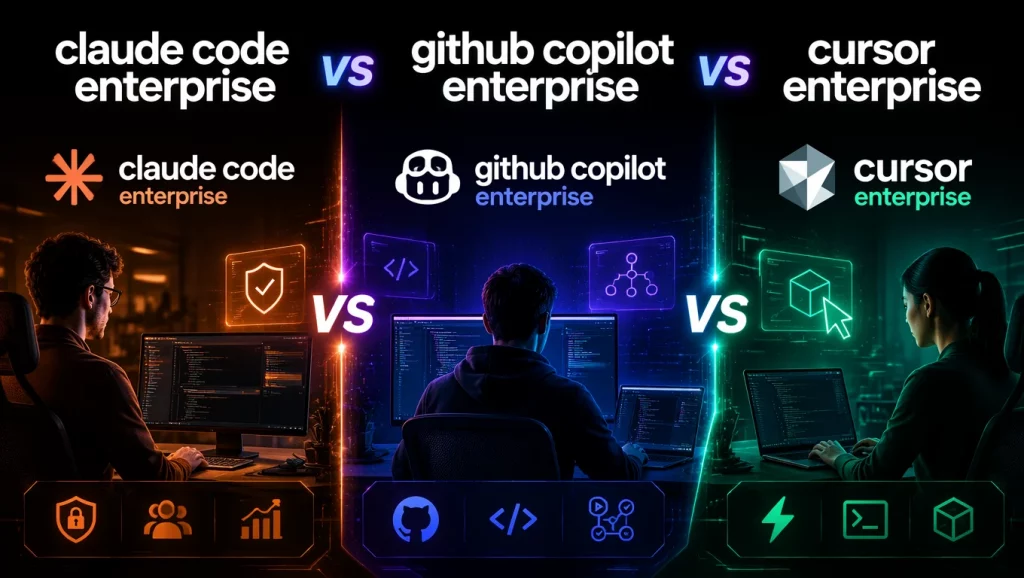
Security Controls Deep Dive: Where Each Tool Draws the Line
For engineering teams in regulated industries, including financial services, healthcare, and government, the security control differences between these three tools are not minor. They determine whether a tool passes your security team’s review at all.
- Data training policies are the sharpest dividing line between these tools. Anthropic does not train Claude on any paid customer’s code, conversations, or documents. This policy applies at the Pro tier and above, not only at the Enterprise level. GitHub Copilot Business and Enterprise exclude code from training, but the individual Pro plan may use code for model improvement. Cursor requires users to opt into privacy mode, and the default on standard plans may include code in product improvement. For a CTO approving a tool that will process proprietary codebases, Claude Code’s blanket no-training policy removes one category of procurement risk entirely.
- VPC isolation is where Claude Code separates from the field. Running Claude Code through Amazon Bedrock routes every request through your existing AWS security infrastructure: IAM roles, CloudTrail logging, and VPC configurations. No new trust boundary is created. No external data egress needs evaluation. LG CNS cited exactly this feature when explaining why Claude Code became viable for their regulated financial services clients. As Hyosup Bae, Director and Head of Build Center at LG CNS, described it: “The conversation shifts from ‘Can we trust this model?’ to ‘How can we use a technology that is already within our security boundary?'”
- Audit log export format matters more than most teams expect. Claude Code exports audit data through OpenTelemetry to your existing observability stack. GitHub Copilot sends audit events through GitHub’s existing audit log API. Cursor exports to a proprietary dashboard. For teams running a unified SIEM or observability platform, Claude Code’s OpenTelemetry approach adds the least incremental tooling.
When GitHub Copilot Enterprise Makes More Sense Than Claude Code
GitHub Copilot Enterprise is the right call for engineering teams whose entire development lifecycle runs on GitHub and who want to switch models by task type. At $39 per seat per month (published pricing), it costs significantly less than most Claude Code Enterprise agreements at comparable seat counts. Copilot lets engineers choose between GPT-5, Claude Opus, Gemini, and o4 depending on the task, which is useful for organizations that do not want a single-vendor model strategy. If your primary need is daily autocomplete, inline suggestions, and PR review comments, and you are not running complex multi-step agent migrations, Copilot Enterprise delivers more flexibility per dollar at current pricing.
When Cursor Enterprise Makes More Sense Than Claude Code
Cursor Enterprise fits teams that do most of their complex work inside a visual editor and want multi-model choice. Engineers who review multi-file diffs, navigate large class hierarchies, and stage selective hunks will find Cursor’s Composer interface more natural than Claude Code’s terminal-first workflow. Cursor also supports Claude Opus alongside GPT-5 and Gemini, which matters for organizations that want to route tasks by cost and capability without committing to one provider. The tradeoff is real, though: your team is locked into the Cursor app. VS Code extensions do not carry over, and there is no terminal-native or Slack-native workflow available.
3 Common Claude Code Enterprise Use Cases Proven in Production
The three use cases below represent areas where Claude Code Enterprise consistently outperforms alternatives in real production deployments. Each one is supported by named organizations with verified outcome metrics.
- Legacy system migration and modernization. Claude Code’s full-codebase context and architectural reasoning make it the strongest tool currently available for migrating systems with 10,000-line stored procedures, undocumented APIs, or proprietary UI platforms that have reached end of service. LG CNS used Claude Code to convert 2,888 of 2,913 APIs from a 20-year-old enterprise system, achieving a 99.1% completion rate while simultaneously migrating 1,340 screens from a proprietary frontend to React across 24/7 parallel tracks. LG CNS’s Head of Build Center put the actual ROI plainly: “The ROI is not simply that we did it faster. The ROI is that we made a previously difficult-to-start project possible.”
- Fleet-wide refactoring across large distributed codebases. Spotify reported that Claude Code enabled fleet-wide migrations at a pace that was simply not achievable before, with Senior Staff Engineer Max Charas citing it as a clear signal of how AI is reshaping development velocity at scale. For organizations maintaining distributed services across hundreds of repositories, the ability to apply a structural change to every affected file in a single agentic session removes the coordination overhead that makes these projects expensive and error-prone.
- Autonomous PR generation and continuous code review. Claude Code analyzes pull requests before human review, checks them against your CLAUDE.md organization standards, flags issues, and suggests improvements directly in the development workflow. Engineering teams at Notion, HubSpot, and Shopify have reported that senior engineers now spend less time on implementation details as a result. Notion co-founder Simon Last described the shift: “We decide what needs to happen, and smooth the process so it can build and verify end-to-end.”
How Enterprise Engineering Teams Actually Deployed Claude Code: 3 Case Studies
The three deployments below draw from Anthropic’s official customer stories. They offer the clearest publicly available evidence of what Claude Code Enterprise produces in regulated, high-stakes production environments.
Case Study 1: LG CNS – 20-Year Legacy Migration at 50% Cost in 7 Months
LG CNS is the IT services and digital transformation arm of LG Group, with approximately 7,000 employees and $4.2 billion in 2025 revenue. Its 200-engineer Build Center modernizes decades-old enterprise systems for financial institutions, manufacturers, and public-sector clients – the exact environments where most conventional AI tools fail security review.

The challenge: A Korean construction company needed its 20-year-old project management system migrated to a modern stack. The deadline was fixed and the budget ruled out conventional delivery. Standard offshore development did not change the math: dozens of developers writing in parallel against poorly documented legacy code makes consistency harder, not easier.
What LG CNS deployed: LG CNS built an engineering orchestration layer around Claude Code running on Amazon Bedrock. The Bedrock deployment kept every request inside the regulated clients’ existing AWS security boundary. Work decomposed into YAML-defined tasks with context chained through the local file system. Claude Opus 4.6 handled architecture design, legacy analysis, and complex code generation across 24/7 parallel tracks.
The outcome: The migration completed in seven months at roughly 50% of conventional rebuild cost. Claude Code achieved a 99.1% API conversion rate, converting 2,888 of 2,913 APIs, while simultaneously migrating 1,340 screens from MiPlatform to React. LG CNS then adopted Claude Code as the standard development approach across its entire 200-engineer Build Center.
Source – Full case study: LG CNS – Claude Code case study (Anthropic).
Case Study 2: Rakuten – 79% Faster Time to Market
Rakuten integrated Claude Code Enterprise across its engineering organization to accelerate feature delivery. Time from feature inception to market deployment dropped from 24 days to 5 days, a 79% reduction. The team also recorded 2x faster execution speed and 99.9% accuracy on complex code modifications verified in production. For a company operating one of Asia’s largest e-commerce platforms across multiple countries, compressing that delivery cycle by nearly four weeks per feature has a meaningful competitive effect.
Case Study 3: Ramp – 1 Million Lines of AI-Suggested Code in 30 Days
Ramp, the corporate finance platform, implemented over 1 million lines of AI-suggested code within the first 30 days of Claude Code Enterprise rollout. Senior Software Engineer Austin Ray noted that the quality of dedicated onboarding support from Anthropic built organizational trust that made expanding Claude Code usage across teams considerably easier. In Ramp’s case, the support experience during rollout became a factor in how quickly internal adoption spread.
How to Deploy Claude Code in Your Enterprise Environment
Deploying Claude Code Enterprise follows six steps, from procurement through organization-wide rollout. The sequence below covers the configuration decisions that most enterprise deployment guides leave out.
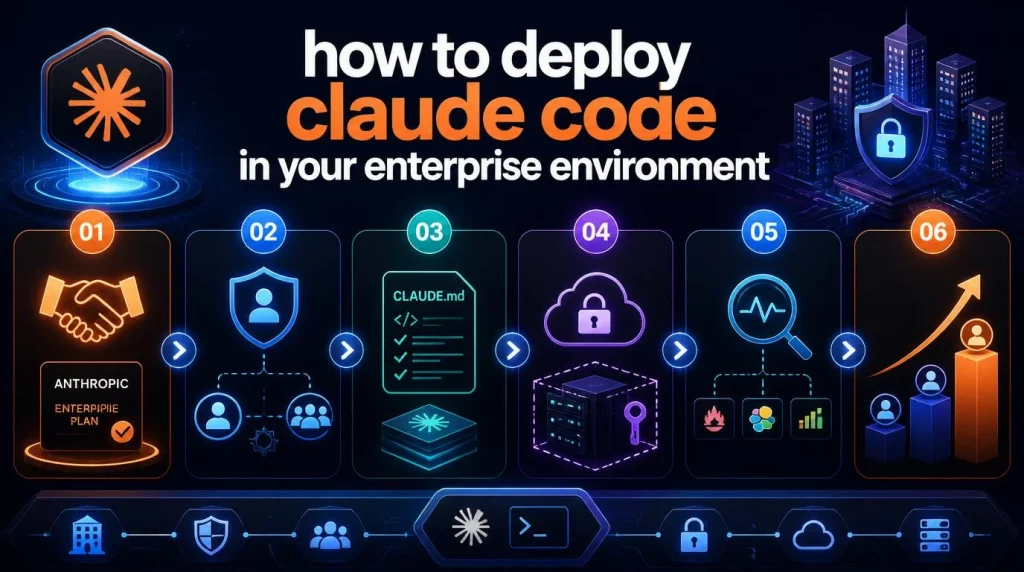
- Step 1: Secure the Enterprise plan through Anthropic sales. Contact Anthropic at claude.com/contact-sales with your seat count estimate, preferred deployment model (Anthropic Cloud, Bedrock, Vertex, or Foundry), and specific security requirements (SCIM, audit trails, IP allowlisting, custom data retention). Enterprise agreements are negotiated, so providing these parameters upfront compresses the proposal timeline from weeks to days.
- Step 2: Configure SSO and SCIM provisioning. Claude Code Enterprise integrates with Okta, Azure Active Directory, and any SAML 2.0 identity provider. SCIM provisioning automates seat management: engineers added to your identity provider receive Claude Code access immediately, and offboarded engineers lose access the same day. This step removes the manual seat administration overhead that makes scaling a self-serve coding tool operationally expensive beyond 100 engineers.
- Step 3: Deploy organization-wide coding standards through CLAUDE.md. Create a CLAUDE.md file and deploy it to system directories to establish company-wide coding standards, architecture guidelines, security rules, and contribution requirements. Claude Code reads this file automatically at the start of every session, with no developer action required. Project-specific CLAUDE.md files in individual repositories can extend or override org-level standards, letting teams customize within the guardrails you have defined.
- Step 4: Configure BYOK deployment for VPC isolation, if your security posture requires it. If your security team requires data to remain inside your cloud perimeter, configure Claude Code to route through Amazon Bedrock, Google Cloud Vertex AI, or Microsoft Foundry. All requests use your existing IAM configurations and CloudTrail logging. This step converts Claude Code from an external tool requiring a new trust boundary into a model configuration inside infrastructure your team already audits.
- Step 5: Connect OpenTelemetry to your observability stack. Export Claude Code metrics, including token usage, session activity, per-team costs, and PR contribution rates, to your existing observability platform. For most enterprise teams, this means Datadog, Grafana, or Splunk. Claude Code sends standard OpenTelemetry signals to your existing collector endpoint, so no custom development is needed.
- Step 6: Run a phased rollout starting with one high-complexity use case. Engineering organizations that report the highest Claude Code adoption rates consistently started with a specific, high-value use case, such as a legacy migration, a fleet-wide refactoring project, or an autonomous PR review workflow, before opening access broadly. For organizations that want implementation support at any stage, our team at AI Hive designs and deploys enterprise AI automation workflows that integrate Claude and other enterprise-grade models into production engineering environments.
Security and Compliance for Claude Code Enterprise
Claude Code Enterprise is SOC 2 Type II certified, encrypts all data with TLS 1.3 in transit and AES-256 at rest, does not train on your code, and supports VPC-isolated deployment through three major cloud providers. Full compliance documentation is available at Anthropic’s Trust Center. Five areas that enterprise security teams evaluate in detail:
- SOC 2 Type II certification. Anthropic maintains SOC 2 Type II compliance for Claude Code Enterprise, covering security, availability, and confidentiality controls. The certification applies to Anthropic’s Cloud deployment. Organizations running through Bedrock or Vertex AI operate under their cloud provider’s compliance framework, which typically simplifies approval for organizations already running workloads in those environments.
- Encryption standards. Claude Code encrypts all data in transit with TLS 1.3 and at rest with AES-256. Enterprise plans support customer-managed encryption keys for organizations that need full key control under their own key management service.
- No training on code, across all paid tiers. Anthropic does not use any customer code, conversations, or documents to train its models. This policy applies at the Pro tier and above, not only at the Enterprise level. Claude Code’s no-training stance is a simpler argument to make to a security review board than GitHub Copilot’s tier-dependent policy.
- Granular access controls. Enterprise plans include fine-grained role-based permissions (RBAC), SSO via SAML 2.0, SCIM for automated provisioning, IP allowlisting by network, custom data retention policies, and seat allocation visibility. Together, these controls satisfy the access management requirements of ISO 27001, SOC 2, and most regulated industry security frameworks.
- VPC isolation through cloud providers. Claude Code Enterprise supports three VPC-isolated deployment paths: Amazon Bedrock, Google Cloud Vertex AI, and Microsoft Foundry. When you use these paths, data does not traverse Anthropic’s servers. The model runs inside your existing cloud security boundary, with your existing logging and audit configurations active. Our team at AI Hive also integrates Claude Code into broader enterprise automation stacks – you can review our platform security approach for enterprise deployments.
The Claude Code Pricing Confusion on Reddit, Cleared Up
The most common question engineering managers bring into Claude Code Enterprise procurement calls comes from Reddit threads that conflate the Team plan’s $100 per seat per month with the Enterprise pricing tier.
Here is the direct answer. The Team plan at $100 per seat per month includes Claude Code but does not include the governance features that enterprise security teams require. There is no SCIM, no audit trails, no IP allowlisting, and no custom data retention. The Enterprise plan sits above Team and requires a sales conversation because pricing scales by seat count, deployment model, and support tier. Anthropic does not publish a standard Enterprise per-seat price because the number varies by agreement.
The second source of confusion is how Claude Code is bundled. As of mid-2026, Claude Code is included in both the Team plan and the Enterprise plan. It is not a separate add-on purchase at either tier. Engineers who see a $20 Claude Code Pro price on the individual product page are looking at the personal subscription, not either organizational plan. The decision logic is straightforward: if your security team requires SCIM, audit trails, or IP allowlisting, the Team plan will fail procurement review and you will need the Enterprise plan.
Conclusion
Claude Code Enterprise suits engineering organizations that need autonomous coding at scale alongside governance controls, such as SCIM, VPC isolation, and a blanket no-training-on-code policy, that regulated industries require before approving any AI tool. Specifically, if your team runs complex multi-step workloads including legacy migrations, fleet-wide refactoring, and autonomous PR pipelines, Claude Code Enterprise is currently the only major coding agent that satisfies all three security requirements without workarounds.
If your organization also wants Claude Code to function as part of a broader enterprise AI stack, connected to internal data systems, embedded in multi-agent workflows, or integrated with automation pipelines, our engineering team at AI Hive builds and deploys exactly these architectures for enterprise clients across regulated industries. Reach out our specialist team to scope your implementation asap.