


The published $20 per seat rate for Claude Enterprise has become one of the most misleading numbers in enterprise AI procurement, since it rarely reflects what teams actually pay once real workflows go live. In addition, the 2026 token unbundling means the same 100-seat organization can face a total annual bill ranging from $26,000 to $66,000 depending on model mix, usage patterns, and automation volume. Consequently, evaluating Claude Enterprise pricing without a clear consumption model almost always leads to budget overruns within the first year. Accordingly, this blog explains how the current pricing structure works, what token usage costs by model, and what mid-market and enterprise teams are actually spending in 2026.
Key Takeaways
|
What Is Claude Enterprise Pricing?
Claude Enterprise is Anthropic’s commercial plan for organizations that need centralized security controls, compliance tooling, and AI deployment across 20 or more users. The plan builds on the Team tier and adds a full enterprise security stack: SSO with SAML 2.0, SCIM provisioning, complete audit logs, custom data retention, HIPAA-readiness, Customer-Managed Encryption Keys, and a 500K-token context window that doubles the 200K limit on Team.
Pricing works differently from any individual Claude subscription. Rather than a single monthly fee that bundles access and usage together, Enterprise separates those two costs entirely. One number appears on your annual contract; a second, variable number appears on your monthly invoice based on how much your team actually uses Claude. Understanding both numbers before you sign is the most important step in evaluating claude enterprise pricing for your organization.
As of July 2026, Enterprise is available through two purchase paths:
- Self-serve – minimum 20 seats, USD only, credit card or ACH bank transfer.
- Sales-assisted – minimum 50 seats, multi-currency support, invoicing available, dedicated account management from Anthropic’s sales team.
Both paths offer identical features and the same base seat price.
How Claude Enterprise Pricing Works in 2026
For teams exploring how Claude API for enterprise deployment scales commercially, the billing structure is the right starting point. Claude Enterprise runs on a two-bucket model: a fixed seat fee paid annually upfront, plus variable token consumption billed monthly at standard API rates. The seat fee is predictable; the token bill is not, and that distinction is where most budget surprises originate.
What the Seat Fee Includes
The $20/user/month seat fee gives each user access to the full Claude platform, including Claude on web, desktop, and mobile, Claude Code, and Cowork. It also covers the complete Enterprise security and admin stack:
- SSO and SCIM provisioning for centralized identity management across your organization
- Full audit logs and Compliance API for programmatic access to usage data, chat histories, and file content with filtering by user and time range
- Analytics API for aggregated team adoption and engagement metrics
- Custom data retention controls and Customer-Managed Encryption Keys (CMEK) so your organization maintains control of encryption in your own cloud provider
- US-only inference option for organizations with data residency requirements
- HIPAA-readiness configuration, available for eligible organizations, with a Business Associate Agreement (BAA) accessible from organization settings
- Workplace connectors for Google Drive, Gmail, Google Calendar, GitHub, Microsoft 365, and Slack
- 500K-token context window on the default model, compared to 200K on Team plans
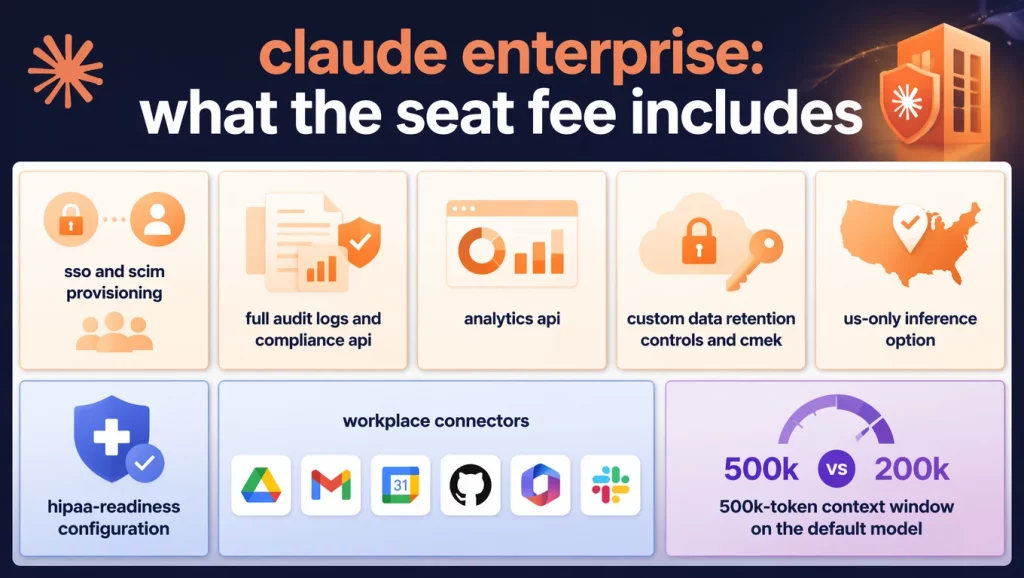
The seat fee does not include any token allowance. There are no per-seat usage limits, no monthly token cap, and no credits bundled into the annual contract.
What Tokens Cost by Model (Updated July 2026)
Every token your team consumes across Claude chat, Claude Code, or any automated workflow is billed at Anthropic’s standard API rates. As of July 2026, those rates by model are:
| Model | Input (per MTok) | Output (per MTok) | Best suited for |
| Claude Opus 4.8 | $5.00 | $25.00 | Complex reasoning, legal analysis, financial modeling |
| Claude Sonnet 4.6 | $3.00 | $15.00 | General workflows, coding, document summarization |
| Claude Haiku 4.5 | $1.00 | $5.00 | High-volume routing, classification, simple Q&A |
Sources: Anthropic API pricing page; Finout Claude pricing analysis, June 2026. Sonnet 4.6 introductory pricing applies through August 31, 2026.
The model your team runs determines your token cost more than nearly anything else in the billing structure. Moving a document classification task from Sonnet 4.6 to Haiku 4.5 cuts that task’s token cost by 67%. For high-volume workflows, model selection is the highest-impact cost control available to Enterprise admins, and it is a decision most procurement teams make after signing rather than before.
Admins can set spend limits at both the organization level and per individual user to prevent overages before they reach the invoice.
Claude Enterprise vs. Team Plan: Which One Do You Actually Need?
The Team-versus-Enterprise decision comes down to one question more than any feature comparison: does your IT or legal team have a written compliance requirement for SSO, SCIM, audit logs, or HIPAA controls?
Anthropic’s Team plan comes in two seat types as of 2026. Team Standard is $25/seat/month and Team Premium is $125/seat/month. Both include a bundled usage allowance within the seat fee, so your monthly cost stays predictable regardless of how much your team uses Claude. That predictability has real value for organizations that cannot accurately model usage volume before committing to a contract.
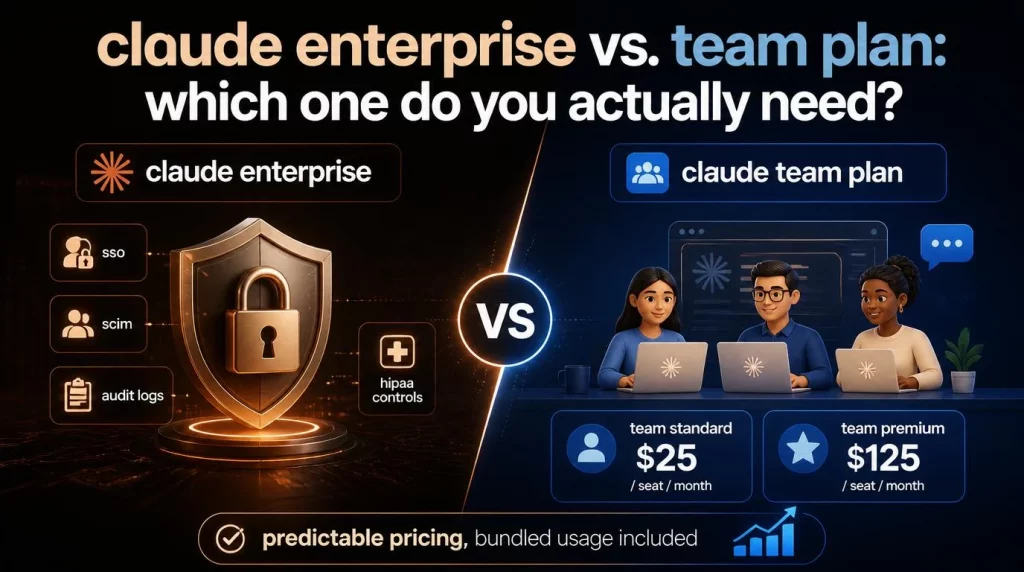
| Feature | Team Standard | Team Premium | Claude Enterprise |
| Seat price | $25/seat/month | $125/seat/month | ~$20/seat/month (custom) |
| Minimum seats | 5 | 5 | 20 (self-serve) / 50 (sales) |
| Max seats | 150 | 150 | No cap |
| Token billing | Included in seat fee | Included in seat fee | Billed separately at API rates |
| Claude Code | No | Yes | Yes |
| SSO / SAML | No | No | Yes |
| SCIM provisioning | No | No | Yes |
| Full audit logs | No | No | Yes |
| HIPAA-readiness | No | No | Yes |
| Context window | 200K tokens | 200K tokens | 500K tokens |
| Data retention control | No | No | Yes |
Team Standard or Team Premium is the right choice when:
- Your team has fewer than 150 users and no IT mandate for SSO or audit logs
- Your usage is difficult to predict and you want a fixed monthly cost ceiling
- You are still in proof-of-concept mode with one or two AI workflows
- Developers need Claude Code but the broader team has no compliance requirement (Team Premium covers this at a flat rate)
Claude Enterprise is the right choice when:
- Your IT or legal team has explicitly confirmed requirements for SSO, SCIM, and audit trails in writing
- You are handling regulated data that requires HIPAA-readiness or US-only data residency
- Your user count will exceed 150 (the hard cap on Team plans) or already has
- Long-document workflows require the 500K context window that Enterprise provides and Team cannot
- Custom data retention, CMEK, or a formal BAA is a non-negotiable requirement
One thing worth saying plainly: the compliance driver should trigger the move to Enterprise, not seat count alone. Validating that requirement in writing before signing saves significant money if the mandate does not materialize.
Real Cost Examples: What Teams Are Actually Paying
The scenarios below use $20/seat/month as the base seat price and Sonnet 4.6 rates for token calculations, which reflect the most common model used across enterprise deployments. Automated workflow estimates assume three workflows running at moderate document volume.
Scenario 1: Small Enterprise (50 Seats)
Profile: A professional services firm with 50 knowledge workers using Claude for research, drafting, and summarization. No automated pipelines have been deployed yet.
| Cost component | Monthly | Annual |
| Seat fee (50 x $20) | $1,000 | $12,000 |
| Conversational tokens (50 users x 500K tokens at Sonnet rates) | ~$100 | ~$1,200 |
| Total estimated TCO | ~$1,100 | ~$13,200 |
At this usage profile, the token cost is essentially a rounding error on the seat fee. The Enterprise decision here is compliance-driven, not cost-driven. If IT has not confirmed an SSO or audit log requirement, Team Standard at $25/seat may actually cost slightly more while offering less governance capability.
Scenario 2: Mid-Market Team (100 Seats)
Profile: A financial services company with 100 employees. Half of the team uses Claude conversationally; the other half runs two automated document-processing workflows covering contract review and report summarization, processing roughly 500 documents per day. According to IT Brief’s April 2026 report on Anthropic’s billing shift, this usage profile is exactly where the token unbundling creates the most impact for mid-market teams.
| Cost component | Monthly | Annual |
| Seat fee (100 x $20) | $2,000 | $24,000 |
| Conversational tokens (50 users x 500K tokens) | ~$100 | ~$1,200 |
| Automated workflows (2 pipelines x 60M tokens/month at Sonnet rates) | ~$540 | ~$6,480 |
| Total estimated TCO | ~$2,640 | ~$31,680 |
The two automated workflows add $6,480 per year that a seat-only budget view would miss entirely. This is precisely the gap the 2026 token unbundling created for teams renewing from legacy contracts. Real-world data from enterprise communities in mid-2026 places 100-seat teams with moderate workflow automation at $3,000-$5,500/month all-in.
Scenario 3: Large Deployment (500 Seats)
Profile: A logistics company deploying Claude across customer service, IT helpdesk, and supply chain operations, with five active automated agents running at volume. For regulated industries including BFSI compliance and AI governance, token cost modeling at this scale is a prerequisite before signing any Enterprise contract.
| Cost component | Monthly | Annual |
| Seat fee (500 x $20) | $10,000 | $120,000 |
| Conversational tokens (500 users x 400K tokens) | ~$900 | ~$10,800 |
| Automated agents (5 pipelines x 80M tokens/month) | ~$1,800 | ~$21,600 |
| Total estimated TCO | ~$12,700 | ~$152,400 |
At this scale, token costs represent roughly 21% of total annual spend. A 10% volume discount on API rates from Anthropic saves approximately $3,200 per year on this profile, which is exactly why negotiating a prepaid token block at signing matters.
What Changed in Claude Enterprise Pricing in 2026
The most significant structural change in Claude Enterprise pricing happened between November 2025 and February 2026. Anthropic decoupled token consumption from the Enterprise seat fee entirely, moving toward pure usage-based billing for enterprise customers.
Under legacy Enterprise contracts through most of 2024 and into early 2025, seat prices ranged from $40 to $200/user/month but included prepaid token allocations and discounts of 10-15% off standard API rates. Under the 2026 structure, the base seat fee dropped to approximately $20/user/month, but the token discounts were removed entirely. A 2026 procurement analysis by NPI Financial found that total cost of ownership increased by $15,000-$40,000 annually for most mid-market teams renewing from legacy contracts, despite the lower headline seat price.
Two things to do before any renewal conversation:
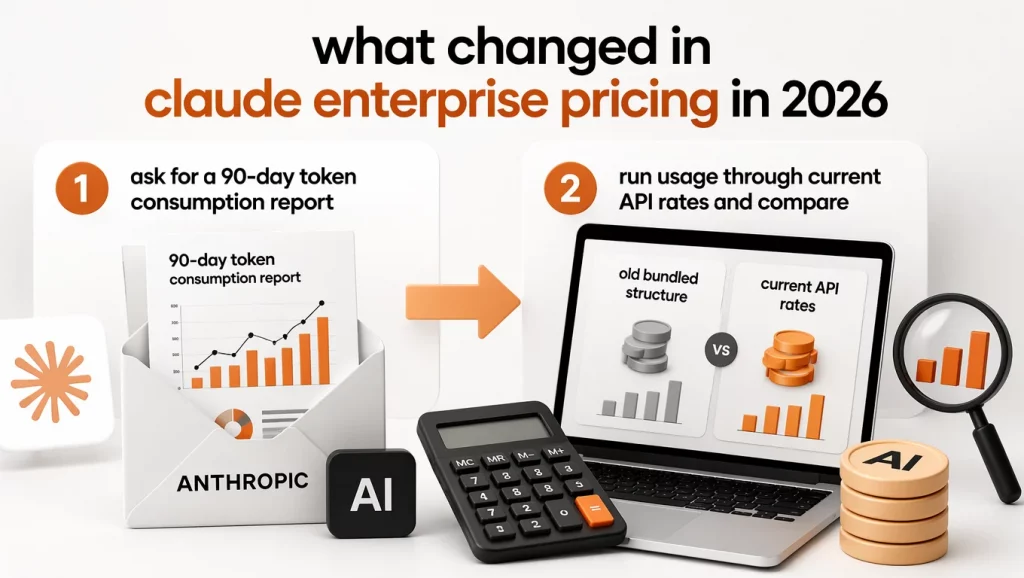
- First, ask your Anthropic contact for a 90-day token consumption report. You need your actual usage numbers, not an estimate, before agreeing to new terms.
- Second, run those consumption numbers through current API rates before the negotiation starts. The difference between what you paid under the old bundled structure and what the same usage costs today is the number that matters in that conversation.
The Model Selection Strategy That Most Teams Ignore
Most enterprise pricing guides focus entirely on seat counts and ignore the single biggest variable in Claude Enterprise billing: which model your workflows actually run on.
Anthropic’s three-tier model structure creates real optimization opportunities that most procurement teams discover six months after signing rather than before. Opus 4.8 delivers the highest reasoning capability at $5/$25 per million tokens. Sonnet 4.6 handles the vast majority of enterprise use cases at $3/$15. Haiku 4.5 covers high-volume, simple tasks at $1/$5. The cost difference between Opus and Haiku for the same volume of input is a 5x multiplier.
Consider a concrete example: a customer service agent handling 10,000 WISMO queries per month at roughly 1,000 tokens per query costs approximately $450/month on Sonnet 4.6 and $150/month on Haiku 4.5. That single routing decision saves $3,600 per year on one workflow. Teams building Claude MCP integration pipelines for multi-step automation can compound these savings across five or more agents, often reducing total token spend by $20,000 or more annually.
Additionally, prompt caching reduces input token costs by 90% for any workflow that repeatedly sends the same system prompt or context document. Cache hits bill at 0.10x the standard input rate. Combining model selection with prompt caching is the most effective way to control token spend without reducing capability.
Claude Enterprise Pricing Cost Calculator: 20 to 1,000 Users
The table below provides estimated annual TCO ranges across common team sizes. Moderate usage reflects primarily conversational work. High usage adds two to three automated workflow agents running at volume. All figures use the $20/seat base and Sonnet 4.6 token rates.
| Team size | Seat cost/year | Moderate token cost | High token cost | Moderate TCO | High TCO |
| 20 seats | $4,800 | ~$500 | ~$2,500 | ~$5,300 | ~$7,300 |
| 50 seats | $12,000 | ~$1,200 | ~$6,000 | ~$13,200 | ~$18,000 |
| 100 seats | $24,000 | ~$2,400 | ~$12,000 | ~$26,400 | ~$36,000 |
| 200 seats | $48,000 | ~$4,800 | ~$24,000 | ~$52,800 | ~$72,000 |
| 500 seats | $120,000 | ~$12,000 | ~$60,000 | ~$132,000 | ~$180,000 |
| 1,000 seats | $240,000 | ~$24,000 | ~$120,000 | ~$264,000 | ~$360,000 |
Estimates use $20/seat/month and Sonnet 4.6 API rates ($3/MTok input, $15/MTok output). Actual costs vary based on negotiated seat pricing, model selection, workflow volume, and prompt caching utilization. Verify current rates at claude.com/pricing before finalizing any budget.
The gap between the Moderate and High TCO columns widens significantly at larger seat counts because automated workflow volume scales independently of the user base. A 1,000-seat organization running five agents at high volume pays roughly $96,000 more per year than the same organization using Claude conversationally. That difference is entirely in token costs and is entirely within the admin’s control through model routing and caching configuration.
5 Factors That Affect Your Claude Enterprise Pricing Quote
The published $20/seat/month is the starting point for negotiation, not a fixed price. Five factors typically influence what Anthropic quotes in practice:
- Committed seat volume. Organizations committing to 200 or more seats can generally negotiate seat pricing below the standard floor. Volume commitments create leverage.
- Multi-year contract terms. A two-year commitment versus a one-year contract typically unlocks better seat pricing and opens access to prepaid token block discounts.
- Prepaid token blocks. Committing to a minimum token volume at signing usually earns a discount on that block. This option becomes significantly harder to negotiate after the contract is signed.
- Industry and compliance requirements. Healthcare organizations requiring a HIPAA BAA or financial organizations needing US-only inference may negotiate slightly different terms depending on additional infrastructure Anthropic provides.
- Self-serve versus sales-assisted path. Both paths offer the same features and the same base seat price, but the sales-assisted route provides invoicing flexibility, multi-currency billing, and access to dedicated customer success management.
Is Claude Enterprise Worth the Cost?
Claude Enterprise is worth the cost when your organization has a compliance requirement that IT or legal has confirmed in writing. It is probably the wrong choice when that requirement is theoretical, pending review, or driven by a vendor’s sales pitch rather than an internal audit finding.
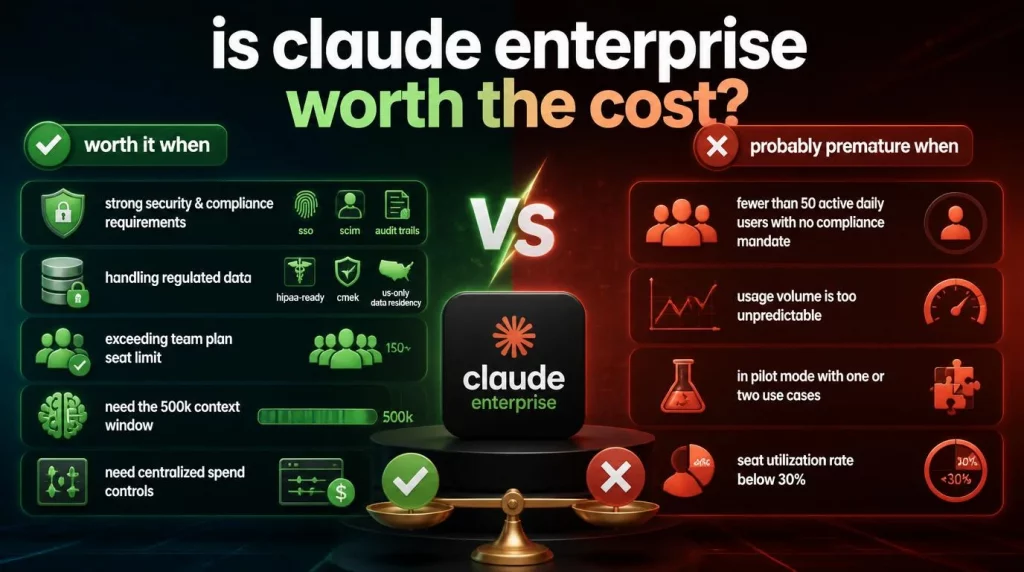
Enterprise makes clear financial sense when:
- Your security or legal team has documented requirements for SSO, SCIM, and full audit trails
- Your organization handles regulated data that requires HIPAA-readiness, CMEK, or US-only data residency
- Your user count exceeds or will exceed the 150-seat cap on Team plans
- Document workflows require the 500K context window that Enterprise provides and Team cannot
- You need centralized spend controls with hard limits at the organization and user level
Enterprise is likely premature when:
- Fewer than 50 users will actively use Claude on a daily basis and no compliance mandate exists
- Usage volume is too unpredictable and the Team plan’s bundled allowance provides a safer cost ceiling
- You are in pilot mode with one or two use cases and need flexibility before committing
- Your team’s actual seat utilization rate is below 30%, which means your real per-active-user cost is already more than three times the listed seat price
One practical check worth running before any Enterprise evaluation: if fewer than a third of your licensed seats are actively used each month, the adoption gap is your real problem. Reviewing the enterprise AI agent strategy for your deployment context is a better starting point than adding seats.
How to Negotiate a Better Claude Enterprise Price
Enterprise contracts are negotiable, and most mid-market procurement teams leave money on the table by accepting the initial quote without pushing back. These four steps reduce that risk before you sign:
- Step 1: Get a 90-day token consumption report before discussing renewal terms. If you are a current Claude Team or legacy Enterprise customer, request a usage summary from your Anthropic contact before any pricing conversation begins. Running your actual consumption numbers against current API rates tells you exactly what the new structure costs you.
- Step 2: Model three scenarios before the call, and present all three. Build out a baseline (conversational use only), a current state (existing workflow volume), and a forward-looking scenario (assume you automate five more processes over the next 12 months). The gap between the baseline and the forward scenario is usually where expensive surprises live at renewal.
- Step 3: Request a prepaid token block at signing. Anthropic typically discounts prepaid token commitments when they are requested during initial contracting. After the contract is signed, adding a prepaid block at a discount is significantly harder. This is the highest-ROI negotiating move available in an Enterprise agreement.
- Step 4: Confirm the compliance trigger before upgrading from Team. If someone on your team recommended Enterprise because the organization is growing, ask IT or legal to produce a written requirement before you proceed. Moving from Team Premium at $125/seat with bundled tokens to Enterprise at $20/seat plus full API rates can cost more in total for moderate-usage teams.
Conclusion
Claude enterprise pricing in 2026 follows a straightforward two-part structure: a $20/seat/month access fee paid annually, plus a variable token bill at standard API rates that reflects exactly how your team uses Claude. For organizations running primarily conversational workloads, total spend stays close to the headline number. For teams deploying automated workflows at scale, however, token costs typically become the dominant line item within six to twelve months of rollout, so modeling that consumption before signing is the most important step in any Enterprise evaluation.
If your organization is assessing Claude as part of a broader enterprise AI agent strategy that also requires multi-model flexibility, on-premise deployment, or dedicated engineering support, AI Hive is worth including in your shortlist. The platform supports Claude alongside 10+ other models and routes each workflow to the most cost-efficient option automatically, which typically reduces total LLM spend by 35-60% compared to single-provider deployments. Explore the AI workflow automation features available on the platform, or contact the AI Hive engineering team to map that to your specific deployment scenario.