

Gartner projects that over 40% of agentic AI projects will be canceled before 2027, and the cause is rarely the technology itself. Most failures trace back to one gap: nobody built a credible AI agent ROI model before the budget was approved. This article gives you the formula, the cost categories most teams miss, and the named case data your CFO will actually accept. By the end, you will know exactly how to calculate a defensible ROI, anticipate every cost your finance team will ask about, and walk into a board presentation with numbers that hold up under scrutiny.
Key Takeaways
|
What Is AI Agent ROI?
AI agent ROI is the financial return an organization gets from deploying enterprise AI agent use cases, measured against the full cost of building, running, and governing that agent over its lifetime. The definition sounds simple, but it diverges from traditional software ROI in one critical way: an AI agent carries two cost layers that legacy tools never had.
The first layer is ongoing model inference cost, which accumulates with every query the agent processes. The second layer is human oversight of probabilistic outputs, because unlike a deterministic rule-based system, an AI agent makes a judgment call on every interaction. Someone still has to review edge cases, retrain the model when its accuracy drifts, and govern what the agent is and is not allowed to decide autonomously. Leaving that second layer out of your cost model is the single most common reason year-one actuals come in over budget.
Why Most AI Agent ROI Models Are Wrong?
The gap between projected and actual ROI is not a rounding error. Deloitte’s 2025 State of Generative AI research found that only 35% of organizations were even tracking ROI in a way that could prove or disprove their original business case. You cannot defend a number to a CFO if you never measured it in the first place.
Three specific mistakes show up again and again in the models we have reviewed across industries:
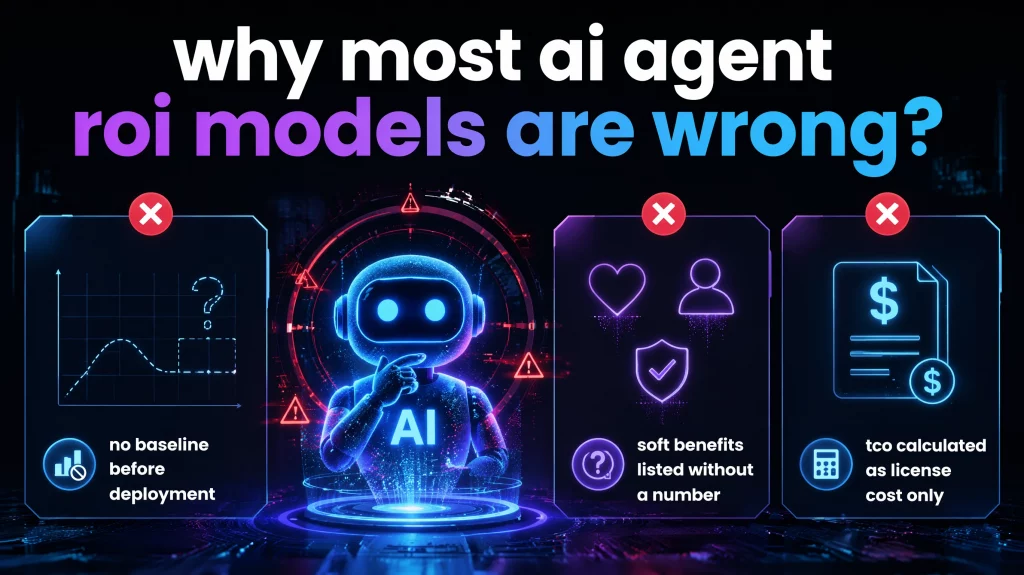
- No baseline before deployment: teams end up measuring the AI agent’s performance against a guess rather than against the documented cost, cycle time, and error rate of the process it replaced. Without a baseline, any improvement number you report is unverifiable.
- Soft benefits listed without a number: “Improves customer experience” is not a line item. A CFO needs a dollar figure or a leading indicator tied directly to a metric they already track, such as CSAT, churn rate, or revenue per customer.
- TCO calculated as license cost only: integration work, data cleanup, monitoring infrastructure, and the human-in-the-loop review queue rarely make it into the spreadsheet, which is exactly why year-one actuals consistently come in over the approved budget.
Address these three issues and your model will survive contact with finance. The next section provides the formula and the steps that force each of them to be resolved.
How to Calculate AI Agent ROI
You need three numbers working together, because a single ROI percentage without payback and NPV tells a CFO almost nothing about financial risk or investment timing.
1. The core formula
| AI Agent ROI (%) = [(Annual Benefits − Total Cost of Ownership) / Total Cost of Ownership] × 100 |
Annual benefits include hard savings, freed capacity valued at a realistic utilization rate, and any direct revenue lift. TCO includes every cost in the Hidden Costs section below, not just the platform subscription fee.
2. Payback period
| Payback (months) = One-time implementation cost / Monthly net benefit |
3. Net present value for multi-year cases
NPV = Σ [Net benefit in period t / (1 + discount rate)^t] − One-time cost
| AI Agent ROI (%) = [(Annual Benefits − Total Cost of Ownership) / Total Cost of Ownership] × 100 Payback (months) = One-time implementation cost / Monthly net benefit |
Forrester’s Total Economic Impact studies typically apply an 8 to 16% discount rate, with 10% as a common default. If your finance team has already set a company-wide cost of capital, use that number instead.
Run the calculation three times using conservative, base, and aggressive assumptions. Present the conservative scenario first. CFOs trust a model that acknowledges its own downside case far more than one that only shows the best possible outcome.
The Hidden Costs Nobody Includes in Agent ROI
A Gartner survey of 506 CIOs published in October 2025 found that 72% of organizations were either breaking even or losing money on their AI investments. The most common root cause is a TCO that was calculated before the project started and left out entire cost categories that only become visible once the agent is actually running.
Five categories consistently get omitted from the initial business case, and each one is large enough to materially change the outcome:
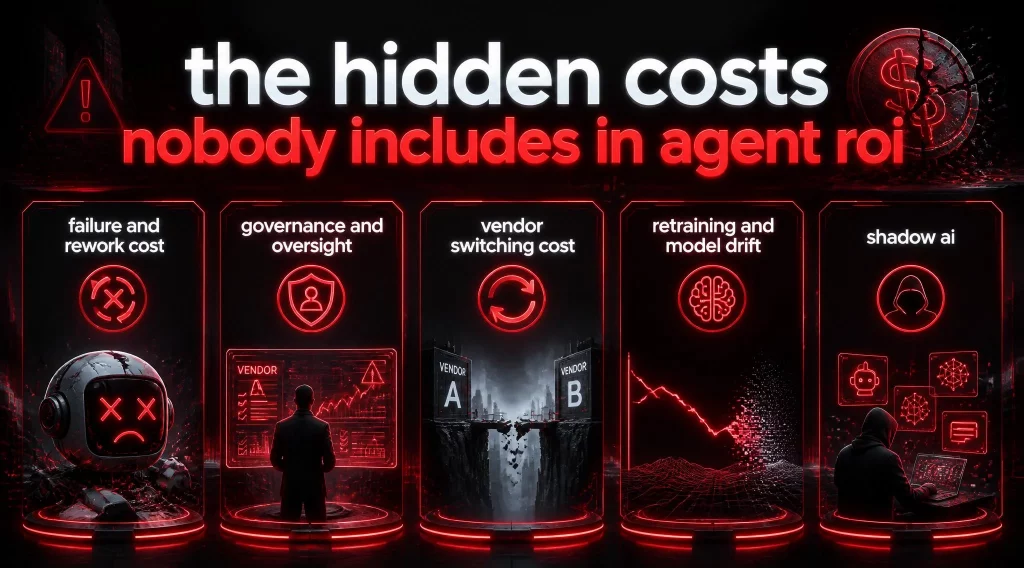
- Failure and rework cost: When the agent gets something wrong, a human has to catch it, correct it, and sometimes communicate the error to the customer. That review loop carries a real, ongoing headcount cost that does not disappear after go-live.
- Governance and oversight: Role-based access controls, audit trails, and compliance review are not optional for an agent that touches customer data or financial decisions. Treating them as optional is a compliance risk, not a cost saving.
- Vendor switching cost: Agent workflows built around one model provider’s prompt structure rarely port cleanly to another provider. Locking yourself into a single vendor early creates a switching cost you will pay later if the commercial terms change.
- Retraining and model drift: Performance degrades as your underlying data and business processes evolve over time. Budgeting for periodic retraining from the start is far less disruptive than discovering mid-year that accuracy has slipped.
- Shadow AI: When the sanctioned agent is too slow or too limited, employees adopt unapproved consumer tools, which creates a parallel, unbudgeted system to manage and a data governance risk to resolve.
Building all five into your TCO from the start is what separates a projection that holds through year one from one that triggers an unplanned budget review. Vendor estimates suggest that under-scoped models typically produce a 40 to 60% cost overrun relative to the original business case, a gap large enough to turn an approved initiative into a credibility problem for whoever signed off on it.
Real-World AI Agent ROI Case Studies
The strongest evidence you can put in front of a CFO is a named, public case that can be independently verified. We’ve compiled some common enterprise AI deployment case studies from multiple industries; the four examples below represent the highest standard of public, attributable data available.
Customer service: Klarna
In its first month of deployment, Klarna’s AI assistant handled 2.3 million conversations, covering two-thirds of all customer chats and doing work equivalent to roughly 700 full-time agents. Resolution time dropped from 11 minutes to under 2, and repeat inquiries fell by 25%.

The part of this story that matters most for your own business case is what happened next. In May 2025, Klarna publicly walked the deployment back, reintroducing human agents for complex and emotionally sensitive cases after concluding it had automated too far. The “700 agents” figure largely reflected hiring avoided rather than roles eliminated. When you cite this case study in a board presentation, include the full arc rather than just the launch numbers. A case study that acknowledges its own limits holds up under scrutiny far better than one that collapses the moment someone googles it.
Document processing: JPMorgan and Google Cloud
JPMorgan’s COiN platform reviews roughly 12,000 commercial credit agreements in seconds, a task that previously consumed an estimated 360,000 lawyer-hours a year, while simultaneously cutting loan-servicing errors by approximately 80%. The scale of that labor reduction is what makes it a compelling reference for AI agents for banking and financial services document-processing use cases specifically.
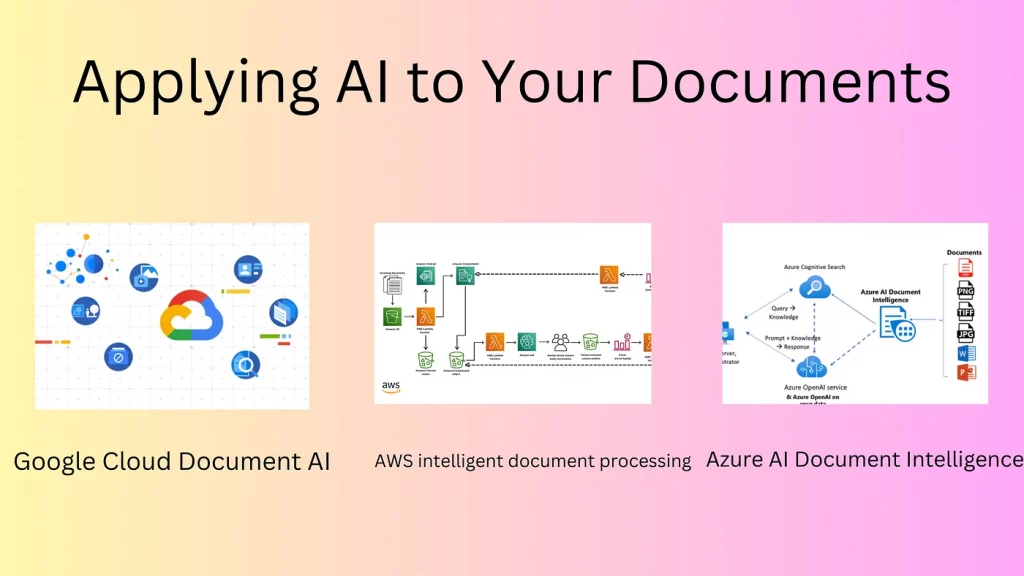
On a smaller scale, biotech firm FibroGen used Google Cloud’s Document AI to automate roughly 1,000 invoices per month at a run cost of about $150 monthly, generating an estimated 40x return and freeing up around a quarter of its accounts payable team’s time. Google Cloud presents this figure as an estimate rather than an audited result, which is exactly the level of epistemic honesty you should apply to your own projections when presenting them to finance.
Insurance: Allianz
Allianz’s agentic claims system, Project Nemo, cut processing and settlement time by 80% for a defined category of home-contents claims, compressing a multi-day workflow into hours. The scope is deliberately narrow by design, covering only low-complexity claims under a fixed dollar threshold. That narrow scope is precisely why the result is credible: Allianz is not claiming an 80% improvement across its entire claims operation, but rather reporting a verified outcome within a well-defined boundary.
Analyst-verified composites: Forrester
Forrester’s Total Economic Impact studies are analyst-constructed composites built from interviews with real paying customers rather than from vendor-supplied figures. Conversational AI vendor boost.ai’s composite showed a 293% three-year ROI with payback inside 12 months. AIOps platform LogicMonitor’s Edwin AI composite showed a 313% ROI with payback inside 6 months. These numbers carry more weight in a board presentation precisely because Forrester, not the vendor, built the model.
ROI Comparison: AI Agents vs Traditional Automation
CFOs who have already funded RPA projects will ask how an AI agent’s ROI profile compares. The honest answer is that traditional automation tends to produce faster, flatter returns, while AI agents produce slower but potentially compounding ones, at a higher ongoing cost to manage.
|
Dimension |
Traditional Automation (RPA) |
AI Agents |
|
Best fit |
Structured, rule-based, repetitive tasks |
Unstructured input, multi-step reasoning, judgment calls |
|
Time to first ROI |
Fast, often under 3 months |
Slower, typically 6 to 12 months |
|
Ongoing cost |
Low after initial setup |
Recurring compute, monitoring, and human review |
|
Return shape |
Flat once deployed |
Can improve over time as the agent and data mature |
|
Failure mode |
Breaks visibly when inputs change |
Degrades quietly through model drift if left unmonitored |
Neither option is universally better. A high-volume, perfectly structured process such as data entry from a fixed-format form is still cheaper and faster to automate with RPA. An AI agent justifies its higher TCO on processes where judgment, natural language, or unstructured data make rule-based automation impractical or impossible. You can explore the full range of AI agent platform capabilities to identify which deployment model fits your specific workflow.
Should You Measure ROI in Headcount Savings or Revenue Uplift?
This question divides most internal ROI debates, and the right answer depends on which function is actually funding the agent deployment.
|
If your team is a… |
Lead with this metric |
Why it works |
|
Cost center (support, IT, back office) |
Headcount and cost-per-transaction savings |
Finance already has a documented baseline cost, which makes the comparison straightforward to verify |
|
Revenue function (sales, marketing, CX) |
Conversion lift, deal velocity, or retention rate |
Headcount framing undersells the case when the real value is top-line growth, not cost avoidance |
|
Regulated function (claims, compliance, KYC) |
Cycle time and error-rate reduction |
Speed and accuracy improvements reduce both operating cost and regulatory exposure at the same time |
If you genuinely cannot determine which category your use case belongs to, the safest approach is to report both. Use headcount or cost-per-transaction as your primary, audit-ready number, and track revenue or retention as a secondary indicator that you formalize once you have two or three quarters of actual data behind it.
What a CFO Wants to See Before Approving AI Agents
A CFO is not primarily evaluating your technology choice. What they are evaluating is whether your investment case would survive a downturn, an audit, and a pointed question from the board. Whether you’re deploying narrow task automation or broader enterprise AI agent solutions, five elements determine whether your proposal gets approved on the first submission.
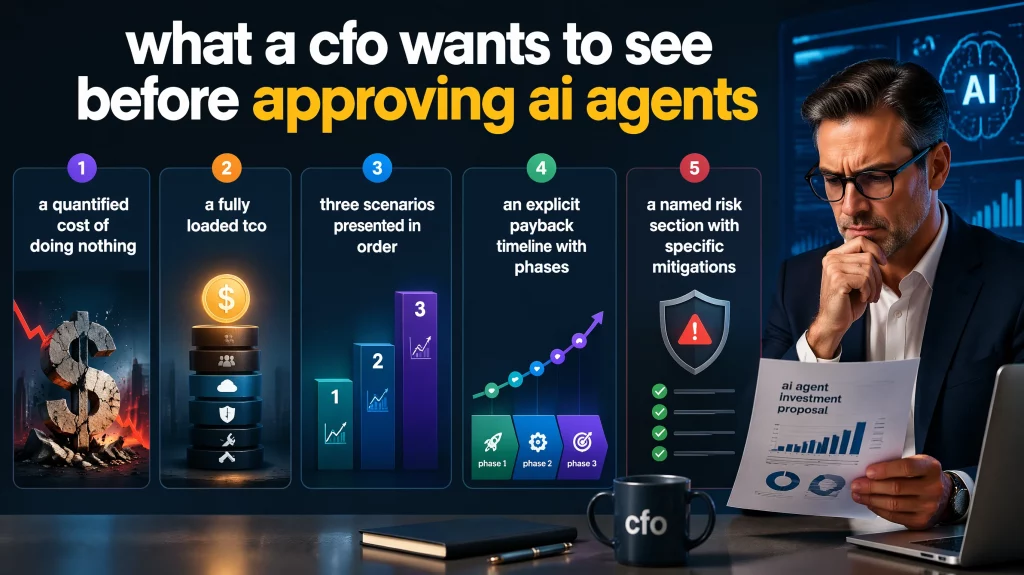
- A quantified cost of doing nothing: your proposal should open with what the current process costs today, including the cost of errors, rework, and delay, not just a statement that you want to explore AI. Framing the status quo as a financial risk rather than a neutral baseline shifts the conversation from “should we spend money” to “can we afford not to.”
- A fully loaded TCO: include every category from the Hidden Costs section above. A CFO who independently discovers a missing line item in your model will not trust the rest of your numbers, and recovering that credibility is harder than including the cost upfront.
- Three scenarios presented in order: lead with the conservative case, then the base case, then the optimistic one. Presenting the downside first signals analytical rigor rather than salesmanship, and it protects you if year one comes in below the base projection.
- An explicit payback timeline with phases: many finance teams use 12 months as an informal approval cutoff. If your case runs longer, structure it as a phased investment where the first use case funds itself and creates the evidence base for the next one.
- A named risk section with specific mitigations: adoption risk, integration risk, data-quality risk, and vendor risk each need a concrete mitigation plan, not a vague assurance that the team will monitor the situation closely.
One more thing worth stating directly: set timeline expectations honestly. Deloitte’s research on enterprise AI ROI found that satisfactory returns on a typical AI use case take 2 to 4 years in practice, well past the 7 to 12 months most executives initially expect. Telling your CFO this upfront is a credibility investment. Discovering it together 18 months into the project is not.
Common Challenges and How to Overcome Them
In most cases, AI agent ROI programs do not fail because the agent itself underperforms. They fail because the team responsible for measuring results skipped a foundational step earlier in the process.
|
Challenge |
Why it happens |
How to fix it |
|
No performance baseline exists |
The team deployed before documenting the current state of cost, cycle time, or error rate |
Measure the existing process for 2 to 4 weeks before go-live, even informally, so you have a reference point to compare against |
|
TCO is understated at approval |
Only the platform license cost was counted; hidden operational costs were excluded |
Work through all five hidden cost categories from the section above before submitting the final TCO to finance |
|
Soft benefits are dropped from the case |
No one agreed on how to assign a dollar value to them |
Tie each soft benefit to a leading indicator such as CSAT, NPS, or retention rate that your team already tracks in an existing report |
|
Adoption stalls after launch |
Employees route around a tool they find slow or unreliable |
Run a 60 to 90 day pilot with a defined performance threshold and a clear kill criterion before committing to a full rollout |
Conclusion
A credible AI agent ROI case comes down to three things: an honest formula applied before budget approval, a TCO that accounts for every cost your finance team will eventually find anyway, and proof points that a skeptical CFO can verify without taking your word for it. The organizations that are actually capturing measurable value from AI, roughly 6% of those McKinsey identifies as high performers generating real EBIT impact, are the ones that built the discipline to measure first and deploy second.
AI Hive helps enterprises move from AI pilot to production in weeks, with built-in ROI tracking, fully loaded TCO visibility, and senior engineers embedded inside your delivery cycle from day one. If you’re building a board-level business case for AI agent deployment, talk to the AI Hive team and we’ll review your use case, cost model, and automation workflow together.