

Numerous multi-agent projects don’t fail because of weak models. They fail because of orchestration, and a UC Berkeley analysis of 1,600+ production failure traces confirms it: 79% of multi-agent failures trace back to coordination problems, not model capability. This article puts LangGraph, CrewAI, Microsoft Agent Framework, IBM watsonx, and AI Hive head-to-head on state management, token cost, failure modes, and deployment flexibility, so you stop guessing which platform survives production and start shipping agents before your competitors do.
Key Takeaways
|
What Is an AI Agent Orchestration Platform?
An AI agent orchestration platform is a coordination layer that manages how multiple AI agents communicate, share state, route tasks, and recover from failures across a multi-step workflow.
Think of it as the control plane sitting above individual agents. One agent handles document retrieval, another runs policy checks, a third drafts responses. The orchestration layer ensures they operate in the right sequence, with the right context, without stepping on each other. Without it, multi-agent systems turn into coordination nightmares: agents lose context mid-task, duplicate actions, and produce inconsistent outputs that compound downstream. As Forrester’s State of Agentic AI 2026 notes, scaling multi-agent systems fails on task complexity – not agent count – and most teams aren’t managing that complexity at all.
Orchestration covers four core functions:
- Task routing: deciding which agent handles each step based on capability, load, and priority
- State management: maintaining context, memory, and workflow progress across agents and sessions
- Inter-agent communication: structured handoffs, shared memory access, and conflict resolution
- Failure recovery: retry logic, fallback paths, and human-in-the-loop (HITL) checkpoints
This is distinct from ML pipeline tools like Airflow or Dagster, which orchestrate data and model training. Agent orchestration handles runtime reasoning, tool calling, and autonomous decision-making. Before evaluating specific platforms, the most important call is choosing your deployment tier.
Framework vs. Managed Platform: Why the Distinction Matters
The market splits into three categories, and conflating them is the single biggest source of evaluation mistakes.
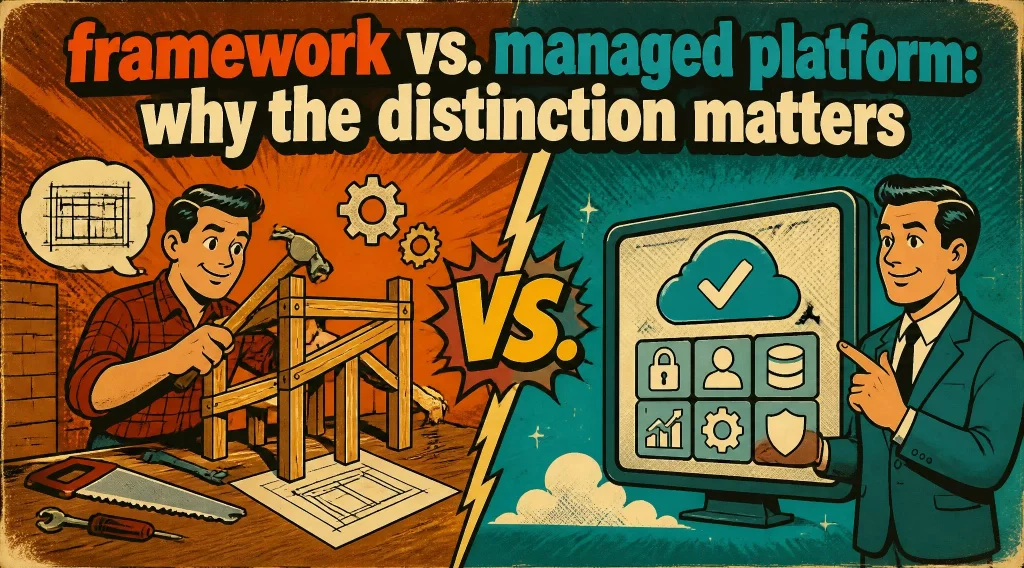
| Tier | Examples | What you own | Best for |
| Open-source frameworks | LangGraph, CrewAI, OpenAI Agents SDK, Claude Agent SDK | Orchestration logic, infra, observability, governance | Engineering teams with ML experience wanting full control |
| Enterprise managed platforms | IBM watsonx Orchestrate, Microsoft Agent Framework (cloud), UiPath | Infrastructure abstracted; you configure, not build | Large orgs needing governance, compliance, 700+ integrations |
| Full-stack orchestration platforms | AI Hive | Platform + on-premise/cloud deployment + Engineers for Hire | Mid-market to enterprise teams without internal AI engineering bench |
Open-source frameworks are libraries. They hand you primitives and stay out of the way. You’re responsible for production-grade observability, retry logic, state persistence, and governance. For teams that have shipped LLM features before, that overhead is manageable. For teams that haven’t, it’s a six-month detour before you touch business logic.
Managed platforms abstract that infrastructure but typically require long procurement cycles, vendor lock-in trade-offs, and pricing that starts at $300K+/year for the incumbents.
The third tier – AI Hive’s enterprise AI agent platform – combines a production-grade platform with embedded engineers and a 500+ agent marketplace, targeting the gap where neither pure frameworks nor heavyweight platforms fit cleanly. It’s also the only tier built to satisfy Vietnam’s AI Law 134/2025/QH15 requirements out of the box.
How AI Agent Orchestration Works: Patterns, State, and Handoffs
Three orchestration patterns dominate production deployments in 2026. Each fits a different problem shape.
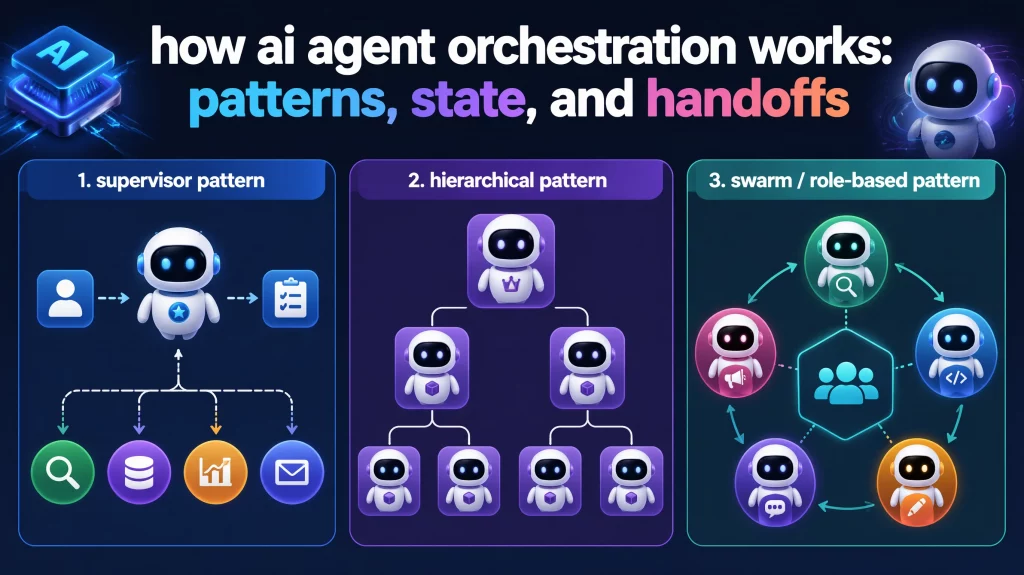
1. Supervisor Pattern
A central controller agent receives the task, decomposes it, and delegates sub-tasks to specialized agents. The supervisor collects outputs, validates them, and decides next steps. This pattern works well for workflows requiring strict oversight – compliance checks, document review pipelines, or any flow where a human-in-the-loop checkpoint sits at a defined decision point.
2. Hierarchical Pattern
Agents are organized in layers: a top-level planner routes to domain-specific orchestrators, which manage their own sub-agents. Supply chain management, multi-department approval workflows, and large-scale customer operations use this structure because it scales horizontally without collapsing into single-point bottlenecks.
3. Swarm / Role-Based Pattern
Agents operate as peers, each with a defined role – researcher, writer, reviewer. There’s no single controller; agents pass outputs to each other through defined handoffs. CrewAI implements this natively. It’s the fastest pattern to prototype and the first to break down under complex conditional branching or stateful retries.
State management is where most production systems get into trouble. Short-term memory holds active session context. Long-term memory persists user profiles and historical patterns across sessions. Episodic memory enables semantic retrieval of past interactions. In-memory platforms like Redis deliver sub-millisecond access for hot state – which matters when agents are making tool calls in sequence and latency compounds across steps.
LangGraph implements checkpointing natively, meaning a workflow can be paused, inspected, and resumed from any node. That single feature makes it the default for regulated industries.
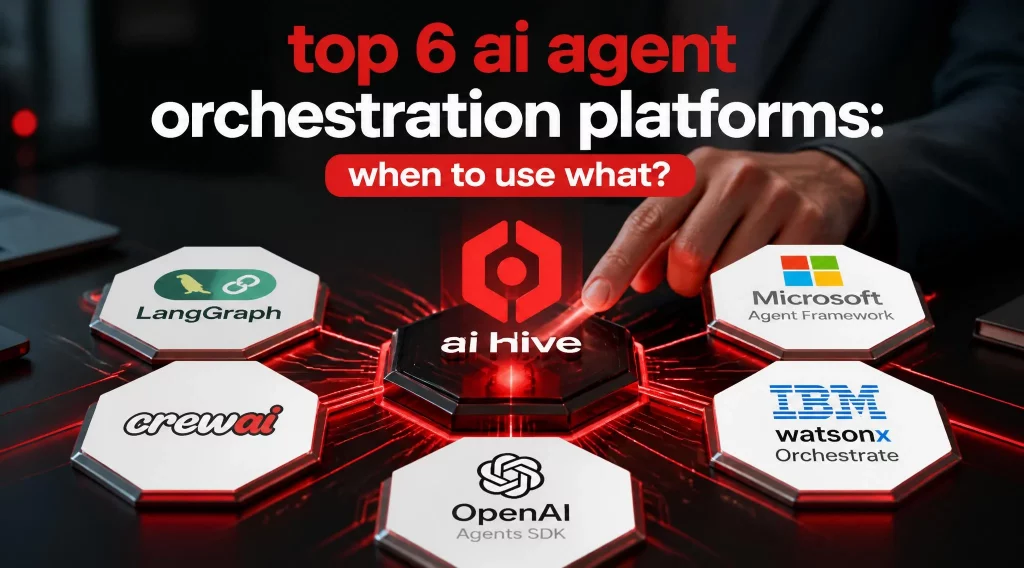
Top 6 AI Agent Orchestration Platforms: When to use What?
The table below consolidates findings from independent benchmarks – 2,000 runs across five frameworks (MHTECHIN/Uvik, 2026) – and production deployment reports from 18+ client engagements (Alice Labs, 2026).
| Platform | Type | Orchestration model | State persistence | Token efficiency | Learning curve | Best for |
| LangGraph | Open-source framework | Graph/state machine | Built-in checkpointing, time-travel debugging | Best (baseline) | Steep (80-150 LoC) | Stateful production workflows, regulated industries, HITL-heavy systems |
| CrewAI | Open-source framework | Role-based crews | Per-agent short-term memory; external backends supported | 3x higher token use on simple tasks | Low (30-60 LoC) | Fast prototyping, role-decomposable tasks, stakeholder demos |
| Microsoft Agent Framework (MAF) | Enterprise SDK | Graph-based (AutoGen + Semantic Kernel unified, GA April 2026) | Azure-native; event-driven persistence | Comparable to LangGraph | Medium | .NET/Azure-native teams; AutoGen migration path |
| IBM watsonx Orchestrate | Enterprise platform | Multi-domain, policy-enforced | Enterprise-grade, AI Factsheets for auditability | Vendor-managed | Sales-led, no self-serve | Financial services, healthcare, government; 700+ system integrations |
| OpenAI Agents SDK | Vendor SDK | Handoff-based, tool-use chain | Ephemeral by default; context variables | OpenAI-native pricing | Low | GPT-centric agents; single-vendor stacks |
| AI Hive | Full-stack platform | Multi-agent + RAG engine + Visual Studio | On-premise, private cloud, or SaaS – switchable | 35-60% cost reduction via model routing | Low (no-code Studio + optional embedded engineers) | Mid-market to enterprise; model-agnostic; APAC/Vietnam AI law compliance |
Platform recommendations by use case:
- Stateful workflows in regulated industries: LangGraph is the strongest choice here. Its graph-based state machines emit traces at every node transition – a non-negotiable requirement in banking, healthcare, and insurance. In Alice Labs’s 18+ production deployments, it consistently outperformed other frameworks for KYC pipelines and document review workflows that require full audit trails.
- Rapid prototyping and stakeholder demos: CrewAI gets a working multi-agent crew running in 30-60 lines of code – faster than anything else on this list. The role-based abstraction is readable enough for non-engineers to review. The trade-off: up to 3x the token overhead of LangGraph on simple tasks, and a well-known migration path to LangGraph once workflows need fine-grained branching or stateful retries.
- .NET or Azure-native enterprise stacks: Microsoft Agent Framework (MAF) reached general availability in April 2026, unifying AutoGen and Semantic Kernel into one SDK. For teams already inside the Microsoft ecosystem, this is the lowest-friction path – Azure-native persistence, event-driven architecture, and a clear migration route for existing AutoGen v0.2 codebases.
- Governance-first regulated deployments with 700+ integrations: IBM watsonx Orchestrate is the right call for enterprises that need policy enforcement, AI Factsheets for model risk management, and out-of-the-box connectors to SAP, Salesforce, and ServiceNow. It’s also the most expensive option on this list – budget for a procurement cycle and implementation partner on top of platform cost.
- Mid-market enterprises without an internal ML engineering bench: AI Hive’s combination of platform, embedded engineers, and 500+ pre-built agent templates compresses deployment from 6-18 months to 4 weeks. Client evidence from banking and insurance AI agent deployments shows first agents in production after 4 weeks – with 78% reduction in KYC processing time and zero data leaving the bank’s infrastructure. It’s the only option here that ships the engineering capacity alongside the software.
>>> Bonus – On token efficiency: An independent benchmark across 2,000 runs found CrewAI consuming up to 3x the tokens of LangGraph on simple single-tool-call workflows. At production scale, that overhead is a real budget line. AI Hive’s model-agnostic routing assigns Llama 3 or Mistral to low-stakes tasks and reserves GPT-4o or Claude for reasoning-heavy steps – client deployments show 35-60% LLM cost reductions compared to single-model approaches.
How to Choose the Right AI Agent Orchestration Platform
The framework debate is mostly a distraction. The gap between a working production system and a failed one is almost never the framework – it’s the eval pipeline, the observability setup, and the failure recovery logic. Use these criteria to narrow your shortlist before you touch a line of code.
- Start with your dominant constraint: Need explicit control over branching, retries, and audit? Go LangGraph. Need a demo in two days? Go CrewAI. Already on Azure? Go MAF. Constraint-first selection saves weeks of framework benchmarking.
- Check observability before committing: If your deployment is customer-facing or regulated, your framework choice is driven by observability first. LangGraph emits traces at every node transition. Most high-abstraction frameworks don’t. A black-box framework in a regulated environment is a compliance risk, not just a debugging inconvenience.
- Map your team’s engineering capacity honestly: Open-source frameworks are free to license; they’re not free to operate. A team without prior LLM-in-production experience should budget 8-16 weeks of engineering overhead before the framework itself delivers business value. If that timeline is unacceptable, a managed platform or full-stack provider is the right trade-off.
- Validate your deployment model early: On-premise requirement? That eliminates most cloud-only SaaS options. Vietnam or APAC data residency? Luật AI 134/2025/QH15 mandates data sovereignty controls that rule out vendors without on-premise Kubernetes deployment. Confirm deployment constraints before evaluating features.
- Pilot before you platform-commit: Run a scoped pilot – one workflow, one team, four weeks – before signing an enterprise contract. The frameworks that look best on paper often have hidden operational costs that only surface under real traffic. A working pilot with real data is worth more than any vendor benchmark.
- Plan your migration path from day one: Teams that start with CrewAI for prototyping regularly migrate to LangGraph when workflows need production-grade state management. Build that migration into your timeline from the start, not as an afterthought when you hit the ceiling.
Overall, AI Hive’s pricing starts at $29/month for the SaaS platform – with the option to add embedded engineers at APAC cost efficiency rather than IBM’s $350/hour consulting rate. For a deeper look at structuring your first enterprise AI agent project, see our implementation guide covering use case selection, scoping, and go-live timelines.
What Production Deployments Reveal About Orchestration Failures?
Here’s something vendor comparison articles won’t tell you: most orchestration failures aren’t caused by picking the wrong framework. They’re caused by assuming that what worked in the demo will hold up under real traffic, ambiguous inputs, and operational pressure.
A UC Berkeley study analyzing 1,600+ failure traces across seven multi-agent frameworks found that the majority of failures were coordination and specification problems – not model capability, not infrastructure. The researchers published this as the Multi-Agent Systems Failure Taxonomy (MAST), identifying 14 distinct failure modes across three categories. What follows are the four patterns engineering teams encounter most in production – and the lessons that come with them.
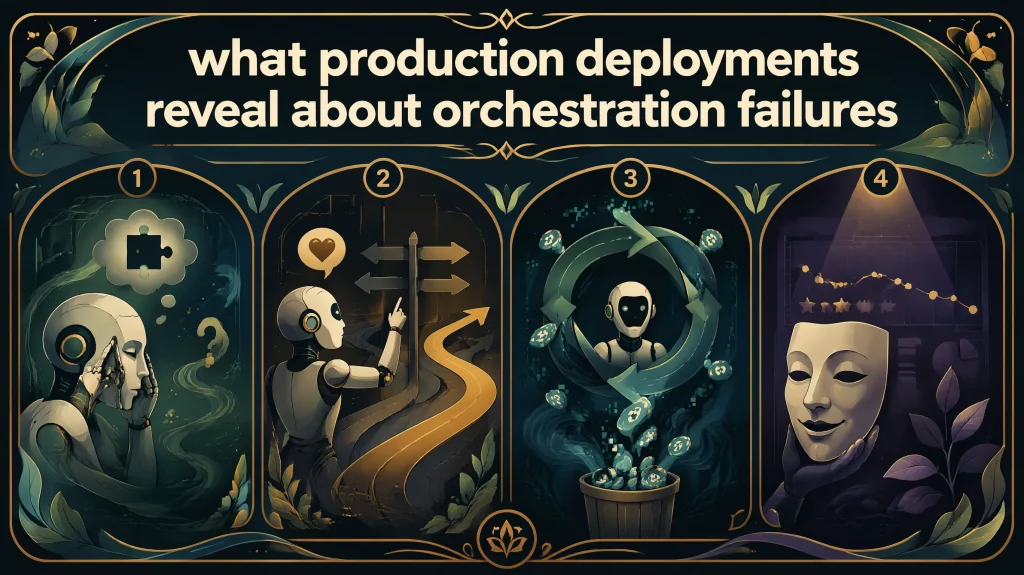
1. Context Reset: The Agent That Forgets What It Was Doing
The scenario: an agent is 80% through a complex document review workflow when it suddenly restarts from step one. No error is thrown. The run just begins again. This is Context Reset (FM-2.1) – and it happens when context windows overflow without graceful degradation logic in place.
What teams learn: native checkpointing is not optional for long-running workflows. LangGraph’s time-travel checkpointing lets you pause, inspect, and resume from any node state. Frameworks without persistence require custom solutions that typically take two to three weeks to build correctly – and often get deprioritized until the first production incident.
Takeaway: if your workflow exceeds five steps or touches external APIs, build checkpointing into your architecture from day one, not as a fix after the first context reset hits production.
2. Task Derailment: When the Agent Decides to Be Helpful in the Wrong Direction
The scenario: a customer service agent is asked to check an order status. Three turns later, it’s recommending product upgrades the customer never asked about. No one changed the prompt. The business context just silently drifted.
Task Derailment (FM-2.3) compounds when agents share context across long-running sessions. The original objective gets diluted by accumulated conversation history, and the agent starts optimizing for what seems helpful rather than what was actually requested.
Takeaway: scope injection – explicitly re-stating the task objective at defined intervals in the orchestration loop – is more reliable than relying on the agent to remember its original mandate. Build it in as a governance checkpoint, not a prompt engineering afterthought.
3. Retry Loops: The Silent Token Burner
The scenario: a tool call returns an ambiguous error. The agent retries. Then retries again. And again. The workflow appears to be running, the logs show activity, but nothing is being produced. By the time someone checks, the LLM cost for that session is ten times the expected amount.
A benchmark study found that 68% of deployed systems use blunt step limits as a proxy for semantic loop detection because no actual loop-detection infrastructure exists. That’s not a framework problem – it’s an architecture problem.
Takeaway: exponential backoff with jitter handles transient failures. Loop detection – flagging when the same action repeats three or more times without measurable progress – handles the rest. Both need to be designed into the orchestration layer before go-live, not patched in after the first runaway cost spike.
4. Silent Quality Degradation: The Failure No One Sees Coming
The scenario: the agent is working. Outputs look correct. No errors fire. Three months later, someone notices the accuracy has drifted below acceptable threshold – and realizes it’s been degrading for weeks.
Silent quality degradation happens from document store drift (new documents confusing retrieval), prompt regression after a version update, or silent model updates from the LLM provider. It’s the most dangerous failure mode precisely because nothing breaks. The system keeps running.
Takeaway: observability that monitors output quality – not just uptime and error rates – is the only reliable detection method. Proactive failure clustering that surfaces patterns across sessions (“accuracy below threshold – 23 occurrences – customer service cluster”) beats reviewing individual logs by an order of magnitude.
The common thread across all four failure modes: they’re governance problems, not engineering problems. The platform layer needs to catch them before they reach production. AI Hive’s orchestration engine includes built-in monitoring and governance layers, which is why regulated financial services teams use it for KYC and AML workflows where silent failures and audit gaps are regulatory violations, not just operational inconveniences.
When You Don’t Need an Orchestration Platform
This is worth saying directly, because most vendor content skips it.
If your workflow is a linear DAG with 1-2 tool calls, no branching, no parallel agent tracks, and no stateful retries – you don’t need an orchestration framework. The OpenAI Agents SDK or Claude Agent SDK handles this with less overhead and a shallower learning curve. Most projects that arrive labeled ‘we need multi-agent orchestration’ are actually deterministic chains in disguise.
Reach for a full orchestration platform when your workflow genuinely requires:
- Iterative reasoning loops where the agent decides next steps based on intermediate outputs
- Parallel agent tracks that must be coordinated and merged
- Human-in-the-loop checkpoints at defined stages
- State that must persist across sessions (not just within one conversation)
- Compliance audit trails for every decision point
If you’re still scoping what your first agent should do, our guide on how to build your first enterprise AI agent walks through use case selection, scope definition, and feasibility validation before you commit to an orchestration stack.
Conclusion
Choosing an AI agent orchestration platform in 2026 is a production architecture decision, not a tooling preference. LangGraph is the right default for stateful, auditable, branching workflows in regulated environments. CrewAI gets you to a working prototype faster than anything else on this list – plan the migration to LangGraph before you hit the ceiling in production, not after. Microsoft Agent Framework is the natural choice if your stack is .NET and Azure. IBM watsonx Orchestrate serves regulated enterprises that need 700+ integrations and governance first.
For mid-market and enterprise teams without a deep ML engineering bench, AI Hive combines the platform, the deployment flexibility, and the engineering capacity in a single relationship – with a first production agent in 4 weeks rather than 6-18 months. If you’re evaluating orchestration architecture for an enterprise deployment, our team can scope your use case, constraints, and stack in a 30-minute call. Book an Orchestration Architecture review and a solutions engineer responds within one business day.