

Moving away from Kore.ai often feels straightforward until the shortlist stage, where every vendor promises flexibility, lower cost, and faster deployment. However, the reality is that most Kore.ai alternative comparisons rely on marketing decks rather than actual pricing, real integration timelines, or how much control your team retains after go-live. Therefore, evaluating alternatives without a structured framework almost always leads to another lock-in cycle within 18 to 24 months. Accordingly, this article compares AI Hive against Cognigy, Synthflow, Retell AI, and Intercom Fin based on documented pricing, deployment flexibility, and real user reviews so you can select the right Kore.ai alternative with confidence.
Key Takeaways
|
What Is Kore.ai and Why Teams Are Leaving It
Kore.ai is an enterprise conversational AI platform that lets businesses build chatbots and voice assistants across more than 30 channels from one configuration. The platform works well for large, well-resourced IT teams. For everyone else, it tends to create friction faster than it removes it.
Independent reviews point to three pain points that show up again and again, often before a vendor even finishes onboarding a new account. The list below breaks each one down with the source behind it.
- Untransparent pricing: Entry-level plans start around $50 to $150 a month, but most enterprise contracts land at $300,000 or more per year once your team adds seats, channels, and support tiers (Retell AI, 2026).
- Slow implementation: Kore.ai’s architecture supports pro-code extensions and multi-stage release pipelines, and that combination typically requires a dedicated engineering team just to get the platform live (Webfuse, 2026).
- Higher voice latency: Voice latency sits at 800 to 1000 milliseconds in typical deployments, a noticeable gap compared with voice-first platforms built specifically for real-time calls (Synthflow, 2026).
Beyond these three patterns, cost surprises tend to surface only after the contract is signed. One G2 reviewer, a VP of Operations at a manufacturing company, put it bluntly: their team calculated a 14-month payback period on the Kore.ai investment, and that estimate assumed internal IT time was free (G2 Review via ReviewNexa, March 2026). Bring in outside consultants for the full rollout, and the math gets worse from there.
None of this makes Kore.ai a bad platform. It simply makes it a specific kind of platform, built for Fortune 2000 teams with dedicated AI headcount and multi-year budgets. If that description doesn’t match your team, the alternatives below deserve a real look, and AI Hive’s enterprise AI agent platform guide covers the wider buying criteria that apply across every vendor on this list, not just Kore AI.
Pros and Cons of Switching to a Kore.ai Alternative
| Pros | Cons |
| Transparent, predictable pricing | Team needs retraining on new interface |
| Faster deployment (days to weeks vs. 6-18 months) | Short-term disruption during parallel run |
| No forced $300K+ annual commitment | Migration effort for complex, deeply customized flows |
| Access to newer LLMs without waiting on vendor roadmap | Some platforms trade breadth for depth (voice-first tools do less outside voice) |
Overall, cost predictability and faster deployment are the strongest reasons teams give for switching, while interface retraining is the most common friction point reported afterward.
Top 5 Kore.ai Alternatives in 2026
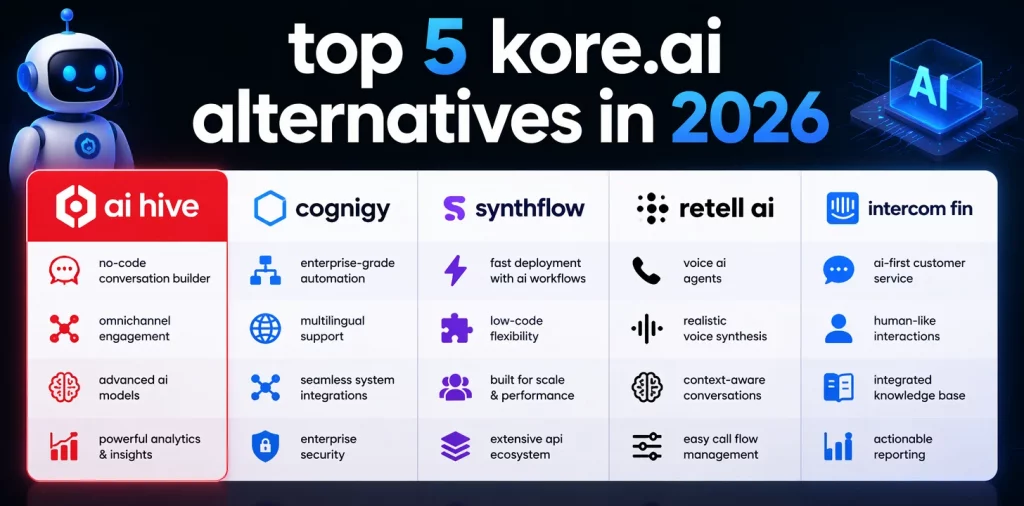
Every vendor on a shortlist claims to be the obvious upgrade, so the table below sticks to measurable factors instead of pitch decks. Here’s how the leading options stack up at a glance, before the platform-by-platform breakdown that follows.
| Platform | Best For | Deployment Model | Voice Latency | Pricing Model |
| AI Hive | Regulated enterprises needing on-premise + agent orchestration | Cloud, on-premise, hybrid | Not voice-first (chat/agent focus) | Tiered SaaS from $0 to custom |
| Cognigy | Contact centers needing low-code orchestration at scale | Cloud, on-premise, hybrid | Optimized for chat, moderate for voice | Custom quote |
| Synthflow | Fast-moving teams needing voice-first automation | Cloud (SaaS) | Under 500ms | $29 to $249/month tiers |
| Retell AI | Voice-first call automation with predictable costs | Cloud (SaaS) | Under 500ms | $0.07 to $0.08/minute |
| Intercom Fin | Existing Intercom users automating L1 support | Cloud (SaaS add-on) | Not applicable (chat only) | $0.99 per resolved conversation |
Every platform on this list gives up something to gain something else, and the sections below unpack exactly what that tradeoff looks like for each one.
1. AI Hive
AI Hive positions itself as the alternative for teams that need Kore.ai’s breadth without the enterprise price tag or the multi-month rollout.
Key Features
- Multi-agent orchestration: Coordinates several agents on one workflow instead of routing everything through a single bot.
- Model-agnostic architecture: Connects to 11 or more LLMs, including OpenAI, Gemini, Grok, DeepSeek, Kimi, and Qwen, with no vendor lock-in.
- Hybrid and on-premise deployment: Supports cloud, private VPC, and on-premise via Kubernetes or Docker on the Custom tier.
- Built-in compliance templates: Covers HIPAA, GDPR, ISO 27001, and the EU AI Act without custom engineering.
Verdict vs Kore.ai: AI Hive wins on flexibility. Kore.ai also supports on-premise deployment, but its compliance tooling is typically layered on through custom engineering rather than included out of the box.
Pricing
- Free: $0/month, 5 agents, community support only.
- Starter: $29/month, 50 agents, multi-agent orchestration up to 3 agents.
- Growth: $149/month, 100 agents, unlimited RAG, observability dashboard.
- Custom: From $2,500/month, hybrid/on-premise deployment, dedicated Forward-Deployed Engineer team.
Verdict vs Kore.ai: AI Hive wins clearly here. Kore.ai’s published entry plans start at $50 to $150 a month, but real enterprise contracts commonly land at $300,000 or more per year (Retell AI, 2026), a tier AI Hive’s Custom plan undercuts even before negotiation. Because AI Hive lets teams route tasks to whichever model performs best, cost comparisons like the ongoing Claude vs ChatGPT debate become part of the vendor-selection process instead of a fixed decision locked in at signup.
Best For
- Regulated industries such as BFSI, healthcare, and manufacturing that need on-premise or hybrid deployment.
- Teams that want to avoid being locked into a single LLM vendor.
- Organizations that need agent orchestration across departments, not just a single contact center use case.
Verdict vs Kore.ai: Both platforms target the same enterprise buyer. AI Hive edges ahead for mid-market teams that need enterprise-grade compliance without an enterprise-grade budget.
Overall, AI Hive takes a different approach here. The platform supports multi-agent orchestration and connects to 11 or more LLMs, including OpenAI, Gemini, Grok, DeepSeek, Kimi, and Qwen, so engineering teams can bring their own model, including newer releases like Claude Fable 5, without getting locked into one vendor’s roadmap.
2. Cognigy
Cognigy competes directly with Kore.ai on contact center depth, and it usually wins on ease of use rather than raw capability.
Key Features
- AI Agent Studio: A low-code visual builder that supports real-time collaboration between technical and non-technical teams.
- High concurrency: Handles up to 25,000 concurrent sessions, built for enterprise-scale traffic spikes (Webfuse, 2026).
- Omnichannel routing: Unifies voice, chat, email, and social into one orchestration layer.
Verdict vs Kore.ai: Roughly even. Kore.ai offers broader enterprise automation beyond the contact center, but Cognigy goes deeper on the specific workflows contact centers actually run day to day.
Pricing
- Custom quote based on deployment scale and channel mix.
- Positioned consistently below Kore.ai’s common $300,000 entry point, according to third-party platform comparisons (Webfuse, 2026).
- Usage-based structure that scales with conversation volume rather than a flat enterprise license.
Verdict vs Kore.ai: Cognigy wins on predictability. Neither platform publishes exact numbers, but Cognigy’s usage-based model is easier to forecast against actual call volume than Kore.ai’s bundled enterprise contracts.
Best For
- Large, multi-region contact centers already running Genesys or Amazon Connect.
- Teams that want a visual builder without giving up enterprise governance features.
Verdict vs Kore.ai: Cognigy wins for teams whose entire use case is the contact center. Kore.ai still wins if the goal extends past support into broader workplace automation.
3. Synthflow
Synthflow is built voice-first from day one, which shows in both its latency numbers and its no-code workflow.
Key Features
- Sub-500ms voice latency: Built for real-time call quality rather than adapted from a chat-first architecture.
- No-code visual builder: Lets non-technical teams launch voice agents without engineering support.
- 50+ language support with built-in voice tuning for brand consistency.
- Compliance coverage: SOC 2, HIPAA, and ISO 27001 included without upgrade barriers.
Verdict vs Kore.ai: Synthflow wins on speed. Kore.ai’s voice latency sits at 800 to 1000 milliseconds in typical deployments, noticeably slower than Synthflow’s sub-500ms benchmark (Synthflow, 2026).
Pricing
- Starter: $29/month for 5,000 minutes and 1 agent.
- Growth: $99/month for 20,000 minutes, unlimited agents.
- Scale: $249/month for 60,000 minutes.
- Custom enterprise pricing available above that.
Verdict vs Kore.ai: Synthflow wins decisively on transparency. Every tier is published upfront, while Kore.ai requires a custom quote for anything beyond its entry-level plans.
Best For
- Voice-heavy support or sales teams that need to launch fast without a dedicated engineering team.
- Businesses scaling call volume gradually and wanting pricing that scales with them.
Verdict vs Kore.ai: Synthflow wins for voice-specific use cases. Kore.ai only makes sense here if voice is one channel among several the business needs to manage from a single platform.
4. Retell AI
Retell AI takes the same voice-first bet as Synthflow, with a pricing model built around raw usage instead of tiers.
Key Features
- Sub-500ms latency with a voice-first foundation rather than a chat system adapted for calls.
- Native telephony flexibility: Connects directly to PBX, SIP, and VoIP systems, including bring-your-own-carrier setups.
- Enterprise compliance: SOC 2 Type II, HIPAA, and GDPR covered as standard.
- 30+ language support for multilingual deployments.
Verdict vs Kore.ai: Retell AI wins on real-time call quality. Kore.ai supports voice, but it was not built voice-first, and that shows in both latency and available telephony integrations.
Pricing
- $0.07 to $0.08 per minute for the voice engine, plus separate per-minute LLM costs depending on the model chosen.
- No tiered plans or seat-based licensing to negotiate.
Verdict vs Kore.ai: Retell AI wins on forecasting. Per-minute billing scales directly with usage, while Kore.ai’s per-seat and per-session model makes cost harder to predict as headcount or channels grow.
Best For
- Enterprises that need high-quality, real-time voice AI for support or sales calls specifically.
- Teams that want to avoid a large upfront contract in favor of pay-as-you-go pricing.
Verdict vs Kore.ai: Retell AI wins for pure voice automation. Kore.ai remains the stronger choice only if voice is a minor piece of a much larger, multichannel deployment.
5. Intercom Fin
Fin is less a Kore.ai alternative and more a shortcut for teams that already have the underlying infrastructure in place.
Key Features
- Feature toggle, not a migration: Works inside an existing Intercom subscription rather than requiring a new platform.
- Resolution-based automation: Answers queries using existing help center articles and conversation history.
- 51% average resolution rate reported at 99.9% accuracy (Intercom, cited via Synthflow, 2026).
Verdict vs Kore.ai: Kore.ai wins on breadth, since Fin only operates within Intercom’s ecosystem. Fin wins on simplicity for teams that have no interest in running a separate platform.
Pricing
- $0.99 per resolved conversation.
- Unresolved handoffs to a human agent cost nothing.
Verdict vs Kore.ai: Fin wins by a wide margin for SaaS teams already on Intercom. Kore.ai’s $300,000-plus enterprise contracts make little sense when the same L1 support volume can be automated for a fraction of the cost inside a tool already in use.
Best For
- SaaS and product-led companies already running Intercom for support.
- Teams that want to automate L1 queries without a vendor evaluation process.
Verdict vs Kore.ai: Fin wins only within its narrow lane. Kore.ai remains the better fit the moment a business needs channels or workflows outside Intercom’s own ecosystem.
Best Alternatives for Specific Use Cases
No single platform wins every scenario, so the right move is matching the choice to the actual workload rather than the vendor with the loudest marketing.
- Contact center voice automation: Synthflow or Retell AI lead here, with sub-500ms latency and per-minute billing built for high call volumes.
- Regulated enterprise with on-premise requirements: AI Hive fits this best, with hybrid deployment, compliance templates, and a dedicated engineering team included in the Custom tier.
- Teams already running Intercom: Fin is a feature toggle rather than a vendor migration, and its $0.99 per-resolution pricing is easy to forecast.
- Large contact centers needing multi-region scale: Cognigy’s 25,000 concurrent session capacity and low-code Agent Studio suit this workload well.
Migration Guide from Kore.ai
Moving away from Kore.ai doesn’t have to mean a hard cutover. A phased approach reduces risk considerably, and most teams that skip this step end up regretting it within the first month.
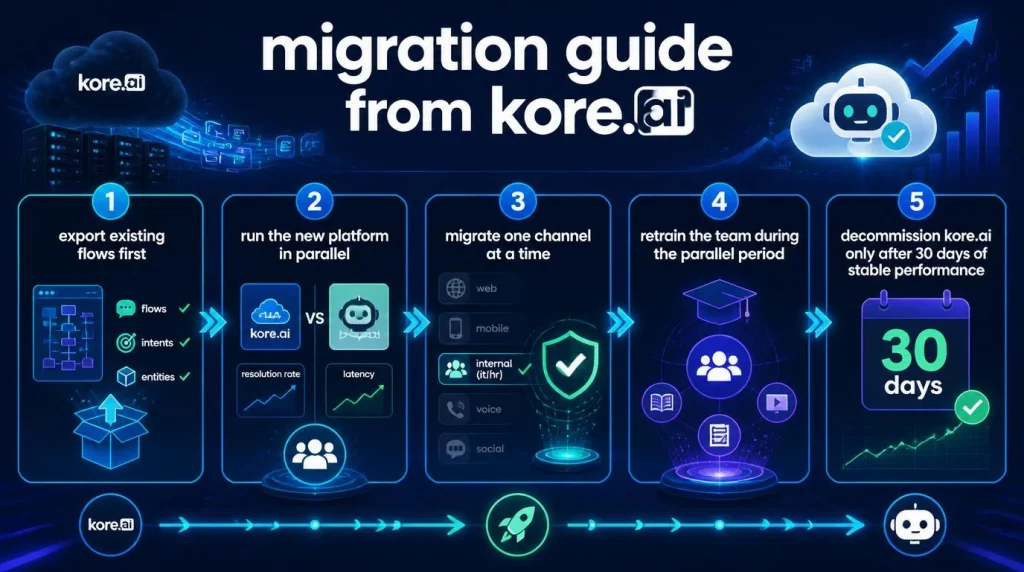
- Export existing flows first. Your team should export flows, intents, and entity definitions before canceling any contract, so the logic already built doesn’t have to be rebuilt from memory.
- Run the new platform in parallel for two to four weeks against a subset of real traffic, comparing resolution rates and latency directly rather than trusting a vendor demo.
- Migrate one channel at a time, starting with the lowest-risk channel, often internal IT or HR use cases, before touching anything customer-facing.
- Retrain the team during the parallel period, not after cutover. Documentation gaps are a common complaint across nearly every alternative on this list, so this step needs real time budgeted for it.
- Decommission Kore.ai only after 30 days of stable performance on the new platform, not the first week that looks fine.
Documented Cost Data: What Leaving Kore.ai Actually Looks Like
This section sticks to verifiable, sourced data on purpose. No named case study appears here, because no publicly documented migration story from Kore.ai to a competitor currently exists with verified before-and-after numbers, and inventing one would defeat the point of a guide like this.
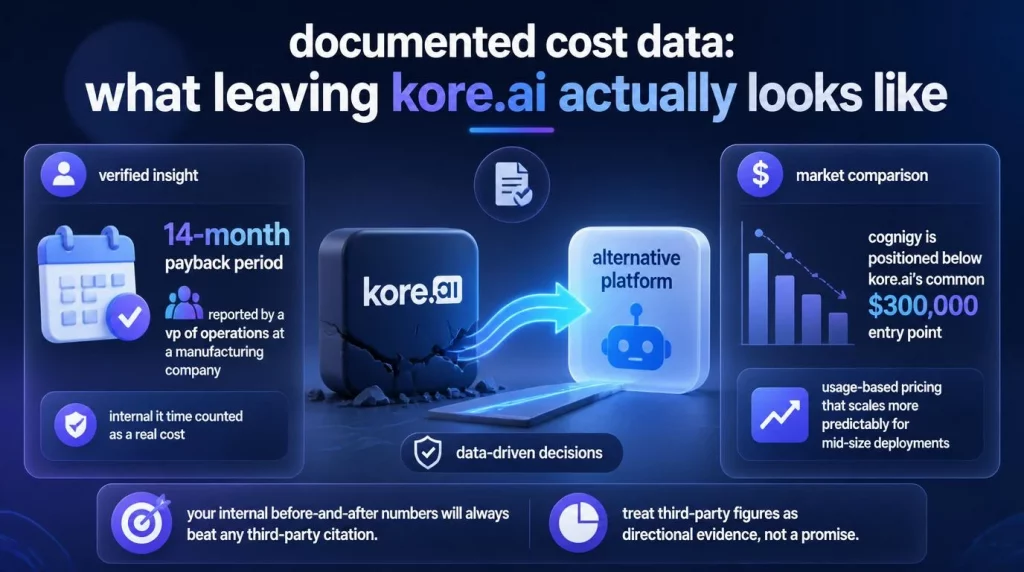
What does exist is more modest but still useful. A G2 reviewer identified as a VP of Operations at a manufacturing company reported calculating a 14-month payback period on the Kore.ai investment, counting internal IT time as a real cost rather than a free resource (G2 Review, March 2026, cited via ReviewNexa). Separately, Cognigy is consistently positioned in vendor comparisons as sitting below Kore.ai’s common $300,000 entry point, with usage-based pricing that scales more predictably for mid-size deployments (Webfuse, 2026).
If a team already has real before-and-after numbers from its own Kore.ai migration, that data will always beat any third-party citation in this section. Until then, treat the figures above as directional evidence, not a promise of identical results.
Conclusion
To summarize, selecting a Kore.ai alternative should be driven by workload fit, deployment flexibility, and long-term total cost rather than surface-level feature comparisons. Consequently, voice-heavy teams may prefer Synthflow or Retell AI, while Intercom users should assess Fin, and enterprises with strict governance needs will find stronger alignment with modular platforms.
In particular, AI Hive supports enterprises that require on-premise deployment, industry-specific compliance controls, and pricing without six-figure minimum commitments. If your team is actively evaluating a kore.ai alternative, contact AI Hive and we can discuss further on what we can do to replace Kore AI.