


Most Shopify merchants who have experimented with AI chatbots have hit the same wall: the bot answers simple FAQs reasonably well, but it falls apart the moment a customer asks something that requires real store context. It cannot look up an order, cannot cross-reference inventory, and cannot process a return without handing off to a human. The underlying problem is not the chatbot interface. The problem is the language model powering it.
Claude, developed by Anthropic, has emerged as the strongest foundation model for building customer-facing AI agents on Shopify. This guide explains the specific technical capabilities that make Claude the best LLM for Shopify agent development in 2026, and how enterprises can deploy Claude Shopify agents that go far beyond scripted chatbot interactions.
What Makes Claude Different from Other LLMs for Shopify
The Claude model family offers three capabilities that matter specifically for ecommerce agent development: an exceptionally large context window, native tool use for API interactions, and strong instruction-following behavior that reduces hallucination in customer-facing scenarios.
Claude’s 200,000-token context window allows an AI agent to ingest an entire product catalog, customer interaction history, and store policies in a single inference call. Other models force developers to chunk this information across multiple calls, introducing latency and context loss that degrades the customer experience. When a returning customer asks about a product they viewed last week while simultaneously requesting a status update on a pending order, Claude can hold both contexts without the retrieval pipeline overhead that smaller-context models require.
Furthermore, Claude’s native tool use capability means the model can call external APIs, including the Shopify Admin API, as part of its reasoning process. The Claude Shopify agent does not simply generate a text response and hope a separate orchestration layer catches the intent. Claude directly invokes functions to look up order status, check inventory levels, or initiate a refund, and it incorporates the API response into its reply to the customer. This architecture produces faster, more accurate interactions than the prompt-chain approaches that many competing solutions rely on.
How Claude Connects to Shopify Through the Model Context Protocol
The Model Context Protocol (MCP) is the integration layer that transforms Claude from a capable language model into an operational Shopify agent. MCP provides a standardized way for Claude to interact with external systems, including Shopify’s APIs, with proper authentication, permission scoping, and audit logging.
As of April 2026, Shopify ships four native MCP servers: Storefront, Customer Account, Checkout, and Dev. Each server exposes a specific set of store operations that Claude can execute during a conversation. The Storefront server handles product catalog queries and search. The Customer Account server manages order history, addresses, and loyalty data. The Checkout server processes cart operations and payment flows. The Dev server provides access to documentation and API schema validation for development workflows.
Specifically, this means a Claude-powered Shopify agent can answer a customer’s question about product availability, check their order status, offer a relevant upsell based on their purchase history, and process a return request, all within a single conversation thread without human handoff. Over 300 public MCP servers existed by mid-2026, and Shopify’s native support makes the Claude x Shopify integration one of the most mature in the ecosystem. For a deeper look at MCP integration patterns, our guide on Claude MCP integration covers the technical details.
The Shopify AI Toolkit: Official Support for Claude Integration
On April 9, 2026, Shopify released the AI Toolkit, a free, open-source plugin system that connects Claude Code, Cursor, and other AI coding agents directly to the Shopify platform. This release marked a turning point for the Claude x Shopify relationship: the integration moved from community-driven workarounds to officially supported infrastructure.
The AI Toolkit gives Claude live access to Shopify’s documentation, real-time API schema validation, and the ability to execute actual store changes through the Shopify CLI. Developers can use Claude to create products, manage collections, upload media, and publish resources using natural language commands. The result, according to early adopters, is a 48% productivity improvement and a 10.3x ROI within 12 months, with store owners consistently reporting 15 to 25 hours saved per week on tasks that previously required manual dashboard navigation or expensive freelancers.
In addition, the AI Toolkit operates as an open-source project, which means the Shopify developer community can extend its capabilities, contribute improvements, and audit the codebase for security concerns. This transparency matters for enterprise merchants who need to verify that AI-driven store operations meet their compliance requirements.
Real-World Use Cases: Claude-Powered Agents on Shopify
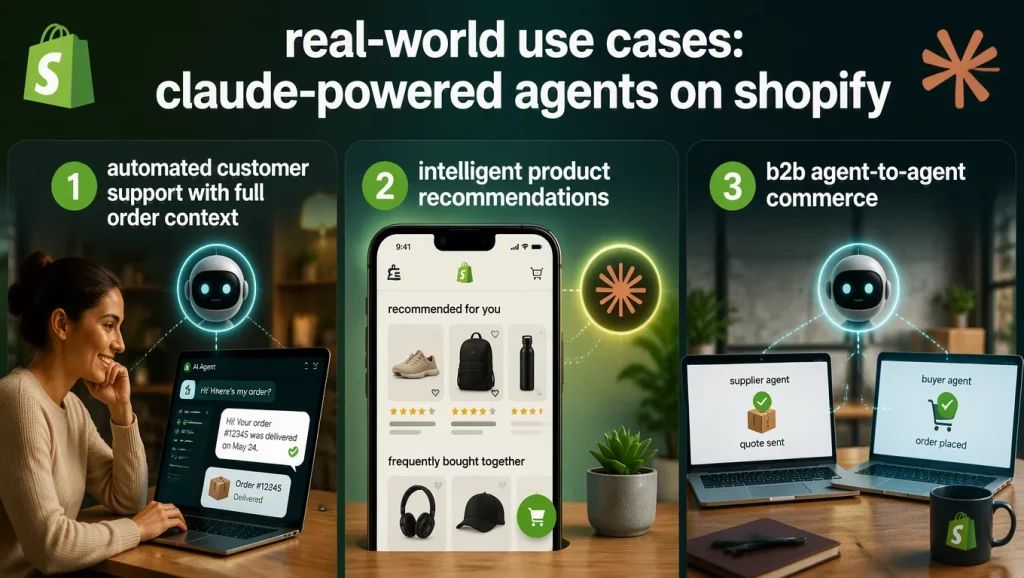
1. Automated Customer Support with Full Order Context
A Claude-powered support agent connects to Shopify’s Admin API to access order details, shipping tracking, and customer profiles in real time. When a customer asks “Where is my order?”, the agent pulls the actual tracking data from the store’s fulfillment system rather than directing the customer to check a separate tracking page. This capability alone resolves up to 40% of support tickets without human involvement.
2. Intelligent Product Recommendations
Claude’s large context window allows the agent to reason across the full product catalog and the customer’s browsing and purchase history simultaneously. The recommendations are not generic “customers also bought” suggestions. The agent can explain why a specific product fits the customer’s stated needs, handle objections, and compare options in conversational depth that traditional recommendation engines cannot match.
3. B2B Agent-to-Agent Commerce
An emerging use case involves Claude-powered agents representing different businesses in procurement negotiations. One brand’s AI agent searches a structured catalog of qualified suppliers, communicates with candidate agencies’ agents, checks internal resource availability, and negotiates scope and timeline. This agent-to-agent commerce pattern is still early but represents the direction that enterprise Shopify operations are heading. Our analysis of enterprise AI agent use cases covers additional production examples across industries.
Claude vs ChatGPT vs Gemini for Shopify AI Agents
Shopify merchants evaluating language models for their AI agents frequently compare Claude against OpenAI’s ChatGPT and Google’s Gemini. Each model has strengths, but the comparison reveals meaningful differences for ecommerce-specific applications.
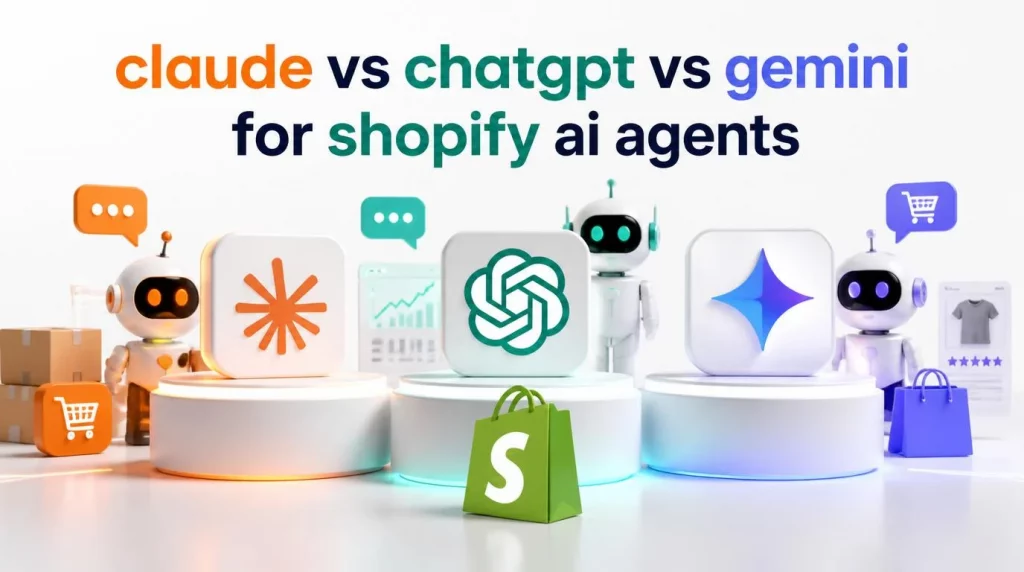
| Comparison Criteria | Claude | ChatGPT | Gemini |
| Context Window | 200K tokens | Up to 128K tokens | Up to 1 million tokens |
| Core Strength | Strong instruction following and reliable long-context processing | Broad tooling and flexible general-purpose capabilities | Large-context processing for data-intensive tasks |
| Shopify Use Case Fit | Product catalogs, customer histories, policies, and support workflows | Multimodal tasks and general ecommerce automation | Large catalog analysis and complex data processing |
| Reliability | Lower hallucination risk and stronger uncertainty handling | Flexible, but output quality depends on model and setup | Effective at scale, with latency and cost trade-offs |
| Shopify Integration | Supported through Shopify’s MCP-based toolkit | Typically requires API or custom integrations | Typically requires API or custom integrations |
| Best For | Customer-facing Shopify AI agents requiring accuracy and policy compliance | Broad, multimodal Shopify workflows | High-volume, data-heavy ecommerce applications |
Claude’s 200K-token context window is the largest production-ready context available for agentic use cases. ChatGPT supports up to 128K tokens, and Gemini offers a 1 million token window but with different latency and cost tradeoffs at that scale. For most Shopify operations, Claude’s 200K tokens provide sufficient room to hold product catalogs, customer histories, and policy documents without requiring external retrieval systems.
Consequently, Claude’s instruction-following behavior and reduced hallucination rate matter enormously in customer-facing contexts. An agent that confidently provides an incorrect shipping estimate or fabricates a return policy creates real business liability. Anthropic’s Constitutional AI training approach produces a model that is more likely to acknowledge uncertainty and defer to verified data sources, which aligns well with the accuracy requirements of ecommerce support.
The Shopify AI Chatbot Toolkit’s official support for Claude also provides a practical advantage. While ChatGPT and Gemini can connect to Shopify through custom integrations, Claude’s MCP-based integration is the most thoroughly documented and actively maintained by Shopify’s own developer relations team.
How AI Hive Deploys Claude Shopify Agents for Enterprise Shopify
Building a Claude-powered Shopify agent is technically feasible for any development team with API experience. Deploying one at enterprise scale with proper governance, security controls, and operational monitoring requires specialized infrastructure that most organizations lack internally.
AI Hive provides the orchestration platform that sits between Claude and your Shopify store, handling the complexity that raw API integration leaves unaddressed. Our platform manages agent versioning, A/B testing across different prompt configurations, real-time performance monitoring, PII redaction, and compliance logging for GDPR, SOC 2, and HIPAA regulated environments.
Our team of AI engineers works directly with enterprise merchants to design agent workflows specific to their store operations, from initial discovery through production deployment. The typical timeline from kickoff to live agent is 4 to 6 weeks, compared to the months-long timelines associated with building custom AI infrastructure in-house. Learn more about our enterprise AI agent platform and how we help organizations move from AI experimentation to production.
Conclusion
The Claude Shopify integration has matured from an experimental concept to production-grade infrastructure in 2026. Claude’s combination of a 200K-token context window, native tool use, and official Shopify AI Toolkit support makes it the strongest LLM foundation for building customer-facing AI agents that operate on Shopify stores.
The merchants gaining the most ground right now are the ones who have moved past experimenting with basic chatbots and deployed agents that actually execute store operations. That transition requires the right language model, the right integration layer, and the right deployment partner.
If your team is ready to build a Claude-powered AI agent for your Shopify operation, contact AI Hive to discuss your requirements with our engineering team.