

The enterprise AI agent platform market in 2026 includes over 2,000 vendors, yet Gartner confirms only approximately 130 deliver genuine autonomous capabilities. This comparison evaluates six platforms across the criteria that matter most to enterprise buyers: model flexibility, governance depth, on-premise deployment, integration quality, and total cost of ownership. We tested each platform against real production scenarios – not demo scripts – to help your team shortlist vendors in days, not months.
Key Takeaways
|
The 5 Non-Negotiable Capabilities for Enterprise Buyers
Most platforms look similar in a demo. The differences surface in production. These are the capabilities that separate platforms when you’re running 50 agents across three departments, not when you’re demoing one.
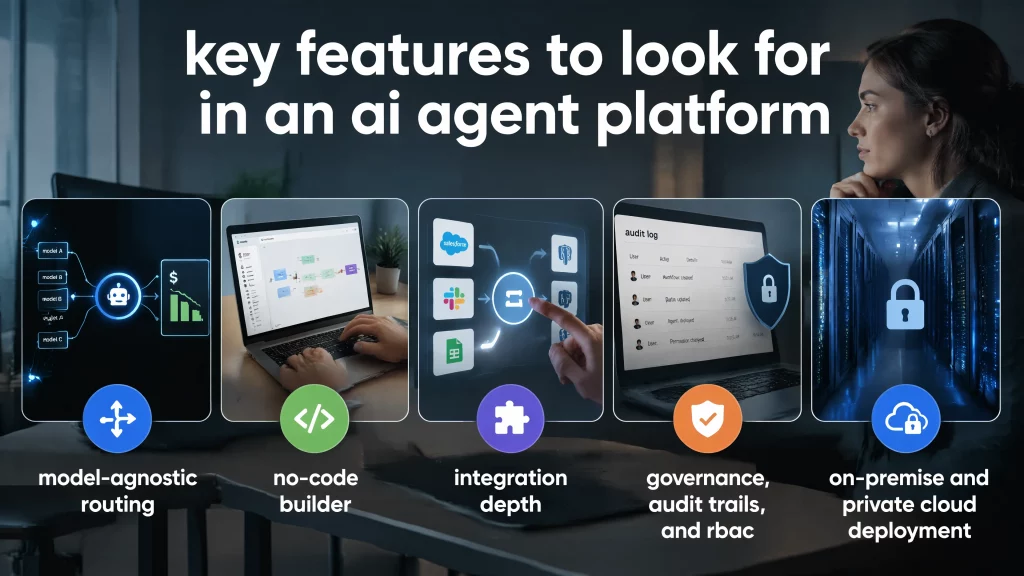
1. Model-agnostic routing: the cost difference is real
A platform locked to a single LLM creates two problems: cost and capability ceiling. GPT-4o handles complex reasoning well but is expensive at scale. Llama 3.1 runs cost-efficiently on-premise but needs more prompting for nuanced tasks. Claude excels at long-context document processing. A model-agnostic platform routes each task to the right model, assigning cheap models to simple classification and expensive frontier models only to tasks that genuinely need them.
Divyam.AI research (March 2026) modeled a production team running $60,000 per month on GPT-4o at 5% monthly usage growth. Intelligent per-task routing captured 60-70% of the potential savings versus single-provider deployments. At that scale, the annual difference exceeds $400,000. Gartner’s March 2026 inference cost analysis confirms the same pattern: value at production scale accrues to platforms that orchestrate workloads across a diverse model portfolio, routing routine high-frequency tasks to cost-efficient smaller models and reserving expensive frontier reasoning for high-margin complex decisions.
2. No-code builder: the real enterprise adoption bottleneck
The enterprise adoption bottleneck isn’t model capability. It’s engineering bandwidth. Every week a business team waits for an engineering sprint to configure an agent is a week of delayed ROI. Platforms with visual, drag-and-drop Agent Studios let business teams build and iterate without writing code.
There’s a real difference in how platforms approach this. AI Hive’s Agent Studio deploys a working agent from a pre-built template in under 30 minutes, including governance configuration and RBAC setup, not just the workflow logic. Gumloop and n8n have strong visual builders for simpler use cases but don’t include compliance controls in the no-code layer. Kore.ai and Salesforce Agentforce both require technical setup measured in weeks, not minutes. For non-technical business teams, that gap in setup time is the gap between testing AI agents and actually deploying them.
3. Integration depth: read vs. write matters more than count
A platform claiming 7,000 integrations usually means 7,000 read-only or trigger-based connectors, many community-maintained. What matters for enterprise agent deployments is whether the specific systems your agents need, your ERP, your CRM, your internal knowledge base, have production-grade bidirectional connectors that handle real data volumes under load. Ask vendors to demonstrate a write-back to Salesforce or a record update in ServiceNow during the demo, not just a data retrieval. AI Hive ships 100+ production-grade connectors. n8n has 400+ connectors but the community-maintained ones have variable uptime and support.
4. Governance, audit trails, and RBAC
Every agent action must be logged: which agent acted, what data it accessed, which model version it used, what decision it made, and when. Without immutable audit trails, you can’t pass a SOC 2 audit, satisfy GDPR Article 30, or meet HIPAA’s Technical Safeguards. RBAC must operate at the agent level, not the user level, so each agent can only access the data sources its defined task requires.
If a platform buries governance settings in an enterprise tier or positions them as optional, that tells you something about how it was designed. Platforms built for regulated industries make governance a required step in the initial deployment flow, not an add-on. Any platform that makes compliance feel optional in the demo is designed for demos, not production.
5. On-premise and private cloud deployment
For BFSI, healthcare, and government, on-premise isn’t a preference. It eliminates cloud-only platforms from consideration immediately. The question to ask vendors: can your full stack, AI Engine, Knowledge Engine, and agent runtime, operate within my infrastructure perimeter with zero data egress to external endpoints? If the answer is ‘yes but LLM inference still hits an external API,’ that’s not on-premise. AI Hive’s on-premise deployment satisfies GDPR cross-border transfer requirements, Vietnam AI Law 134/2025 data residency mandates, and HIPAA Technical Safeguards from a single architecture decision.
Explore our enterprise AI agent platforms comparison for a full side-by-side feature breakdown.
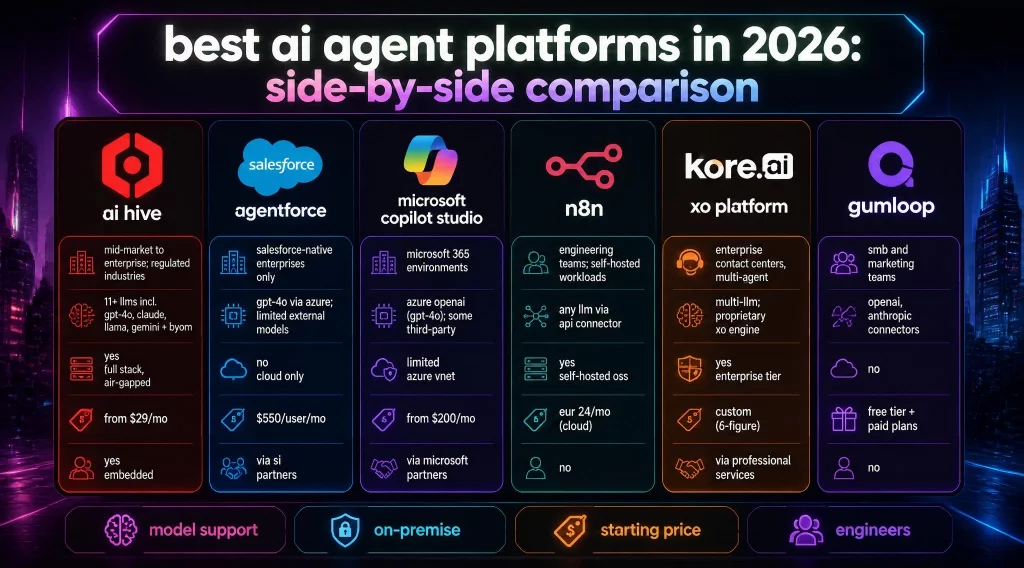
6 Best AI Agent Platforms in 2026: Side-by-Side Comparison
The platform landscape in 2026 breaks into three tiers: all-in-one enterprise platforms; developer-first frameworks that require significant engineering to reach production; and vertical specialists optimized for one function or industry. Most enterprises need Tier 1.
|
Platform |
Best For |
Model Support |
On-Premise |
Starting Price |
Engineers? |
|---|---|---|---|---|---|
|
AI Hive |
Mid-market to enterprise; regulated industries |
11+ LLMs incl. GPT-4o, Claude, Llama, Gemini + BYOM |
Yes (full stack, air-gapped) |
From $29/mo |
Yes, embedded |
|
Salesforce Agentforce |
Salesforce-native enterprises only |
GPT-4o via Azure; limited external models |
No (cloud only) |
$550/user/mo |
Via SI partners |
|
Microsoft Copilot Studio |
Microsoft 365 environments |
Azure OpenAI (GPT-4o); some third-party |
Limited (Azure VNet) |
From $200/mo |
Via Microsoft partners |
|
n8n |
Engineering teams; self-hosted workloads |
Any LLM via API connector |
Yes (self-hosted OSS) |
EUR 24/mo (cloud) |
No |
|
Kore.ai XO Platform |
Enterprise contact centers, multi-agent |
Multi-LLM; proprietary XO engine |
Yes (enterprise tier) |
Custom (6-figure) |
Via professional services |
|
Gumloop |
SMB and marketing teams |
OpenAI, Anthropic connectors |
No |
Free tier + paid plans |
No |
Note: Pricing as of June 2026. Enterprise contracts vary significantly from published starting points. Source: vendor documentation, G2 reviews, and public announcements.
|
>>> Watch for agent washing: Gartner estimates only ~130 vendors out of thousands actually deliver genuine agentic capability (Gartner, June 2025). Before signing, ask the vendor to demo an agent reasoning through an unexpected input, not a pre-configured one. If the demo breaks without a scripted input, you’re looking at a workflow tool. |
>>> What most comparison articles miss: Salesforce Agentforce at $550/user/month only works if your entire operation lives inside Salesforce. Outside that ecosystem, integration costs pile up fast. n8n at EUR 24/month is genuinely capable for engineering teams that want self-hosted control, but it has no native governance layer, no on-premise AI engine, and needs significant DevOps to run reliably in production. Kore.ai is powerful for enterprise contact center orchestration, but the implementation timeline runs months and the pricing reflects that. AI Hive at $29/month is the only platform in this comparison combining full enterprise governance, on-premise deployment, model-agnostic routing across 11+ LLMs, 500+ pre-built templates, and an embedded engineering team, without a six-figure annual contract to access production-grade capabilities.
Real-World AI Agent Platform Use Cases by Industry
The platforms that earn sustained enterprise adoption are deployed against workflows with baseline metrics that already exist. Here’s what production deployments actually look like across four industries, drawn from AI Hive client deployments.
Note: Performance metrics below come from AI Hive deployments. Results vary by organization, workflow maturity, and data quality. Ask any AI agent platform vendor for reference contacts before committing to production.
BFSI: KYC and AML compliance automation
One regional banking group we worked with across 6 countries was processing 15,000+ account applications per month with a 5-day average KYC turnaround. A KYC Onboarding Agent deployed on-premise within the bank’s Kubernetes cluster handled document OCR, AML watchlist screening, and automated eligibility decisions, with zero data leaving the bank’s infrastructure post-deployment. Turnaround time fell substantially. The compliance team’s manual AML screening hours dropped by more than half. Two countries in the deployment required full data residency, which ruled out every cloud-only vendor the bank had evaluated before coming to us.
Healthcare: Patient triage and no-show reduction
A national healthcare network with 120 clinics ran 18-minute average call center wait times and 34% appointment no-shows. A Patient Triage Agent deployed across chat and voice handles symptom assessment, appointment routing, and urgent escalation 24/7. A separate No-Show Reduction Agent automates reminders and manages waitlist filling. Call center inbound volume dropped significantly. The no-show rate fell from 34% to 18%. The network required a HIPAA BAA from every vendor in the stack. Several competing platforms couldn’t provide one at the time of evaluation.
Logistics: WISMO query resolution at scale
A logistics provider processing 50,000+ monthly shipments across Southeast Asia was fielding 800-1,200 customer enquiries per day. About 65% were asking where their order was. A WISMO Resolution Agent deployed across WhatsApp, web chat, and email resolved the majority of those enquiries autonomously, with real-time shipment status, proactive delay notifications, and rerouting request handling. Average email response time dropped from 14 hours to under 4 minutes. Deployment across three channels happened in a single sprint.
IT operations: Tier-1 helpdesk automation
A manufacturing group with 4,200 employees across 3 countries was running a 5-day average IT helpdesk resolution time. About 70% of tickets were tier-1 issues that still consumed senior engineer time. Password resets. VPN troubleshooting. Software provisioning. An IT Helpdesk Agent with Datadog/PagerDuty integration handles all tier-1 cases autonomously, including an Access Provisioning Agent for new employee onboarding and automatic deprovisioning on offboarding. Standard tier-1 resolution time fell from 5 days to under 2 hours.
How to Build and Deploy an AI Agent in 30 Minutes on AI Hive
Most platforms describe deployment as straightforward. The reality for most enterprises is weeks of integration work, model tuning, and governance setup before anything reaches production. AI Hive compresses template-based deployments to 30 minutes and full custom builds to 4 weeks. Here’s what the actual process looks like for a non-technical user starting from zero.
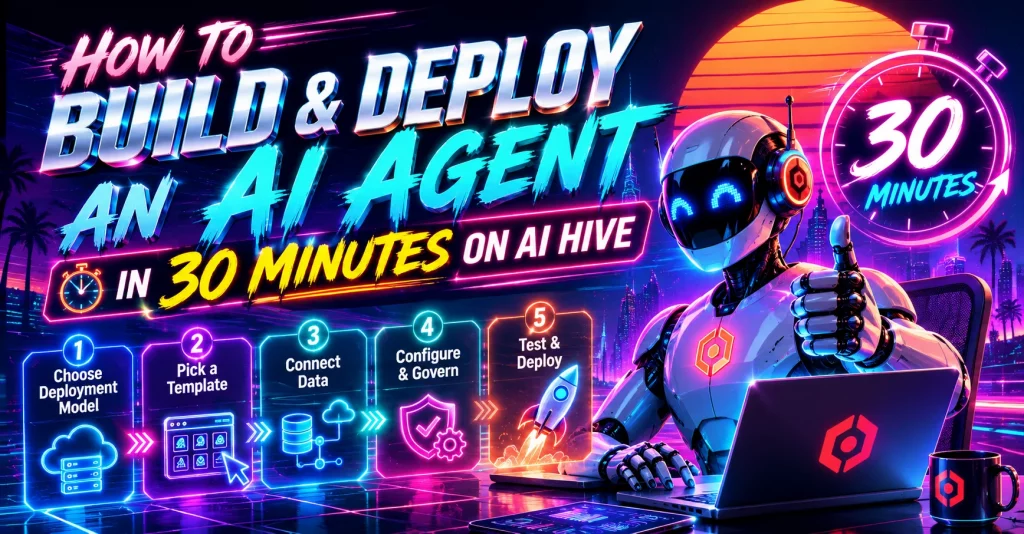
Step 1: Choose your deployment model (5 minutes)
Cloud SaaS for non-regulated workloads or fast pilots. On-premise for any deployment where PHI, financial transaction data, or data residency requirements are involved. Make this decision deliberately. It’s harder to change post-deployment than switching LLM providers. Don’t default to cloud just because it’s faster to start.
Step 2: Select a template from the Marketplace (5 minutes)
The AI Hive Marketplace has 500+ pre-built agent templates organized by industry and function: BFSI, Healthcare, Logistics, Retail, Manufacturing, plus customer support, KYC, IT helpdesk, medical coding, and WISMO. Most production deployments start from a relevant template. Starting from scratch is for edge cases where no template applies. If your use case fits any of the industry categories above, a relevant template almost certainly exists.
Step 3: Connect your data sources (10 minutes)
The Agent Studio’s Integration panel shows 100+ available connectors. Select the systems your agent needs to read from and write to: your CRM, knowledge base, ticketing system, or document repository. The RAG and Knowledge Engine layer handles semantic retrieval automatically. Set scope boundaries here. This is where data minimization happens at the architectural level, not in a policy document the agent never reads. An agent scoped to customer support tickets should not have access to HR records. Enforce that constraint technically, not by assumption.
Step 4: Configure model routing and governance (5 minutes)
Assign LLMs by task type. Sensitive document processing on an on-premise Llama deployment. Complex reasoning on Claude 3.5 or GPT-4o. Set RBAC rules. Enable audit trail logging. These are not advanced settings. They’re in the main Agent Studio interface and take under 5 minutes to configure. Any platform that makes governance feel optional at this stage is designed for demos.
Step 5: Test and deploy (5 minutes)
Run the agent against a controlled test dataset. Review the audit log output. Does it show what you expect? If the agent’s decision logic matches expected behavior across 10-15 test cases, deploy to production. Your first production agent is typically running within 30 minutes of opening the platform.
For complex deployments or regulated industries, AI Hive’s Engineers-for-Hire option embeds 1-3 senior engineers within your team’s sprint cycles. Full production build-and-handover in 4 weeks.
See our no-code Agent Studio guide for a full interface walkthrough.
AI Agent Platform Pricing: What Technology Leaders Actually Pay
Pricing in this market is deliberately opaque. Most enterprise platform vendors quote ‘custom pricing’ for anything beyond a starter plan, and the gap between the starter plan and what enterprise deployments actually cost can be substantial. Here’s what the market looks like as of June 2026.
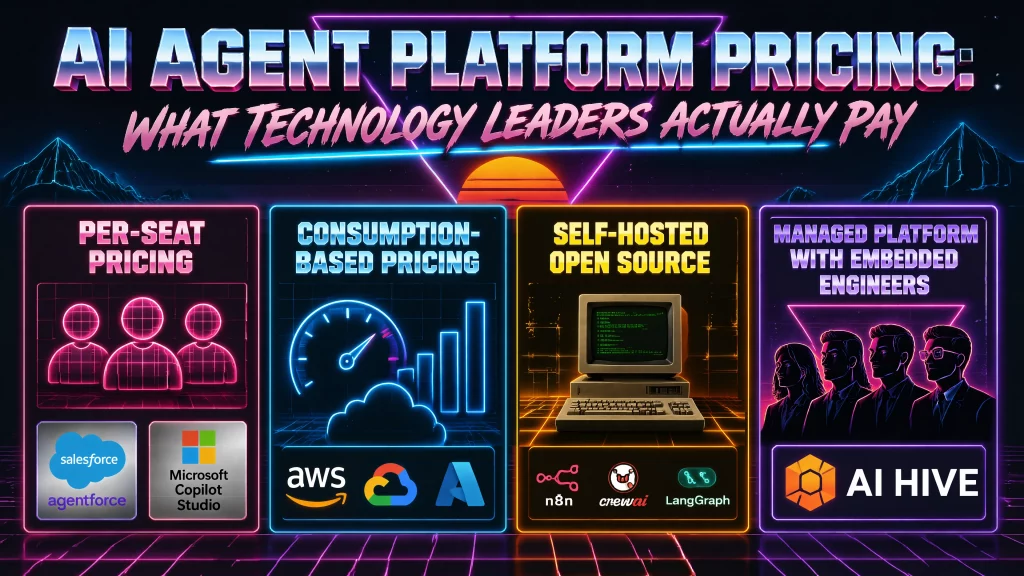
- Per-seat pricing (Salesforce Agentforce, Microsoft Copilot Studio): Published pricing runs $200-$550 per user per month. Manageable at 10 users. Gets expensive fast at 100+. With Salesforce Agentforce, watch for Flex Credits. The platform charges $500 per 100,000 credits, and enterprise workflows burn through them faster than initial estimates suggest. G2 reviews from 2025-2026 consistently flag Flex Credit overages as the hidden cost at scale.
- Consumption-based pricing (most cloud platforms): Per token, per action, or per resolution. Easy to forecast at low volume. Unpredictable at scale. Before signing any consumption-based contract, ask the vendor for a 12-month cost projection at 3x your current expected usage volume, not at baseline. Vendors who resist that conversation are the vendors whose billing surprises their customers.
- Self-hosted open source (n8n, CrewAI, LangGraph): Infrastructure cost plus engineering time. n8n Cloud starts at EUR 24/month but the Business tier with SSO costs EUR 800/month. Self-hosted Community Edition is free but requires dedicated DevOps. Count the engineering hours at market rate when comparing total cost of ownership. They’re real costs even if they don’t appear on a software invoice.
- Managed platform with embedded engineers (AI Hive): Platform from $29/month for SaaS. On-premise deployment pricing on request. Engineers-for-Hire billed separately at APAC cost efficiency rates. The total cost of a 4-week production deployment with AI Hive is structured to avoid the implementation cost structure that makes enterprise AI projects expensive with established consulting firms, where hourly rates for senior AI engineers run significantly above APAC market.
For a detailed pricing breakdown and ROI calculation for your specific use case, book a 30-minute scoping call with AI Hive.
Build vs. Buy vs. Hire: Which Path Fits Your Organization?
Most enterprises evaluating an AI agent platform face the same strategic decision: build everything in-house, buy a ready-made platform, or hire specialized AI engineers to accelerate delivery. Each path carries different cost, time, risk, and control trade-offs.
| Approach | Typical Cost | Time to Production | Best For | Main Trade-off |
|---|---|---|---|---|
| Build (in-house) | $500K – $2M+ (first year) | 6 – 18 months | Organizations with strong AI engineering teams and unique proprietary requirements | Highest control, highest risk of delay and talent dependency |
| Buy SaaS Platform | $29 – $550 / month (or enterprise contract) | Weeks to 2–3 months | Most mid-market and enterprise teams that need speed and governed features | Faster value, less custom depth than pure custom builds |
| Hire AI Engineers (augmented team) | Project or sprint-based (typically $X per sprint) | ~4 weeks to first working agents | Companies that want custom agents without long hiring cycles | Flexible capacity, still requires clear product ownership and architecture |
- Build makes sense when your use cases are highly differentiated and you already have senior AI talent. The downside is well documented: most internal builds take longer and cost more than projected because of integration, security, monitoring, and ongoing model maintenance.
- Buy (SaaS or hybrid platform) is the dominant path in 2026 for teams that need governed multi-agent workflows, pre-built connectors, audit logs, and faster time-to-value. The right platform should still allow deep customization and on-premise or private-cloud options when data residency matters.
- Hire AI engineers (or a dedicated offshore/nearshore squad) sits between the two. It shortens the timeline of a pure build while giving more control than a pure SaaS configuration. Many organizations now combine a platform purchase with a short-term engineering squad for the first wave of agents.
The practical recommendation for most enterprises is a hybrid: start with a mature AI agent platform for core orchestration, security, and connectors, then use specialized engineers only for the highest-value custom agents.
Evaluation Checklist: 15 Questions to Ask Every Vendor
Before shortlisting any AI agent platform, run every vendor through these 15 questions. The answers will quickly separate marketing claims from production-ready systems. (Download the printable PDF version of this checklist at the end of the article.)
Architecture & Deployment
1. Can your platform run entirely on-premise or in a private cloud with zero external API calls when required?
2. Do you support multi-LLM routing (Claude, GPT, Gemini, open-source) without forcing us onto a single model provider?
3. How do you handle agent memory, state, and long-running multi-step workflows?
Integration & Action
4. Show me a live write-back to Salesforce (or our CRM/ERP) — not just a read.
5. How many pre-built enterprise connectors do you ship, and can we add custom ones without your engineering team?
6. Can agents trigger actions across systems in a single orchestrated workflow with proper rollback?
Security, Governance & Compliance
7. What audit logging and human-in-the-loop controls exist by default?
8. How do you enforce role-based access, data isolation, and approval gates for high-risk actions?
9. Can you demonstrate SOC 2, GDPR, HIPAA, or equivalent controls in a live environment?
Observability & Operations
10. How do we monitor agent performance, cost per execution, and failure rates in real time?
11. What happens when an agent encounters an unexpected error or hallucinated output?
12. Do you provide evaluation frameworks or testing tools so we can measure agent quality before production?
Commercial & Support
13. What is the true total cost of ownership at our expected volume (including overage, premium connectors, and support)?
14. How quickly can we get a working pilot with our own data and systems?
15. What does the post-go-live support model look like — dedicated engineers, SLAs, or ticket-only?Vendors that cannot answer these questions clearly or demonstrate the capabilities live usually struggle in production. Use the checklist in every demo and RFP response.
Conclusion
The AI agent platform market in 2026 has one defining dynamic: the gap between what platforms demo and what they deliver in production is wider than it’s ever been. Gartner’s estimate that only ~130 vendors are genuinely agentic is the most useful buying signal available. It means most vendor shortlists include platforms that will fail at governance, integration depth, or scale before the first production review.
AI Hive‘s platform is built for organizations that need to close that gap quickly: regulated enterprises, mid-market companies with complex integration requirements, and any organization where ‘we’ll hire the engineers eventually’ isn’t a viable deployment strategy. From a 30-minute first agent to a full production fleet with embedded Engineers-for-Hire, the AI agent platform compresses what incumbent vendors stretch across 6-18 months into a deployment cycle that delivers measurable ROI.
Our solutions engineers respond within one business day and run a free 30-minute scoping call to map your use case to a realistic deployment timeline. Contact us for more details on deploying your ideal AI agent.