


Your agent resolves a customer dispute on Monday, then asks the same customer to repeat their account history on Tuesday. That gap is an AI agent memory problem, and the usual fix of stuffing every past turn into a bigger context window makes it worse: models miss facts buried in long inputs, while token bills and response times climb with every turn. The memory that keeps everything also keeps personal data your legal team will one day be asked to find and delete. A memory design that decides what to store, where to store it, and when to forget it fixes all three problems at once.
Key Takeaways
|
What Is AI Agent Memory and Why It Matters for Agents
AI agent memory is the set of mechanisms an agent uses to store, retrieve, and act on information beyond a single prompt and response. It is neither the context window, a temporary buffer that empties when a session ends, nor the model’s training data, which is frozen when the model is built. Memory sits between the two as an external store the agent queries at run time.
A bigger context window does not replace it. Liu and colleagues showed in Lost in the Middle (2024) that models use information at the start and end of a long input far better than information in the middle. The LongMemEval benchmark (Wu and colleagues, ICLR 2025) found that commercial chat assistants and long-context models lost about 30 percent accuracy when facts had to be remembered across sustained interactions.
Stateless agents also cost more to run. Every turn that resends the whole history pays again for tokens the model has already seen, and response time grows with the input.
The problem multiplies with scale. Gartner forecast in August 2025 that 40 percent of enterprise applications will include task-specific agents by the end of 2026, and an enterprise running dozens of agents needs memory rules enforced in one place, which is a core job of an AI agent orchestration platform.
4 Types of AI Agent Memory: The CoALA Framework Tiers
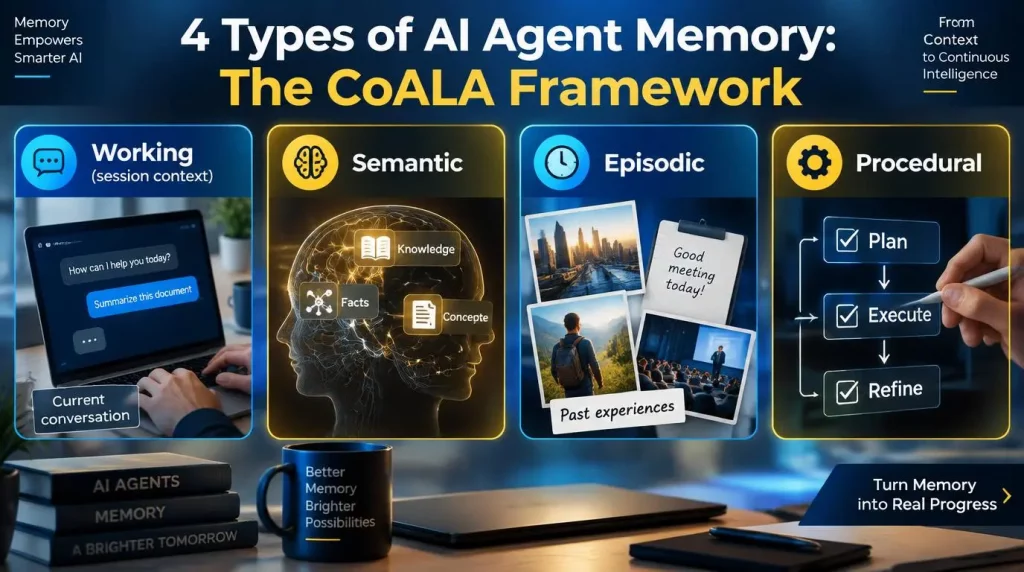
AI agent memory works best as four tiers, following the CoALA framework (Sumers and colleagues, 2023), which borrowed the split from cognitive science. Each tier has a different lifespan, storage layer, and risk.
| Tier | What it stores | Example data | Lifespan | Typical storage |
|---|---|---|---|---|
| Working (session context) | Current goal, recent turns, intermediate reasoning, and tool outputs | The income figure an applicant gave three turns ago | One session or task | Context window, scratchpad, checkpoint store |
| Semantic | Facts about users, entities, and the business | A customer’s product tier or a contract’s renewal date | Until updated or expired | Vector index, knowledge graph, relational tables |
| Episodic | Specific past events with time and outcome | The customer called twice last month about a billing error | Months, per retention policy | Event log with a time index plus a vector index |
| Procedural | How tasks are done | The approved steps for a refund above a set limit | Until the process changes | Prompts, tool definitions, workflow code |
In AI agent memory, the split between semantic and episodic memory matters more than it sounds. Semantic memory answers what is true now, while episodic memory answers what happened last time. An agent with only semantic memory knows a customer’s tier; one with episodic memory also knows a credit was promised on the last call. Keeping the two apart is a basic decision in any AI agent architecture, because they need different update and retention rules.
Procedural memory is the one teams forget to version. When a refund policy changes, the prompts and tools that encode it change too, and an audit later needs to know which version the agent used. AI agent memory design is therefore part of the wider architecture, not a storage choice made at the end.
3 Ways to Implement AI Agent Memory: Full Context, Summarization, Retrieval
Three approaches dominate, and most production systems move through them as conversations grow. The choice of AI agent memory approach changes cost and latency more than most model choices do.
- Full context: The whole history goes into every prompt. It is simple and loses nothing, but cost and latency grow with every turn.
- Rolling summarization: Older turns are compressed into a running summary while recent turns stay verbatim. Prompts stay short, but details the summary drops are gone for good.
- Selective retrieval: Facts and events are extracted into a store, embedded, and retrieved by relevance when needed. The approach scales to years of history, but it needs extraction, ranking, and update logic.
The Mem0 paper, presented at ECAI 2025, measured the gap on the LoCoMo benchmark. Its retrieval approach used about 1,800 tokens per query against roughly 26,000 for full context, and its p95 latency was 1.44 seconds against 17.12 seconds. The paper comes from a memory vendor, so the numbers are a strong indication rather than a neutral benchmark.
| Approach | Tokens per query (LoCoMo) | Input cost per query at an illustrative $2 per million tokens | p95 latency | When to move on |
|---|---|---|---|---|
| Full context | About 26,000 | About $0.052 | 17.12 s | When latency passes your target or history no longer fits |
| Rolling summary | Not measured in the paper | Low, plus the cost of summarization calls | Low | When users return across sessions or need exact past details |
| Selective retrieval | About 1,800 | About $0.0036 | 1.44 s | The default for multi-session agents |
The thresholds in the last column are our planning guidance for AI agent memory, not measured cut-offs. Many teams start with full context in the pilot, add summarization when sessions grow long, and move to retrieval once users return across sessions.
Prompt caching softens the cost of full context but does not remove it. Anthropic bills cache reads at a tenth of the base input price, which helps a long, stable prefix, yet every new turn still adds tokens and latency.
4 Common AI Agent Memory Challenges: Stale Data, Noise, Cost, and Privacy
AI agent memory introduces failure modes of its own, and each one tends to appear weeks after launch rather than in the demo.
- Stale memory: A fact that was true six months ago, such as an address or a price tier, becomes wrong when the system of record changes, and the agent repeats it with confidence.
- Retrieval noise: A store that saves every turn without curation returns near-matches that distract the model, which can make answers worse than having no memory at all.
- Cost creep: Memory writes, embeddings, and extraction calls are paid on every interaction, and they are easy to leave out of a pilot budget.
- Privacy exposure: Memory turns a passing remark into stored personal data, which then falls under retention, access, and deletion rules.
Hallucination from memory is harder to spot than hallucination from the model. The answer sounds grounded because it is grounded, just in a record that is out of date or belongs to the wrong customer. Cross-tenant leakage is the worst version: a retrieval query without a customer filter can surface one client’s data in another client’s session.
Abstention is the other skill to check. A good memory system lets the agent say it does not know, rather than filling the gap with the nearest match, and LongMemEval scores this behavior separately from recall.
5 Best Practices for AI Agent Memory: What to Write, Keep, and Prove
The practices below turn AI agent memory from a growing log into a governed data asset. They cover what to write, how long to keep it, and how to prove it works.
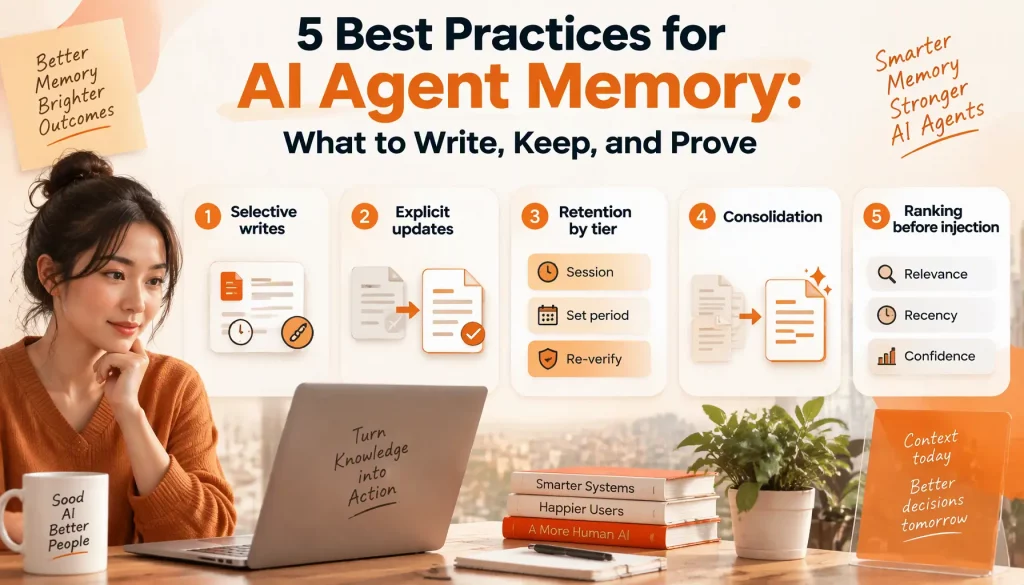
- Selective writes: The agent stores facts and events that a later task will need, not every turn, and records the source and time of each entry.
- Explicit updates: When a new fact conflicts with an old one, the store updates or invalidates the old entry instead of keeping both.
- Retention by tier: Working memory expires with the session, episodic memory follows a set retention period, and high-stakes semantic fields such as credit terms are re-verified on a schedule.
- Consolidation: Older episodes are summarized into fewer, higher-confidence facts, the way a person remembers the gist of a meeting rather than every sentence.
- Ranking before injection: Candidate memories are scored on relevance, recency, and confidence before they enter the prompt.
Memory quality needs its own test suite. A regression set of questions with known answers, run before every release, measures two numbers: the share of questions where the right memory was retrieved, and the share of answers that relied on an outdated or wrong record.
Both numbers should be tracked per tier. A drop in episodic recall and a rise in stale semantic answers need different fixes, and a single blended score hides which one is happening.
4 Privacy Controls for AI Agent Memory: Deletion and Data Residency
Vendor guides on AI agent memory mostly skip the legal side, yet remembering customer data is a regulated activity in most markets. Four controls belong in the design from day one.
- Per-customer partitioning: Each tenant, and where needed each end user, gets a separate namespace, and every retrieval query carries that filter.
- Masking before storage: Card numbers, national ID numbers, and health details are redacted or tokenized before an entry is written, unless the task truly needs them.
- Deletion on request: The store can find and delete every entry about one person across all tiers, including embeddings and summaries derived from them.
- Residency: Long-term and episodic stores sit in the jurisdiction and network boundary your regulator requires.
The deletion duty is written into law. GDPR Article 17 gives people in the EU a right to erasure, and Vietnam’s Law No. 91/2025/QH15 on Personal Data Protection, in force since January 1, 2026, lets data subjects request deletion when the processing purpose is fulfilled or consent is withdrawn. In US healthcare, HIPAA sets access and audit duties for any protected health information a memory store holds.
Summaries are the trap. A consolidated fact derived from a deleted conversation still contains personal data, so deletion has to follow lineage from the raw entry to every summary and embedding built from it.
Residency often decides the hosting model. Keeping episodic and semantic stores on-premise or in a private cloud satisfies most locality rules, at the cost of running that infrastructure yourself.
6 AI Agent Memory Tools Compared: Layers, Frameworks, and Cloud Services
The AI agent memory market splits into memory layers, agent frameworks with built-in stores, and cloud services. The table compares them by what they manage and where they run, based on public documentation read on October 2, 2026.
| Option | Type | What it manages | Hosting |
|---|---|---|---|
| Mem0 | Memory layer | Extraction, update, and retrieval of user and agent memories | Open source or managed cloud |
| Zep | Memory layer | A temporal knowledge graph that tracks how facts change over time | Managed cloud, with the open-source Graphiti engine |
| Letta (formerly MemGPT) | Agent framework | Agents that manage their own memory tiers, following the MemGPT design | Open source or managed cloud |
| LangGraph | Agent framework | Checkpoints for working memory and a store for long-term memory | Open source, self-hosted or managed |
| Amazon Bedrock AgentCore Memory | Cloud service | Short-term events and extracted long-term memories | AWS |
| Redis | Data store | Vector search, session state, and caching used as a memory backend | Self-hosted or managed |
The deciding question for AI agent memory is rarely which store is fastest. It is who controls the data, because managed memory services are quick to adopt while regulated teams usually need the store inside their own boundary with the same retrieval logic.
AI Hive’s platform supports SaaS, private cloud, and on-premise deployment, so memory stores can stay inside your infrastructure while agents share one orchestration layer. If you want to map these options to your data classification, you can talk to our team about your memory requirements.
4 AI Agent Memory Design Lessons from Multi-Session Agent Research
Public research on multi-session agents points to a handful of lessons that hold across vendors. They come from benchmarks and published system designs rather than vendor claims, which makes them a fair starting point for any AI agent memory roadmap.
- Updates matter as much as recall: LongMemEval tests knowledge updates and temporal reasoning separately from simple recall, because systems that retrieve well can still answer with old facts.
- Self-managed memory: MemGPT (Packer and colleagues, 2023) showed that an agent can page information between its context and external storage, much like an operating system, which keeps prompts small without hard-coded rules.
- Time as a field: Storing when a fact became true, as Zep’s temporal graph does, is what lets an agent resolve two conflicting records correctly.
- Designed abstention: A system that can report a missing memory is safer than one that answers from the nearest match, which is why LongMemEval scores abstention on its own.
Multi-agent systems add an ownership question to AI agent memory: which agent writes which memory, and who reads it. A common design gives each agent its own working memory and shared, permissioned access to semantic and episodic stores, so a billing agent and a support agent never answer from different versions of the same customer.
Those access rules are enforced at the same layer that routes tasks, which is why multi-agent orchestration and memory design are usually planned together.
The rollout order follows from these lessons. Working memory comes first, then semantic facts with update rules, then episodic memory once audit and personalization needs are clear, and governance controls before real customer data arrives at volume.
Conclusion
AI agent memory decides whether an agent remembers the relationship or only the last message. Four tiers with clear jobs, retrieval instead of ever-growing prompts, explicit forgetting, and per-customer partitioning with deletion built in make an agent both useful and defensible in a compliance review. This quarter, your team can build a 50-question recall test from real conversations and run it against your current agent before choosing any memory tool.
The next question is where those stores live and how one governance layer covers every agent as the fleet grows. Our platform features page shows how orchestration, retrieval, and on-premise deployment fit together for enterprise agents.