

Ecommerce support teams field the same 800 tickets a day, year after year: where is my order, how do I return this, does this fit me. That repetition is exactly the gap an AI agent for ecommerce now closes, resolving requests end to end instead of just answering them. This article walks through what these agents do, which platforms lead the market in 2026, and how your enterprise can deploy one without disrupting your existing commerce stack.
Key Takeaways
|
What Is an AI Agent for Ecommerce?
Most teams still describe every chat widget as “the bot,” but the distinction matters more than the label suggests. An agent does not just answer a question; it finishes the job behind it.
An AI agent for ecommerce is a software system that interprets a shopper’s request, reasons through the steps required to resolve it, and takes action inside your store’s backend systems. A traditional chatbot, by contrast, points the customer to a policy page and stops there. Consider a return request: the agent checks the order in your OMS, confirms eligibility, generates the shipping label, and issues the refund once the item scans in, and the customer never opens a ticket.
Three technical layers make this possible:
- Reasoning: The agent interprets intent using a large language model rather than matching keywords to scripted flows.
- Context: It pulls live order history, inventory, and customer data instead of relying on static FAQ content.
- Action: It executes real backend operations through API connections to your commerce, OMS, CRM, and billing systems.
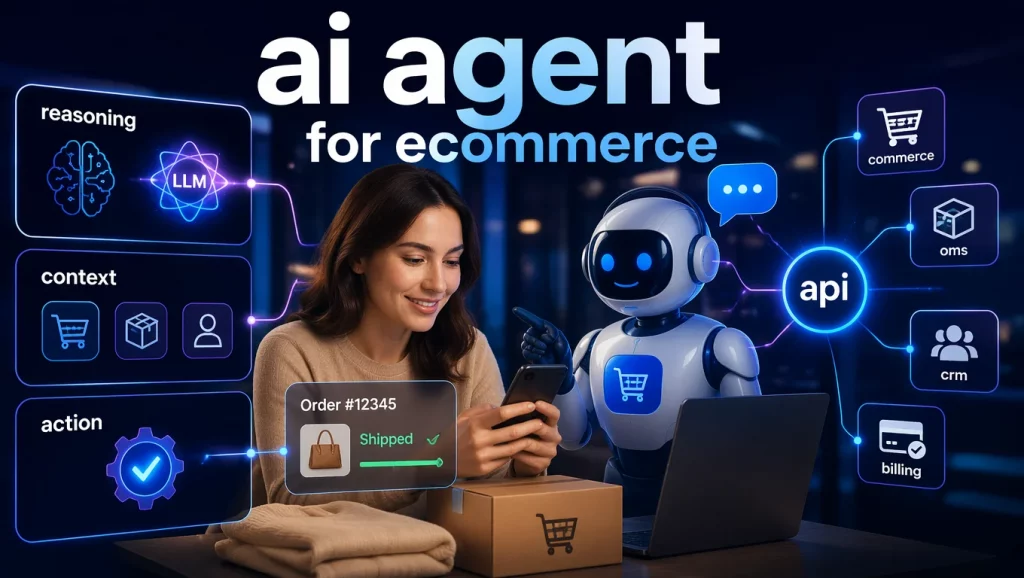
Without the action layer, your enterprise still has a chatbot with a better vocabulary. Integration depth, not conversational polish, is what determines how much work an agent can genuinely remove from your team.
Why Are Ecommerce Businesses Adopting AI Agents Now?
Three forces explain why ecommerce brands are moving faster on this than most other industries.
Support volume in ecommerce is predictable but expensive, clustering around order status, returns, refunds, and product questions. This predictability makes automation viable, while the cost of staffing seasonal spikes makes it necessary. Fin by Intercom reports that more than 70% of Shopify Inbox chats come from customers actively making a purchasing decision, so the conversation itself carries revenue weight.
The ROI case is also well documented now. According to data cited in Fin’s research, McKinsey estimates AI can reduce service costs by up to 30%, and agentic commerce could orchestrate up to $1 trillion in US B2C retail revenue by 2030. Consequently, enterprise budgets no longer treat agent deployment as an experimental line item.
Customer expectations have shifted too. The same research cites Salesforce data showing 69% of consumers now prefer conversational interactions over forms or phone trees, and shoppers expect that conversation inside the same window where they are already browsing.
Proof from the Field: A Retail Deployment at Scale
Our team’s own engagement history illustrates this pattern concretely. AI Hive deployed a Tier-1 Auto-Resolution Agent, a Returns Processing Agent, and a Cart Recovery Agent for an online retailer processing 120,000+ monthly orders through 38 customer service agents. Before deployment, this retailer needed a 60% headcount surge every Q4, and returns processing alone consumed 30% of total agent capacity.
The pattern holds regardless of vendor: high-frequency, low-judgment requests are where an AI agent for ecommerce delivers the fastest return, a pattern our team also sees repeated across AI agents for retail deployments beyond pure ecommerce.
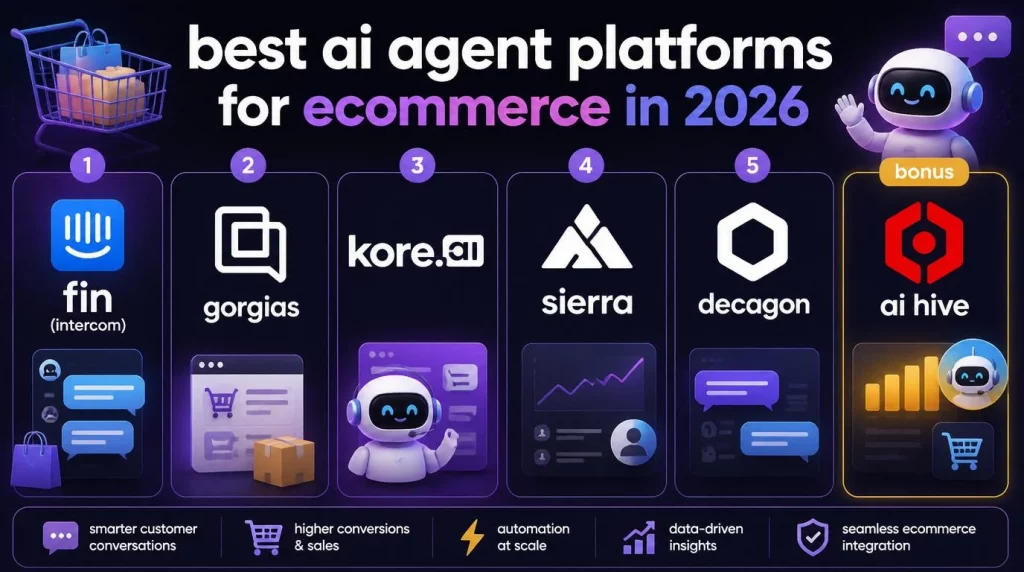
6 Best AI Agent Platforms for Ecommerce in 2026
Picking the wrong category of platform is the most common mistake we see, since a brand will benchmark a search tool against a support automation platform and conclude neither one works. The market actually splits into three categories: customer-service specialists, full-stack agentic platforms, and personalization tools.
| Platform | Best For | Integration Depth | Engineering Required |
| Fin (Intercom) | Teams maximizing automation rate | Deep OMS, billing, CRM actions | Medium |
| Gorgias | Shopify-native brands | Strong on Shopify, limited elsewhere | Low |
| Kore AI | Enterprises needing full retail coverage | 250+ integrations | Low to medium |
| Sierra AI | Post-purchase and subscription workflows | Moderate; weaker on legacy systems | Medium |
| Decagon | Technical teams, natural-language config | Needs a separate helpdesk layer | High |
| AI Hive | Mid-market retailers needing SaaS speed plus data control | 100+ connectors, model-agnostic | Low |
1. Fin (Intercom)
Fin is built around resolution rather than deflection, completing refunds and edits directly instead of routing the ticket to a human queue. Your team gets a resolution-rate metric instead of a deflection metric, which matters when you report ROI to leadership.
Best for:
- Ecommerce brands with high ticket volume maximizing automation rate without replacing their existing helpdesk
- Teams that already track resolution rate as a KPI
- Mid-market retailers comfortable with outcome-based pricing
2. Gorgias
Gorgias grew up inside the Shopify ecosystem, and that heritage still defines its strengths and limits. The platform reads order and customer data directly from Shopify without custom middleware, though coverage on WooCommerce or headless stacks remains thinner.
Best for:
- Shopify-native DTC brands wanting agent-assisted support live within days
- Small to mid-size retail teams without a dedicated engineering resource
- Businesses selling on a single commerce platform
3. Kore.ai
Kore.ai differentiates through multi-agent orchestration, where specialized agents, such as a discovery agent and a post-purchase agent, collaborate across one workflow, a design Kore.ai’s own research on agentic retail platforms covers in more depth. This architecture suits large retailers with complex operations, but it carries an enterprise timeline: six to eighteen months, with contracts often exceeding $300,000 a year.
Best for:
- Enterprise retailers with 2,500+ employees and multiple business units
- Organizations needing agents to collaborate across discovery, support, and fulfillment
- Companies able to manage a long implementation cycle
4. Sierra AI
Sierra AI focuses on post-purchase and subscription workflows, an area many general-purpose agents handle poorly. It manages plan pauses, swaps, and cancellations directly inside the billing system, reducing the friction that drives subscription churn.
Best for:
- Subscription or recurring-revenue brands with high volumes of plan changes
- Retailers on modern commerce and billing platforms rather than legacy systems
- Teams prioritizing churn reduction over general deflection
5. Decagon
Decagon lets technical teams configure agent behavior in natural language instead of a rules builder, which appeals to engineering-led support organizations. That flexibility comes at a cost, since Decagon typically requires a separate helpdesk layer underneath it.
Best for:
- Companies with an in-house engineering team willing to maintain agent logic
- Retailers wanting an AI layer on top of an existing helpdesk, not a replacement
- Organizations valuing configuration flexibility over simplicity
BONUS: AI Hive
AI Hive occupies the middle ground most incumbents ignore. As a specialized AI brand built on AHT Tech’s 18+ years of enterprise software delivery, our SaaS platform, on-premise option, and embedded AI Engineers for Hire let mid-market retailers reach a first working agent in weeks rather than quarters. This matters most for retailers in regulated markets or APAC that need on-premise deployment for data residency, without the hiring burden a build-in-house approach demands.
Best for:
- Mid-market retailers (100-2,500 employees) needing enterprise-grade compliance without an enterprise timeline
- Businesses wanting to avoid vendor lock-in and switch LLMs per agent
- Retailers in regulated or APAC markets requiring on-premise deployment
You can review the full technical breakdown on the AI Hive platform features page. Based on this comparison, our advisory stance is simple: a Shopify-only brand with low ticket volume should start with Gorgias, an enterprise above 2,500 employees can absorb Kore.ai’s longer rollout, and the mid-market retailer in between, where most of our clients sit, gets the closest match with AI Hive.
5 Common Use Cases of AI Agents in Ecommerce
Not every ticket qualifies as a good automation candidate, but a specific set of use cases consistently deliver the strongest return.
- WISMO (Where Is My Order): The highest-volume contact driver, resolved by pulling live tracking data and flagging delays before the customer asks.
- Returns and refunds: The agent checks eligibility, generates a label, and processes the refund once the return is confirmed, cutting a multi-day process to minutes.
- Guided selling: Instead of a static FAQ, the agent asks about size, use case, or budget and narrows a large catalog to a short shortlist.
- Abandoned cart recovery: Triggered automatically after checkout drop-off, with a follow-up addressing the likely reason for hesitation.
- Subscription changes: Pausing or swapping a plan happens directly inside the billing system, reducing both churn and ticket volume.
Each use case shares a common trait: high frequency, low judgment required, and a clear system of record the agent can act against. These same patterns show up across other industries too, as our broader roundup of enterprise AI agent use cases illustrates.
How Do You Implement an AI Agent in a Shopify or WooCommerce Store?
Rolling out an ecommerce AI agent works best as a phased project rather than a single launch event. Our team recommends this sequence for enterprises new to agentic deployment.
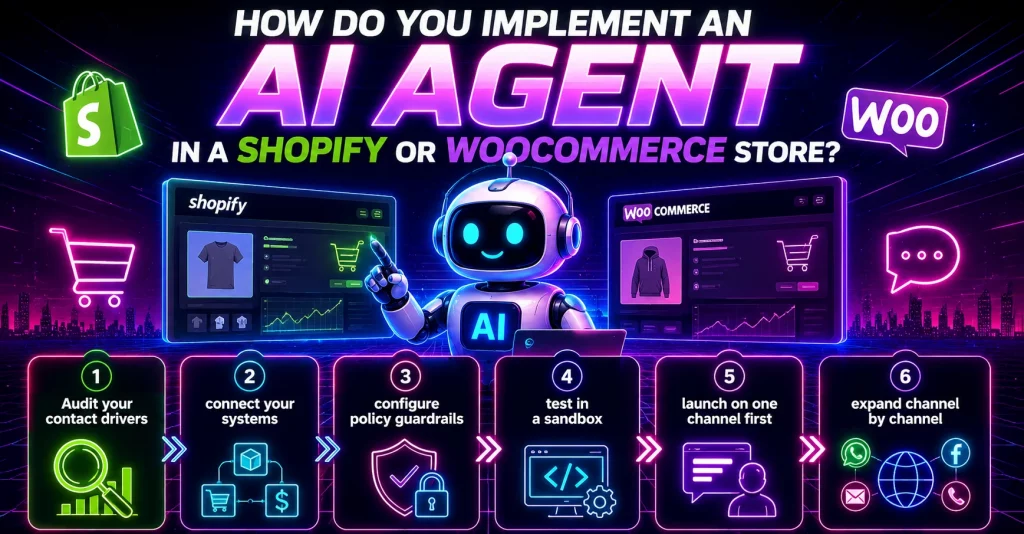
- Audit your contact drivers: Rank three months of tickets by volume; WISMO and returns almost always lead.
- Connect your systems of record: The agent needs live access to your commerce platform, OMS, and billing tool.
- Configure policy guardrails: Define what the agent can approve automatically versus what it must escalate.
- Test in a sandbox: Run the agent against last month’s real conversations before it touches a live customer.
- Launch on one channel first: Start with web chat or email so your team can monitor quality closely.
- Expand channel by channel: Add WhatsApp, social, or voice once resolution rates hold steady.
For Shopify stores, certified native apps sync order data automatically. WooCommerce stores typically need a direct API connection instead, which takes longer but gives your team more control. Enterprises without in-house engineering capacity can also engage AI Hive’s AI Engineers for Hire to complete this work directly.
Checklist: Choosing the Right AI Agent for Your Ecommerce Store
Use this before signing any contract, not after.
- ☐ Does the agent take real backend actions, or does it only answer and route?
- ☐ Does it integrate natively with your commerce, OMS, and CRM systems?
- ☐ Can your team test it against historical tickets before going live?
- ☐ Does pricing charge per resolution, per seat, or per outcome?
- ☐ Does it support the channels your customers actually use?
- ☐ Can the vendor deploy on-premise if data residency requires it?
- ☐ What is the real time to first production agent?
A platform scoring well on the first points but failing the last one can still cost your enterprise a full quarter of delayed ROI. Enterprises still comparing options can also review AI Hive’s retail solutions for pre-configured agent packs built around these exact criteria.
What Each Leader Actually Cares About: The CFO, CXO, and IT View
An AI agent for ecommerce touches three stakeholders, and each evaluates it through a different lens.
The CFO cares about predictable cost. A ticket-based model with separate AI fees can create double-billing, so your CFO should request a worst-case projection at peak volume, not just an average. The CXO, by contrast, cares about resolution quality over deflection rate, since a high deflection number that never solves the problem shows up later as repeat contacts.
IT and Engineering leadership care about integration debt and data exposure. Every agent connecting to your OMS, CRM, and billing system adds a new dependency to maintain, so IT should push for pre-built connectors rather than custom API work for every system. Aligning these three views before your enterprise shortlists vendors prevents the common failure where Support picks a tool the CFO later kills over cost.
Challenges and Best Practices for Ecommerce AI Agents
Deploying ecommerce AI agents is not just a technology challenge. The biggest obstacles often appear in data privacy, system integration, and operational scale long after a successful pilot.
The most common challenges include:
- Data privacy and compliance: Agents handling customer orders, delivery addresses, and payment references must operate within strict governance boundaries. Our on-premise deployments run inside the client’s Kubernetes environment to ensure PII remains within the organization’s infrastructure rather than relying solely on protections inside a shared cloud environment.
- Integration complexity: Most delays occur when connecting agents to legacy OMS platforms, ERP systems, and multiple regional storefronts. In our experience, validating business logic and mapping real OMS fields often takes longer than configuring the AI model itself.
- Scaling consistency: An agent that performs well at 500 tickets per month may behave differently at 20,000. Performance, escalation rates, and workflow quality must be continuously monitored as volume increases.
As a best practice, enterprises should begin with a single high-volume, low-complexity workflow such as WISMO (Where Is My Order), validate performance against historical data, and expand scope only after achieving stable production results.
Future Trends in Ecommerce AI Agents
Enterprise ecommerce teams are already seeing a shift from isolated automation tools toward autonomous agent ecosystems that operate across the customer journey.
Several trends are expected to shape ecommerce AI agents over the next 18 months:
- Multi-agent orchestration: Retailers are moving from single-purpose bots to coordinated agent systems that share context across customer support, product discovery, inventory management, and fulfillment.
- Voice-driven commerce operations: Voice interfaces are evolving beyond simple assistants and becoming a practical channel for order tracking, returns management, and customer service interactions.
- Growing regulatory requirements: New regulations are pushing retailers to re-evaluate deployment models and governance controls before scaling AI initiatives.
The regulatory trend is particularly important for enterprise retailers. Vietnam’s AI Law 134/2025/QH15, together with emerging governance frameworks across the EU, is increasing demand for on-premise and hybrid deployment options as organizations seek greater control over customer data, compliance, and auditability.
Conclusion
An AI agent for ecommerce earns its place when it resolves tickets end to end instead of merely answering them. The platforms leading this market in 2026 are separated by integration depth and time to production, not conversational polish, so your enterprise should evaluate vendors on that basis first.
Our team at AI Hive builds exactly this kind of agent for mid-market retailers, combining a SaaS platform with embedded engineers who map your top contact drivers to a working deployment. Talk to AI Hive’s team to see how quickly your store could go live.