

Most enterprises don’t fail at AI because their models underperform. They fail because their compliance architecture was never built for systems that act autonomously on sensitive data. In 2026, dropping an AI agent into production without a structured compliance framework exposes your organization to GDPR enforcement, HIPAA penalties, failed SOC 2 audits, and – if you operate in Southeast Asia – legally binding obligations under Vietnam’s AI Law 134/2025/QH15. This latest article gives CTOs, CIOs, and compliance leads a practical map for meeting those obligations without stalling production deployment.
Key Takeaways
|
What Is AI Agent Compliance?
AI agent compliance is the practice of ensuring autonomous AI systems meet applicable data privacy laws, security certification standards, technical security frameworks, and jurisdiction-specific AI regulations. In 2026, your compliance obligation depends on where your data flows, not just where your company is registered.
The key difference from standard IT governance is autonomy. Traditional IT systems run predefined instructions under human supervision. AI agents reason, retrieve context, make probabilistic decisions, and initiate follow-on actions without anyone approving each step. Regulators in the EU, the US, and Vietnam now treat that autonomous behavior as a distinct risk category requiring its own governance layer, built on top of your existing data protection programs.
In practice, standard IT governance policies don’t constrain agent behavior at the architectural level. An AI agent accesses any data source its permissions allow unless the constraint is built in explicitly. Compliance by design means enforcing those constraints before the first production workload runs, not documenting them in a policy that no agent ever reads.
Why AI Agent Compliance Fails in Practice?
The compliance failure rate for enterprise AI agents isn’t a future risk. It’s a present pattern with documented financial consequences. Infosys’s 2025 report Responsible Enterprise AI in the Agentic Era found that 95% of executives reported their organizations experienced negative consequences from enterprise AI use in the past two years, with direct financial loss affecting 77% of cases. Another 86% of executives familiar with agentic AI specifically identified autonomous decision-making as introducing compliance risks their existing frameworks weren’t built to handle.
In regulated industries, the failure patterns get more specific. A 2026 analysis by Promethium AI found that 73% of healthcare AI agent deployments failed HIPAA compliance audits. Not because of deliberate non-compliance. Because default AI architectures don’t align with what HIPAA’s Technical Safeguards technically require. AtScale’s March 2026 research found only 7% of organizations have fully embedded AI governance, despite 93% using AI in production. Gravitee’s 2026 State of AI Agent Security report showed that only 47.1% of an organization’s agents are actively monitored or secured on average.
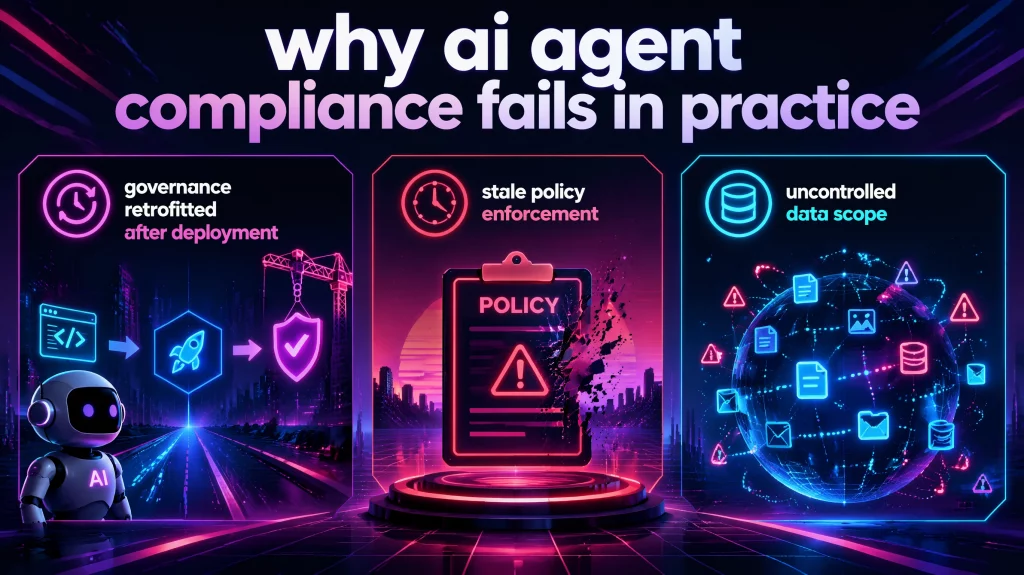
Three structural failure patterns account for most compliance gaps:
- Governance retrofitted after deployment: Compliance frameworks built for human-operated software don’t transfer to autonomous agents without architectural rework. When an AI agent is dropped into an existing environment and governance is bolted on afterward, critical controls are either incomplete or inconsistent across agent types.
- Stale policy enforcement: An agent enforces the rules it was given at build time. When policies are updated and those updates aren’t pushed to running agents, those agents keep applying logic that a compliance team superseded two policy cycles ago. Forrester reports this pattern incurs an average penalty of $2.4 million per incident.
- Uncontrolled data scope: An AI agent accessing enterprise systems retrieves anything its permissions allow unless the Knowledge Engine or RAG layer enforces scope at the architectural level. Unlike a human employee whose unusual data access gets flagged in a quarterly review, an agent operating at scale can run thousands of out-of-scope retrievals before an audit flag triggers.
The organizations achieving compliant production deployments share one characteristic: they treat compliance as an architectural requirement, not a pre-launch checklist.
Regulatory Standards and Frameworks for AI Agent Compliance
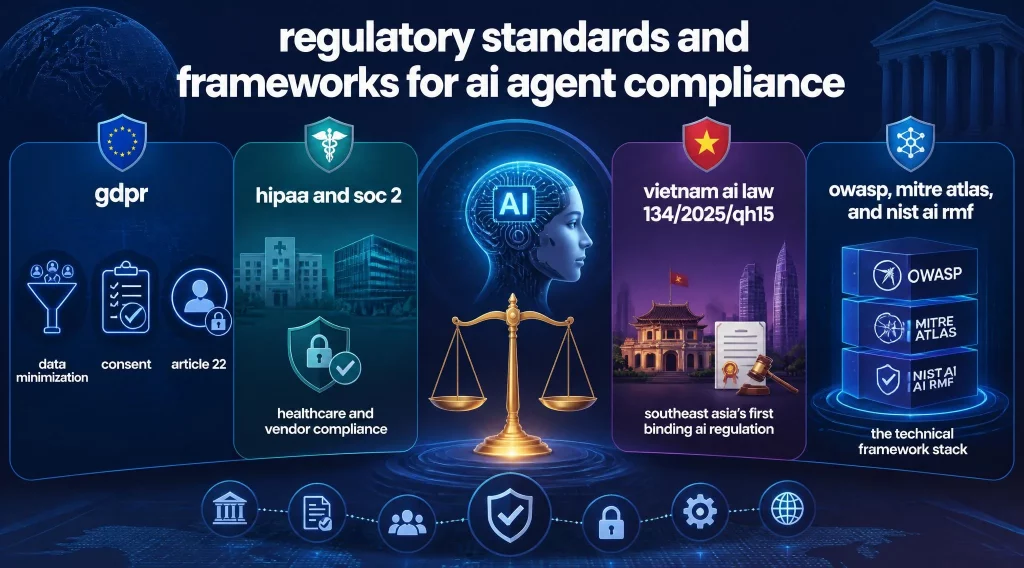
AI agent compliance runs across two framework layers at once: legal regulations that carry enforcement penalties, and technical security frameworks that define how compliant architecture must actually be built. The distinction matters because failing a technical framework audit can directly trigger legal regulation violations.
GDPR: Data Minimization, Consent, and Article 22
The General Data Protection Regulation governs any AI agent processing personal data of EU residents, regardless of where your organization is headquartered. Three provisions carry the most operational weight.
- Article 5 (Data minimization) requires that agents collect and process only the personal data strictly necessary for their defined purpose. Your Knowledge Engine or RAG layer must be architecturally scoped to exclude irrelevant sources. A KYC agent processing identity documents has no legitimate basis to pull transaction history unless risk scoring is explicitly part of its function.
- Article 22 (Automated decision-making) is the provision most consistently overlooked. It restricts decisions made solely by automated means that produce a legal or similarly significant effect on an individual. Loan approvals, insurance eligibility determinations, and medical triage assignments all qualify. When your AI agent produces such a decision, GDPR requires the affected individual to have the right to request human review, the right to contest the outcome, and a clear explanation of the logic. That obligation must be technically implemented, not just described in a privacy policy.
- Cross-border data transfers require approved mechanisms, either Standard Contractual Clauses or adequacy decisions, for any EU personal data routed to LLM APIs or cloud inference endpoints outside the EEA. On-premise deployment eliminates this risk by keeping personal data within your infrastructure perimeter. The EU AI Act’s high-risk provisions, applying from August 2, 2026, add a parallel conformity assessment obligation for AI systems in credit, employment, and healthcare, creating dual compliance requirements that need to be planned together, not sequentially.
HIPAA and SOC 2: Healthcare and Vendor Compliance
For any AI agent that processes Protected Health Information, HIPAA compliance starts before the first data point is processed. Healthcare organizations frequently discover this in the wrong order – after a vendor is already onboarded and PHI has already moved through an uncontracted system.
- The Business Associate Agreement (BAA) is required under 45 CFR §164.504(e). Every vendor that handles PHI on your behalf – AI platform providers, LLM API providers, cloud infrastructure vendors – must sign one before any PHI is processed. A vendor without a BAA is a vendor you cannot legally use for PHI processing, regardless of their stated security posture. Treat BAA confirmation as step zero, not step five.
- Technical safeguards under 45 CFR §164.312 require encryption at rest and in transit, RBAC limiting PHI retrieval by agent and user, and audit logs capturing not just data access but the specific agent identity, inferred purpose, and output produced. The HHS Office for Civil Rights enforced over $14.5 million in HIPAA penalties in 2023 alone, with fines scaling from $100 per unknowing violation to $1.9 million per violation category annually for willful neglect (HHS OCR, 2024 Enforcement Highlights).
- SOC 2 Type II is now the baseline certification for enterprise AI vendors. Type II verifies that controls operated effectively over a sustained period – typically six to twelve months – not just that they were designed well on paper. When evaluating vendors, demand the full auditor report with findings, not a compliance badge. Check for subservice organization carve-outs covering the LLM providers your vendor relies on. And verify that the report covers the specific LLM backend you’ll actually use in production.
Vietnam AI Law 134/2025/QH15: Southeast Asia’s First Binding AI Regulation
Vietnam’s Law on Artificial Intelligence took effect March 1, 2026 as the first standalone, legally binding AI law in Southeast Asia. It applies to both domestic and foreign organizations whose AI systems affect users, markets, or national interests in Vietnam. Where your company is incorporated is not a carve-out.
- Risk classification under Article 9 divides all AI systems into three tiers: high, medium, and low risk. High-risk systems face mandatory conformity assessments, registration in Vietnam’s National AI Database, continuous monitoring, and appointment of a local legal representative for foreign providers. Under Decree 142/2026/ND-CP (effective May 1, 2026), risk classification must happen before deployment. Importantly, integrating a third-party LLM API such as OpenAI, Claude, or Gemini into a business application can alter that system’s risk tier and trigger reclassification obligations.
- Data residency under the combined framework of the AI Law, Personal Data Protection Law, and Cybersecurity Law (effective July 2026) effectively requires on-premise or locally hosted deployment for high-risk AI systems processing critical national or sensitive personal data. Cloud deployments routing Vietnamese personal data through foreign servers face additional data localization obligations.
- Compliance deadlines: healthcare, education, and finance sectors must reach full compliance by September 1, 2027. All other sectors face March 1, 2027. Penalties reach VND 2 billion (approximately USD 75,800) per violation for organizations, and VND 1 billion (approximately USD 37,900) for individuals. Serious violations by large organizations carry revenue-based fines.
One provision with no equivalent in GDPR or HIPAA: Article 4’s human-centered principle establishes that AI systems must not replace human authority in decisions of national significance. That’s a structural architectural constraint, not just a policy statement.
OWASP, MITRE ATLAS, and NIST AI RMF: The Technical Framework Stack
Legal regulations define what your AI agents must comply with. Technical frameworks define how compliant architecture is actually built. In 2026, three frameworks form the baseline stack that regulated enterprises reference in procurement, audit, and incident response.
- OWASP Top 10 for Agentic Applications (2026), released December 2025 with input from over 100 security experts and endorsed by NIST, Microsoft, and NVIDIA, is the first peer-reviewed framework targeting autonomous AI security. It covers agent goal hijacking (ASI01), insecure tool use (ASI02), identity and privilege abuse (ASI03), excessive permissions (ASI04), and multi-agent trust boundary failures. The OWASP Agentic Top 10 is moving from best practice to regulatory expectation. The EU AI Act’s security requirements for high-risk systems directly align with several of its controls.
- MITRE ATLAS catalogs real-world adversarial techniques against AI systems, helping enterprises map their platform-level security controls against tactics observed in production environments. The January 2026 ATLAS update (v5.3.0) added three case studies specifically covering MCP server compromises and indirect prompt injection via MCP channels. Enterprise security teams use MITRE ATLAS for AI-specific threat modeling and red team exercises.
- NIST AI Risk Management Framework (AI RMF) provides the governance structure connecting technical controls to organizational accountability. NIST’s February 2026 AI Agent Standards Initiative extended the AI RMF to cover agent identity, authorization, delegation, and audit as explicit domains. The practical implementation sequence: NIST AI RMF for governance structure, OWASP Agentic Top 10 for sprint-level engineering controls, MITRE ATLAS for threat modeling before each major deployment.
Key Components of an AI Agent Compliance Framework
Regulatory compliance for AI agents isn’t a checklist you complete at launch. It’s a set of continuously enforced technical controls operating across the agent’s full lifecycle. Every governance-first architecture for AI agents rests on six components, and the order matters because each layer depends on the one below it.
- Agent identity and access management. Each AI agent needs a unique, authenticated identity – not a shared API key or a generic service account. RBAC and attribute-based access control (ABAC) define what each agent can access and what actions it can take. Gravitee’s 2026 research found that only 21.9% of organizations treat AI agents as independent identity-bearing entities. That means the majority are running agents whose actions can’t be individually traced to a specific system identity in an audit. That’s a direct compliance gap under HIPAA §164.312, SOC 2’s Security TSC, and Vietnam AI Law’s audit trail requirements.
- Data scope enforcement at the architecture layer. Policy documents don’t constrain agent behavior. Technical boundaries do. Your Knowledge Engine or RAG layer must enforce data scope at the query level, restricting which document types, data sources, and record categories each agent can retrieve based on its defined task. Permission boundaries need to be defined, documented, and tested against adversarial prompt inputs before any agent touches production data.
- Human oversight mechanisms with documented intervention points. EU AI Act Article 14 is explicit: high-risk AI systems must technically allow human operators to monitor, understand, intervene in, and override outputs. The law doesn’t say humans should theoretically be able to do this. It says the system must be technically designed to make it possible. Required documentation for each agent handling high-risk decisions: named roles with authority to intervene, an escalation path when the agent can’t resolve a decision, iteration bounds defining how many autonomous steps it can take before requiring human review, and a documented kill switch.
- Immutable audit trails with regulatory-grade retention. Audit logs must capture agent identity, data sources and specific records accessed, model version used, full decision output, timestamp, and trigger source. Logs must be immutable and retained for the minimum period required by applicable regulations – six months under EU AI Act Article 26, the applicable HIPAA retention period for PHI audit logs, and the period specified in SOC 2 audit scope. The log format must support regulatory review without requiring custom extraction tooling. Organizations report 20% efficiency gains in compliance audits through continuous monitoring versus periodic assessment (MintMCP, 2025).
- Runtime monitoring and policy propagation. Static configuration at build time isn’t sufficient. Agent behavior drifts as models are updated, integrations change, and data distributions shift. Continuous monitoring must track agent behavior against compliance parameters in real time, not in a quarterly audit cycle. Equally important: when regulations change and compliance policies are updated, those updates must reach all running agents automatically, without requiring redeployment. This is the control that prevents the stale policy failure pattern described above.
- Incident response with AI-specific protocols. Standard incident response runbooks don’t account for agent-specific failure modes: goal hijacking, prompt injection via MCP channels, cascading multi-agent failures, or autonomous actions that can’t be rolled back. Before any production deployment of a high-risk AI agent, your incident response plan must specify how to identify when an agent has acted outside its permitted scope, how to halt agent execution without data loss or downstream cascades, root cause analysis procedures for autonomous decision failures, and a regulatory notification protocol if the incident triggers GDPR breach notification, HIPAA breach reporting, or Vietnam AI Law incident reporting obligations.
Best Practices and Tools for AI Agent Compliance
The organizations getting measurable compliance outcomes right share a consistent pattern: they treat compliance infrastructure as foundational, not as a layer added after the AI stack is already running.
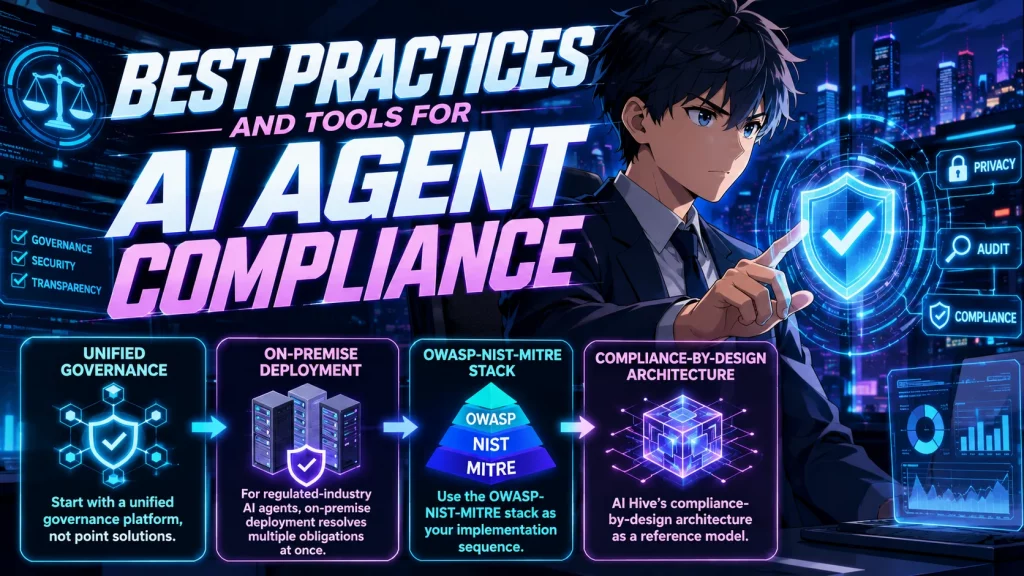
- Start with a unified governance platform, not point solutions. A recurring failure mode in 2026 is fragmented compliance architecture where different tools manage different AI environments under separate policy configurations. EU AI Act Article 9’s risk management requirement assumes a unified evidence chain. A patchwork of disconnected audit logs from three different tools creates structural compliance gaps at the intersections. Leading governance platforms in 2026 include OneTrust, Vanta, Drata, and ServiceNow for documentation and control management; Microsoft Purview for AI observability in Microsoft-adjacent stacks; and ISO 42001-aligned AI management system tools for enterprises requiring external certification. Building compliance infrastructure from scratch typically costs $825K to $2.45M for initial implementation plus ongoing operational costs (MintMCP, 2025). A managed compliance infrastructure platform reduces that substantially.
- For regulated-industry AI agents, on-premise deployment resolves multiple obligations at once. On-premise eliminates GDPR’s cross-border transfer risk, satisfies Vietnam AI Law’s data residency requirements for high-risk systems, and gives healthcare organizations the PHI boundary that HIPAA Technical Safeguards require. A single architectural decision handles what would otherwise be three separate control implementations.
- Use the OWASP-NIST-MITRE stack as your implementation sequence. Start with NIST AI RMF for organizational governance and risk classification. Layer OWASP Top 10 for Agentic Applications as the sprint-level engineering baseline – it requires no enterprise licensing and can be implemented team by team. Add MITRE ATLAS for threat modeling before each major agent deployment. Framework crosswalks mapping OWASP Agentic Top 10 to NIST AI RMF, EU AI Act, and ISO 42001 are publicly available, so a single implementation pass can satisfy multiple framework requirements simultaneously.
- AI Hive’s compliance-by-design architecture as a reference model. We built AI Hive so that compliance controls are embedded at the platform architecture level, not configured after deployment. Our On-Premise Deployment option runs the full AI Hive stack – AI Engine, Knowledge Engine, Agent Studio – within your infrastructure perimeter with zero data egress to external endpoints. Our Governance layer implements PII masking at data ingestion, RBAC restricting agent data access, and a full audit trail capturing agent identity, retrieved context, model version, decision output, and timestamp in a format ready for regulatory review.
For organizations operating under strict regulatory regimes, adopting compliance frameworks for financial services ensures alignment with both internal audit standards and external supervisors such as the SEC, FCA, or MAS.
Cross-Jurisdiction Compliance: Regulation Comparison Table
The table below maps the four primary regulatory frameworks against the compliance dimensions most relevant to enterprise AI agent deployments. Use it to identify where obligations overlap across your operating jurisdictions, and where a single architectural decision – such as on-premise deployment – resolves multiple requirements at once.
|
Compliance Dimension |
GDPR |
HIPAA |
SOC 2 Type II |
Vietnam AI Law 134/2025 |
|
Geographic trigger |
EU resident data, anywhere |
US patient data, anywhere |
Vendor-defined audit scope |
Any AI system affecting Vietnamese users or markets |
|
Data residency |
EEA or adequacy decision for external transfers |
No explicit requirement; BAA required |
Vendor-defined; audited |
Mandatory local storage for high-risk systems |
|
Consent / authorization |
Explicit opt-in; purpose limitation |
Patient authorization (PHI); amendment rights |
Contractual |
User rights; right to object to automated decisions |
|
Automated decisions |
Art. 22: human review + explanation for significant decisions |
Limited; amendment rights for record corrections |
No direct equivalent |
Art. 4: human authority cannot be replaced by AI |
|
Audit trail |
Art. 30 Records of Processing |
45 CFR §164.312: access logs |
Required across all 5 TSCs |
Required; decision logic for high-risk systems |
|
Vendor certification |
DPA mandatory |
BAA mandatory |
SOC 2 Type II + bridge letters |
Conformity assessment + National AI Database registration |
|
Penalty range |
Up to EUR20M or 4% global revenue |
USD100 to USD1.9M per category/year |
Loss of certification; contractual liability |
Up to VND 2B (~USD 75,800); revenue-based fines |
|
On-premise resolves? |
Yes – eliminates cross-border transfer risk |
Yes – preferred for PHI safeguards |
Partial – reduces subservice org gaps |
Yes – mandatory for high-risk sensitive data systems |
|
Grace period |
N/A (in force since 2018) |
N/A (in force) |
N/A |
12 months general (March 2027); 18 months healthcare/education/finance (Sept 2027) |
AI Agent Compliance in 2027 and Beyond: What to Prepare for Now
The compliance landscape for AI agents isn’t stabilizing. It’s accelerating. The organizations that will navigate it without scrambling are the ones building adaptive governance infrastructure now, before the next regulatory wave lands.
- EU AI Act enforcement intensifies from August 2026. The high-risk provisions covering AI systems in credit, employment, healthcare, and critical infrastructure activate on August 2, 2026. Articles 8 through 17 – risk management, data governance, technical documentation, record-keeping, transparency, human oversight, and robustness – become enforceable simultaneously. Penalties for the most serious violations reach EUR 35 million or 7% of worldwide turnover. A May 2026 provisional agreement deferred high-risk obligations for stand-alone systems to December 2027 and product-embedded systems to August 2028, but that deferral isn’t formally adopted yet. Building to the August 2026 standard is still the only defensible preparation.
- Vietnam’s implementing decrees are still arriving. Vietnam AI Law 134/2025/QH15 is a 35-article framework law that deliberately defers operational specifics to implementing decrees. Decree 142/2026/ND-CP covered risk classification and sandbox mechanisms. At least eleven additional regulations are still required by specific articles of the law, and none had been published as of June 2026. Organizations operating in Vietnam should track MOST (Ministry of Science and Technology) decree publication closely, since risk classification criteria, conformity assessment procedures, and penalty schedules will be defined in those instruments. The practical approach: begin with the framework principles now and build in flexibility for decree-level specifics as they arrive.
- ISO 42001 is shifting from differentiator to baseline. The first certifiable AI management system standard, ISO/IEC 42001:2023, is entering a rapid certification adoption phase. Enterprise procurement teams are beginning to gate deals on ISO 42001 certification the same way they gated deals on ISO 27001 five years ago. Organizations whose AI agent vendors can’t demonstrate ISO 42001 alignment will face increasing procurement friction by 2027.
- Agent identity is the next technical compliance frontier. NIST’s February 2026 AI Agent Standards Initiative explicitly covers agent identity, authentication, authorization, and audit as emerging standards domains. The NCCoE concept paper on software and AI agent identity identifies agent identification, delegation chains, and non-repudiation as areas needing implementation guidance. For 2026 deployments: design your agent identity architecture to accommodate cryptographically verifiable agent identity tokens. Organizations relying on API keys and generic service accounts will face a retrofit when those standards are finalized.
- The Gartner number that defines the stakes: by 2027, 40% of agentic AI projects will be canceled due to inadequate risk controls. The organizations that avoid that outcome are building governance-first infrastructure now – not because regulation forces it yet, but because retrofitting governance onto a live fleet of autonomous agents is substantially more expensive than building it in from the start.
When evaluating enterprise AI agent platforms, prioritize vendors that provide audit-ready logging, role-based access controls, and certified compliance reports out of the box.”
Conclusion
AI agent compliance in 2026 isn’t a checkbox. It’s a set of continuously enforced architectural controls spanning legal regulations, technical security frameworks, and organizational governance – all running simultaneously on systems that act autonomously on sensitive data. The enterprises moving fastest in regulated industries made the same design choice: they built compliance in before the first production workload ran, not after the first compliance incident.
If your organization is evaluating AI agent infrastructure that meets GDPR, HIPAA, SOC 2, Vietnam AI Law, and OWASP-NIST requirements from day one, our team at AI Hive is ready to walk through the specific controls our platform provides for your industry and jurisdiction. Schedule us a meeting and we can help you set up a complete AI Agent to deploy automation workflow with ease from scratch.