


Your emergency department is overwhelmed, your front desk is fielding three hundred scheduling calls a week, and your compliance officer is asking hard questions before anyone touches patient data with a new tool. A healthcare AI chatbot promises to solve all three problems at once, but only if you choose the right architecture and the right safeguards. This guide walks CTOs, CIOs, and innovation leaders through what these systems actually do, which platforms lead the market, how to keep every conversation HIPAA compliant, and what deployment really costs at enterprise scale.
Key Takeaways
|
What Is a Healthcare AI Chatbot?
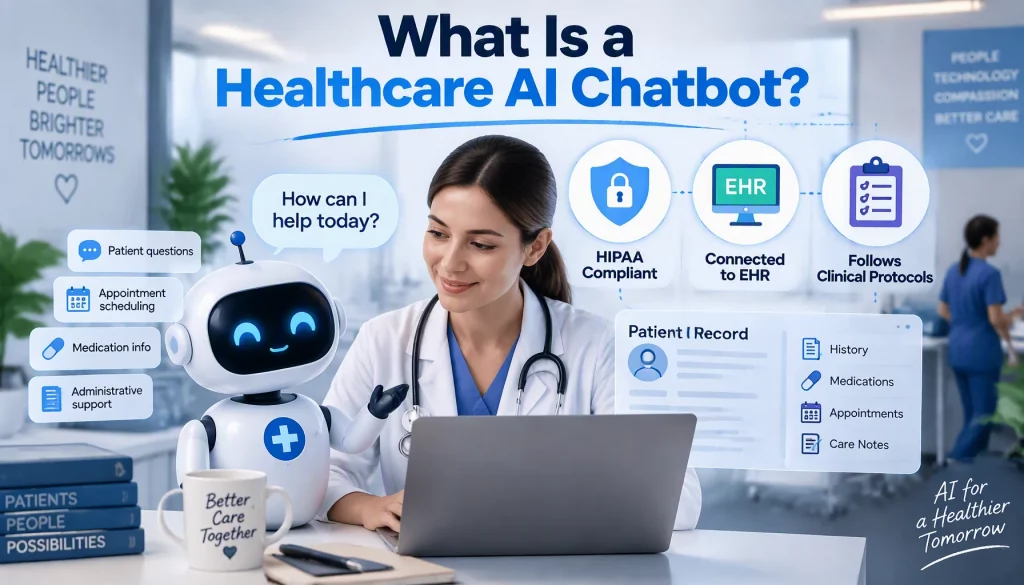
A healthcare AI chatbot is a conversational agent that handles clinical and administrative interactions inside a regulated care environment. Three things separate it from a general-purpose assistant with a medical skin on top: it operates under HIPAA, it reads from and writes to the electronic health record (EHR), and it follows clinical protocols set by your own staff. Treating it as a generic bot is where most failed pilots begin.
The stakes explain why. A retail bot that invents a product feature annoys a customer, as we describe in our guide to AI chatbots for ecommerce. A healthcare bot that misclassifies triage severity creates a patient safety incident. That gap is why ECRI ranked misuse of AI chatbots first on its 2026 list of health technology hazards, noting that general-purpose chatbots are neither regulated as medical devices nor validated for healthcare use.
Most enterprise deployments now blend two designs. Rule-based systems follow decision trees written by clinicians, so they are predictable but rigid. Large language model (LLM) systems understand open-ended patient language far better, yet they need tighter constraints to avoid confident, wrong answers. Our position is that the rules layer, not the model, is the real product: the LLM runs the conversation while the rules decide what it may say about diagnosis, medication, or treatment.
Types of Healthcare AI Chatbots and What Each One Does
The healthcare AI chatbot market has split into categories, each tuned to a different point in the patient journey. Mapping capability to use case should come before any vendor evaluation.
| Category | Primary Function | Typical Integration | Best Fit For |
|---|---|---|---|
| Symptom checker and triage assistants | Guide patients through structured symptom intake and recommend a care pathway | EHR, telehealth platform | Emergency departments and urgent care networks managing intake volume |
| Appointment scheduling agents | Book, reschedule, and confirm visits through natural conversation | Practice management systems, calendar APIs | Multi-location practices with high call center volume |
| Mental health and behavioral support bots | Deliver structured emotional support content and mood tracking | Standalone or EHR-linked | Payers and employers expanding behavioral health access |
| Chronic condition management assistants | Track medication adherence, vitals, and follow-up reminders | Remote monitoring devices, EHR | Health systems managing diabetes, hypertension, and cardiac populations |
| Administrative and revenue cycle agents | Handle insurance verification, prior authorization status, and billing questions | Claims systems, payer portals | Large health systems with heavy administrative overhead |
| Enterprise multi-agent platforms (agentic AI) | Orchestrate several specialized agents across triage, scheduling, and admin under one governance layer | Full EHR and IT stack | Health systems and payers standardizing AI governance across departments |
Buyers of a healthcare AI chatbot tend to underestimate the last row. A single scheduling bot is easy to pilot, but five point solutions mean five security reviews, five Business Associate Agreements, and five separate audit trails. That is why we plan toward a multi-agent model from the first deployment, so governance is built once instead of five times.
Which Healthcare AI Chatbot Use Cases Deliver Value First?
Where you deploy first decides whether your pilot succeeds or stalls. The four use cases below cover most enterprise healthcare AI chatbot deployments we encounter, ordered from lowest to highest clinical risk.
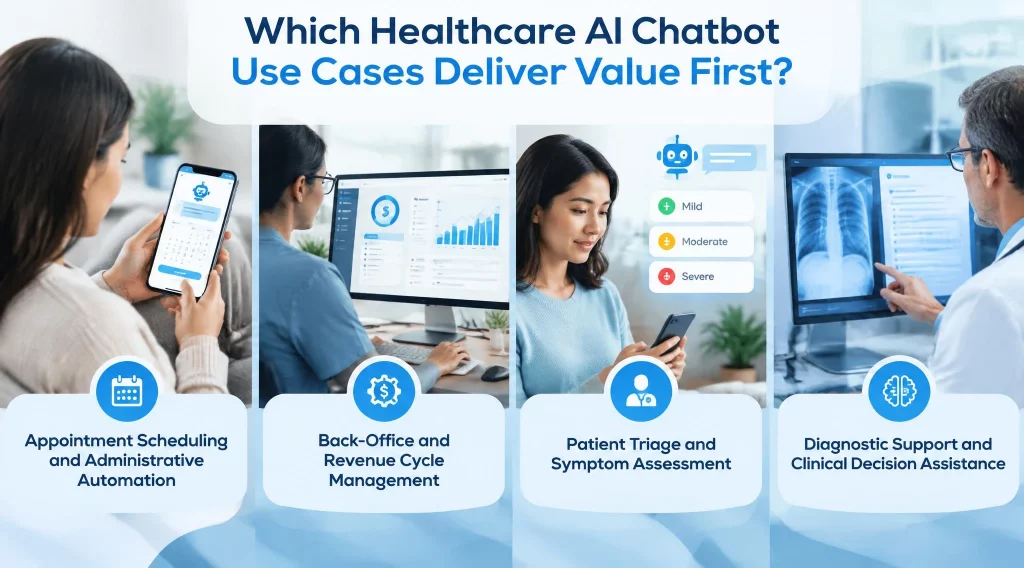
Appointment Scheduling and Administrative Automation
Scheduling is the highest-volume, lowest-risk use case for a healthcare AI chatbot, which is exactly why it should be your first deployment. A well-built chatbot handles provider availability, insurance eligibility windows, and patient preference in one conversation instead of a multi-step phone tree.
The published results show what is possible, with a caveat. Hyro’s own case study reports that Intermountain Health saw call abandonment fall 85 percent after deploying its assistants. That is a vendor-reported figure from a single multi-site health system, so treat it as a ceiling for your business case, not a forecast.
Back-Office and Revenue Cycle Management
Administration is where much of the money goes. Researchers writing in Annals of Internal Medicine estimated that administrative costs took up 34.2 percent of US national health expenditures in 2017, and insurance verification, prior authorization status checks, and billing questions fill a large share of that work.
However, the chatbot-addressable slice is far smaller than that headline, so size your business case from your own call and claim volumes. These interactions rarely touch clinical decisions, which makes them a comparatively low-risk place to automate aggressively once your PHI controls are proven on the front-end use cases.
Patient Triage and Symptom Assessment
A healthcare AI chatbot built for triage asks structured questions about symptoms, duration, and severity, then routes the patient toward self-care, a scheduled visit, urgent care, or the emergency department. The value lies in routing correctly at scale, not in diagnosing.
Design matters more than model choice here, as the safety data in the next section shows. A bot that leads with structured questions and escalates on red-flag phrases behaves very differently from one that invites free-form advice.
Diagnostic Support and Clinical Decision Assistance
This is the highest-risk category, and it belongs with clinicians rather than patients. Diagnostic support tools summarize patient history, flag drug interactions, and surface clinical guidelines for the physician to review, and they never issue a final diagnosis on their own.
Regulation is thinner than most buyers assume. Law-firm analyses of FDA’s January 2026 revision, including one from Covington, note that its clinical decision support guidance addresses clinician-facing software only. Consequently, any vendor claiming its chatbot can diagnose independently of clinician review should raise an immediate flag for your legal team.
How Safe Is Healthcare AI Chatbot Advice for Patients?
Patients are already skeptical of any healthcare AI chatbot, and that instinct is healthy. In a Harris Poll of 2,057 US adults for Merck Manuals, 62 percent had used AI tools for medical information, and about 9 in 10 of those users took steps to verify it, most often by asking a healthcare professional.
The verification habit is well founded. A randomized study in Nature Medicine gave 1,298 participants ten medical scenarios. Tested alone, the LLMs identified the right condition in 94.9 percent of cases. With real people using them, that fell to under 34.5 percent, no better than a control group using ordinary search. Participants struggled to tell good suggestions from bad ones.
Our reading is that the model’s medical knowledge was not the bottleneck. The conversation was. That is the strongest argument for bot-led structured intake with hard escalation rules over open-ended advice, in any healthcare AI chatbot, and it is why your deployment should make verification easy instead of fighting it.
When to Trust the Answer
Logistics questions, appointment availability, office hours, insurance coverage basics, and medication refill status are low-risk territory. Chatbot answers are reliable here because they pull from structured system-of-record data instead of generating a probabilistic response.
When to Escalate to a Human Clinician
Any of the following should bypass the bot and reach a person immediately:
- New or worsening symptoms: A patient reporting chest pain, shortness of breath, or a sudden change in condition needs a clinician, not a script.
- Medication changes: Any request to start, stop, or adjust a drug, or a question about interactions, belongs with a pharmacist or prescriber.
- Mental health crisis language: Phrases that suggest self-harm route straight to a trained human, with no AI reply in between.
- Requests that contradict clinical guidance: When a patient asks the bot to confirm advice their physician gave differently, the bot hands off rather than arbitrates.
Your team should design these triggers as a first-class requirement rather than an afterthought bolted on before launch. In our experience, teams that do so spend far less time redesigning workflows after go-live.
What Does HIPAA Require of a Healthcare AI Chatbot?
Compliance is not a certificate you buy once. It is an operating discipline that reaches every layer of a healthcare AI chatbot, from the data it stores to the vendor contract that governs it. The table turns the core requirements into contract language and evidence you can ask for.
| Control | What to require | Proof to request |
|---|---|---|
| Business Associate Agreement | Signed before the first patient message; restricts use of your PHI for model training unless you authorize it in writing | Executed BAA and the vendor’s subprocessor list |
| Minimum necessary access | The bot retrieves only the PHI a task needs, enforced at field level rather than through one broad database | Data-flow diagram for each use case |
| Encryption | PHI encrypted in transit and at rest | Key-management documentation |
| Access control | Role-based access for staff and system components, plus multi-factor authentication | Role matrix and periodic access reviews |
| Audit logging | An immutable log entry for every access event and every bot response | A sample log export your compliance team can read |
| Breach notification | Vendor reports incidents within the BAA timeline, never later than the 60 days HIPAA allows | Incident response runbook |
Any healthcare AI chatbot vendor that creates, receives, maintains, or transmits PHI on your behalf is a business associate. HHS’s cloud computing guidance goes further: a cloud provider is a business associate even if it stores only encrypted PHI and never holds the key. The BAA is also the most commonly skipped step we see in rushed AI pilots, and it leaves your organization, the covered entity, directly exposed if the vendor mishandles data.
One nuance most vendor pages skip concerns encryption. Today the Security Rule treats it as an “addressable” specification. The proposed rule HHS published in the Federal Register in January 2025 would remove the addressable-versus-required distinction and make encryption and multi-factor authentication mandatory. It was not final as of this writing, but retrofitting encryption is expensive, so build to the proposed standard now.
Which Guardrails Keep a Healthcare AI Chatbot Safe?
Compliance proves the system was built correctly. Guardrails prove it behaves correctly while a real patient is typing, and this is where most vendors quietly fall short.
We structure every healthcare AI chatbot deployment around what our team calls the four-gate model, and we walk prospective clients through it before any integration code is written:
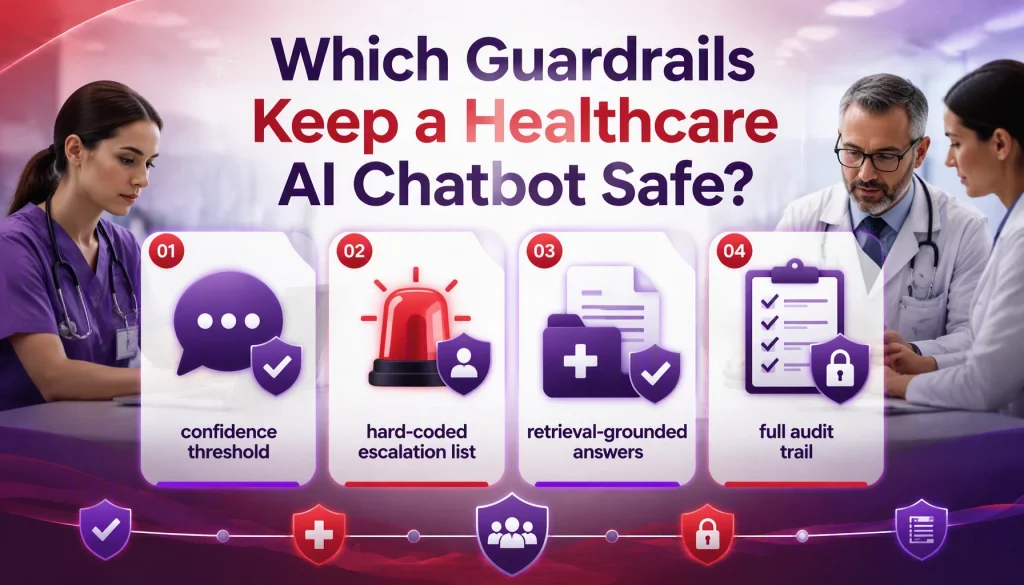
- Gate one, confidence threshold: The agent says “I am not certain, let me connect you with a nurse” instead of guessing when it lacks enough information.
- Gate two, hard-coded escalation list: Symptom phrases such as chest pain, suicidal ideation, and difficulty breathing bypass the AI entirely and route to a human, with no override switch that a well-meaning administrator can quietly disable.
- Gate three, retrieval-grounded answers: Clinical answers come only from your organization’s approved knowledge base, not the model’s general training data, which sharply reduces hallucination risk on medical claims.
- Gate four, full audit trail: Your compliance team can review every conversation directly instead of depending on the vendor’s engineers.
So the question for your evaluation committee is not which AI model a vendor uses. It is whether they can show the exact rule that stops the chatbot from answering a chest pain complaint. A vendor who cannot answer that in one sentence is not ready for production, and we invite prospective clients to run the same test on us. Our breakdown of AI agent deployment in healthcare walks through the escalation architecture in more depth.
Practical Safety Checklist Before a Healthcare AI Chatbot Goes Live
The checklist below condenses the four gates and the HIPAA controls into pass-or-fail tests for any healthcare AI chatbot. You should run it in staging with real transcripts from your own patient population, not with vendor demo scripts.
| Check | Pass condition | Typical owner |
|---|---|---|
| Escalation list stress test | The bot hands off on misspelled, slang, and non-English versions of every red-flag phrase | Clinical lead |
| Confidence threshold tuning | Low-confidence answers route to a human, with the threshold tuned on your transcripts | Clinical informatics |
| Grounding check | Every clinical answer traces back to an approved source with a review date | Clinical informatics |
| Out-of-scope refusal | The bot declines diagnosis, dosing advice, and medication changes | Compliance |
| PHI in logs and prompts | No unredacted PHI in debug logs, analytics, or third-party model calls without a BAA | Security |
| Audit log walkthrough | Compliance reads a sample log end to end and can reconstruct a full conversation | Compliance |
| Human handoff coverage | A staffed nurse line or queue exists for every hour the bot is live, nights included | Operations |
| Rollback | You can switch the bot off channel by channel without opening a vendor ticket | IT |
The seventh row is the one teams forget. A bot that escalates to an unstaffed queue at 2 a.m. is worse than no bot at all.
Leading Healthcare AI Chatbot Solutions Compared
No single healthcare AI chatbot wins across every category, so the table compares representative options by focus and by the signals worth verifying. The entries reflect vendors’ own published claims, which you should confirm during evaluation.
| Solution | Focus | Signals to verify | Watch-out |
|---|---|---|---|
| Ada Health | Patient-facing symptom assessment and triage | EU MDR Class IIa certification announced in December 2022 | An EU certification is not FDA clearance or HIPAA compliance, so confirm the US posture |
| Infermedica | Triage, intake, and follow-up modules delivered through an API | MDR Class IIb certification | Clinical engine first, so plan the patient experience layer and your US data-handling terms |
| Hyro | Call center, web, and SMS agents for health systems | Epic integration for scheduling, verification, and refills | Centered on access and administrative tasks rather than clinical triage |
| General-purpose LLM assistants (ChatGPT, Claude, Gemini, Copilot) | Broad question answering and drafting | Some vendors offer a BAA on enterprise plans; confirm in writing | Not regulated as medical devices or validated for healthcare, per ECRI, so wrap them in your own guardrails |
Because regulators have said little about patient-facing chatbots, the burden of validation lands on you. You should ask each vendor for validation studies on a patient population like yours, and treat a certification as one input, not a verdict.
Viability deserves the same scrutiny as accuracy in any healthcare AI chatbot purchase. Babylon Health, once a flagship AI symptom checker, filed for Chapter 7 bankruptcy in August 2023, as Healthcare Dive reported, after an insurer declined to renew contracts that the company said made up nearly half of its 2022 revenue. Your BAA should cover data return, export formats, and transition support before you ever need them.
What the Evidence Shows: Effectiveness and Limitations
The direction of the healthcare AI chatbot market is clear even if the pace varies. McKinsey’s survey of US healthcare leaders, fielded in the fourth quarter of 2025, found that half of organizations have implemented generative AI, up from 25 percent in late 2023, as Becker’s Hospital Review reported.
Deloitte’s survey of 100 US health system and health plan technology executives adds that 61 percent are already building agentic AI initiatives or have secured budget, and 98 percent expect at least 10 percent cost savings within two to three years. Agentic AI, in this context, means a system that plans and executes multi-step tasks across connected tools, such as checking a calendar, verifying insurance eligibility, and confirming an appointment in one flow. These are executive expectations, not measured savings.
The divide inside that data matters more than the headline. Deloitte found that 82 percent of early adopters pursue multi-agent solutions built for scale, while 92 percent of “watcher” organizations still prefer point solutions. Only 13 percent of watchers expect savings above 20 percent, against 59 percent of early adopters. The fragmentation problem described earlier is therefore partly a strategy choice.
Implementation Challenges in Clinical Settings
In practice, the limiting factor for a healthcare AI chatbot is organizational readiness, not the technology. Four blockers recur across deployments.
- EHR data quality and integration depth: One-way integrations create reconciliation work later, so confirm real-time, bidirectional sync during evaluation, not after signing.
- Workflow fit: A bot that adds a step for nurses gets bypassed, so map the handoff before anyone builds it.
- Escalation ownership: Someone must own the nurse queue, the response-time target, and the review of missed escalations.
- Clinical staff buy-in: Clinicians adopt tools they helped test, so involve them in designing the red-flag list.
All four take longer to build than the chatbot deployment itself, which should shape your timeline. Organizations still running paper-based or heavily fragmented EHR systems should fix that first, since the integration gap alone can stall a project for months.
Enterprise Deployment Cost Framework
A healthcare AI chatbot budget built on a per-seat license quote covers only one of four cost categories. Organizations that budget for just that one are the ones that run out of runway mid-project.
| Cost category | What it covers | Where budgets usually slip |
|---|---|---|
| Platform licensing | Core chatbot software and hosting | The most visible line, but rarely the swing factor |
| EHR and systems integration | Connecting the agent to scheduling, records, and billing systems | Usually the largest line, and it grows with every downstream system |
| Compliance and security review | BAA negotiation, penetration testing, audit logging setup | Smaller, but delays here block go-live |
| Clinical workflow design and staff training | Defining escalation rules, testing edge cases, onboarding staff | Most often underfunded, and it drives adoption |
The license fee rarely determines total cost of ownership. Integration complexity, meaning how many downstream systems the agent must talk to, drives the real swing between a small pilot and an enterprise rollout.
Phasing helps. Scheduling first, then triage, then administrative automation spreads the integration cost over a longer timeline and reaches production faster on each use case. Every vendor should price all four rows in writing, because a quote that covers only the first row is a demo, not a budget.
Conclusion
A healthcare AI chatbot only delivers value when compliance, clinical safety, and integration planning happen before the first patient conversation. Your enterprise should start with the lowest-risk, highest-volume use case, scheduling or basic triage routing, and build guardrails and an audit trail from day one. Diagnostic support and administrative automation come next, once the model has proven it works safely.
To map a HIPAA-compliant deployment plan onto your patient volume and technology stack, explore AI Hive’s healthcare AI solutions. You can also contact our team at AI Hive to start the conversation.