

Your support queue fills up every night with the same three questions: where is my order, does this come in a different size, and why hasn’t my refund shown up yet. An AI chatbot for eCommerce exists to answer those questions in real time, recover carts before shoppers close the tab, and free your team to handle the escalations that actually need a human. This guide breaks down what these tools do well, what they cost, and how to choose one that fits your platform and your growth stage.
Key Takeaways
|
What Is an AI Chatbot for eCommerce, and Why Does It Matter in 2026?
An AI chatbot for eCommerce is a conversational layer that sits inside your storefront, your help center, or a messaging channel like WhatsApp or Instagram, and it uses a large language model to understand what a shopper is asking rather than matching keywords to a script. Consequently, it can hold a real conversation about sizing, compare two products a shopper is torn between, or explain a delayed shipment without a human typing a single word. This is a meaningful shift from the decision-tree bots that dominated eCommerce support through the late 2010s, which could only follow a fixed set of branches and broke the moment a shopper phrased a question in an unexpected way.
The stakes are higher in 2026 because shopper expectations have moved faster than most support teams have staffed up to meet them. Furthermore, Gartner reports that 58 percent of customers have already used generative AI tools to complete a task themselves, and that figure climbs to 74 percent in B2B buying contexts.
In practice, this means your customers are not waiting for you to catch up. They are already comfortable typing a question into a chat window and expecting a useful answer on the first try, which raises the bar for what a chatbot on your own site needs to deliver.
4 Core Features That Separate a Real AI Chatbot for eCommerce From a Basic FAQ Bot
A surprising number of tools marketed as “AI chatbots” are still rule-based scripts with a language model bolted on for tone. That distinction matters once you are the one paying the invoice. Specifically, you should evaluate any candidate against four capabilities that a genuine AI agent brings to an eCommerce storefront.
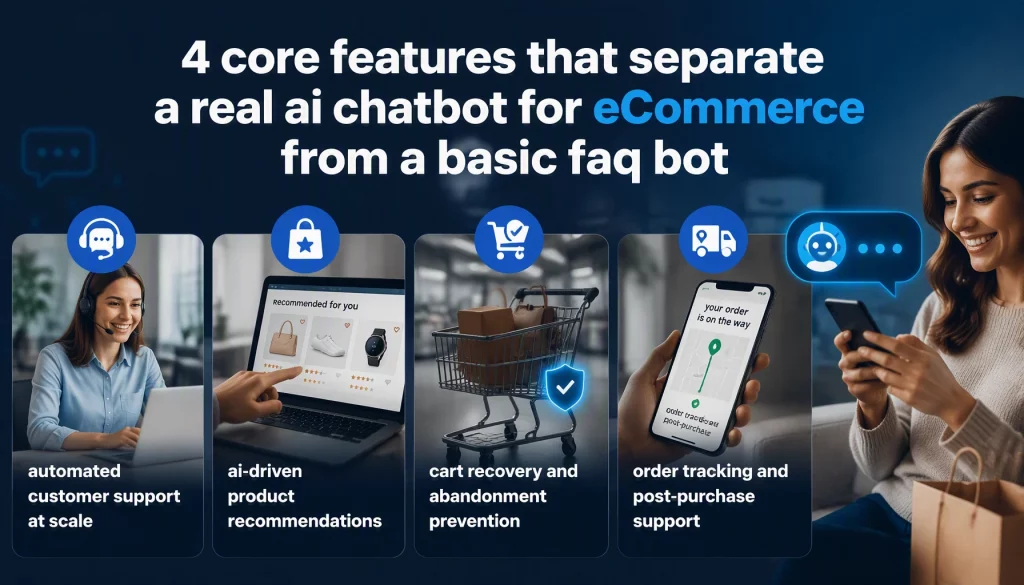
Automated Customer Support at Scale
The chatbot should resolve the repetitive tier-one volume, order status, return eligibility, sizing questions, and shipping policy, without escalating every third message to a human. Moreover, it needs to pull live data from your order management system rather than reciting a static FAQ page, because a shopper asking “where is my order” wants today’s tracking status, not a generic shipping timeline.
AI-Driven Product Recommendations
Beyond answering questions, a capable chatbot reads signals from the current session, browsing history, cart contents, and stated preferences, to suggest products the shopper is genuinely likely to buy. This differs from a static “customers also bought” widget because the recommendation logic responds to what the shopper just said in the conversation, not only to what they clicked.
Cart Recovery and Abandonment Prevention
Rather than waiting for an abandoned-cart email to land in an inbox hours later, the chatbot can intervene while the shopper is still on the page, surfacing a discount, answering an unspoken objection about shipping cost, or simply confirming stock availability before hesitation turns into an exit.
Order Tracking and Post-Purchase Support
We consistently see this category deliver the fastest measurable return because it directly replaces ticket volume your support team already handles by hand. A chatbot connected to your fulfillment stack can answer “when will this arrive” or “how do I start a return” without a human touching the conversation at all.
Shopify, WooCommerce, and Magento: How Integration Complexity Changes Your Chatbot Choice
The eCommerce chatbot conversation online skews heavily toward Shopify because it dominates the small-to-mid-market storefront count, but your platform choice actually determines which tools are even viable. Shopify’s API exposes order, inventory, and customer data in a fairly standardized way, so most chatbot vendors build their deepest integration there first. If your store runs on Shopify and you want a feature-by-feature comparison of the strongest options, our breakdown of the best AI chatbot for Shopify walks through pricing tiers and setup time for each contender.
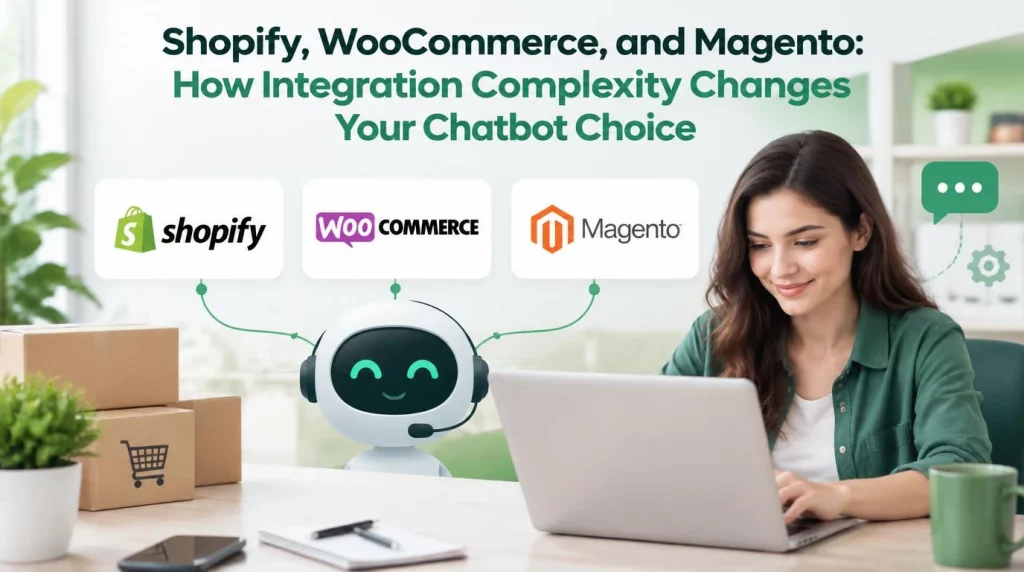
WooCommerce, by contrast, runs on WordPress, which means the chatbot needs a plugin architecture rather than a native app, and integration quality varies far more between vendors than it does on Shopify. Magento, now largely deployed as Adobe Commerce, tends to sit under larger catalogs with custom checkout flows, so enterprise buyers on that platform should weight custom API access and developer support more heavily than out-of-the-box setup speed. Therefore, the practical takeaway is this: you should request a platform-specific demo before you sign a contract, because a chatbot’s marketing page rarely tells you how deep its WooCommerce or Magento integration actually goes compared with its free chatbot options for Shopify one.
Top AI Chatbot Platforms Compared
Platform integration is only half the decision. The other half is which vendor’s AI agent you actually put in front of shoppers, and the field breaks into a few clear categories once you look past the marketing pages.
| Platform | Primary Strength | Best Fit |
| Gorgias | Native Shopify-first helpdesk with AI resolution built around ecommerce tickets and revenue-driving conversations, plus a deep app ecosystem spanning Klaviyo and Recharge. | Shopify and BigCommerce stores that want support and sales handled inside one tool. |
| Tidio (Lyro) | Sales-focused AI agent with transparent entry-level pricing and revenue-per-chat tracking. | Small to mid-size stores on Shopify, WooCommerce, or Wix that want a fast setup and a free tier to start. |
| Intercom Fin | Full-journey AI agent with outcome-based pricing, built into a broader customer messaging suite spanning chat, email, and voice. | Mid-market to enterprise brands already running Intercom, or wanting one platform across channels. |
| Ada | Enterprise-grade autonomous resolution built for very high support volume across regulated and high-trust industries. | Large retailers that prioritize compliance credentials and volume over ecommerce-specific features. |
| Zowie | A deterministic decision engine layered on top of an LLM, built for high-stakes actions such as refunds and eligibility checks. | Enterprise retailers that need predictable, auditable behavior on sensitive support flows. |
Exact pricing is public for only a few of these vendors. Tidio publishes tiers starting near $29 a month, for example, while Fin, Ada, and Zowie price custom deployments after a demo. Treat this table as a shortlist for your own trial rather than a final scorecard, since integration depth and support quality shift as these products update quarterly.
Build vs. Buy: When a Custom Chatbot Actually Makes Sense
Every enterprise retailer eventually asks whether to buy one of the platforms above or build a custom agent on top of a foundation model. For most stores, buying is the right call, and building is a costly detour a lean team tends to underestimate.
- Buy when your catalog and workflows look like everyone else’s: Standard product recommendations, order tracking, and return handling are solved problems, and a vendor platform reaches production in weeks instead of the months a custom build requires.
- Build only when your data model or compliance requirements are genuinely unusual: A retailer with a proprietary configurator, a regulated product category, or a data residency requirement no vendor supports yet has a real case for building, not just a preference for control.
- Budget for the ongoing cost of building, not just the initial build: A custom agent needs the same monitoring, retraining, and guardrail maintenance a vendor platform bundles into its subscription, and few internal teams budget honestly for that maintenance cycle.
- A middle path exists between the two: Pre-built agent templates that you configure rather than build from scratch, such as the ecommerce templates in the AI Hive agent marketplace, give you vendor-speed deployment with more control over data handling and workflow logic than an off-the-shelf SaaS chatbot allows.
What the Data Says: Conversion, Response Time, and ROI Benchmarks for eCommerce Chatbots
Vendor case studies tend to cherry-pick their best month, so it helps to anchor expectations in independent research instead. According to McKinsey’s analysis of generative AI in retail, shoppers using a gen-AI chatbot completed an order 50 to 70 percent faster than shoppers navigating a standard app flow. McKinsey also projects that gen-AI-powered decision systems in retail will drive up to 5 percent of incremental sales, alongside a 0.2 to 0.4 percentage point improvement in EBIT margin.
In addition, McKinsey estimates that generative AI could unlock $240 billion to $390 billion in economic value across the retail sector, a margin increase of roughly 1.2 to 1.9 percentage points industry-wide.
On the customer experience side, Gartner’s August 2026 customer service survey of 3,566 B2B and B2C customers found that 50 percent reported an easier interaction when GenAI support was done well. However, the same survey found customers are three times more likely to trust a third-party GenAI tool than the chatbot a company built for its own site. That gap matters for your rollout: it suggests trust is earned through consistent, accurate answers rather than assumed just because the interface says “AI-powered.”
Cost and ROI: What an AI Chatbot for eCommerce Actually Costs in 2026
Pricing in this category has fragmented into three tiers, and confusing them is the most common budgeting mistake we see. Entry-level tools charge a flat monthly subscription, typically between $50 and $300, and cap the number of conversations included.
By contrast, mid-market platforms shift to usage-based pricing on message volume or resolved conversations, which scales your bill directly with traffic, so a viral sale weekend can spike costs even without a plan upgrade. Enterprise deployments, meanwhile, often combine a platform fee with implementation services, custom integrations, and a dedicated account team, pushing annual contracts well past five figures.
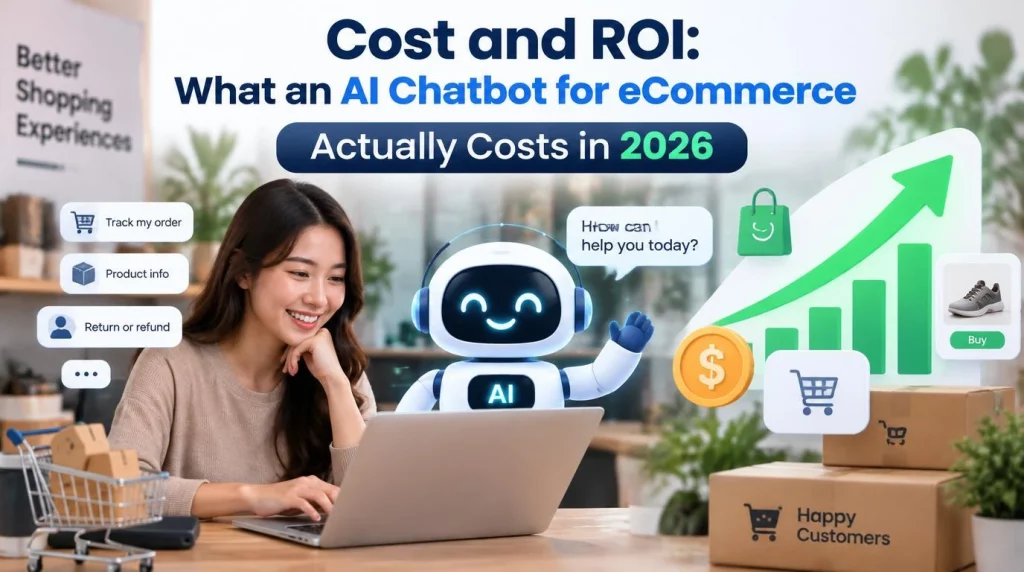
The ROI calculation, however, is more forgiving than the sticker price suggests. McKinsey’s finding that a 2 to 4 percent basket uplift is enough to justify the underlying LLM cost gives you a concrete benchmark: if your chatbot lifts average order value or conversion by even that modest margin, the tool has already paid for itself before counting the labor hours it saves your support team. Specifically, a store handling 2,000 support tickets a month that automates even half of that volume is typically looking at savings in the low five figures annually, well before any lift in sales is counted.
| Pricing tier | Typical monthly cost | Billing model | Best fit |
|---|---|---|---|
| Entry-level | $50 to $300 | Flat subscription, capped conversations | Stores under 1,000 monthly orders |
| Mid-market | Usage-based, scales with volume | Priced per message or resolved conversation | Growth-stage stores with variable traffic |
| Enterprise | Five figures annually and up | Platform fee plus implementation services | Multi-brand or high-compliance retailers |
How to Choose the Right AI Chatbot for Your eCommerce Business Size and Industry
Most comparison articles rank chatbots by feature count, which is close to useless because a feature-rich tool aimed at enterprise retailers will overwhelm a five-person team, and a lightweight tool built for solo founders will frustrate an operation running multiple warehouses. We recommend matching the tool to two variables instead: your monthly order volume and your catalog complexity.
| Store profile | Monthly order volume | What to prioritize |
|---|---|---|
| Early-stage | Under 1,000 orders | Fast, templated self-serve setup over feature depth |
| Growth-stage | 1,000 to 20,000 orders | Native help desk integration and ticket deflection |
| Enterprise | Above 20,000 orders | Data residency, SOC 2 compliance, multi-brand support |
For stores under roughly 1,000 monthly orders, a self-serve platform with templated flows and a fast setup wins over a heavier enterprise suite, because your team does not have the bandwidth to manage a complex configuration. Growth-stage stores between 1,000 and 20,000 monthly orders should prioritize platforms with strong native integration into their existing help desk, since ticket deflection at this volume is where the real savings accumulate. Enterprise retailers above that threshold need to evaluate data residency, SOC 2 compliance, and multi-brand support before feature breadth, because a single security gap at that scale carries far more downside than a missing feature.
Industry also shapes the requirement. A fashion retailer needs strong visual and sizing logic in its recommendation engine, while an electronics seller needs the chatbot to handle detailed spec comparisons accurately, and a subscription-box business needs deep integration with billing and cancellation flows rather than product discovery.
Consequently, our team builds and evaluates these deployments through the AI Hive agent marketplace, where you can compare pre-built eCommerce agent templates against your specific platform and catalog before committing to a build.
Real-World Use Cases: Closing Sales and Supporting Customers After Purchase
Two moments in the shopper journey consistently show the clearest return, and they sit at opposite ends of the funnel. At the point of decision, a shopper comparing two similar products often abandons the page simply because no one answered a quick question about fit, compatibility, or delivery timing. A chatbot that resolves that hesitation in the moment converts a browsing session that would otherwise have gone cold.
On the other end, post-purchase support, tracking updates, return initiation, exchange requests, is high-volume, low-complexity work. A well-configured agent handles it without any loss of quality compared with a human rep, which is exactly why it produces the fastest payback of any use case we evaluate.
A mid-size home goods retailer, for example, typically fields a large share of its ticket volume on “where is my order” alone. Once that single query type is automated end to end, connected live to the carrier’s tracking API rather than a static shipping estimate, the support team’s remaining time shifts toward higher-value work like handling damaged-item claims or building loyalty with repeat buyers, which no chatbot should be handling unsupervised in the first place.
Where AI Chatbots Still Fall Short
We would be doing you a disservice if we sold this as a fully solved problem, because it is not. Complex disputes, anything involving a damaged or missing high-value item, a policy exception, or a visibly frustrated customer, still need a human.
Specifically, Gartner’s research backs this up directly: 87 percent of customers in its 2026 survey said companies deploying GenAI for support must still provide a path to a human agent. Forcing shoppers through several failed AI attempts before reaching a person is, in Gartner’s own words, one of the fastest ways to make a customer abandon the tool altogether.
In addition, a chatbot is only as accurate as the data it can see. If your inventory feed lags by even a few hours, the chatbot will confidently recommend a product that just sold out, which damages trust faster than a human agent making the same mistake would, because shoppers hold automated systems to a stricter standard. Your enterprise should treat data freshness as a launch requirement, not a nice-to-have, before any chatbot goes live on a revenue-generating page.
Conclusion
An AI chatbot for eCommerce earns its cost fastest in post-purchase support and cart recovery, and the McKinsey and Gartner data above gives you a defensible benchmark to hold any vendor against before you sign a contract. Your next step is matching the tool to your platform, whether that is Shopify, WooCommerce, or Magento, and to your order volume rather than chasing the longest feature list.
If you want to compare pre-built eCommerce agent templates against your own catalog and platform, talk to our team and we will walk through what fits your stack.