
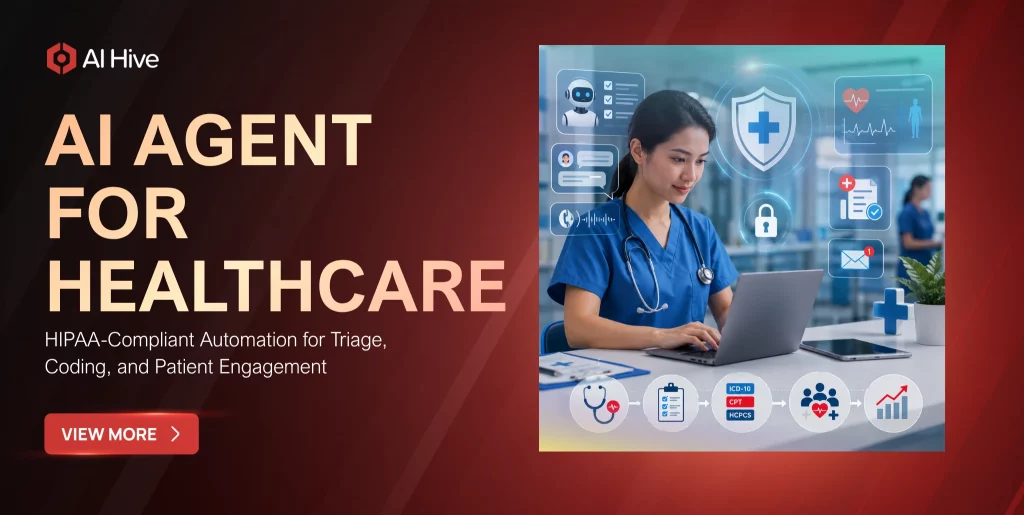

Healthcare organizations are caught between two forces that do not naturally coexist: the imperative to contain operating costs and the obligation to maintain clinical quality and regulatory compliance. Administrative work consumes an estimated 34% of total healthcare spending in the United States, according to JAMA research. Much of that burden, including appointment scheduling, insurance verification, medical coding, and patient follow-up, does not require clinical judgment. It requires accurate, consistent, rules-based execution at scale, which is precisely what AI agents are built to deliver.
In 2026, HIPAA-compliant AI agents are moving from proof-of-concept to production across hospital systems, insurance networks, and specialty practices. According to Gartner’s Predicts 2026 healthcare technology forecast, agentic AI will reduce administrative processing costs by up to 30% while maintaining strict regulatory compliance. Leading health systems are already validating that projection with their own production data. This article examines which healthcare workflows benefit most from AI Agent for Healthcare automation, what HIPAA compliance actually requires in practice, and how to evaluate whether an AI agent platform is genuinely enterprise-ready for healthcare.
Key Takeaways
|
Why Healthcare AI Automation Has Accelerated in 2026
Three converging factors explain why healthcare AI agent adoption has accelerated faster than any previous technology cycle in the industry.
First, the administrative burden has become clinically unsustainable. Physicians in the United States spend an average of 4.5 hours per day on administrative tasks, according to a 2025 AMA survey, time that cannot be spent with patients. AI agents that automate documentation, coding, and scheduling do more than reduce cost. They return clinical capacity to a system that badly needs it.
Second, the compliance landscape has matured. HIPAA-compliant AI deployments are no longer rare exceptions that require extraordinary legal review. Business associate agreements, data processing addendums, and audit trail requirements are now well understood by both AI platform vendors and healthcare procurement teams, which has reduced contracting delays.
Third, EHR integration has improved dramatically. The widespread adoption of FHIR-compliant APIs across Epic, Cerner, and Meditech means AI agents can now read and write structured patient data without the custom integration work that once required months of development.
5 Core Use Cases of AI Agent for Healthcare in 2026
The five use cases below are the highest-volume, lowest-clinical-risk processes where healthcare AI agent deployments have already moved from pilot to production.
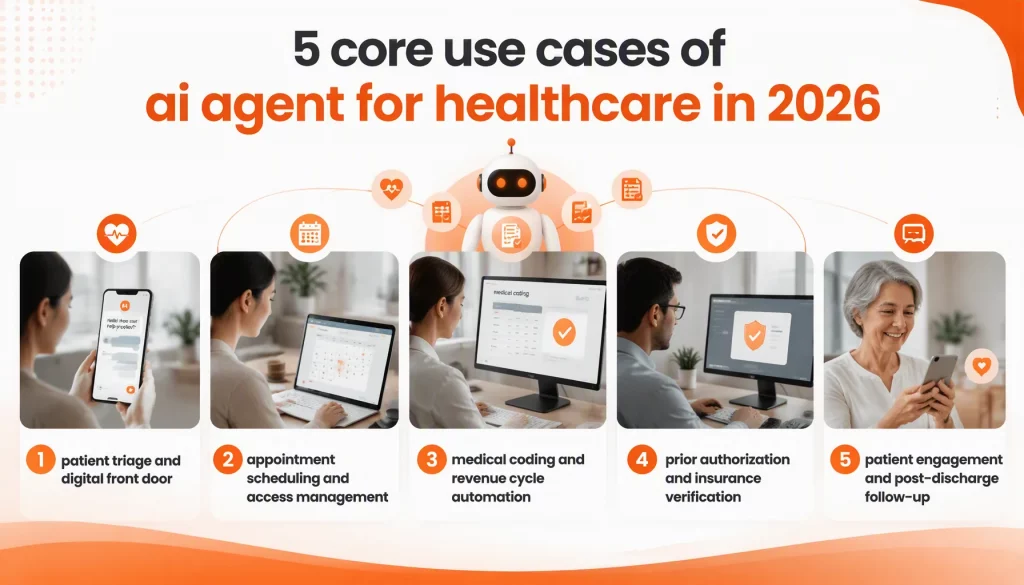
1. Patient Triage and Digital Front Door
Patient triage AI agents serve as the first point of contact in the patient journey, handling intake, symptom assessment, and routing before a patient ever speaks with a clinical team member. These agents conduct structured symptom interviews using validated clinical frameworks such as Infermedica’s triage engine, assess acuity level, and route the patient to the appropriate level of care: emergency, urgent care, telehealth, or a scheduled appointment.
Production deployments of healthcare triage AI agents have demonstrated 51% containment rates for Medicaid partner networks, meaning more than half of patient contacts are fully resolved without requiring a live clinician or administrative staff member. DestiLabs reported that a patient-booking AI agent cut support inquiries by 67% for a regional health system, freeing patient access staff to handle complex scheduling and insurance verification cases.
Critically, triage AI agents must include a clearly defined escalation path to a clinical professional for any inquiry involving chest pain, difficulty breathing, neurological symptoms, or other high-acuity presentations. The agent’s role is assessment and routing. Clinical judgment remains the exclusive domain of licensed practitioners.
2. Appointment Scheduling and Access Management
Appointment scheduling is one of the highest-volume, lowest-complexity administrative tasks in healthcare, and one of the best fits for AI agent automation. Scheduling agents integrate with EHR and practice management systems to check provider availability, match patient needs to appropriate appointment types, send multilingual confirmations and reminders, process cancellations, and fill open slots from waitlists, all without manual intervention.
The measurable outcomes are substantial. Health systems deploying AI scheduling agents report $3.2 million in revenue gains from automated waitlist management and no-show reduction, driven primarily by timely reminders and real-time slot backfilling that would be impractical for human schedulers to manage manually at this scale.
3. Medical Coding and Revenue Cycle Automation
Medical coding is a high-stakes, high-volume process where accuracy directly affects revenue. Incorrect codes result in claim denials, delayed reimbursement, and in some cases compliance penalties. AI agents trained on clinical documentation and ICD-10/CPT coding standards can review clinical notes, propose accurate code assignments, flag missing documentation that would support additional codes, and submit claims with a level of consistency that human coding teams struggle to maintain at scale.
Microsoft Azure combined with Nuance’s clinical AI tooling represents one validated approach to automated clinical documentation and coding in enterprise health systems. AI Hive’s modular architecture supports integration with any clinical documentation platform through our FHIR-compliant API layer, so your organization can deploy coding automation without being locked into a single vendor ecosystem.
4. Prior Authorization and Insurance Verification
Prior authorization is one of the most time-consuming administrative burdens in US healthcare. It consumes an estimated 1.5 hours of physician time per week, according to the AMA’s prior authorization physician survey. AI agents can automate most of the prior authorization workflow: retrieving payer requirements, assembling the required clinical documentation from the EHR, submitting the authorization request, tracking status, and flagging exceptions that require physician attestation.
Insurance verification agents perform real-time eligibility checks, coverage determination, and co-pay calculation at scheduling, which eliminates coverage surprises that generate patient complaints downstream.
5. Patient Engagement and Post-Discharge Follow-Up
Patient engagement between clinical encounters is a significant gap in most health system workflows. AI agents can automate structured post-discharge follow-up conversations, checking for symptom recurrence, medication adherence, and red-flag presentations that warrant clinical review. These agents operate through patient-preferred channels, such as SMS, patient portal messaging, or voice, and escalate clinical concerns to the care team based on predefined protocol thresholds.
What HIPAA Compliance Actually Requires for AI Agents
HIPAA compliance for AI agents is frequently misunderstood. No AI model is inherently HIPAA-compliant; compliance is determined entirely by how the system is deployed, governed, and monitored. Healthcare organizations evaluating AI agent platforms should assess four specific compliance requirements.
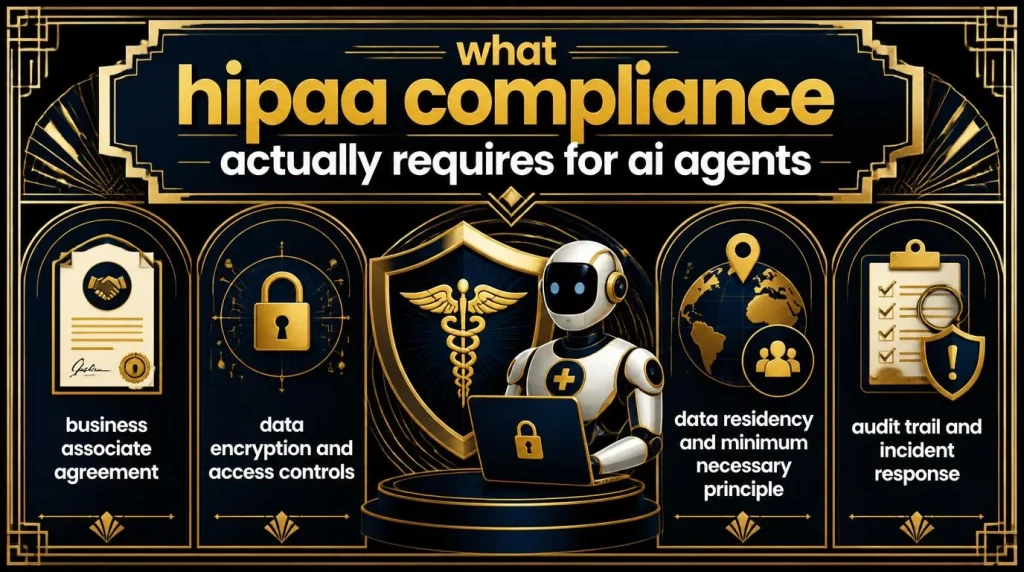
Business Associate Agreement
Any AI platform that processes protected health information on behalf of a covered entity must execute a signed Business Associate Agreement (BAA) before the system goes live. The BAA establishes the vendor’s obligations regarding PHI handling, breach notification, and security controls. Vendors that cannot or will not sign a BAA are not suitable for healthcare AI deployments, regardless of their technical capabilities.
Data Encryption and Access Controls
HIPAA’s Security Rule requires encryption of PHI in transit and at rest, role-based access controls that limit PHI visibility to authorized personnel, audit logging of all PHI access events, and automatic session termination for inactive users. AI agent platforms must implement all of these controls at the infrastructure level, not as optional add-ons. Our enterprise security architecture enforces AES-256 encryption and MFA-backed access control by default.
Data Residency and Minimum Necessary Principle
Healthcare organizations frequently operate in geographies with specific data residency requirements that restrict where patient data can be processed and stored. An AI agent platform that processes all data in a shared cloud environment may not satisfy these requirements. AI Hive’s modular deployment architecture supports on-premise and private cloud deployment, ensuring PHI never transits a shared infrastructure environment.
Audit Trail and Incident Response
HIPAA requires maintaining comprehensive audit logs of all PHI access and processing events, along with a documented incident response procedure for breaches. AI Hive generates immutable audit logs for every agent interaction involving PHI, with built-in incident classification and escalation workflows that support your compliance team’s breach notification obligations under HIPAA’s 60-day notification requirement.
| HIPAA Requirement | AI Hive Implementation | Documentation Provided |
| Business Associate Agreement | Signed BAA available for all healthcare clients | BAA document |
| PHI encryption (transit and rest) | AES-256 encryption enforced by default | Security architecture doc |
| Role-based access controls | Granular RBAC with MFA enforcement | Access control policy |
| Audit logging | Immutable audit trail for all PHI interactions | Audit log specifications |
| Data residency | On-premise and private cloud deployment options | Deployment architecture doc |
| Incident response | Automated breach classification and notification | Incident response runbook |
EHR Integration: The Technical Foundation of Healthcare AI Agent Success
An AI agent for healthcare that operates in isolation from your EHR is not an operational tool. It is a demonstration. Production value requires bidirectional integration with your clinical and administrative systems, and the quality of that integration determines the quality of the agent’s output.
FHIR API Integration
The HL7 FHIR standard has become the predominant integration framework for healthcare AI deployments in 2026. FHIR R4 APIs support structured data exchange with Epic, Cerner, Meditech, and most major EHR platforms, enabling AI agents to read patient demographics, appointment history, clinical notes, and medication records in a standardized format. AI Hive’s platform includes a native FHIR R4 integration layer that eliminates the custom development work previously required to connect AI tools to clinical systems.
Legacy System Connectivity
Many healthcare organizations operate legacy systems, particularly in revenue cycle and laboratory information management, that do not support FHIR APIs. AI Hive’s integration architecture supports HL7 v2 messaging, direct database connectivity with appropriate security controls, and robotic process automation bridges for systems that require screen-level integration. Healthcare AI agents can therefore operate across your entire technology portfolio, not just your most modern systems.
Build vs. Buy vs. Partner: AI Agent for Healthcare Deployment Models
Healthcare organizations evaluating AI agent deployment must choose among three models, each with distinct tradeoffs in cost, timeline, and compliance risk.
| Model | Cost | Timeline | Compliance Risk | Best For |
| Build in-house | $40K-$350K+ | 6-18 months | High (internal) | Large health systems with AI engineering teams |
| SaaS point solution | $20K-$80K/year | 4-8 weeks | Moderate (shared infra) | Single-use-case pilots |
| AI Hive Modular Platform | Enterprise pricing | Days to weeks | Low (on-prem option) | Multi-use-case enterprise deployments |
We designed AI Hive’s healthcare deployment model specifically for organizations that need multi-use-case automation across triage, coding, scheduling, and engagement, deployed on infrastructure that meets their data residency and compliance requirements without the cost and timeline of a custom build. Our enterprise AI agent platform includes a dedicated healthcare vertical with pre-built FHIR integrations, BAA execution, and PHI-aware agent templates drawn from production healthcare deployments. Our Phase 1 rollout maps your priority workflow, executes the BAA, and connects your FHIR R4 endpoint within the first three weeks.
How to measure Healthcare AI Agent ROI
Healthcare AI agent ROI frameworks must account for both cost reduction and revenue protection. Administrative errors that result in claim denials carry both a direct cost, in the form of rework and resubmission, and an indirect cost, in the form of delayed reimbursement and write-offs. McKinsey’s research on digital investment priorities in health systems confirms administrative automation as among the fastest-realized returns. A complete ROI model should include the following four components.
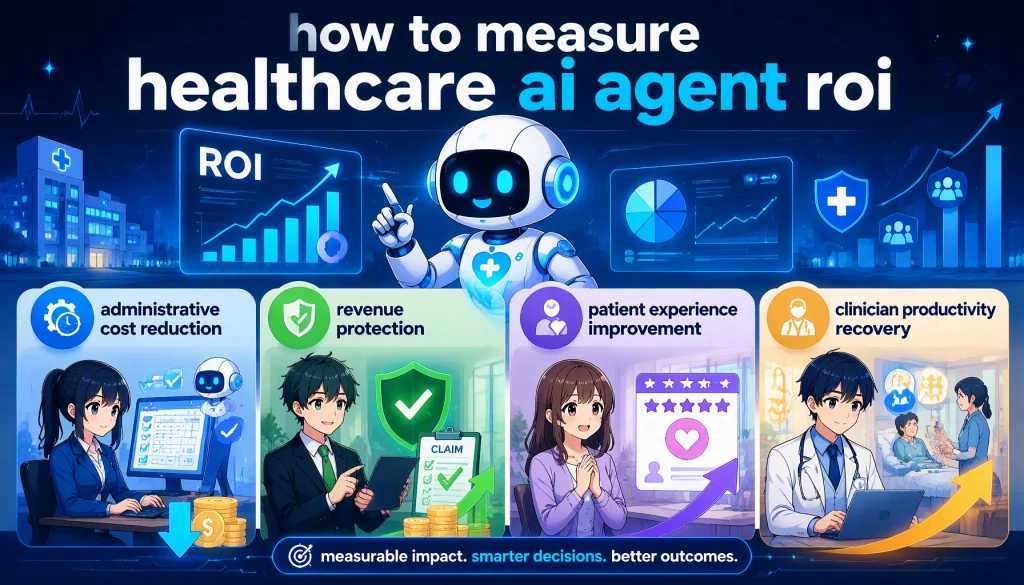
- Administrative cost reduction: Time savings from automated scheduling, prior authorization, and coding workflows, expressed as FTE hours recovered and converted to dollar savings at your blended administrative labor rate.
- Revenue protection: Reduction in claim denial rate and associated rework costs, plus incremental revenue from faster prior authorization approvals and reduced no-show rates.
- Patient experience improvement: HCAHPS score improvement attributable to faster scheduling, better follow-up, and reduced wait times, which matters for both patient retention and value-based care contract performance.
- Clinician productivity recovery: Hours returned to clinical practice from documentation and administrative task automation, expressed in terms of additional patient capacity.
For context on how healthcare AI agent deployments compare to implementations in other regulated industries, review our enterprise AI agent use cases library and our case studies for deployment-specific ROI data.
Conclusion
Healthcare organizations that deploy HIPAA-compliant AI Agent for Healthcare in 2026 are not taking a risk. They are managing the risk of not acting. Administrative costs consuming 34% of healthcare spending represent an unsustainable structural burden, and the technology to automate a significant portion of that burden is operational today. The question is not whether AI agents belong in healthcare. It is which workflows to automate first, on which platform, and with which compliance architecture.
AI Hive brings together four capabilities that healthcare organizations need from an AI agent platform: a modular deployment model that supports on-premise installation for data sovereignty, pre-built FHIR integrations that eliminate months of custom development, a full HIPAA compliance framework with BAA execution and audit logging, and a team of AI engineers who can build and deploy healthcare-specific agent workflows in days rather than months.
If your organization is evaluating AI agent deployment for administrative automation, patient engagement, or revenue cycle optimization, we invite you to talk with the AI Hive healthcare team and explore how we can design a compliant, production-ready deployment around your specific clinical and operational requirements.