

Enterprise customer service has always been a volume problem disguised as a quality problem. Your contact center agents are not failing because they lack skill. They are failing because they spend most of their day on repetitive, low-complexity inquiries that do not need a human at all. Gartner projects that by 2029, agentic AI will autonomously resolve 80% of common customer service issues without human intervention, cutting operational costs by 30% (Gartner, 2025). In 2026, the most competitive enterprises are not waiting for that projection to materialize. They are already achieving 55-70% first-contact resolution with AI customer service agents running in production today.
This playbook covers how AI customer service agents work, where they outperform human agents, where they still need human backup, and how your enterprise can move from a fragmented pilot program to a coordinated, measurable tier-1 resolution engine.
Key Takeaways
|
What Is an AI Customer Service Agent?
An AI customer service agent is an autonomous system that handles customer inquiries across digital and voice channels: understanding natural language, accessing enterprise knowledge bases and backend systems, executing transactions, and resolving issues without requiring human involvement for each interaction. Unlike rule-based chatbots that follow rigid decision trees, AI customer service agents use large language models to interpret ambiguous requests, generate contextually appropriate responses, and adapt their approach based on customer sentiment and conversation history.
The distinction that matters architecturally is simple: a modern AI customer service agent does not just answer questions. It takes action. The agent processes refunds, updates account records, schedules callbacks, retrieves order status from logistics systems, and escalates to a human agent with a complete interaction summary when the situation exceeds its resolution capability.
AI Customer Service Agent vs. Traditional Chatbot
The table below breaks down where a true AI customer service agent diverges from a rule-based chatbot, particularly on the two capabilities that drive most of the ROI: system integration and transaction execution.
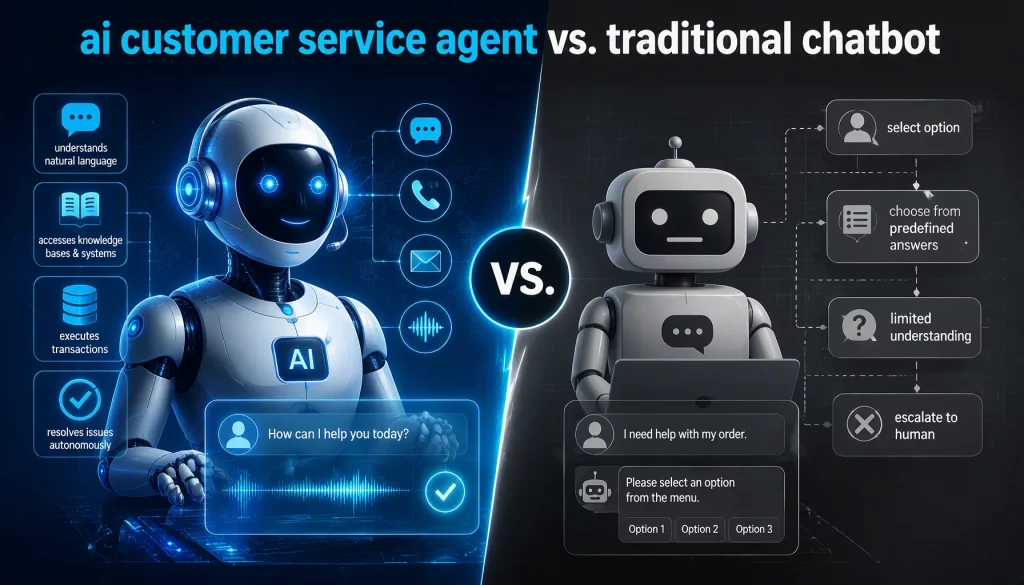
| Capability | Traditional Chatbot | AI Customer Service Agent |
|---|---|---|
| Natural language understanding | Keyword matching only | Full semantic comprehension |
| Response generation | Pre-written scripts | Dynamic, context-aware generation |
| System integration | Limited, static APIs | Real-time CRM, ERP, and logistics access |
| Transaction execution | Cannot take action | Processes refunds, updates records |
| Escalation handling | Dead-end or wait queue | Smart escalation with full context transfer |
| Self-improvement | Manual update required | Continuous learning from interaction data |
The Business Case: Why Enterprise CX Leaders Are Deploying AI Agents Now
The financial case for AI customer service agents in 2026 rests on a stark cost differential. McKinsey’s research on contact center economics points to generative AI’s ability to cut service costs meaningfully while improving consistency (McKinsey & Company, 2024). Inside AI Hive’s own enterprise deployments, we track an average cost of $0.62 per AI-resolved interaction against $7.40 for the same inquiry handled by a human agent. For an enterprise processing 100,000 customer interactions per month, that gap adds up to more than $6.7 million in annual savings, without reducing the quality of the customer experience.
In addition to direct cost reduction, AI customer service agents deliver three categories of operational value:
- Speed: AI agents respond within seconds regardless of queue depth, which eliminates the wait times that consistently rank as a top driver of customer dissatisfaction.
- Consistency: AI agents deliver identical quality on the thousandth interaction as on the first, which removes the performance variability that plagues large human teams operating under high-volume conditions.
- Scalability: AI agents absorb demand spikes, including seasonal surges, product launches, and service outages, without the six-to-eight-week hiring and training cycle required to staff human agents.
Momentum backs this up at the industry level. Salesforce’s Agentic Enterprise research shows a majority of enterprise service teams now run AI agents in production, and speed to value is a consistent theme across the reports we track (Salesforce, 2026). Across AI Hive’s own client base, most enterprises see measurable value, fewer escalations, faster handle times, better CSAT on AI-handled interactions, within the first sixty days of going live.
Tier-1 Resolution: What AI Customer Service Agents Handle Best
Not every customer inquiry carries equal complexity or equal suitability for AI resolution. The most successful enterprise deployments in 2026 follow a structured approach to tier-1 scope definition. They start with high-volume, low-complexity inquiry types and expand systematically as the agent demonstrates consistent resolution quality.
High-Resolution-Rate Inquiry Types
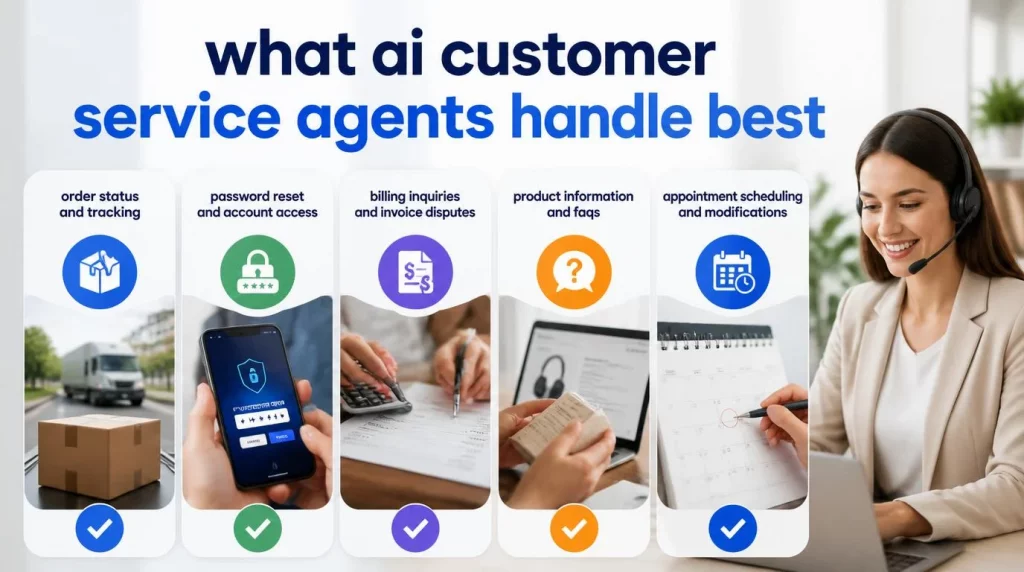
- Order status and tracking: AI agents retrieve shipping data from logistics systems in real time and deliver precise, current status without requiring a human to look up the information. Resolution rates exceed 85% for this category.
- Password reset and account access: AI agents authenticate identity through multi-factor verification and execute account recovery workflows autonomously. Resolution rates exceed 95% in most enterprise deployments.
- Billing inquiries and invoice disputes: AI agents access billing records, explain charges, and initiate approved dispute workflows without escalation. Resolution rates range from 60% to 75%, depending on the complexity of the billing structure.
- Product information and FAQs: AI agents retrieve and synthesize information from product knowledge bases, delivering accurate answers to technical and commercial questions. Resolution rates exceed 80% for well-structured knowledge bases.
- Appointment scheduling and modifications: AI agents integrate with calendar systems to book, reschedule, and cancel appointments without human involvement. Resolution rates exceed 90% for straightforward scheduling tasks.
Where Human Agents Remain Essential
Certain inquiry types consistently require human judgment, and enterprise deployments that ignore this boundary damage customer satisfaction fast. High-value retention conversations, emotionally charged complaints involving significant financial loss, and legally sensitive matters such as fraud disputes or warranty litigation call for empathy and situational judgment that AI agents cannot reliably replicate in 2026, and we do not expect that to change within the next two or three years. The most effective implementations treat AI as a tier-1 resolver and humans as a specialized tier-2 resource, not as competing channels.
Enterprise Architecture for AI Customer Service Agents
A production-grade AI customer service agent is not a standalone chatbot bolted onto your website. It is an integrated system that sits at the center of your CX technology stack and communicates in real time with every relevant data source and workflow engine your enterprise operates.
Core Integration Requirements
Your AI customer service agent must integrate bidirectionally with your CRM to read customer history and write interaction summaries, with your order management system to retrieve and update order status, with your knowledge base to surface accurate product and policy information, and with your escalation routing system to transfer conversations to human agents with full context. Our enterprise AI agent platform provides native connectors for Salesforce, Zendesk, ServiceNow, SAP, and all major order management platforms, which lets your team deploy without custom integration development.
Because our platform is model-agnostic, you can run GPT-4o, Claude, or an open-weight model such as Llama behind the same agent without re-architecting your integrations, which keeps you out of a single-vendor lock-in position.
Omnichannel Deployment Strategy
Enterprise customers interact with your brand across multiple channels: web chat, mobile app, email, SMS, voice, and social messaging. Your AI customer service agent must deliver consistent resolution quality across all of these surfaces, maintaining conversation continuity when a customer switches from chat to voice mid-interaction. Our orchestration layer manages this cross-channel continuity natively, so the agent retains full conversation context regardless of channel transitions.
Compliance and Data Governance
AI customer service agents process customer PII at massive scale: names, account numbers, payment details, and in some industries, health information. Enterprise deployments must enforce GDPR, CCPA, HIPAA where applicable, and industry-specific regulatory requirements at the platform level, not as an afterthought. Our architecture includes built-in PII detection, data residency controls, and complete audit logging to support regulatory compliance in any geography.
For a comprehensive view of what AI agents are doing across industries, review our enterprise AI agent use cases library.
Implementation Roadmap: From Pilot to Production
Enterprise service leaders are already under real pressure to move fast here, a dynamic Gartner has documented consistently since its original 2029 resolution forecast (Gartner, 2025). In our experience, though, the gap between piloting an AI customer service agent and running it in full production is rarely a technology problem. It is a process and governance problem. The following phased approach has proven effective across AI Hive’s enterprise deployments.
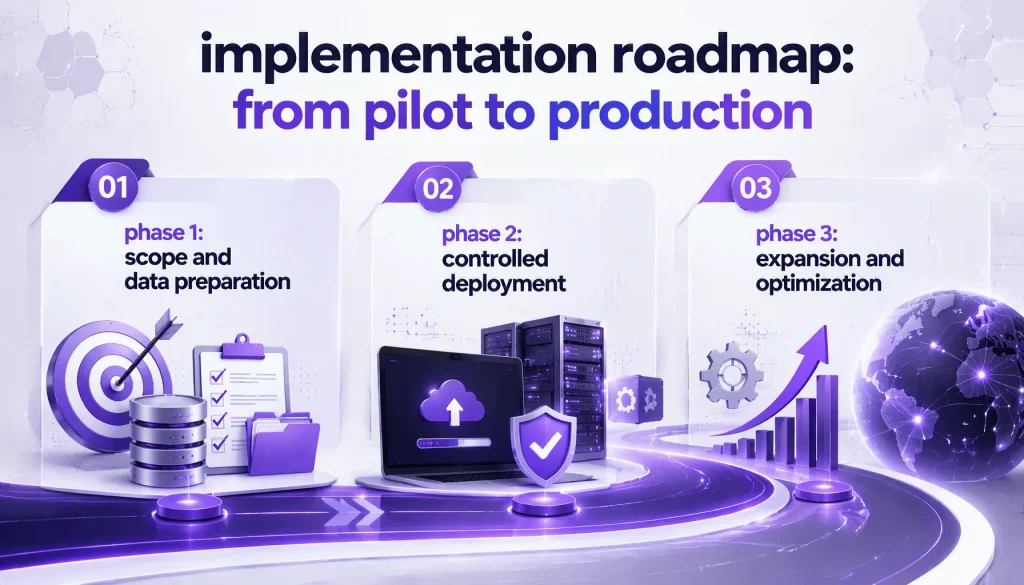
Phase 1: Scope and Data Preparation (Weeks 1-3)
Your team identifies the five to ten inquiry types that represent the highest volume in your current contact center, validates that accurate data is available in your connected systems for each type, and configures the agent’s knowledge base with reviewed and approved content. Rushing this phase is the single most common cause of pilot failure we see. An agent that gives inaccurate answers on day one loses the trust of your customer service leadership, and that trust is hard to win back.
Phase 2: Controlled Deployment (Weeks 4-8)
The agent goes live on a single low-risk channel, typically web chat, handling a defined subset of inquiry types. Your team monitors resolution rates, CSAT scores, and escalation patterns daily, making targeted adjustments to knowledge base content, escalation triggers, and response tone. This phase validates the agent’s performance before you expand its scope.
Phase 3: Expansion and Optimization (Weeks 9-16)
Based on Phase 2 data, the agent expands to additional channels and inquiry types. Our platform provides built-in analytics dashboards that surface resolution rate trends, escalation drivers, and customer satisfaction scores by inquiry type, giving your CX leadership the evidence it needs to make informed expansion decisions.
Measuring AI Customer Service Agent Performance
The metrics you track determine the decisions you make. Enterprise CX teams that focus exclusively on cost reduction often underinvest in quality assurance and ultimately damage their customer satisfaction scores. We recommend tracking the following balanced metric framework:
- Tier-1 resolution rate: The percentage of interactions the AI agent resolves without escalation to a human agent. Benchmark: 55-70% for well-scoped deployments.
- First-contact resolution rate: The percentage of issues fully resolved on the customer’s first interaction with the AI agent, with no repeat contact within 72 hours.
- CSAT score by channel: Customer satisfaction scores for AI-handled interactions, tracked separately from human-handled interactions so you can compare them directly.
- Average handle time: The time from initial customer contact to resolution confirmation, measured for both AI and human agents.
- Escalation quality score: A measurement of whether escalations are appropriate, meaning the agent escalates when it should and resolves when it can.
Conclusion
AI customer service agents are delivering measurable, auditable value at enterprise scale in 2026. The cost differential is compelling, $0.62 versus $7.40 per interaction in our own deployment data, but the strategic value goes beyond cost reduction. Enterprises that deploy AI customer service agents at tier-1 scale are reshaping their CX economics: they serve more customers at higher speed and consistent quality, while redeploying their human agents to the complex, high-value interactions where empathy and judgment genuinely matter.
The gap between enterprises running pilots and enterprises reaching full production is not primarily a technology gap. It is a planning and partnership gap. Your enterprise does not need more experimentation. It needs an experienced implementation partner that has guided this journey from proof of concept to production across dozens of deployments.
Our team at AI Hive specializes in exactly this transition. We invite you to reach out to our AI customer service solution to discuss your tier-1 resolution goals and design a deployment plan that delivers results within 90 days.